
Can glow plugs affect performance? Yes, but mostly when a diesel engine is cold. Bad glow plugs can cause hard starting, rough idle, temporary misfires, white smoke, hesitation, and poor cold-engine response. Once a healthy diesel reaches normal operating temperature, failed glow plugs usually have little or no direct effect on maximum engine power because diesel combustion relies on compression rather than the glow plugs to ignite fuel.
However, modern diesel engines make the answer more complicated. Many electronically controlled glow plug systems continue operating after startup to improve combustion during warm-up. Some systems also use glow plug operation as part of emissions and engine-management strategies. Because of this, a glow plug or glow plug control-system fault can sometimes affect drivability for longer than the first few seconds after starting.
A diesel that feels weak all the time—even after it is fully warmed up—usually has another problem. Common possibilities include a fuel injector fault, turbocharger or boost problem, clogged fuel filter, restricted intake, EGR issue, diesel particulate filter problem, low compression, or another engine-management fault.
In this guide, I’ll explain how glow plugs affect diesel performance, what happens when one or more fail, whether bad glow plugs can cause loss of power, misfires, poor acceleration, increased fuel consumption, smoke, and when you should look beyond the glow plug system for the real problem.
What Do Glow Plugs Actually Do?
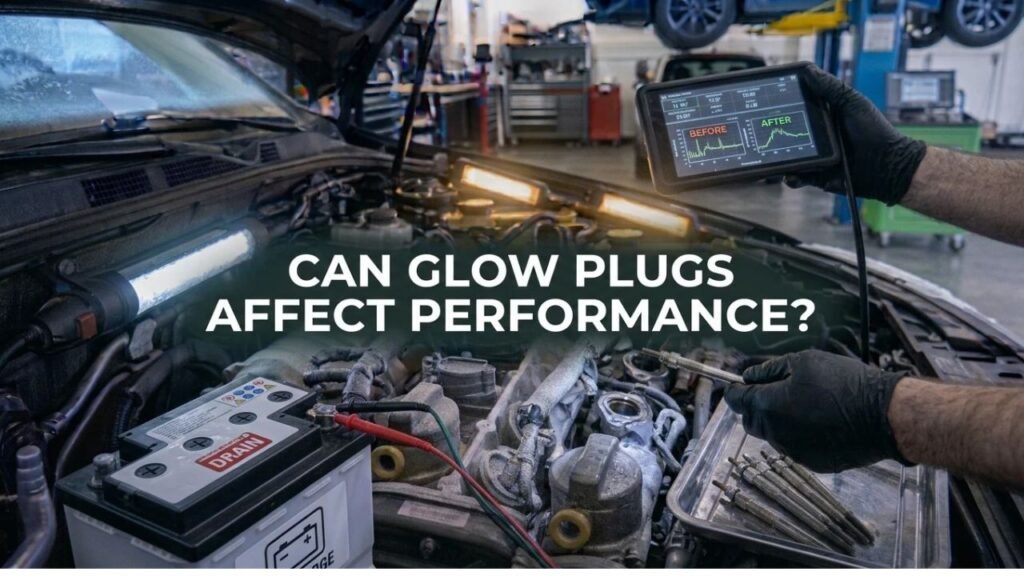
Glow plugs are electrical heating elements used in many diesel engines.
Unlike spark plugs, they do not create an electrical spark to ignite fuel.
A diesel engine relies on compression ignition.
The piston compresses air inside the cylinder to a very high pressure. Compression raises the air temperature, and diesel fuel is injected into that hot air near the end of the compression stroke.
The fuel then begins burning without needing a spark.
The problem occurs when the engine is cold.
Cold pistons, cylinder walls, and cylinder heads absorb heat from the compressed air. That can make initial combustion more difficult.
Glow plugs compensate by heating the combustion area before and during starting.
Modern Glow Plugs Do More Than Preheat
Older diesel systems often used glow plugs primarily before the engine started.
Modern diesel engines may continue using them after startup.
This period is commonly called post-glow or after-glow.
The additional heat can help:
- Stabilize cold combustion
- Reduce white smoke
- Improve cold idle quality
- Reduce combustion noise
- Lower emissions during warm-up
Some sophisticated systems can activate glow plugs under other operating conditions as well.
That is why modern glow plug failures can sometimes affect more than just whether the engine starts.
Can Bad Glow Plugs Cause Loss of Power?
They can cause temporary loss of performance while the engine is cold.
If one cylinder is not warm enough to ignite fuel reliably, it may contribute little or no power immediately after startup.
The engine may feel weak, shake, hesitate, or respond poorly to the accelerator.
As combustion-chamber temperature rises, that cylinder may begin operating normally.
At that point, engine power usually returns.
What About Power Loss After the Engine Is Warm?
A conventional failed glow plug normally should not cause significant continuous power loss once the engine is fully warmed.
The diesel engine is no longer depending on the plug for combustion heat.
If you have noticeable power loss during a fully warmed drive, investigate other causes rather than assuming the glow plugs are responsible.
Possible causes include:
Turbocharger or boost leaks, fuel-delivery problems, injector faults, restricted filters, EGR problems, DPF restriction, sensor faults, or low compression.
A stored glow plug code may exist at the same time without being the reason for the power loss.
Key Takeaways:
- Failed glow plugs mainly affect diesel performance during cold starting and warm-up.
- One dead plug can temporarily make one cylinder contribute less power.
- Continuous loss of power after full warm-up usually indicates another problem.
Can Bad Glow Plugs Cause Poor Acceleration?
Yes, particularly immediately after a cold start.
If combustion is unstable in one or more cylinders, the engine may hesitate when you press the accelerator.
You may feel:
A lack of response, shaking, stumbling, or uneven acceleration.
Once the engine warms, the symptom may disappear.
Why Cold Acceleration Feels Weak
Imagine a four-cylinder diesel with one failed glow plug.
Immediately after startup, three cylinders may burn fuel normally while the fourth struggles.
Even if that cylinder fires occasionally, it may not contribute the same torque as the others.
The engine therefore feels rough and weak.
As cylinder temperature rises, diesel fuel begins igniting more consistently and performance improves.
If poor acceleration remains after several minutes of normal driving, glow plugs move much lower on the diagnostic list.
Can Glow Plugs Cause a Diesel Misfire?
Yes, especially when cold.
A failed glow plug can prevent a cylinder from reaching an ideal temperature during startup.
Fuel is still injected, but it may ignite late, burn incompletely, or fail to ignite for several cycles.
This creates what feels like a misfire.
The engine may shake and sound uneven.
Cold Misfire vs. Warm Misfire
This distinction is extremely useful.
If a diesel:
Starts rough, misfires for 10–30 seconds, and then becomes perfectly smooth, the glow plug system is a reasonable suspect.
If it:
Misfires cold, warm, at idle, and under acceleration, look for additional problems.
Potential causes include an injector fault, low compression, fuel-pressure problem, wiring issue, or mechanical damage.
Glow plugs should not be blamed for every diesel misfire.
Can Bad Glow Plugs Cause Rough Idle?
Yes.
A rough idle immediately after a cold start is one of the classic symptoms of glow plug failure.
One or more cylinders may lag behind until enough heat accumulates for reliable compression ignition.
The engine might:
Shake, sound uneven, idle lower than expected, or briefly feel as though it wants to stall.
As the engine warms, idle usually becomes smoother.
What if Rough Idle Continues When Warm?
Persistent rough idle usually points toward another issue.
Possible causes include:
- Faulty fuel injector
- Low cylinder compression
- Intake or EGR problem
- Fuel-pressure issue
- Air entering the fuel system
- Sensor or engine-management fault
A modern scan tool can help identify cylinder contribution problems or injector corrections.
Can Bad Glow Plugs Cause White Smoke?
Yes.
White or light-gray smoke during a cold start is commonly associated with poor initial diesel combustion.
When a cylinder is too cold, some injected fuel may leave the cylinder without burning completely.
That unburned or partially burned fuel can produce white smoke from the exhaust.
Smoke Should Normally Improve
If glow plugs are the main problem, smoke often decreases rapidly as the engine warms.
Heavy white smoke that continues after the engine reaches normal temperature deserves further investigation.
Other causes can include:
Injector problems, poor compression, incorrect injection timing, or coolant entering the combustion chamber.
A bad glow plug is only one possibility.
Can Bad Glow Plugs Cause Black Smoke?
Not usually as the primary cause.
Black diesel smoke generally means too much fuel is being delivered relative to the available air or that combustion is poor under load.
Common causes include:
Dirty air filter, boost leak, turbocharger problem, excessive fueling, injector fault, EGR issue, or other air-management problems.
Glow plug failure can contribute to poor combustion while the engine is cold, but persistent black smoke during acceleration is usually related to another system.
Can Bad Glow Plugs Affect Fuel Economy?
Possibly, but usually not dramatically by themselves.
During cold operation, failed glow plugs can cause incomplete combustion.
The engine may use fuel without converting all of it efficiently into useful power.
Modern engine management may also alter operating strategies when faults are detected.
However, once the engine is fully warm, a conventional bad glow plug generally should not have a large direct effect on fuel economy.
A Large MPG Drop Usually Means More
If your diesel suddenly loses a significant amount of fuel economy, check for additional issues such as:
Fuel injector problems, frequent DPF regeneration, low tire pressure, thermostat problems, dragging brakes, turbo issues, sensor faults, or driving-condition changes.
Do not assume replacing glow plugs will restore a major fuel-economy loss unless diagnosis shows they are actually contributing to poor combustion.
Can Bad Glow Plugs Affect Turbo Performance?
Not directly in the normal sense.
Glow plugs do not control turbocharger boost.
A failed glow plug will not normally prevent the turbo from spinning or directly reduce boost pressure.
However, severely unstable cold combustion can temporarily reduce exhaust energy, making overall engine response feel weak.
Once the engine is warm and all cylinders are burning correctly, turbo operation should not depend on the glow plugs.
If boost remains low, investigate:
Turbo actuator, boost-control system, intercooler hoses, intake leaks, variable-geometry mechanism, exhaust restriction, or relevant sensors.
Can Bad Glow Plugs Put a Diesel Into Limp Mode?
Potentially, depending on the vehicle and fault.
A simple failed heating element does not automatically place every diesel into reduced-power mode.
But modern diesel control systems monitor many electrical circuits.
A serious glow plug control-module problem, wiring fault, or related engine-management code may trigger warning lights and, in some vehicles, influence operating strategy.
The exact behavior is manufacturer-specific.
Don’t Assume Limp Mode Means Glow Plugs
When a diesel suddenly loses power and refuses to accelerate normally, read the diagnostic codes.
Limp mode is more commonly associated with problems such as:
Boost control, turbocharger faults, DPF restriction, EGR faults, fuel-pressure problems, or critical sensor failures.
A glow plug fault code may be present simultaneously but not be the cause of reduced power.
Key Takeaways:
- Bad glow plugs can cause cold misfires, rough idle, hesitation, and white smoke.
- They normally do not directly control turbo boost.
- Warm-engine power loss or limp mode should trigger a broader diagnostic check.
Can One Bad Glow Plug Affect Performance?
Yes, although the effect may be relatively small.
A diesel with one failed glow plug may:
Take slightly longer to start, shake briefly after startup, produce a small amount of white smoke, or hesitate while cold.
In warm weather, you may notice almost nothing.
That is because the remaining cylinders begin firing normally and engine heat quickly helps the affected cylinder catch up.
Cold Weather Makes the Difference Bigger
As ambient temperature falls, the engine depends more heavily on preheating.
One failed plug becomes much more noticeable.
Several failed plugs can make the engine extremely difficult to start.
This explains why some drivers first discover a glow plug problem during winter even though the plug may have failed months earlier.
What Happens if Two or More Glow Plugs Are Bad?
Symptoms usually become progressively worse.
With multiple failed plugs, you may experience:
Long cranking, difficult starting, severe roughness, heavy white smoke, and poor initial throttle response.
In very cold weather, the engine may not start at all.
The starter and battery can also suffer because repeated long cranking requires substantial electrical energy.
More Bad Plugs Means Fewer Cylinders Starting Cleanly
On a four-cylinder diesel, losing two glow plugs can leave half the engine struggling to ignite fuel initially.
That creates far more noticeable roughness than losing one plug in an eight-cylinder engine.
The impact therefore also depends on engine size and cylinder count.
Do Glow Plugs Affect Performance in Warm Weather?
Usually much less.
Warm ambient air and warm engine components make compression ignition easier.
A healthy high-compression diesel may start with one or even several failed glow plugs when temperatures are mild.
That can make the glow plug problem appear intermittent.
However, modern vehicles can still detect the electrical fault and illuminate a warning light even if you notice no drivability issue.
Do Glow Plugs Affect Performance After Startup?
They can on modern diesel engines.
Post-glow operation means the plugs may continue heating during the warm-up period.
This helps combustion remain smooth as cylinder temperatures stabilize.
If post-glow is unavailable because of failed plugs or a controller fault, the engine may be:
Rougher, noisier, smokier, or less responsive during early operation.
Once normal combustion temperature is established, the difference should become much smaller.
Can Glow Plugs Affect DPF Regeneration?
On some modern diesel systems, glow plug operation can interact indirectly with emissions-management strategies.
Diesel particulate filters require high exhaust temperatures to burn accumulated soot during regeneration.
Manufacturers can use multiple engine-control strategies to raise temperature, and glow plugs may participate in temperature or combustion management on certain engines.
This does not mean every failed glow plug will stop every DPF regeneration.
The relationship is vehicle-specific.
If you have both glow plug and DPF-related codes, consult the diagnostic information for that exact engine instead of assuming the problems are unrelated—or that one automatically caused the other.
Can Bad Glow Plugs Damage the DPF?
Indirectly, repeated poor cold combustion may increase soot and unburned hydrocarbons entering the exhaust.
Over time, abnormal combustion can place additional demand on emissions systems.
However, it would be an oversimplification to say one failed glow plug automatically damages a DPF.
DPF loading is influenced by many factors, including:
Driving pattern, injector condition, EGR operation, turbo performance, engine oil consumption, regeneration frequency, and exhaust-temperature management.
Repair glow system faults, but diagnose DPF problems separately.
Can Bad Glow Plugs Damage an Engine?
A normal electrically failed glow plug generally does not immediately damage the engine.
The biggest effects are difficult starting and poor cold combustion.
However, secondary consequences can occur.
Repeated long cranking can stress:
The battery and starter motor.
Incomplete combustion can increase smoke and unburned fuel.
A physically damaged glow plug is a more serious concern.
Broken Glow Plug Tips
If part of a glow plug breaks off inside the cylinder, the loose material can potentially damage:
Piston, valves, cylinder head, or combustion chamber.
If a removed glow plug is missing part of its tip, do not simply install another plug and start the engine.
Determine where the missing piece went.
Can a Bad Glow Plug Damage an Injector?
A failed heating element does not normally damage a fuel injector directly.
However, injector problems can sometimes contribute to glow plug damage.
An abnormal spray pattern can expose the glow plug tip to excessive heat or fuel impingement.
If a replacement glow plug fails repeatedly in the same cylinder, do not continue replacing plugs without investigating the injector and combustion condition.
Can Bad Injectors Look Like Bad Glow Plugs?
Absolutely.
Both can create:
Hard starting, white smoke, rough idle, misfires, and poor cold performance.
The difference is often what happens after warm-up.
Glow plug problems generally improve as the engine heats.
Injector problems may continue.
Modern scan-tool data, injector balance information, return-flow testing, or cylinder contribution testing can help separate the two.
Can Low Compression Look Like Bad Glow Plugs?
Yes.
Compression is fundamental to diesel ignition.
If a cylinder has worn rings, leaking valves, cylinder damage, or another mechanical sealing problem, it may not create enough compression heat during cold cranking.
That cylinder can behave almost exactly like one with a failed glow plug.
Important Diagnostic Clue
Suppose you replace a glow plug and the same cylinder still struggles every cold morning.
Do not assume the new plug is defective.
Verify that it receives proper power and then consider a compression or leak-down test.
A good glow plug cannot compensate indefinitely for a mechanically weak cylinder.
Can a Weak Battery Look Like Bad Glow Plugs?
Yes.
Diesels require strong cranking performance.
A weak battery can slow the starter.
Slower cranking means the engine produces less compression heat.
At the same time, the glow plug system itself requires substantial electrical current.
A weak battery therefore creates two problems at once.
The engine may appear to have defective glow plugs even when the plugs are fine.
Check Cranking Speed
If the starter sounds sluggish, battery and charging-system testing should be part of the diagnosis.
Do not replace glow plugs solely because the engine struggles to start.
How to Tell Whether Glow Plugs Are Affecting Performance
Start by paying attention to when the problem occurs.
If the symptoms are strongest:
Immediately after a cold start and disappear after warming, the glow system becomes more likely.
If the symptoms occur:
At full temperature, under heavy acceleration, or continuously throughout the drive, broaden the diagnosis.
Scan for Trouble Codes
Modern diesel vehicles can store glow plug-specific fault codes.
A scan may identify:
Individual cylinder glow plug circuit faults, controller problems, supply-voltage issues, or other engine faults.
A code is a starting point, not proof that the component named in the code is defective.
Wiring and control modules can produce similar codes.
Test the Glow Plugs
Depending on the system, testing may involve:
Resistance checks, current measurement, circuit-voltage testing, or scan-tool diagnostics.
Use the specifications for your exact glow plug system.
Modern low-voltage ceramic plugs can be damaged by improper direct-battery testing.
What Does a Bad Glow Plug Feel Like While Driving?
Immediately after a cold start, you may notice:
A lumpy idle, weak response, vibration, hesitation, or an engine that sounds harsher than usual.
Once the engine warms, these symptoms may disappear entirely.
That pattern is different from problems that become worse under load.
For example, a boost leak often becomes most noticeable when accelerating hard.
A fuel filter restriction may become more noticeable when fuel demand increases.
A glow plug problem typically becomes less noticeable as the engine gets hotter.
Should You Replace Glow Plugs if Performance Is Poor?
Only after diagnosis indicates the glow plugs are faulty.
Replacing all of them because a diesel feels slow can waste money.
If the engine is sluggish only when cold and diagnostic testing confirms failed plugs, replacement makes sense.
If it is slow constantly, test the systems responsible for warm-engine performance.
When Replacement Makes Sense
Replacement is appropriate when a plug:
Has an open electrical circuit, falls outside the specified resistance/current range, has visible physical damage, or is identified as faulty through the manufacturer’s diagnostic procedure.
If several plugs are the same age and access is labor-intensive, replacing the full set may sometimes be practical.
Will New Glow Plugs Increase Horsepower?
Not on a healthy warm engine.
New glow plugs are not a conventional performance upgrade.
If old failed plugs were causing cold misfires, replacing them can restore normal performance during starting and warm-up.
That can feel like an improvement.
But a functioning set of new glow plugs does not generally increase the engine’s rated horsepower beyond normal output.
Restoring Performance Is Not Adding Performance
This distinction applies to many maintenance components.
Replacing a clogged fuel filter might restore lost power.
Replacing a weak injector might restore lost power.
Neither necessarily creates more power than the engine was designed to produce.
Glow plugs work the same way.
Will New Glow Plugs Make a Diesel Run Smoother?
They can when cold.
If failed glow plugs were causing unstable combustion, replacement may produce:
Faster starting, smoother initial idle, less white smoke, and better cold throttle response.
Once the engine is hot, you may notice little difference.
That is completely normal.
The purpose of glow plugs is primarily to support combustion when additional heat is needed.
Key Takeaways:
- New glow plugs can restore smooth cold operation but do not normally add warm-engine horsepower.
- If symptoms persist after warm-up, test fuel, air, boost, compression, and emissions systems.
- Diagnosis should confirm a glow plug fault before parts are replaced.
How Long Can You Drive With Bad Glow Plugs?
A diesel may continue operating for a long time with one failed glow plug, particularly in warm weather.
However, ignoring the fault is not ideal.
As temperatures fall, starting can become much harder.
Long cranking stresses the battery and starter.
Poor cold combustion can create additional smoke and emissions.
If multiple plugs fail, the vehicle may eventually refuse to start in cold weather.
Repairing the problem before winter is usually much easier than discovering it on a freezing morning.
Can You Drive Normally Once the Diesel Is Warm?
In many cases, yes.
If the only problem is a conventional failed glow plug and the diesel is otherwise healthy, it may run completely normally once warm.
That is actually an important diagnostic clue.
But do not ignore a flashing warning light, reduced-power mode, heavy smoke, or persistent misfire.
Those symptoms may indicate a more significant problem.
Can Glow Plug Control Module Failure Affect Performance?
Yes, particularly during starting and warm-up.
If the module does not supply proper power to the glow plugs, several cylinders may lack preheating simultaneously.
This can produce far more severe symptoms than one failed plug.
You might experience:
Very long cranking, severe roughness, heavy white smoke, or failure to start in cold weather.
Controller Problems Can Also Cause Diagnostic Confusion
A control module fault may set multiple individual glow plug codes.
That can make it appear that several glow plugs failed simultaneously.
Before replacing a full set, verify power supply, fuse condition, controller operation, wiring, and grounds.
Does Glow Plug Resistance Affect Performance?
The resistance of the heating element affects how current flows and how the glow plug heats.
A plug with an open circuit produces no heat.
A plug with abnormal electrical characteristics may heat too slowly or incorrectly.
However, there is no universal resistance value for every glow plug.
Some operate at very low resistance, and modern electronically controlled designs vary considerably.
Use manufacturer specifications instead of applying a generic resistance threshold.
Can the Wrong Glow Plugs Reduce Performance?
They can create cold-operation problems and potentially damage the glow system.
Glow plugs that physically fit are not automatically interchangeable.
Differences can include:
Voltage rating, heating speed, temperature profile, length, tip design, electrical resistance, and whether the plug contains additional sensing technology.
A wrong plug may heat too little, overheat, fail quickly, or create diagnostic faults.
Always match the exact engine application.
FAQs about Can Glow Plugs Affect Performance
Can glow plugs affect performance?
Yes, particularly during cold starting and warm-up.
Failed plugs can cause rough running, hesitation, temporary power loss, white smoke, and cold misfires.
Can bad glow plugs cause loss of power?
They can cause temporary power loss while the engine is cold.
Persistent loss of power after full warm-up usually has another cause.
Can bad glow plugs cause poor acceleration?
Yes, during cold operation if one or more cylinders are not combusting properly.
Warm-engine acceleration problems usually point elsewhere.
Can bad glow plugs cause a misfire?
Yes.
A cold cylinder with insufficient preheating may fail to burn fuel consistently until it warms.
Can glow plugs cause rough idle?
Yes, especially immediately after a cold start.
The roughness often improves within seconds or minutes.
Can bad glow plugs cause white smoke?
Yes.
Poor cold combustion can allow unburned or partially burned diesel fuel to exit as white smoke.
Can bad glow plugs cause black smoke?
They are not a common cause of persistent black smoke.
Black smoke more often indicates excessive fueling, insufficient air, boost problems, or other combustion faults.
Can glow plugs affect fuel economy?
Poor cold combustion can slightly reduce efficiency during warm-up, but one failed glow plug usually does not cause a large overall MPG loss.
Do bad glow plugs affect turbo boost?
Not directly.
Glow plugs do not control turbocharger boost pressure.
Can bad glow plugs cause limp mode?
Some vehicles may react to serious glow-system or controller faults, but limp mode commonly has other causes.
Scan the vehicle before assuming the glow plugs are responsible.
Can one bad glow plug affect engine performance?
Yes, especially during cold starting.
The effect may be very mild in warm weather.
What happens if two glow plugs are bad?
Cold starting usually becomes more difficult, and rough idle, smoke, and hesitation become more noticeable.
Do glow plugs affect performance when the engine is warm?
Usually very little in a conventional diesel.
Modern systems may use glow plugs for additional strategies, but normal warm combustion relies primarily on compression.
Will new glow plugs increase horsepower?
No, not beyond normal engine output.
They can restore performance that was lost because of poor cold combustion.
Will new glow plugs make my diesel run smoother?
They can significantly improve cold-start smoothness if the old plugs were faulty.
Can bad glow plugs cause engine shaking?
Yes.
One or more cylinders may fail to contribute normally immediately after a cold start.
Can glow plugs affect DPF regeneration?
They can be involved in emissions and temperature-management strategies on some modern diesels.
The relationship is engine-specific.
Can a bad glow plug damage the DPF?
One bad plug does not automatically damage a DPF, although prolonged poor combustion can increase the burden on emissions systems.
Can a bad glow plug damage an injector?
Not normally.
In some cases, an injector problem can damage the glow plug instead.
Can bad injectors feel like bad glow plugs?
Yes.
Both can cause hard starting, smoke, rough running, and misfires. Injector problems are more likely to continue after warm-up.
Can low compression mimic bad glow plugs?
Yes.
Low compression reduces the heat generated during cranking and can create similar cold-start symptoms.
Can a weak battery mimic glow plug problems?
Yes.
Slow cranking reduces compression heat and makes diesel starting difficult.
Should I replace all glow plugs if one is bad?
Not automatically.
Consider their age, test results, engine access, and manufacturer recommendations.
Can you keep driving with a bad glow plug?
Often yes, particularly in warm conditions, but repair is advisable before cold weather or additional plugs fail.
Conclusion
So, can glow plugs affect performance? Yes, but their biggest impact occurs while a diesel engine is cold.
A failed glow plug can leave one cylinder too cold for reliable combustion during startup. That can cause long cranking, rough idle, temporary misfires, white smoke, hesitation, and weak throttle response.
If several glow plugs fail, the symptoms become much more severe and the engine may struggle or completely fail to start in cold weather.
Modern diesel engines can also use glow plugs after startup. Post-glow operation helps stabilize combustion, reduce smoke, improve cold-engine smoothness, and support emissions control. Because of this, a modern glow plug system fault may affect drivability for longer than it would on an older diesel.
However, bad glow plugs normally do not cause major continuous horsepower loss once a healthy diesel is fully warmed up. If your engine remains slow, misfires when hot, lacks boost, or enters limp mode during normal driving, investigate other systems such as the injectors, turbocharger, fuel supply, EGR, DPF, sensors, and cylinder compression.
Replacing faulty glow plugs can restore proper cold-start performance, but it should not be considered a horsepower upgrade.
The simplest diagnostic rule is: if the problem is worst when cold and improves as the engine warms, glow plugs deserve attention. If the performance problem remains when fully warm, look beyond the glow plug system.