
If you are wondering can glow plugs cause engine light, yes—a failed glow plug, damaged glow-plug wiring, or a faulty glow-plug relay or control module can cause the check engine light to come on in many diesel vehicles. The engine computer can monitor the glow system and store diagnostic trouble codes when it detects abnormal resistance, current flow, voltage, or circuit operation.
The important point is that a glow-plug-related check engine light does not always mean the heating element itself has failed. A corroded connector, broken wire, blown fuse, weak electrical connection, or defective glow-plug control module can generate similar fault codes.
Glow plugs are primarily used to help a diesel engine start and run cleanly while cold. Modern diesel engines may use them before cranking, during startup, and for a period after the engine begins running. Because the glow system is electronically controlled, the engine computer can often recognize a problem even when the vehicle still starts normally.
This is especially common when only one glow plug has failed. The engine may start easily in warm weather and drive perfectly once warm, yet the check engine light remains illuminated because the control system has detected an electrical fault in one cylinder’s glow-plug circuit.
In this guide, I’ll explain whether glow plugs can cause the engine light, which trouble codes are commonly associated with them, what symptoms to expect, how to distinguish a bad glow plug from a bad controller, how to test the system, and whether you can continue driving with a glow-plug warning.
Can Glow Plugs Cause Engine Light?
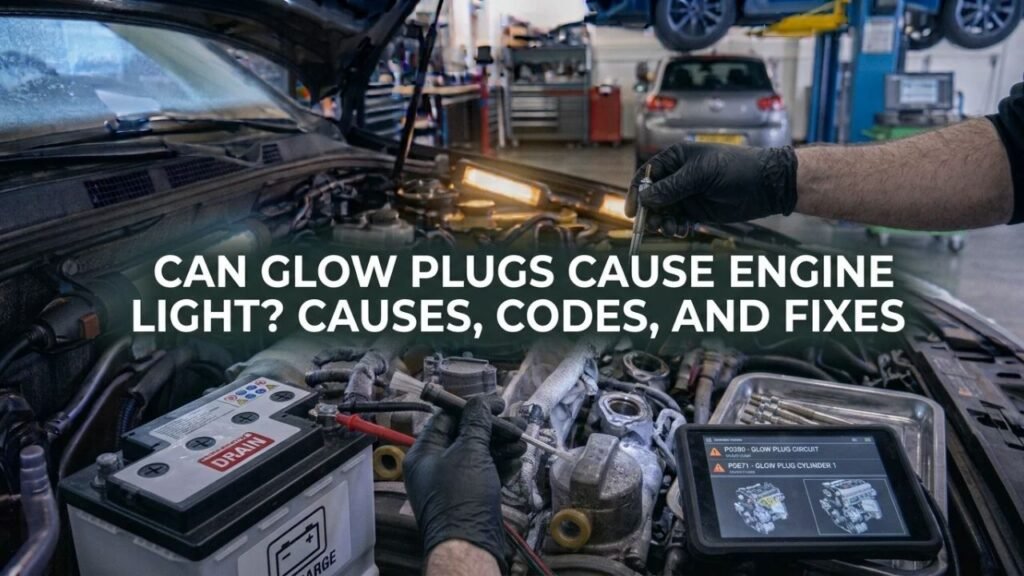
Yes.
On many electronically controlled diesel engines, the glow-plug system is monitored by the engine control module or a dedicated glow-plug control module.
If the system detects that one glow plug is drawing too little current, has unusually high resistance, has an open circuit, or is otherwise not responding correctly, it may store a diagnostic trouble code.
That stored fault can switch on the check engine light.
The vehicle may also display a separate glow-plug warning symbol depending on its design.
One Bad Glow Plug Can Be Enough
You do not necessarily need several failed glow plugs for the check engine light to appear.
Modern diesel systems can sometimes monitor individual cylinders.
If glow plug number 3, for example, develops an electrical open circuit, the control system may detect the difference and store a cylinder-specific fault.
The engine may still start normally because the remaining plugs work.
This is one reason the check engine light can appear even when the driver notices no obvious starting problem.
The Glow Plug Itself May Not Be the Problem
A trouble code identifying a glow-plug circuit does not prove that the glow plug has physically failed.
The circuit includes more than the plug.
Depending on the engine, it can include wiring, connectors, a bus bar, fuse, relay, glow-plug control module, and engine computer.
Diagnosis should therefore include the entire circuit.
Key Takeaways:
- A bad glow plug can illuminate the check engine light.
- A wiring or control-module fault can produce the same type of warning.
- One failed glow plug may set a code even when the diesel still starts normally.
Why Does a Bad Glow Plug Trigger the Check Engine Light?
Modern engine computers monitor electrical systems by comparing expected behavior with actual behavior.
A glow plug acts as a high-current electrical heating element.
When the controller powers it, the plug should draw a predictable amount of current and exhibit electrical characteristics within a designed range.
If the circuit behaves abnormally, the controller can recognize a fault.
Open-Circuit Glow Plug
A glow plug can burn out internally.
When that happens, current can no longer pass through the heating element.
The control module may detect essentially no current in that circuit.
That often produces a fault code.
Excessive Resistance
A glow plug does not need to be completely open to become faulty.
Its internal resistance may change enough that it draws less current or heats too slowly.
A sophisticated controller may identify this difference compared with the other plugs.
Short Circuit
A glow plug or wiring fault can sometimes create unusually high current flow.
The controller may disable the affected circuit to protect itself and store a diagnostic code.
Wiring and Connector Problems
A plug may be electrically healthy while its connector is loose or corroded.
From the control module’s perspective, the result may look similar to a failed heating element because current cannot flow normally.
This is why testing should come before replacement.
What Glow Plug Codes Can Turn On the Check Engine Light?
The exact diagnostic trouble codes depend on the manufacturer and vehicle.
However, the generic OBD-II system includes several glow-plug-related codes.
P0380
P0380 generally refers to a glow plug or heater circuit malfunction.
It often indicates a broader problem in the glow system rather than identifying one particular cylinder.
Possible causes include glow plugs, relays, wiring, fuses, or controller faults.
P0670
P0670 generally relates to the glow-plug control-module circuit.
If you see this code, replacing individual glow plugs without testing the controller may not solve the problem.
P0671 Through P0678
On many vehicles, codes in this range can identify individual glow-plug circuits.
For example:
P0671 may relate to cylinder 1.
P0672 may relate to cylinder 2.
The sequence can continue for additional cylinders.
However, code definitions can vary by manufacturer, so confirm the exact meaning for your vehicle before replacing parts.
Manufacturer-Specific Codes
Modern diesel vehicles may also use manufacturer-specific codes that provide much more detailed information about current draw, control-module communication, or individual-cylinder heating performance.
A capable scan tool can therefore be very useful.
Can a Glow Plug Light and Check Engine Light Come On Together?
Yes.
Some diesel vehicles have both a check engine light and a dedicated glow-plug warning symbol.
The glow-plug symbol commonly looks like a small coil or spring.
During normal startup, that symbol may illuminate briefly while the glow system preheats.
That is normal.
If it flashes, remains illuminated unexpectedly, or appears together with the check engine light, the vehicle may have stored a fault.
A Glow-Plug Light Does Not Always Mean a Bad Glow Plug
On some diesel vehicles, the glow-plug warning lamp can also be used to indicate other engine-management problems.
Its exact meaning depends on manufacturer.
Therefore, do not assume that replacing the plugs will solve every flashing glow-plug light.
Scan the vehicle for codes first.
What Symptoms Come With a Glow-Plug Check Engine Light?
The symptoms depend on how many plugs have failed and the outside temperature.
A vehicle with one bad glow plug may show no noticeable drivability problem.
A vehicle with several failures can be much harder to start.
Hard Cold Starting
The most common symptom is increased cranking time when the engine is cold.
The starter may need to turn the engine several more revolutions before combustion begins consistently.
Rough Running After Startup
A cylinder without effective glow-plug heating may take longer to begin burning fuel properly.
The engine can shake or idle unevenly during the first few seconds.
Once it warms, operation may return to normal.
White or Gray Smoke
Poor cold combustion can produce white or light gray exhaust smoke after startup.
This may clear once the engine warms.
No Symptoms at All
One failed glow plug can sometimes trigger the check engine light without causing obvious symptoms, particularly during warm weather.
That does not mean the code should be ignored.
When temperatures fall, the starting problem may become much more apparent.
Key Takeaways:
- Hard cold starting and rough warm-up are classic glow-plug failure symptoms.
- One failed plug may set a code without affecting normal driving.
- White smoke after cold startup can support a glow-system diagnosis but is not proof by itself.
Can One Bad Glow Plug Cause the Check Engine Light?
Yes.
Many modern diesel systems monitor individual glow-plug circuits.
If one cylinder’s plug draws the wrong current or becomes open circuit, the engine computer can store a specific code and illuminate the check engine light.
The remaining cylinders may still receive enough heating for the engine to start.
Why the Engine Can Still Run Normally
Once the diesel engine warms up, it generally does not rely on the glow plugs for normal combustion.
Diesel fuel ignites from compression heat.
That means a single failed glow plug can become almost irrelevant after warm-up even though the electrical fault remains stored.
Can All Glow Plugs Be Good and Still Trigger a Glow Code?
Yes.
If every plug tests correctly, look at the rest of the system.
Glow-Plug Control Module
Modern diesels often use an electronic module rather than a simple traditional relay.
The module may control each plug individually.
An internal module fault can generate cylinder-specific or system-wide codes.
Glow-Plug Relay
Older systems may use a high-current relay.
Burned contacts can prevent the plugs from receiving proper power.
The relay may still click while failing to deliver enough current.
Wiring Harness
Heat, vibration, oil contamination, and age can damage the glow-plug wiring.
Broken conductors and corroded terminals can create excessive resistance.
Fuse or Fusible Link
Because glow plugs consume substantial current, their circuits usually have significant fuse protection.
A blown main fuse can disable the entire system.
Can a Weak Battery Cause a Glow-Plug Engine Light?
Potentially, depending on the vehicle and how low system voltage becomes.
Glow plugs draw substantial electrical current.
A weak battery or charging-system problem can cause abnormal system voltage during preheating and cranking.
Modern control modules may detect voltage-related faults.
However, if you have a cylinder-specific glow-plug code, a failed plug or circuit is usually more directly suspicious than the battery alone.
Battery Condition Still Matters
A weak battery can make glow-plug problems appear much worse.
It has to support the glow system while also powering the high-current starter motor.
Low cranking speed reduces compression heat, making cold starting even more difficult.
For a diesel with hard starting, checking the battery is worthwhile even when glow codes are present.
Can Bad Glow Plugs Cause a Check Engine Light but No Starting Problems?
Yes.
This is quite common when the outside temperature is warm or only one plug has failed.
The engine may have enough compression heat to start without needing full glow assistance.
The computer still detects that one circuit is not working as intended.
Winter Often Reveals the Problem
A vehicle that starts normally in summer may become much harder to start when winter arrives.
Cold engine components absorb more heat during compression.
That increases dependence on the glow system.
For this reason, I would repair a confirmed glow-plug fault before cold weather rather than waiting for the engine to become difficult to start.
Will the Check Engine Light Go Away After Replacing Glow Plugs?
It may, but not always immediately.
After the repair, the engine computer may require one or more successful operating cycles before it turns the check engine light off automatically.
Alternatively, a scan tool can usually clear the stored code after the fault is repaired.
Do Not Clear the Code Before Diagnosing It
Reading and documenting the codes before clearing them is useful.
If you clear everything first, you may remove information that could have guided diagnosis.
Scan the system, record the codes, perform the repair, then clear and retest.
If the Light Comes Back
If the check engine light returns with the same code after installing a new glow plug, investigate the wiring and controller.
Do not keep replacing the plug.
The new plug may be functioning perfectly while the electrical circuit remains faulty.
How Do You Test Glow Plugs When the Engine Light Is On?
Start by scanning the vehicle.
A specific code can tell you which cylinder or circuit deserves attention.
Then test the glow plug electrically.
Resistance Test
Turn the ignition off and disconnect the electrical connection from the suspect glow plug.
Set a digital multimeter to its lowest resistance range.
Touch the meter probes together first and note the lead resistance.
Then measure between the glow plug’s electrical terminal and a clean engine ground.
Repeat the same procedure for the other glow plugs.
Compare the Readings
Glow plugs typically have very low resistance.
The exact acceptable number depends on the plug and engine.
Comparison is extremely useful.
If seven plugs show similar low resistance and one reads open circuit, that one plug is highly suspicious.
Do Not Rely on a Universal Ohm Number
Glow-plug designs differ.
Modern ceramic and low-voltage plugs can have electrical characteristics very different from older metal plugs.
Use application-specific specifications whenever possible.
How Do You Check Whether the Glow Plugs Are Getting Power?
A healthy plug cannot work if its electrical supply is missing.
You can check the supply with a digital multimeter when following the appropriate service procedure.
Measure Voltage During Glow Operation
Connect the meter ground lead appropriately and measure voltage at the glow-plug supply while the system is commanded on.
Depending on the vehicle, this may occur after switching on the ignition with a cold engine.
Do Not Assume You Should See 12 Volts
This is extremely important on modern diesels.
Some glow plugs operate below nominal battery voltage and are controlled through pulse-width modulation.
A conventional meter may show a value that seems unusual even though the system is operating correctly.
Use the specification for your engine.
Can You Drive With a Glow-Plug Check Engine Light?
In many cases, the vehicle can still be driven normally once it has started and warmed up.
A failed glow plug generally does not cause the same immediate drivability danger as, for example, severe oil-pressure loss.
However, whether you should continue driving depends on what code is actually stored.
The check engine light could be illuminated for an unrelated fault.
Scan It Before Assuming
Never assume the warning is only a glow plug because the vehicle is a diesel.
Read the codes.
If the glow-plug circuit is genuinely the only problem, the biggest practical risk may be being unable to start the vehicle during colder weather.
Flashing Check Engine Light
A flashing check engine light deserves more immediate attention.
It commonly indicates a serious active combustion problem rather than a simple stored glow-plug heater fault.
Do not treat a flashing light as normal just because the vehicle also has a glow-related code.
Can You Ignore a Bad Glow Plug?
You may get away with it temporarily, especially in warm weather, but I do not recommend ignoring a confirmed failure.
Cold starting may worsen.
The engine may smoke more during startup.
The remaining glow system has to compensate as much as it can.
Modern emissions strategies may also depend on proper post-glow operation.
It Can Hide Another Problem
A code that appears to involve one glow plug may actually come from a wiring or control-module issue.
Ignoring it can allow the electrical fault to deteriorate.
Diagnosis is preferable to simply living with the warning light.
Can Bad Glow Plugs Cause Limp Mode?
It depends on the vehicle.
A basic single glow-plug failure often does not cause limp mode because glow plugs are less important once the engine is warm.
However, some diesel control systems may restrict operation if a broader glow-control, engine-management, or emissions fault is present.
If the vehicle enters reduced-power mode, read the complete set of fault codes rather than assuming the glow plug alone is responsible.
Can Bad Glow Plugs Cause Engine Misfire Codes?
They can contribute to rough or incomplete combustion during a cold start.
A cold cylinder that fails to ignite diesel consistently may create combustion irregularities that the engine computer notices.
However, persistent misfire after the engine is fully warm is less likely to be caused solely by the glow plugs.
Warm Misfire Needs Broader Diagnosis
If the engine continues shaking once at operating temperature, investigate:
Fuel injectors, compression, fuel pressure, EGR operation, air intake problems, sensor faults, and other diesel-specific combustion issues.
A new set of glow plugs will not repair a mechanical cylinder problem.
Can Bad Glow Plugs Cause White Smoke and Check Engine Light?
Yes.
This combination makes sense during a cold start.
A failed glow plug leaves one cylinder colder than intended.
Injected fuel may not burn completely at first.
That can produce white or light gray smoke.
Meanwhile, the engine computer detects the electrical glow-plug fault and illuminates the check engine light.
If smoke continues after the engine warms, however, do not stop diagnosis at the glow plugs.
Glow Plug vs. Glow-Plug Controller: How Do You Tell the Difference?
The pattern of codes and electrical test results can help.
If one individual glow plug reads open circuit while all others are similar, the plug itself is the obvious suspect.
If several plugs test good but none receives power, look toward the shared power circuit, relay, fuse, or controller.
If a modern system reports multiple implausible cylinder faults at once, the control module or its power supply may deserve close attention.
Wiring Can Create Cylinder-Specific Problems
Do not forget the section of harness between the module and the individual plug.
A broken wire to cylinder 4 can generate a cylinder 4 glow code even though the actual glow plug is perfectly good.
Key Takeaways:
- Test both the glow plug and its electrical supply before replacing parts.
- A cylinder-specific code can be caused by the plug or its individual wiring.
- Multiple circuit faults may point toward a common fuse, relay, module, or power-supply problem.
Should You Replace One Glow Plug or the Whole Set?
There is no rule that every failure requires replacing all glow plugs.
If the plugs are relatively new and one has failed unexpectedly, replacing the single confirmed bad unit can be reasonable.
If the entire set is old and one has failed through normal aging, replacing all of them may make sense.
Labor Matters
On some diesels, glow plugs are easy to access.
On others, considerable disassembly is required.
If labor is extensive and all plugs have similar mileage, replacing the aged set during one repair can avoid paying the same labor again.
Do Not Replace the Set Before Testing
If the controller has failed, installing eight new glow plugs may change nothing.
Diagnose first.
Are Glow Plugs Hard to Replace?
Some are easy.
Others can be challenging because glow plugs are long, narrow components exposed to years of heat and combustion deposits.
They can seize in the cylinder head.
Excessive removal force can break a glow plug.
A broken plug may require specialized extraction.
Follow the Correct Removal Procedure
Manufacturer recommendations differ regarding engine temperature and removal method.
Some procedures call for specific warming conditions or torque limits.
If a plug feels abnormally tight, forcing it is not always the best approach.
For difficult or high-mileage engines, professional removal may be safer.
How Long Do Glow Plugs Last?
There is no universal mileage at which all glow plugs fail.
Many can last well beyond 100,000 miles, while some fail much earlier.
Operating conditions, controller behavior, plug design, combustion quality, and electrical health all influence lifespan.
Glow plugs are often treated as condition-based service items.
A check engine light or cold-start problem may be what finally leads to testing.
Can a Faulty Glow-Plug Module Damage New Glow Plugs?
Yes, potentially.
A controller that applies incorrect voltage or keeps the glow plugs energized improperly can shorten their life.
If several glow plugs fail again shortly after replacement, investigate the control system.
Repeated plug failure should not automatically be treated as bad luck.
Wrong Glow Plug Can Also Fail Quickly
Modern diesel glow plugs may have very specific voltage and heating characteristics.
Installing a plug that physically fits but is electrically incompatible can cause rapid failure.
Always use the exact application-approved part.
How to Prevent Glow-Plug Engine Light Problems
There is relatively little routine maintenance required, but maintaining the rest of the diesel starting system helps.
Keep the battery healthy so the glow system receives stable voltage and the starter cranks at the proper speed.
Address charging-system faults promptly.
Repair damaged glow-plug connectors and harnesses rather than allowing corrosion to spread.
If a glow-related check engine code appears, investigate it before winter or before several additional plugs fail.
Common Mistakes When Diagnosing a Glow-Plug Engine Light
One common mistake is replacing a glow plug solely because a code mentions its cylinder.
A code identifies the circuit, not necessarily the exact failed component.
Another mistake is using a generic resistance specification for every glow plug.
Designs vary substantially.
Directly connecting every glow plug to a 12-volt battery is another risky shortcut because some modern plugs are designed for lower controlled voltages.
Finally, do not clear the check engine light and assume the problem has been repaired simply because it stays off for a few minutes.
Complete the correct diagnostic cycle and confirm that the fault does not return.
FAQs about can glow plugs cause engine light
Can glow plugs cause engine light?
Yes. A failed glow plug or fault in its electrical circuit can cause the check engine light to illuminate on many diesel vehicles.
Can one bad glow plug cause the check engine light?
Yes.
Modern glow-plug control systems can often identify a fault in an individual cylinder.
What code does a bad glow plug cause?
Common generic codes include P0380 and cylinder-specific P0671-series codes, although exact definitions vary by vehicle.
What does P0671 mean?
It commonly indicates a fault in the cylinder 1 glow-plug circuit.
The cause could be the glow plug, wiring, connector, or controller.
What does P0670 mean?
It generally refers to a glow-plug control-module circuit problem.
Check vehicle-specific diagnostic information before replacing parts.
Can glow plugs be bad without a check engine light?
Yes.
Older vehicles may have limited monitoring, and certain failures may not immediately trigger a warning.
Can the check engine light come on even if the diesel starts normally?
Yes.
One failed glow plug may have little effect in warm weather while still setting a stored fault code.
Will a bad glow plug make the engine run rough?
It can during cold startup.
Once the diesel is warm, the effect usually becomes much smaller.
Can bad glow plugs cause white smoke?
Yes.
Incomplete cold combustion can produce white or gray smoke after startup.
Will bad glow plugs affect the engine once it is warm?
Usually much less.
A warm diesel relies primarily on compression heat for ignition.
Can a glow-plug relay cause the check engine light?
Yes.
A relay or controller failure can prevent proper glow operation and trigger diagnostic codes.
Can bad glow-plug wiring cause the check engine light?
Yes.
Broken wires, corrosion, or poor connectors can make a healthy plug appear faulty to the control system.
Can a weak battery cause glow-plug problems?
Yes.
Low voltage can reduce glow-system effectiveness and cranking speed, although it may not be the direct cause of every glow-plug code.
Will replacing the glow plugs turn off the engine light?
It may if the plugs were the actual cause.
The code may need to be cleared or the vehicle may require successful drive cycles before the light goes out.
Why did the check engine light come back after replacing the glow plug?
The circuit may still have damaged wiring, a poor connector, control-module fault, or another problem.
Retest the complete circuit.
Can I drive with a bad glow plug?
Often yes once the engine is running, but cold starting may become increasingly difficult.
Diagnose the warning rather than ignoring it.
Can a bad glow plug cause limp mode?
Not usually by itself, but vehicle behavior depends on the manufacturer and whether other related engine-management faults are present.
Can bad glow plugs cause a no-start?
Yes, especially if several plugs have failed and the engine is very cold.
How do I test a glow plug?
Measure its resistance and compare it with specifications and the other cylinders. You can also test current draw and verify that the control system supplies power.
Should I replace all glow plugs if one is bad?
Not necessarily.
Age, accessibility, and the condition of the remaining plugs should guide the decision.
Can a bad glow-plug control module ruin new glow plugs?
Potentially, yes.
Incorrect voltage or excessive heating time can shorten glow-plug life.
Conclusion
If you are asking can glow plugs cause engine light, the answer is yes. A failed glow plug can cause the check engine light to illuminate when the diesel engine’s control system detects abnormal resistance, current draw, or circuit behavior.
However, the glow plug itself is only one possible cause.
A bad connector, damaged wiring, blown fuse, failed relay, or defective glow-plug control module can generate similar codes.
That is why I recommend scanning the vehicle before replacing anything. A cylinder-specific code can tell you where to begin, but it does not automatically prove that the heating element is bad.
Test the suspected glow plug and compare it with the others. Then verify that the circuit actually provides the correct power when commanded.
If one plug has failed, the diesel may still start and run normally, particularly in warm weather. Cold weather often makes the problem much more noticeable, producing long cranking, rough startup, or white smoke.
Once the engine is warm, a failed glow plug usually has much less effect because diesel combustion relies on compression rather than a continuous electrical ignition source.
The best approach is therefore to treat a glow-plug check engine light as an electrical-system diagnostic problem, not an automatic parts-replacement instruction. Confirm whether the fault is the plug, wiring, or controller, repair the actual cause, clear the code, and verify that it does not return.