
Yes, glow plugs can sometimes be cleaned if they only have light external soot or carbon deposits, but cleaning will not repair a glow plug that has electrically failed, overheated, swollen, cracked, or otherwise deteriorated. In most modern diesel engines, testing the glow plug and replacing it when defective is usually more useful than attempting to restore it through aggressive cleaning.
There is also an important difference between cleaning the glow plug itself and cleaning the glow plug bore in the cylinder head. Carbon can accumulate around the glow plug tip and inside its bore. When a plug is removed, carefully cleaning that bore with the correct engine-specific tool can sometimes be an important part of service.
What you should avoid is attacking the heating tip with a wire wheel, sandpaper, grinding tool, or abrasive blasting equipment. Modern metal and ceramic glow plugs are precision components, and damaging the heating element can cause premature failure or, in the worst case, allow part of the plug to break inside the engine.
In this guide, I’ll explain can glow plugs be cleaned, what types of deposits can be removed, when cleaning is pointless, how glow plug bore cleaning differs from plug cleaning, and when replacing the plug is the safer choice.
Can You Clean a Glow Plug and Reuse It?
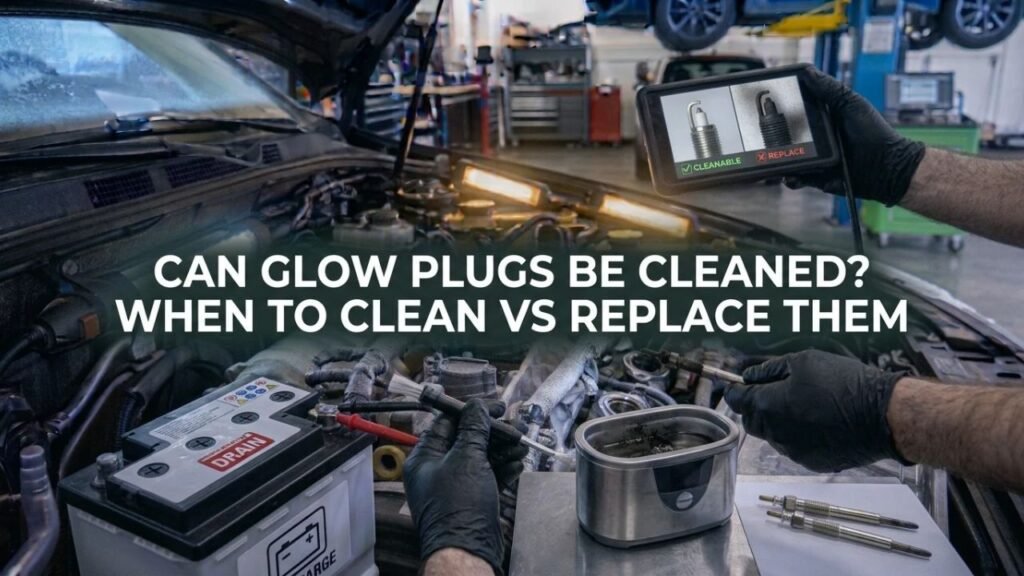
Sometimes, but only when the plug is otherwise healthy.
If you remove a glow plug and find a relatively thin layer of dry carbon on the exposed metal surface, you may be able to remove loose deposits gently before inspection and testing.
However, cleaning should never be used as a substitute for checking whether the heating element actually works.
A glow plug is fundamentally an electrical heater.
If its internal heating element is open, its resistance is abnormal, it draws incorrect current, or it no longer reaches the correct temperature, cleaning the outside will not restore it.
Cleaning Does Not Reverse Wear
A glow plug can deteriorate internally even when it looks acceptable from the outside.
Likewise, a dirty-looking plug may still electrically test correctly.
Visual appearance and electrical condition are related only to a limited degree.
That is why a good diagnosis normally combines visual inspection with the appropriate electrical tests for the particular glow-plug system.
When Reusing May Be Reasonable
Reusing a removed glow plug may be reasonable when it is relatively new, electrically tests correctly, has no physical damage, and was removed only as part of another repair or inspection.
If it has already accumulated substantial service time and removal required considerable labor, replacing it may make more practical sense.
Key Takeaways:
- Light surface deposits can sometimes be removed from a healthy glow plug.
- Cleaning cannot repair a failed heating element or damaged plug.
- Test the plug instead of judging its condition solely by how dirty it looks.
Why Do Glow Plugs Get Carbon on Them?
The glow plug tip operates directly in or very close to the diesel combustion chamber.
That means exposure to combustion deposits is normal.
A small amount of discoloration or soot does not automatically mean something is wrong.
Heavy or unusual deposits, however, can provide clues about engine operation.
Incomplete Combustion
Poor combustion can leave more carbon around the glow plug.
Cold operation, inadequate compression, injector problems, and other conditions can contribute.
If the engine repeatedly starts roughly and produces excessive smoke, heavy carbon on a glow plug may be a symptom rather than the original cause.
Injector Problems
A poor injector spray pattern can direct fuel abnormally toward the glow plug tip.
Excessive fuel exposure can overheat or damage a glow plug and may create unusual deposits.
If one glow plug looks dramatically different from the others, the corresponding injector deserves consideration.
Oil Entering the Cylinder
An engine that burns oil can create oily or heavy carbon deposits.
Possible sources include worn piston rings, cylinder wear, turbocharger problems, valve-guide issues, or other engine-specific faults.
Cleaning the glow plug will not stop the deposits from returning.
Short-Trip Operation
Engines that spend much of their time cold may accumulate deposits more readily because they do not remain at stable operating temperature for long periods.
Modern diesel emissions systems can also be sensitive to repeated short journeys.
Does Carbon on a Glow Plug Mean It Is Bad?
Not necessarily.
A thin, relatively even layer of combustion residue may simply reflect normal engine operation.
The more important questions are whether the plug still heats correctly and whether its tip is physically intact.
Compare All the Glow Plugs
When several plugs have been removed, comparing them can be useful.
If every plug has a similar appearance, the deposits may be normal for that engine.
If one plug is heavily carboned while the others are relatively clean, the difference may point toward a cylinder-specific condition.
Possible causes can include an injector problem, low compression, oil contamination, or different combustion temperature.
Do not immediately blame the glow plug itself.
How to Clean a Glow Plug Safely
If you have determined that the plug is reusable and only needs light external cleaning, keep the process gentle.
Allow the engine and parts to cool before working.
Remove the glow plug according to the vehicle manufacturer’s procedure, particularly if carbon buildup makes removal difficult.
Once it is out, inspect it before doing anything abrasive.
Remove Loose Deposits Gently
Loose dry soot may sometimes be removed with a soft nonmetallic brush or a clean cloth.
A suitable parts-cleaning solvent may be useful for external contamination if it is compatible with the plug and manufacturer’s instructions.
The goal is to remove loose deposits—not to polish the heating tip until it looks new.
Keep the Electrical Connection Clean
Corrosion or dirt around the electrical terminal can interfere with a reliable connection.
Clean the terminal carefully if necessary.
Make sure it is dry and free from contamination before reassembly.
Inspect the Threads
If the threads are dirty, remove loose debris carefully without damaging them.
Do not grind material away or use aggressive tools that alter the thread profile.
Damaged glow-plug threads can create installation and removal problems later.
What Should You Not Use to Clean Glow Plugs?
Aggressive cleaning methods create more risk than benefit.
Avoid Sandblasting or Abrasive Blasting
Abrasive media can damage the plug surface and potentially affect the heating tip.
There is little reason to blast a relatively inexpensive precision electrical heater when a questionable plug can simply be replaced.
Avoid Grinding the Tip
Do not use a bench grinder, rotary tool, or file on the heating element.
Glow plug dimensions are important.
Removing material from the tip can weaken it or change how it transfers heat.
Avoid Aggressive Wire-Wheel Cleaning
A powered wire wheel can place significant mechanical force on a small heating tip.
This is especially undesirable with modern thin or ceramic glow plugs.
If deposits are so severe that only aggressive mechanical cleaning would remove them, replacement and investigation of the underlying cause are generally better choices.
Avoid Bending the Heating Tip
A glow plug tip should not be straightened or reshaped.
A swollen, distorted, or bent plug should be treated as defective.
Key Takeaways:
- Gentle cleaning is very different from grinding or abrasive restoration.
- Never reshape, sandblast, or aggressively wire-brush the heating tip.
- A severely carboned, swollen, or damaged plug is usually a replacement candidate.
Can Ceramic Glow Plugs Be Cleaned?
Ceramic glow plugs deserve even greater caution.
Ceramic materials can tolerate very high operating temperatures, which makes them useful in advanced diesel systems, but they can also be vulnerable to mechanical impact and improper handling.
Do not scrape or strike a ceramic heating element.
Do not attempt to remove heavy deposits with abrasive tools.
If a ceramic glow plug shows damage or the service information identifies it as faulty, replacement is generally the safer approach.
Why a Broken Ceramic Tip Matters
Any fragment from a glow plug that enters the combustion chamber can potentially damage the piston, valves, cylinder head, or other components.
This is why careful removal and handling are important.
If a plug does not come out normally, forcing it can create a much bigger repair.
Can Cleaning Fix a Bad Glow Plug?
Usually not.
The phrase “bad glow plug” normally means the plug has failed electrically or physically.
Cleaning cannot reconnect a broken internal heating element.
It cannot correct abnormal electrical resistance caused by internal deterioration.
It cannot repair a cracked ceramic section.
It cannot reverse a melted or swollen heating tip.
And it cannot make an old heating element perform like a new one if it has deteriorated internally.
Test Before Deciding
Depending on the glow-plug design, technicians may use resistance testing, current measurement, scan-tool data, or manufacturer-specific diagnostic procedures.
Do not assume every glow plug can be safely tested by connecting it directly to a 12-volt battery.
Modern fast-heating plugs can operate under electronically controlled voltages significantly different from full battery voltage.
Applying excessive voltage can destroy a perfectly good plug.
Can You Clean a Glow Plug With Carb Cleaner?
A solvent may remove external oily contamination, but carburetor cleaner should not automatically be considered an approved glow-plug restoration method.
Modern glow plugs may contain coatings, electrical insulating components, seals, or ceramic materials that should not be exposed unnecessarily to harsh chemicals.
If you use a solvent for light external cleaning, choose one that is appropriate for automotive electrical or metal components and follow the relevant manufacturer’s service procedure.
Do not soak the entire glow plug indiscriminately.
And remember that solvent cannot repair an electrical failure.
Can You Clean Glow Plugs With Brake Cleaner?
The same caution applies.
Brake cleaner can remove grease and residue from many metal automotive parts, but cleaning a glow plug is not simply a degreasing task.
Avoid saturating electrical connections or using aggressive chemical treatment on ceramic or specialty plug designs unless the service information permits it.
If a plug is heavily contaminated and already old, replacement is often a more sensible solution.
Can You Use a Wire Brush on Glow Plugs?
A very soft hand brush may be acceptable for removing loose deposits from robust external metal surfaces, but avoid aggressive brushing of the actual heating tip.
I would not use a powered wire brush on a modern glow plug.
The risk of weakening, scratching, or mechanically damaging the heating element is not worth the cosmetic improvement.
The plug does not need to look brand new to function properly.
What Is Glow Plug Bore Cleaning?
This is where “cleaning glow plugs” and “glow plug cleaning” are often confused.
The glow plug sits inside a narrow bore in the cylinder head.
Carbon can accumulate in that bore, particularly around the part of the heating tip exposed to combustion.
When servicing the glow plugs, the bore may need to be cleaned according to the engine manufacturer’s procedure.
Why Bore Carbon Matters
Heavy carbon can grip the glow plug tip.
This can make removal difficult and increase the risk of breaking the plug.
Carbon can also interfere with correct installation of the replacement plug.
A clean bore allows the plug to fit as intended and can reduce the risk of future seizure from combustion deposits.
How Is a Glow Plug Bore Cleaned?
The exact method is engine-specific.
Some engines have dedicated glow-plug bore reamers or cleaning tools sized precisely for the bore.
Other manufacturer procedures specify a suitable brush or similar tool.
The objective is to remove carbon without damaging the cylinder head or leaving debris inside the cylinder.
Use the Correct Tool Size
Do not insert a random drill bit into the glow-plug hole.
A drill bit can remove cylinder-head material rather than simply scraping carbon.
A proper glow-plug reamer or manufacturer-specified bore-cleaning tool is designed for the job.
Prevent Debris From Entering the Cylinder
Carbon removed from the bore has to go somewhere.
Follow the vehicle manufacturer’s specified procedure for controlling or removing debris.
Depending on the engine and tool, this may involve grease on a reamer, vacuum extraction, compressed air applied in a controlled manner, or positioning the piston appropriately.
Never casually push carbon deeper into the combustion chamber.
Do Not Over-Ream
The goal is to remove deposits.
You are not enlarging the hole.
Once the correct-size tool passes as intended, additional material removal provides no benefit.
Should You Clean the Glow Plug Hole Every Time?
Not necessarily.
If the manufacturer’s service instructions specifically call for bore cleaning during glow plug replacement, follow that procedure.
If the plugs come out easily and the bores are clean, aggressive reaming may not be necessary.
Unnecessary tool use creates its own possibility of damage.
The amount of carbon can also vary dramatically among engines.
An older high-mileage diesel with combustion problems may need more cleaning than a properly running low-mileage engine.
Why Glow Plugs Sometimes Get Stuck
Carbon is one cause, but not the only one.
Corrosion around the threads or plug body can make removal difficult.
Thermal cycling over thousands of engine hours can contribute.
Incorrect installation torque can also create problems.
Do Not Force a Stuck Glow Plug
A broken glow plug can leave part of its body or heating tip inside the cylinder head.
Removing the broken piece may require specialized extraction tools and substantial labor.
If resistance becomes excessive during removal, stop and follow an engine-specific stuck-glow-plug procedure.
Professional removal is often cheaper than repairing damage caused by forcing it.
Can Cleaning Prevent a Glow Plug From Breaking?
Cleaning the accessible bore as part of the proper removal or installation procedure may help reduce future carbon-related sticking.
However, you cannot always clean the bore effectively until the plug is removed.
For a badly seized plug, technicians may use controlled warming, penetrating products where appropriate, gradual loosening and tightening, or specialized tools.
There is no universal removal method because cylinder-head and glow-plug designs vary.
The key is controlled force.
Should You Clean or Replace Carbon-Fouled Glow Plugs?
Look at the entire condition of the plug.
If it is relatively new, tests correctly, and carries only removable surface soot, cleaning and reinstallation may be reasonable.
If it is old, tests poorly, or has severe carbon buildup, replacement is usually the better option.
Investigate Heavy Carbon
Replacing the plug alone may not solve the underlying problem.
Ask why the deposits formed.
Check for injector problems, compression issues, oil consumption, prolonged incomplete combustion, and other engine-specific causes when appropriate.
A replacement glow plug installed into an unhealthy cylinder may develop the same deposits.
Signs a Glow Plug Should Be Replaced Instead of Cleaned
A plug should generally be replaced when electrical testing confirms failure.
Physical damage is another clear reason.
A swollen or distorted heating tip should not be reused.
Cracks, missing material, severe erosion, melted areas, or damaged electrical terminals also justify replacement.
Heavy deposits accompanied by starting problems may make replacement more practical even if the plug still has some electrical continuity.
Age and Labor Matter
Suppose one plug on an eight-cylinder engine fails, but reaching all eight requires extensive disassembly.
If the entire set is old, replacing additional aging plugs while access is available may be economically sensible.
On an engine where every plug is easily accessible, replacing only the confirmed failed plug may be more reasonable.
There is no universal rule that every glow plug must always be replaced as a set.
Key Takeaways:
- Replace plugs that are electrically faulty, swollen, cracked, melted, or otherwise damaged.
- Heavy deposits can indicate another engine problem that cleaning alone will not fix.
- Whether to replace one plug or a complete set depends on testing, age, access, and manufacturer guidance.
Can Cleaning Glow Plugs Improve Cold Starting?
Only if deposits were genuinely interfering with a healthy plug’s operation or installation.
If the plug’s heating element is weak or failed, cleaning its exterior will not significantly improve cold starting.
A diesel that struggles to start cold may have several possible problems, including failed glow plugs, weak battery, slow starter, low compression, fuel-system air, injector problems, or a failed glow-plug controller.
Do not treat cleaning as a universal cure for hard starting.
Can Cleaning Glow Plugs Fix White Smoke?
Usually not by itself.
White smoke during a cold diesel start can occur when injected fuel does not burn completely.
A functioning glow system can reduce this by helping the combustion chamber heat quickly.
If a glow plug is electrically faulty, cleaning it will not restore its heating function.
Replace or repair the actual failed component.
Persistent white smoke after the engine warms also suggests that something beyond the glow plugs may be wrong.
Can Cleaning Fix a Glow Plug Fault Code?
No, not if the diagnostic code was caused by an electrical failure.
A glow-plug circuit code may result from an open plug, wiring problem, poor connector, controller failure, power-supply issue, or abnormal resistance.
Removing soot from the heating tip does not repair those electrical faults.
However, if you remove the plugs while diagnosing the circuit, cleaning electrical connections and correcting corrosion where appropriate can be part of the repair.
Scan and test the circuit rather than clearing the code repeatedly.
How to Keep New Glow Plugs From Carboning Up
Some carbon formation is inevitable because the heating tip is exposed to combustion.
You are not trying to keep it cosmetically spotless.
The more important goal is maintaining a healthy engine.
Correct injector operation helps.
So does good compression.
Repair excessive oil consumption and intake-system faults when present.
Use the correct glow plug specified for the engine.
Modern plugs have different lengths, voltages, temperature characteristics, and control requirements.
An incorrect plug can fail quickly even if it physically fits.
Should You Apply Anti-Seize When Reinstalling Glow Plugs?
Do not automatically put anti-seize on glow-plug threads.
Whether thread lubricant is allowed depends on the engine and glow-plug manufacturer.
Lubrication changes the relationship between tightening torque and actual clamping force, potentially resulting in excessive loading if the specified torque assumes dry threads.
Follow the installation instructions for the exact plug.
Also use the correct tightening torque.
Glow plugs are relatively slender components, and overtightening can create future removal problems or damage the plug.
Should Glow Plugs Be Removed From a Hot or Cold Engine?
There is no universal rule appropriate for every engine.
Some manufacturer and professional procedures use a warm engine to help loosen carbon-bound plugs, while other operations may specify particular temperature limits.
This becomes especially important when dealing with a plug known to be stuck.
Follow the removal procedure for the specific engine rather than relying on a general internet rule.
If the plug begins requiring excessive torque, do not force it.
FAQs about Can Glow Plugs Be Cleaned
Can glow plugs be cleaned?
Yes, light external soot or carbon can sometimes be removed gently from a healthy reusable glow plug.
Cleaning cannot repair an electrically failed or physically damaged plug.
Is it worth cleaning glow plugs?
Usually only if the plugs test correctly and have minor removable deposits.
Old, damaged, or electrically faulty plugs are generally better replaced.
Can carbon cause a glow plug to fail?
Heavy carbon can interfere with plug removal and may indicate combustion problems. Abnormal combustion conditions that create deposits can also contribute to plug damage.
Can you clean carbon off glow plugs?
Loose carbon may be removed gently.
Avoid aggressive scraping, grinding, wire-wheel cleaning, or abrasive blasting of the heating element.
Can I clean glow plugs with a wire brush?
Avoid aggressive wire brushing, especially on the heating tip or ceramic plugs.
A soft brush can be used for light loose contamination where appropriate.
Can glow plugs be sandblasted?
It is not a good service method for modern glow plugs.
Abrasive blasting can damage a precision heating element. Replace a questionable plug instead.
Can I clean glow plugs with brake cleaner?
A suitable solvent may remove external contamination on some designs, but it does not repair the plug. Follow the service recommendations for the exact glow plug.
Can I clean glow plugs with carb cleaner?
Solvent may remove some external deposits, but aggressive soaking or chemical treatment is unnecessary and may be inappropriate for some modern plugs.
Can ceramic glow plugs be cleaned?
Handle ceramic glow plugs extremely carefully.
Avoid scraping or abrasive cleaning of the ceramic heating element. A damaged ceramic plug should be replaced.
Can a dirty glow plug cause hard starting?
Potentially, but electrical failure, insufficient heating, low compression, weak battery performance, and fuel-system problems are more important diagnostic considerations.
Can cleaning a glow plug fix a misfire?
If the plug is electrically failed, no.
Glow-plug-related cold misfires normally require restoring proper heating, which may mean replacing the failed plug or repairing its circuit.
Should I clean the glow plug bore?
Some engines benefit from manufacturer-specified bore cleaning during glow-plug service, especially when carbon has accumulated.
Use the correct bore-cleaning tool.
Can I use a drill bit to clean a glow plug hole?
A random drill bit is not recommended.
It can remove cylinder-head material or damage the bore. Use the correct glow-plug reamer or manufacturer-specified cleaning tool.
Why is there carbon around my glow plug?
Combustion naturally produces some deposits, but excessive carbon can be associated with incomplete combustion, injector problems, oil burning, or other engine conditions.
Should I replace a heavily carboned glow plug?
If the plug is old, electrically weak, physically damaged, or heavily fouled, replacement is usually more sensible than aggressive cleaning.
Can you reuse removed glow plugs?
Potentially, if they are serviceable, test correctly, and are undamaged.
Follow the manufacturer’s installation and torque procedure when reinstalling them.
Should all glow plugs be replaced together?
Not always.
Replacing a full aging set can make sense when access is difficult, but individual replacement may be appropriate when the remaining plugs test correctly.
Does cleaning remove a glow plug fault code?
Not usually.
Electrical glow-plug codes require diagnosis of the plug, wiring, connections, control module, and power supply.
Can a clogged glow plug bore damage a new plug?
Heavy deposits can interfere with proper installation and may contribute to future removal problems.
Bore cleaning should be performed when specified or necessary.
Conclusion
Can glow plugs be cleaned? Yes, but only in a limited sense. Light soot or loose external carbon can sometimes be removed gently from a glow plug that is otherwise electrically and physically healthy.
Cleaning is not a repair for a genuinely bad glow plug.
If the heating element has failed, the resistance or current draw is incorrect, the tip is swollen, the ceramic is cracked, or the plug has melted or eroded, replacement is the appropriate solution.
Avoid aggressive methods such as grinding, sandblasting, powered wire brushing, or scraping the heating element. These methods can damage the plug and create a greater risk than the original deposits.
Also remember that the glow plug bore may need more attention than the plug itself. Carbon can build up in the cylinder-head bore and around the heating tip, making plugs difficult to remove and potentially interfering with installation. When cleaning is required, use the correct engine-specific reamer, brush, or manufacturer-approved tool and take precautions to keep loosened carbon out of the cylinder.
If a glow plug is heavily carboned, investigate why rather than simply making it look clean. Injector problems, oil consumption, low compression, and poor combustion can all allow deposits to return.
For most diesel owners, the practical rule is simple: gently clean a healthy plug only when necessary, test it before reuse, clean the bore correctly when the service procedure calls for it, and replace any plug that is electrically faulty or physically damaged.