
If you are wondering what causes glow plugs to go bad, the most common reasons are normal heating-cycle wear, excessive voltage or glow time, carbon buildup, faulty relays or control modules, incorrect glow plugs, injector problems, and abnormal combustion conditions. Glow plugs operate in an extremely harsh environment, repeatedly heating to very high temperatures while exposed to combustion pressure and deposits, so they eventually wear even when the engine has no other problem.
A glow plug that fails after many years may simply have reached the end of its service life. A plug that fails shortly after replacement, however, deserves more investigation. Installing another plug without finding the underlying cause can result in the new one failing again.
Modern glow plug systems make diagnosis even more important. Many late-model diesels use electronically controlled low-voltage glow plugs that heat extremely quickly. A failed controller, incorrect replacement plug, poor electrical connection, or wrong control strategy can damage them far faster than normal wear.
In this guide, I’ll explain the most common causes of glow plug failure, why plugs can burn out, swell, or break, how injector and electrical problems affect them, and what to check when the same glow plug keeps failing.
Why Glow Plugs Eventually Wear Out
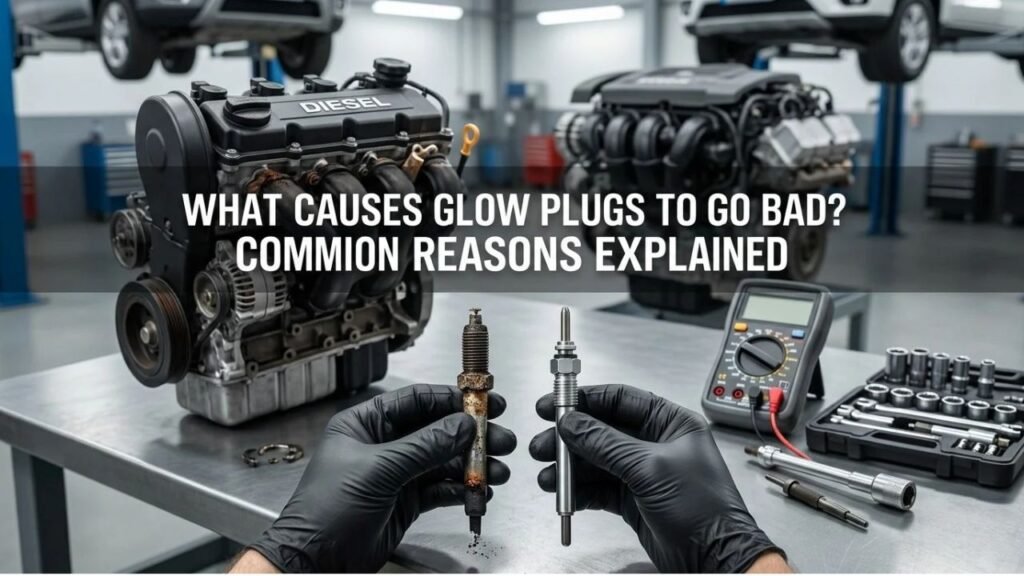
Glow plugs are essentially high-temperature electrical heating elements.
Every time the engine performs a glow cycle, electrical current passes through the heating element and raises the tip temperature rapidly.
When the engine cools, the plug cools too.
This repeated heating and cooling creates thermal stress.
Over thousands of cycles, the internal heating element and outer sheath can deteriorate.
Eventually, the electrical circuit may become open, resistance may change, or the heating tip may no longer reach the required temperature.
Starting Cycles Matter More Than Mileage Alone
Glow plug life is not determined purely by odometer mileage.
A delivery vehicle that starts and stops twenty times each day may put more glow cycles on its plugs than a highway vehicle that travels 100 miles after one cold start.
Climate also matters.
A vehicle operated in very cold weather may use longer pre-glow and post-glow periods.
Modern engines may also continue energizing glow plugs after startup for emissions and combustion control.
That means two identical diesels with the same mileage can have very different glow plug wear.
Key Takeaways:
- Glow plugs naturally wear from repeated heating and cooling cycles.
- Number of starts and operating conditions can matter as much as mileage.
- Early failure usually deserves diagnosis instead of simply installing another plug.
What Causes Glow Plugs to Go Bad Prematurely?
A glow plug that fails much earlier than expected may be overheating electrically or experiencing abnormal combustion conditions.
The most important causes include controller faults, over-voltage, incorrect plugs, injector problems, and excessive carbon.
These conditions can damage one plug or an entire set.
Faulty Glow Plug Relay
Older diesel engines commonly use a relay to send high current to the glow plugs.
The relay is supposed to energize them for a controlled amount of time and then switch them off.
If the relay sticks closed, the glow plugs may remain powered much longer than intended.
That excessive heating can burn out the elements.
Symptoms of a Stuck Relay
You may notice unusual battery drain, repeated glow plug failures, or a relay that remains active after it should have switched off.
Because glow plugs draw a large amount of current, a stuck relay can also place heavy strain on the battery and charging system.
If an entire set of plugs fails unusually quickly, checking the relay is much more sensible than assuming every plug was defective.
Faulty Glow Plug Control Module
Modern diesels often replace the simple relay with an electronic glow plug control module.
The module may individually control each plug, regulate voltage, monitor current, and communicate with the engine control module.
If it malfunctions, one or several glow plugs can receive incorrect power.
Too Much Voltage
Some modern glow plugs are designed to operate well below full battery voltage.
The controller rapidly regulates or pulses power to achieve fast heating.
If the wrong voltage reaches one of these plugs, it can overheat extremely quickly.
This is why directly connecting a modern glow plug to a 12-volt battery can be dangerous unless the plug is specifically designed for that test.
Excessive Glow Duration
Even with the correct voltage, leaving a plug energized too long can damage it.
A faulty control module, temperature sensor input, or control circuit may command excessive glow time.
Repeated overheating gradually weakens the tip until it burns out or becomes damaged.
Using the Wrong Glow Plugs
Incorrect glow plugs are a major cause of premature failure.
Two plugs can look almost identical while having very different electrical specifications.
Differences may include voltage rating, resistance, heating speed, tip length, thread size, and temperature characteristics.
Wrong Voltage Rating
Installing a low-voltage plug in a system that supplies more voltage than it was designed to handle can destroy it quickly.
The plug may glow excessively hot and fail internally.
Wrong Heating Rate
Some glow plugs are designed for rapid heating.
Others warm more gradually.
The engine controller expects a particular electrical response.
A mismatched plug can heat incorrectly even if it physically fits.
Wrong Tip Length
A heating tip that protrudes too far into the combustion area may experience excessive temperature or even physical interference in extreme cases.
A tip that is too short may not heat the correct area effectively.
Never select a glow plug by thread size alone.
Use the exact application.
Excessive Carbon Buildup Around the Glow Plug
Carbon buildup is another common cause of trouble.
Combustion deposits can accumulate around the heating tip and inside the glow plug bore.
Over time, this buildup can affect heat transfer and make removal difficult.
Carbon Can Trap the Tip
A glow plug may unscrew normally but refuse to slide out of the cylinder head because carbon has built up around the heating element.
Pulling aggressively can break the plug.
Carbon Can Contribute to Hot Spots
Heavy deposits can alter the environment around the glow plug tip.
Depending on engine condition, this can contribute to abnormal heating or stress.
Excessive carbon itself often points toward another engine issue, such as poor combustion, injector problems, oil consumption, or extensive short-trip operation.
Key Takeaways:
- Wrong voltage or excessive glow time can destroy glow plugs quickly.
- Always use the exact plug specified for the engine.
- Heavy carbon buildup can shorten plug life and make removal much more difficult.
Faulty Fuel Injectors
A bad fuel injector can damage a glow plug.
This is one of the most important causes to consider when the same cylinder repeatedly destroys glow plugs.
A diesel injector is supposed to deliver a finely atomized spray pattern at the correct time.
If the nozzle is worn, damaged, or partially blocked, the spray pattern may become distorted.
Fuel may then strike the glow plug tip directly.
Direct Fuel Impingement
A concentrated fuel spray hitting the glow plug can cool and heat the tip unevenly.
It may also contribute to excessive deposits.
Over time, this can cause erosion, cracking, or abnormal swelling.
Injector Over-Fueling
An injector that delivers too much fuel can produce abnormal combustion temperatures and heavy carbon deposits.
You may also notice black smoke, rough running, poor fuel economy, or an unusual diesel knock.
If one glow plug repeatedly fails while all the others last normally, inspect that cylinder’s injector rather than continually replacing the plug.
Poor Fuel Atomization
Even if the injector is not completely failed, poor spray quality can affect plug life.
Diesel fuel needs to be finely atomized for clean combustion.
A poor spray pattern creates uneven flame development.
This can expose the glow plug to localized temperature extremes.
Modern common-rail systems are particularly precise, so injector condition matters considerably.
Incorrect Injection Timing
Combustion that begins too early or too late can increase abnormal cylinder temperature or create poor burning conditions.
The glow plug is directly exposed to that combustion environment.
On modern electronically controlled engines, injection timing is generally managed by the ECU, but sensor, injector, fuel-pressure, or mechanical timing problems can still affect combustion.
Older mechanically injected diesels can also suffer from incorrect pump timing.
Engine Overheating
Severe engine overheating can expose glow plugs to unusually high cylinder-head and combustion temperatures.
Glow plugs are designed to survive extreme heat, but excessive operating temperature can shorten their life.
If plugs show repeated signs of overheating, also investigate the cooling system.
Possible causes include low coolant, thermostat problems, radiator restriction, cooling-fan faults, water-pump problems, or combustion-related overheating.
Low Compression
Low compression does not normally burn out a glow plug directly, but it can create conditions that make the glow system work harder.
Diesel engines need high compression to generate enough heat for ignition.
If piston rings, valves, or cylinders are worn, starting becomes more difficult.
The control system may use longer glow periods where applicable, and the engine may experience poor cold combustion.
A vehicle with low compression may therefore appear to “eat glow plugs” when the real underlying issue is engine wear.
Signs of Low Compression
You may notice difficult cold starting, excessive cranking, uneven startup, white smoke, or one cylinder that takes longer to begin firing.
If new glow plugs do not solve the problem, compression testing may be necessary.
Oil Entering the Combustion Chamber
Oil consumption can contribute to carbon deposits around glow plug tips.
Worn piston rings, worn valve guides, turbocharger oil leakage, or crankcase ventilation problems can allow oil into the intake or combustion chamber.
Burned oil forms deposits.
These deposits may coat the glow plug and make removal difficult.
Heavy oil burning can also create abnormal combustion conditions that shorten component life.
Coolant Entering a Cylinder
Coolant intrusion can also damage or contaminate a glow plug.
A head gasket failure, cracked cylinder head, or other cooling-system fault may allow coolant into one cylinder.
The affected glow plug may look unusually clean compared with the others because steam can wash deposits from the combustion chamber.
Alternatively, corrosion or abnormal deposits may appear.
If one plug has a very different appearance from the rest and coolant is disappearing, investigate the engine rather than assuming the plug itself is the only problem.
Bad Electrical Connections
Not all glow plug failures are caused by excessive power.
Poor electrical connections can also cause trouble.
Corroded connectors, damaged harnesses, loose terminals, and high-resistance connections can reduce the voltage reaching the plug.
The plug may heat slowly or incompletely.
Why Resistance Matters
Glow plugs draw substantial current.
Even a small amount of unwanted resistance in a connection can create a meaningful voltage drop.
The engine may then have hard-start symptoms even though the plug itself is functional.
This is why an electrical test should include the wiring and connectors, not just the heating element.
Weak Battery or Slow Cranking
A weak battery does not usually damage glow plugs directly, but it can make the glow plug system appear faulty.
Glow plugs draw significant current before the starter even begins cranking.
A weak battery may not provide enough voltage to heat them properly and still crank the engine at the required speed.
That leads to hard starting and white smoke.
Owners may replace the plugs when the real problem is insufficient battery capacity or poor cable connections.
Multiple Batteries
Many diesel trucks use two batteries.
Both need to be in good condition.
One weak battery can reduce overall starting-system performance even if the second battery seems healthy.
Faulty Engine Temperature Sensor
Modern glow plug operation depends partly on engine temperature.
The ECU may use coolant-temperature or other sensor data to determine how long the plugs should operate.
If a temperature sensor incorrectly reports that the engine is extremely cold, the system may command longer heating than necessary.
Conversely, if the sensor falsely reports a warm engine during cold weather, the plugs may receive insufficient preheating.
A sensor problem therefore can affect both starting and glow plug operating time.
Frequent Short Trips
Short-trip driving increases the number of cold-start cycles relative to miles traveled.
A delivery van might start dozens of times each day while traveling relatively little distance.
Each start can involve another glow cycle.
This accelerates wear compared with a vehicle that starts once and travels hundreds of highway miles.
Short trips can also contribute to carbon buildup because the engine may not remain hot long enough to burn deposits efficiently.
Extremely Cold Weather
Cold weather itself does not mean a properly functioning glow plug should fail, but it increases system demand.
Glow periods may become longer.
Post-glow may continue longer after startup.
The battery must also work harder.
Over many winters, this additional duty cycle contributes to normal plug wear.
If a plug is already weakened, the first very cold morning may be when it finally fails completely.
Can Glow Plugs Burn Out?
Yes.
An internal heating element can burn open just like other electrical heating elements.
When that happens, the plug no longer conducts current properly or fails to produce heat.
An electrical resistance test may show an open circuit.
Common reasons include age, over-voltage, prolonged heating, or manufacturing failure.
Do All Burned-Out Plugs Look Damaged?
No.
A failed glow plug may look perfectly normal externally.
The internal heating element can be open while the metal tip still appears intact.
That is why visual inspection alone is not enough.
What Causes Glow Plugs to Swell?
Swollen tips are especially concerning because they can make removal difficult.
Overheating is a major contributor.
Excessive voltage or glow duration can cause the heating element to run beyond its intended temperature.
Injector spray problems may also create abnormal localized heat.
Carbon buildup can make a normal plug appear stuck even without actual swelling, so the two conditions should not be confused.
What to Do With a Swollen Plug
If a plug unscrews but will not come out, do not yank on it.
The heating tip may be larger than the opening because of swelling or deposits.
Forcing it can break the tip.
Specialized removal tools or professional extraction may be necessary.
Key Takeaways:
- Repeated failure on one cylinder can indicate an injector or combustion problem.
- Glow plugs can fail internally without looking damaged from the outside.
- A plug that unscrews but will not come out should never be forced.
What Causes Glow Plug Tips to Break Off?
A glow plug can break because of mechanical damage, overheating, swelling, corrosion, or excessive removal force.
The heating tip becomes especially vulnerable if it has spent years surrounded by carbon deposits.
If the plug is twisted aggressively, the upper body can separate while the tip remains in the head.
Why a Broken Tip Is Serious
A loose piece of metal inside a diesel cylinder can contact the piston, valve, or cylinder head.
That can cause major engine damage.
If you remove a glow plug and discover that the tip is missing, do not start the engine until you know where the broken section is.
A borescope may help locate it.
Why Does the Same Glow Plug Keep Failing?
Repeated failure on the same cylinder should make you suspicious of something other than the plug.
Check the injector first.
A poor spray pattern can concentrate fuel on the heating element.
Inspect the wiring to that plug.
A control module channel fault could supply abnormal voltage or current.
Also consider compression, oil contamination, carbon buildup, and combustion-chamber problems.
Replacing the same glow plug repeatedly without diagnosing the cylinder is rarely a good long-term strategy.
Why Do All Glow Plugs Fail at Once?
It is uncommon for every plug to reach the end of its life at exactly the same moment.
If several plugs fail together, investigate a shared cause.
The glow plug relay or controller may have supplied excessive voltage or stayed on too long.
The wrong type of plugs may have been installed as a set.
A major electrical fault may also affect all cylinders.
Sometimes the plugs themselves are still good and only the shared fuse, relay, wiring, or control module has failed.
Test before replacing the complete set.
How Long Should Glow Plugs Last?
There is no universal mileage.
Some glow plugs operate reliably for many years and well over 100,000 miles, while others fail sooner.
Service life depends on plug technology, engine design, number of glow cycles, climate, controller strategy, combustion condition, and maintenance.
This is why many diesel manufacturers do not specify one universal glow plug replacement interval.
They are often replaced based on diagnosis rather than mileage alone.
How to Make Glow Plugs Last Longer
You cannot eliminate normal wear, but you can avoid several causes of premature failure.
Use the exact specified plugs.
Keep the battery and charging system healthy.
Repair injector problems promptly.
Do not ignore glow plug controller or relay faults.
Address oil consumption and poor combustion.
Avoid manually energizing modern glow plugs with full battery voltage unless the manufacturer explicitly approves that test.
Correct installation also matters.
Use the specified torque.
Do not automatically apply anti-seize if the plug manufacturer calls for dry threads.
Overtightening can damage the plug or make future removal difficult.
Should You Replace All Glow Plugs When One Fails?
Not necessarily.
If one plug fails unexpectedly and all the others test correctly, replacing one may be reasonable.
If every plug is the same age and several test weak, a complete set may make more sense.
Access also matters.
If significant engine disassembly is required, replacing aging plugs together can save future labor.
However, old glow plugs can be difficult to remove.
Do not create unnecessary breakage risk by removing healthy plugs purely out of habit.
How to Diagnose Premature Glow Plug Failure
Start by identifying which plugs have actually failed.
Read diagnostic trouble codes.
Test resistance or current according to the vehicle procedure.
Then inspect the power supply and glow plug control module.
If one cylinder repeatedly causes trouble, test the injector and consider compression.
Look at the removed plug carefully.
A burned or deformed tip can suggest overheating.
Heavy carbon may indicate poor combustion or oil consumption.
An unusually clean plug can sometimes suggest coolant intrusion.
Diagnosis should use the complete symptom pattern rather than one visual clue.
Common Mistakes That Shorten Glow Plug Life
Using the wrong plug is one of the biggest mistakes.
Another is direct battery testing on a modern low-voltage plug.
That can destroy the heating element in seconds.
Ignoring a sticking glow plug relay is equally dangerous.
Some owners repeatedly replace burned plugs while the relay continues over-heating them.
Poor installation also creates problems.
Overtightening can damage the body and threads.
Under-tightening may affect sealing.
Finally, ignoring injector faults can lead to repeated failure on the same cylinder.
FAQs about What Causes Glow Plugs to Go Bad
What causes glow plugs to go bad?
Common causes include normal thermal wear, excessive voltage, prolonged glow time, faulty controllers or relays, incorrect plugs, injector problems, carbon buildup, and abnormal combustion.
Can a bad relay damage glow plugs?
Yes. A relay that stays on too long can overheat the glow plugs and burn them out prematurely.
Can a bad glow plug control module ruin new glow plugs?
Yes. If the module supplies excessive voltage or incorrect glow duration, even new plugs can fail quickly.
Can bad injectors damage glow plugs?
Yes. A poor injector spray pattern can direct fuel onto the glow plug tip and expose it to abnormal thermal stress.
Why do glow plugs swell?
Excessive heat, incorrect voltage, injector problems, or internal plug damage can cause the tip to deform or swell.
Why do glow plug tips break?
Overheating, carbon buildup, corrosion, swelling, and excessive force during removal can all contribute to tip breakage.
Can carbon buildup damage glow plugs?
Yes. Heavy carbon can trap the glow plug tip, interfere with heat transfer, and make removal difficult.
Can using the wrong glow plug damage the engine?
Potentially. Incorrect length, voltage, or heat characteristics can cause plug failure and may create more serious problems.
Does cold weather wear glow plugs faster?
Cold conditions usually require longer glow cycles, which increases operating time and contributes to normal wear.
Can a weak battery make glow plugs go bad?
A weak battery normally does not directly destroy them, but it can prevent proper heating and create symptoms that resemble bad glow plugs.
Can low compression cause glow plug failure?
Not usually directly, but poor compression can make cold starting more difficult and increase reliance on the glow system.
Can engine oil damage glow plugs?
Oil entering the combustion chamber can contribute to heavy deposits and abnormal combustion around the glow plug.
Can coolant damage a glow plug?
Coolant entering a cylinder can alter combustion and contaminate or corrode the plug.
Why does one glow plug keep failing?
Suspect a cylinder-specific injector problem, wiring issue, controller channel fault, carbon buildup, or mechanical engine problem.
Why would all glow plugs fail together?
A shared controller, relay, voltage problem, or installation of incorrect plugs is more likely than every plug wearing out simultaneously.
How long do glow plugs normally last?
There is no universal lifespan. Their life depends on engine design, glow cycles, climate, plug technology, and system condition.
Conclusion
Understanding what causes glow plugs to go bad helps you avoid repeatedly replacing the symptom while leaving the real problem untouched.
Glow plugs naturally wear because they heat and cool thousands of times during their service life. If a high-mileage plug eventually develops an open heating element, normal aging may be the only explanation.
Premature failure is different.
A faulty glow plug relay or control module, excessive voltage, prolonged heating, incorrect plug specification, bad injector spray pattern, carbon buildup, oil contamination, or abnormal combustion can shorten glow plug life dramatically.
The failure pattern can provide useful clues.
If one plug repeatedly fails, investigate that cylinder and its injector or wiring. If several plugs burn out together, inspect the shared controller, relay, voltage supply, and part-number compatibility.
If a glow plug becomes swollen or refuses to come out after the threads are loose, do not force it. A broken glow plug tip can turn a routine repair into a much more serious job.
My recommendation is to treat unusually early glow plug failure as a diagnostic clue. Test the plugs, verify the correct replacements, inspect the controller and electrical supply, and investigate injector or combustion problems when necessary. Fixing the cause is the best way to keep the next set of glow plugs working reliably.