
The most common faulty spark plug wires symptoms include engine misfires, rough idle, hard starting, hesitation, reduced power, and a check engine light. Damaged wires may also produce visible electrical arcing, a ticking sound, or problems that become worse in wet weather.
Spark plug wires carry high ignition voltage from the ignition coil or distributor to the spark plugs. If a wire becomes cracked, burned, loose, or internally damaged, some or all of that voltage may escape before reaching the plug.
The engine may continue running when the damage is minor. As the insulation or internal conductor deteriorates, ignition becomes less reliable, especially during acceleration, cold starts, humid weather, and high engine load.
What Happens When Spark Plug Wires Go Bad?
A spark plug requires high voltage to create a spark across its electrode gap.
On an engine with traditional spark plug wires, the ignition coil generates this voltage and sends it through the wires. Each wire must deliver the energy to the correct spark plug without allowing it to leak into the engine, cylinder head, or nearby metal components.
A faulty wire may develop excessive internal resistance or damaged insulation. The voltage may then weaken, stop completely, or arc through the side of the wire.
This can cause:
Intermittent ignition, cylinder misfires, incomplete combustion, reduced engine power, and increased stress on other ignition components.
Not every modern vehicle uses spark plug wires. Many newer engines use a coil-on-plug system, where an ignition coil sits directly over each plug. On those engines, similar problems may come from a damaged coil boot rather than a separate spark plug wire.
Common Faulty Spark Plug Wires Symptoms
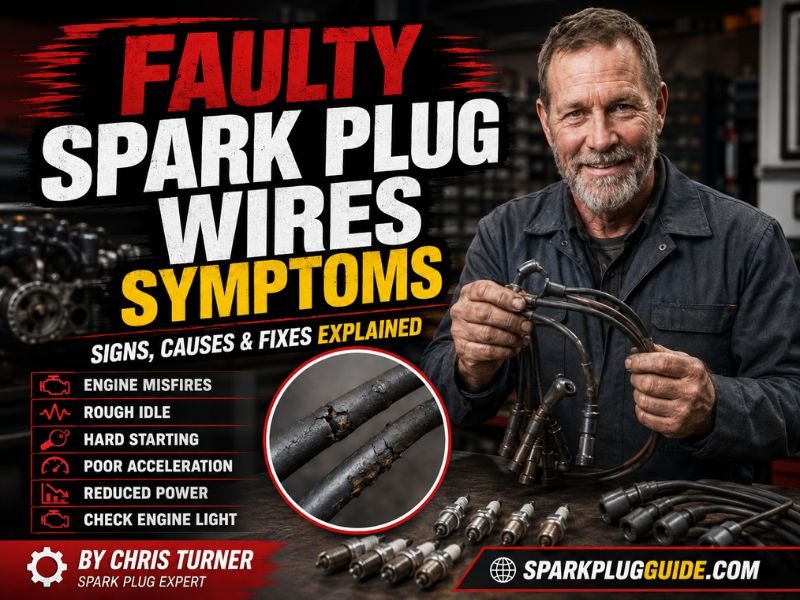
Spark plug wire problems may be constant or intermittent.
A badly broken conductor can disable one cylinder continuously. A small insulation crack may create symptoms only when the engine is damp, hot, or operating under load.
Engine Misfires
An engine misfire is one of the most common signs of faulty spark plug wires.
When a wire cannot deliver sufficient voltage, the spark plug may fail to ignite the air-fuel mixture. The affected cylinder then produces weak combustion or no useful combustion during that cycle.
The vehicle may jerk, stumble, or briefly lose power. The exhaust rhythm may sound uneven, and the engine may shake.
A damaged wire may misfire only occasionally at first. As the internal conductor or insulation worsens, the misfire can become continuous.
Misfires are often more noticeable during acceleration because higher cylinder pressure requires more ignition voltage. A wire that can deliver enough energy at idle may leak or fail when electrical demand increases.
Rough or Unstable Idle
Faulty spark plug wires can make the engine idle unevenly.
At idle, every cylinder should produce a consistent combustion event. If one wire delivers voltage intermittently, the engine becomes unbalanced.
You may feel vibration through the steering wheel, seat, or floor. Engine speed may fluctuate slightly, and the exhaust may sound irregular.
A mild wire fault may create a brief stumble every few seconds. Severe damage can make the engine shake continuously or feel close to stalling.
Rough idle can also result from a bad spark plug, weak ignition coil, fuel injector problem, vacuum leak, or low compression. Wire damage becomes more likely when the symptoms change after the wire is moved or when visible arcing is present.
Hesitation During Acceleration
A damaged spark plug wire may cause hesitation when the accelerator is pressed.
Acceleration raises cylinder pressure and increases the voltage required to fire the spark plug. If the wire has high resistance or cracked insulation, it may not deliver enough energy under these conditions.
The vehicle may pause before responding, stumble while leaving a stop, or jerk during highway merging.
The symptom may disappear when the throttle is reduced because the ignition system requires less voltage during light-load operation.
This load-related behavior is a strong clue that high-voltage ignition energy is escaping or being restricted somewhere between the coil and plug.
Weak Engine Power
A cylinder receiving weak or intermittent ignition cannot produce its normal share of engine power.
The vehicle may accelerate slowly, require more throttle, or struggle while climbing hills. It may also feel weak at higher RPM.
Power loss may be more obvious in engines with fewer cylinders. One inactive cylinder has a greater effect on a four-cylinder engine than it does on a six- or eight-cylinder engine.
When several wires are old or damaged, the engine may feel generally sluggish rather than showing one obvious cylinder-specific problem.
The power loss may gradually worsen as heat, vibration, and electrical stress continue damaging the wires.
Hard or Delayed Starting
Faulty spark plug wires can make an engine difficult to start.
During cranking, the ignition system must create a strong spark while the starter motor is drawing significant battery power. A damaged wire may not deliver enough voltage under these conditions.
The engine may crank longer than usual, require multiple attempts, or start and immediately run roughly.
Cold weather can make the problem more noticeable because a cold air-fuel mixture is harder to ignite.
A wire with moisture inside its boot may also cause difficult starting after rain, washing the engine bay, or parking in humid conditions.
If several wires are badly damaged, the engine may crank without starting.
Problems That Worsen in Rain or Humidity
Moisture-related misfires are a particularly useful clue for damaged spark plug wires.
Water can collect around cracked insulation, loose boots, or contaminated terminals. Moisture creates an easier electrical path from the wire to nearby grounded metal.
The engine may run normally in dry weather but begin misfiring during rain, fog, or high humidity.
You may notice rough starting in the morning, hesitation after driving through heavy rain, or unstable idle after washing the engine compartment.
The symptoms may improve after the engine becomes warm and the moisture evaporates.
A moisture-sensitive problem can also involve a cracked distributor cap, damaged ignition coil, or worn coil boot. The complete high-voltage ignition system should be inspected.
Visible Electrical Arcing
A faulty spark plug wire may produce visible blue or white electrical sparks.
This is known as arcing. It occurs when ignition voltage escapes through damaged insulation and jumps to the engine block, cylinder head, heat shield, or another nearby grounded surface.
Arcing is often easier to see in a dark environment while the engine is running. However, inspecting a running ignition system requires caution because spark plug wires carry extremely high voltage.
You may also hear a sharp ticking or snapping sound that follows engine speed.
Visible arcing confirms that the wire insulation or connection is no longer containing ignition voltage correctly.
Do not touch the wires while the engine is running. High ignition voltage can cause a painful electrical shock and may be dangerous for people with certain medical devices.
Check Engine Light
Faulty spark plug wires may activate the check engine light when the engine control module detects repeated misfires.
A steady light may indicate an intermittent or moderate problem. A flashing light usually means the engine has a severe active misfire that could damage the catalytic converter.
A scan tool may show a cylinder-specific misfire or random multiple-cylinder misfires.
The code does not identify the wire as the failed component. A bad spark plug, ignition coil, injector, wiring fault, or compression problem can create the same code.
However, the plug wire should be inspected when the misfire is limited to a cylinder that uses a visibly cracked, burned, or loose wire.
Poor Fuel Economy
Damaged spark plug wires may reduce fuel economy by causing incomplete combustion.
The fuel injector continues delivering gasoline to the affected cylinder even when the wire does not provide enough voltage for reliable ignition.
Some fuel may pass into the exhaust without producing useful power. The driver may also press the accelerator farther to compensate for reduced performance.
The result may be fewer miles from a tank or more frequent refueling.
Poor fuel economy alone does not confirm faulty spark plug wires. It becomes more meaningful when combined with misfires, hesitation, rough idle, or visible wire damage.
Raw Fuel Smell or Exhaust Popping
A misfiring cylinder may send unburned gasoline into the exhaust system.
This can create a raw fuel smell, irregular exhaust pulses, or occasional popping from the tailpipe.
A strong gasoline smell around the engine compartment may indicate an external fuel leak rather than an ignition fault. An external leak requires immediate attention.
When the odor comes mainly from the exhaust and appears with a wire-related misfire, incomplete ignition is a likely explanation.
Continued misfiring can overheat the catalytic converter as unburned fuel burns inside the exhaust system.
Engine Stalling
Severely faulty spark plug wires can contribute to stalling, especially when several cylinders are affected.
At idle, the engine produces only enough power to keep itself running and operate accessories. Repeated misfires may reduce RPM until the engine stops.
The vehicle may stall while waiting at a traffic light, shifting into gear, or running the air conditioner.
It may restart immediately but continue running roughly.
Stalling has many possible causes, including fuel-pressure loss, crankshaft sensor failure, throttle-body problems, and vacuum leaks. Spark plug wires become more likely when stalling occurs with visible insulation damage or weather-sensitive misfires.
Faulty Spark Plug Wires Symptoms at a Glance
| Symptom | What You May Notice | Why Bad Wires Cause It |
| Engine misfire | Jerking or interrupted power | Voltage does not reach the plug reliably |
| Rough idle | Shaking or unstable RPM | One or more cylinders fire inconsistently |
| Hesitation | Stumbling during acceleration | The wire leaks voltage under higher demand |
| Weak power | Slow acceleration or poor hill performance | The affected cylinder produces less output |
| Hard starting | Extended cranking | Ignition voltage is weak during startup |
| Moisture sensitivity | Misfires during rain or humidity | Water encourages external voltage leakage |
| Visible arcing | Blue sparks or snapping sounds | Electricity escapes through damaged insulation |
| Check engine light | Cylinder-specific misfire code | The computer detects failed combustion |
| Poor fuel economy | Increased gasoline use | Fuel burns incompletely |
| Stalling | Engine stops at low RPM | Repeated misfires reduce engine speed |
What Do Faulty Spark Plug Wires Look Like?
Faulty wires may show visible insulation damage, burned areas, loose terminals, or contamination inside their boots.
Some wires look normal externally even when the internal conductor has developed excessive resistance. Visual inspection should therefore be combined with resistance testing and symptom evaluation.
Cracked or Brittle Insulation
Spark plug wire insulation becomes hard and brittle as it ages.
Heat from the engine, exposure to oil, vibration, and repeated temperature changes can create small cracks.
A fine crack may be difficult to see until the wire is gently bent. The damaged area may open as the insulation flexes.
Cracks allow ignition voltage to arc toward grounded metal rather than travel to the plug.
Burned or Melted Areas
Spark plug wires routed too close to an exhaust manifold or another hot component may become burned.
The insulation may look melted, flattened, discolored, or unusually hard.
A heat-damaged wire may work when cold and begin leaking voltage after engine temperature increases.
Protective heat sleeves and factory wire-routing clips help prevent this type of damage.
White or Black Electrical Marks
A wire that has been arcing may develop small white spots, pinholes, or black burn marks.
The nearby metal surface may show a matching mark where the electrical spark has been jumping.
Electrical tracking may also appear inside the plug boot or distributor cap terminal.
Once a conductive path forms, the voltage may continue following it even after moisture or surface dirt is removed.
Loose or Damaged Boots
The rubber boot at each end of the wire should fit securely over the spark plug and ignition coil or distributor terminal.
A loose boot may allow an intermittent electrical connection. It may also permit moisture and dirt to enter.
The boot can become torn when removed by pulling on the wire rather than gripping the boot itself.
A damaged boot may feel loose, fail to click into place, or show burn marks around its internal terminal.
Oil or Water Contamination
Oil and water around a spark plug wire connection can encourage electrical leakage.
Oil may enter the spark plug well through a leaking valve cover gasket or spark plug tube seal. Water may enter during engine washing, heavy rain, or through damaged seals.
The contamination can damage the boot and reduce insulation quality.
Simply replacing the wire may not provide a lasting repair unless the source of the oil or water is corrected.
What Causes Spark Plug Wires to Fail?
Spark plug wires operate in a hot, vibrating environment while carrying thousands of volts.
Their insulation and internal conductors gradually deteriorate with age.
Heat Exposure
Engine heat is one of the main causes of wire deterioration.
Wires routed near exhaust manifolds may become brittle, burned, or melted. Missing routing clips can allow a wire to rest directly against hot metal.
Repeated heating and cooling cycles also harden rubber insulation over time.
Vibration and Abrasion
Engine vibration can cause a wire to rub against brackets, covers, or other components.
The insulation may gradually wear through at the contact point.
A small abrasion can become a reliable path for electrical arcing, particularly in humid conditions.
Oil and Chemical Contamination
Engine oil, fuel, cleaners, and other chemicals can weaken wire insulation.
Oil contamination may cause rubber boots to swell, soften, or slip off their terminals.
The leak should be repaired before replacement wires are installed.
Improper Removal
Pulling directly on the cable can separate the internal conductor from the terminal inside the boot.
The wire may look normal externally but have an intermittent or open internal connection.
Spark plug wires should be removed by gripping and twisting the boot, not by pulling on the cable.
Excessive Electrical Demand
Worn spark plugs with enlarged gaps require more ignition voltage.
The additional demand can increase the chance that voltage will escape through aging wire insulation.
Installing new wires while leaving severely worn plugs in place may shorten the life of the replacement set.
Incorrect Routing
Spark plug wires should follow the manufacturer’s routing pattern.
Improper routing may place them against hot surfaces, sharp edges, or moving components.
On some engines, routing certain wires parallel and close together can contribute to inductive crossfire, where voltage in one wire affects another cylinder.
Factory separators and clips should remain in place.
Faulty Spark Plug Wires vs. Bad Spark Plugs
Bad wires and bad spark plugs can produce nearly identical engine symptoms, but their physical evidence is different.
| Condition | Most Useful Clue | Typical Failure |
| Faulty spark plug wire | Cracks, arcing, high resistance, or loose boot | Voltage fails before reaching the plug |
| Bad spark plug | Fouling, worn electrodes, incorrect gap, or cracked ceramic | Spark fails at the firing tip |
| Bad ignition coil | Heat-related failure or no output from the coil | High voltage is not generated correctly |
| Bad coil boot | Carbon tracking, oil damage, or cracked rubber | Voltage leaks between coil and plug |
A wire problem is more likely when symptoms change in wet weather or when visible arcing appears along the cable.
A spark plug problem is more likely when the firing tip shows heavy deposits, electrode erosion, or physical damage.
Both components can fail together. Worn plugs can increase voltage demand and accelerate wire insulation breakdown.
Faulty Spark Plug Wires vs. Bad Ignition Coil
The ignition coil produces high voltage, while the spark plug wires carry it.
A weak coil may affect one cylinder or several cylinders, depending on the ignition-system design. A damaged wire normally affects the cylinder connected to that wire.
A misfire that follows a wire during controlled testing may indicate a wire fault. A misfire that remains associated with one coil output may point toward the coil.
The exact testing method depends on whether the vehicle uses a distributor, coil pack, waste-spark system, or coil-on-plug ignition.
Many modern coil-on-plug engines do not have conventional spark plug wires, so diagnosing them as a wire problem would be incorrect.
How to Check Spark Plug Wires
I recommend beginning with a visual inspection while the engine is off and cool.
Check the complete length of each wire for cracks, burns, abrasion, swelling, and oil contamination. Make sure the boots are fully seated at both ends.
Inspect the wire-routing clips and confirm that the cables are not touching exhaust components or sharp metal edges.
A controlled resistance test can identify a wire with an open or unusually high-resistance conductor. The acceptable value depends on the wire design and length, so it should be compared with vehicle or wire-manufacturer specifications.
Do not assume that every low-resistance wire is healthy. Some modern wire designs use different conductor materials and resistance characteristics.
A wire can also pass a resistance test while still leaking voltage through damaged external insulation.
Professional testing may include observing ignition waveforms or checking for secondary-voltage leakage under load.
Can You Test Spark Plug Wires With a Multimeter?
Yes. A digital multimeter can measure the electrical resistance of many conventional spark plug wires.
Remove the wire only after the engine is switched off and cool. Connect one meter probe to each terminal and note the reading.
The reading should be compared with the correct specification and with wires of similar length from the same set.
A wire showing no continuity has a broken internal conductor. A wire with substantially higher resistance than comparable wires may also be faulty.
Resistance testing does not detect every problem. Cracked insulation and moisture-related arcing may occur even when the internal conductor reads normally.
Can You See Bad Spark Plug Wires Arcing?
Sometimes.
Electrical arcing may appear as blue or white flashes along the wire or near its boots. A snapping or ticking sound may accompany the flashes.
Arcing is easier to see in low light, but working around a running engine creates risks from high voltage, hot surfaces, belts, and fans.
Do not touch the wires or spray liquid onto a running ignition system.
A safer professional inspection method is preferable when the wire damage is not already visible.
Can Faulty Spark Plug Wires Cause a No-Start?
Yes, particularly when several wires are damaged or the main coil-to-distributor wire has failed.
One faulty cylinder wire usually allows a multi-cylinder engine to start, although the engine may run roughly.
On a distributor-based system, failure of the central high-voltage wire can prevent spark from reaching every cylinder.
A no-start condition can also involve the battery, ignition coil, distributor, crankshaft sensor, fuel system, or engine timing. Wire inspection should be one part of a complete diagnosis.
Can Faulty Spark Plug Wires Damage the Engine?
Faulty wires do not normally cause immediate internal engine damage.
However, continued misfiring can create secondary problems.
Unburned fuel may overheat the catalytic converter, reduce lubrication by contaminating the engine oil, and increase carbon deposits.
Voltage leakage can also damage ignition coils, distributor components, spark plug boots, and nearby wiring.
The loss of power may create a safety risk during merging or passing.
Can You Drive With Faulty Spark Plug Wires?
Driving with confirmed faulty spark plug wires is not recommended when the engine is actively misfiring.
A minor insulation crack may initially cause only occasional hesitation. The fault can become severe in wet weather or under heavy load.
Stop driving as soon as it is safe when the check engine light flashes, the engine shakes heavily, acceleration becomes unpredictable, or a strong fuel odor is present.
Continuing to drive may turn an inexpensive ignition repair into a catalytic converter or coil replacement.
Should Spark Plug Wires Be Replaced as a Set?
Spark plug wires are commonly replaced as a complete set when they have similar age and mileage.
If one wire has deteriorated because of heat and age, the remaining wires may be approaching the same condition.
Set replacement also helps maintain consistent resistance and insulation quality across all cylinders.
An individual wire may sometimes be replaced when it was recently damaged by incorrect routing, impact, or improper removal.
The replacement must have the correct length, terminal design, resistance characteristics, and heat protection for the engine.
Should Spark Plugs Be Replaced With the Wires?
Spark plugs do not always require replacement when new wires are installed.
However, their condition should be checked.
Worn plugs with enlarged gaps increase ignition-voltage demand and may have contributed to the wire failure. Installing new wires while leaving badly worn plugs in place can continue stressing the ignition system.
Replacing both may be appropriate when the plugs are near their service interval or show wear, fouling, cracks, or overheating.
Frequently Asked Questions
What Is the First Sign of Faulty Spark Plug Wires?
The first sign is often an occasional misfire, hesitation under acceleration, or roughness in wet weather.
The engine may run normally under light conditions and begin stumbling when cylinder pressure or moisture increases.
Can Faulty Spark Plug Wires Cause a Rough Idle?
Yes. A damaged wire may deliver ignition voltage inconsistently, causing one cylinder to misfire at idle.
The engine may shake, stumble, or show small RPM fluctuations.
Can Bad Spark Plug Wires Cause a Check Engine Light?
Yes. The engine computer may activate the check engine light when wire failure causes repeated cylinder misfires.
The stored code identifies the affected cylinder but does not prove that the wire is responsible.
Can Bad Spark Plug Wires Cause Poor Acceleration?
Yes. Acceleration increases ignition-voltage demand.
A wire with excessive resistance or damaged insulation may fail under load, causing hesitation, jerking, or weak power.
Do Bad Spark Plug Wires Act Worse When Wet?
Often. Moisture makes it easier for high voltage to escape through cracked insulation or contaminated boots.
The engine may misfire during rain or humid weather and improve after drying.
Can Bad Spark Plug Wires Make a Ticking Sound?
Yes. Electrical arcing may create a sharp ticking or snapping sound that follows engine speed.
A loose spark plug or exhaust leak can produce a similar noise, so the source should be inspected carefully.
Can Faulty Spark Plug Wires Cause Stalling?
They can, especially when several cylinders are misfiring or the engine is operating at low RPM.
However, fuel-system, sensor, airflow, and charging faults can also cause stalling.
Can I Repair a Cracked Spark Plug Wire?
Temporary tape or sealant is not a reliable repair for high-voltage ignition insulation.
The damaged wire should be replaced with the correct part. A temporary patch may fail under heat, moisture, and electrical stress.
How Do I Know Whether the Wire or Spark Plug Is Bad?
A faulty wire may show cracks, arcing, high resistance, or moisture-sensitive behavior.
A bad plug may show worn electrodes, deposits, an incorrect gap, or damaged ceramic. Both should be inspected because one can increase stress on the other.
Conclusion
The main faulty spark plug wires symptoms are engine misfires, rough idle, hesitation, hard starting, reduced power, poor fuel economy, and a check engine light.
Wire-specific clues include visible arcing, snapping sounds, cracked insulation, loose boots, and engine problems that become worse in rain or humid weather.
I recommend inspecting the complete wire length, checking both terminal connections, and comparing electrical resistance with the correct specification. The spark plugs and ignition coil should also be examined because worn plugs can increase voltage demand and accelerate wire failure.
Damaged wires should be replaced rather than patched. When the complete set has similar age and deterioration, replacing all wires together usually provides more consistent ignition performance.