
The most common symptoms of bad spark plug wires include engine misfires, rough idling, hesitation during acceleration, reduced power, difficult starting, poor fuel economy, and an illuminated check engine light. In some cases, you may also notice visible cracking, burn marks, electrical arcing, or a ticking sound from the ignition system.
Spark plug wires carry high-voltage electrical energy from the ignition coil or distributor to the spark plugs. When a wire is damaged or its internal resistance becomes excessive, some of that energy may escape or fail to reach the plug. The affected cylinder may then produce a weak spark, fire inconsistently, or stop contributing power altogether.
In this guide, I will explain how to recognize failing ignition wires, distinguish them from other engine problems, inspect and test them safely, and decide when replacement is appropriate. Because many modern vehicles use coil-on-plug ignition without traditional plug wires, the first step is confirming which ignition design your vehicle actually has.
What Do Spark Plug Wires Do?
Spark plug wires, also called ignition wires, ignition cables, or high-tension leads, transfer high voltage to the spark plugs. This voltage allows a spark to jump across each plug’s electrode gap and ignite the compressed air-fuel mixture inside the cylinder.
Older distributor-based ignition systems usually have a central ignition coil, a distributor cap, a rotor, and one wire for each spark plug. Other vehicles use a coil pack connected to several plugs by individual wires. Some engines use coil-near-plug systems with short wires between the coils and plugs.
Many newer gasoline vehicles use coil-on-plug ignition, where an individual ignition coil sits directly on each spark plug. These engines do not have a traditional spark plug wire set. A vehicle with coil-on-plug ignition can experience similar misfire symptoms, but the problem may involve an ignition coil, coil boot, spark plug, electrical connector, or control circuit instead.
When ignition wires are functioning properly, they transmit spark energy with minimal loss while containing high voltage within their insulated jackets. Heat, vibration, oil, moisture, abrasion, age, and electrical stress can gradually weaken that insulation or damage the conductor inside.
Symptoms of Bad Spark Plug Wires You Should Not Ignore
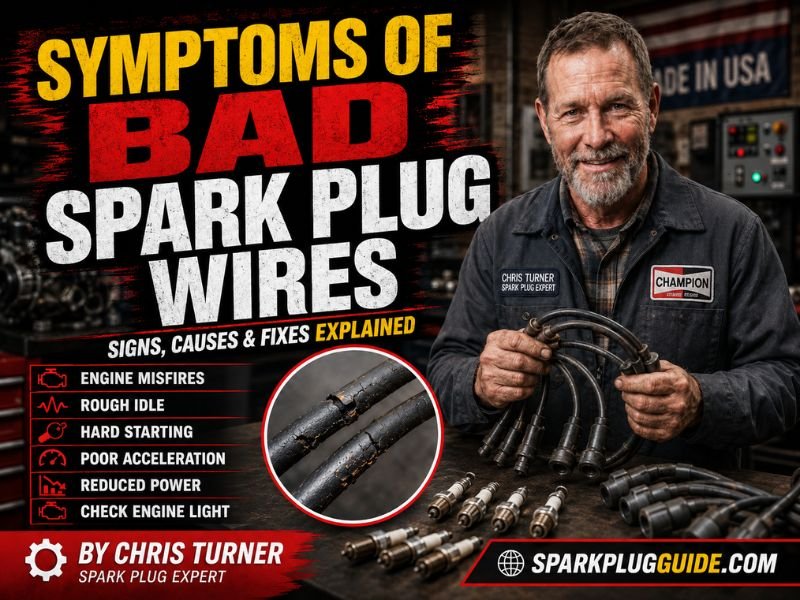
Bad ignition wires do not always fail completely at once. Their condition may deteriorate gradually, causing symptoms only under certain temperatures, weather conditions, engine loads, or operating speeds.
Engine Misfires
An engine misfire is one of the clearest signs of an ignition-system problem. A misfire occurs when a cylinder fails to produce normal power because combustion did not occur correctly.
A damaged spark plug wire may prevent enough voltage from reaching the plug, especially when cylinder pressure is high. The engine may feel as though it skips, stumbles, or briefly loses power.
A wire-related misfire can be constant or intermittent. It may become more noticeable when climbing a hill, accelerating onto a highway, towing, or carrying a heavy load because the ignition system requires more voltage under demanding conditions.
However, a misfire does not prove that the wires are bad. Faulty spark plugs, ignition coils, fuel injectors, vacuum leaks, low compression, valve problems, and other faults can produce similar behavior.
Rough or Unstable Idle
At idle, an engine should normally run at a relatively consistent speed. When one or more cylinders fire irregularly, you may feel shaking through the steering wheel, seat, floor, or dashboard.
The tachometer may fluctuate slightly, and the exhaust note may sound uneven. In severe cases, the engine may stall when the vehicle stops at an intersection or when an accessory places an additional load on the engine.
A rough idle related to ignition wires may become worse in humid or rainy weather. Moisture can make it easier for high voltage to escape through weakened insulation rather than travel to the spark plug.
Rough idle can also result from a dirty throttle body, vacuum leak, fuel-delivery problem, engine mount, or internal mechanical issue, so diagnosis should not stop at the first symptom.
Hesitation During Acceleration
A vehicle with deteriorated plug wires may hesitate when you press the accelerator. Instead of responding smoothly, the engine may stumble, surge, or pause before gaining speed.
Acceleration increases cylinder pressure, which can raise the voltage needed to fire the spark plug. A wire that appears to work at idle may leak energy under load and cause the cylinder to misfire.
This load-related hesitation is often confused with a failing fuel pump, clogged injector, transmission problem, or throttle-control fault. Checking diagnostic trouble codes and evaluating the ignition system can help separate these possibilities.
Reduced Engine Power
If one or more cylinders are not firing consistently, the engine cannot produce its expected power. The vehicle may feel sluggish, particularly during passing, uphill driving, or rapid acceleration.
Power loss may be mild when the wire failure is intermittent. If a wire is disconnected internally or severely damaged, the affected cylinder may contribute little or no power.
Continuing to operate an engine with a serious misfire can increase exhaust temperature and place additional stress on the catalytic converter. A flashing check engine light should therefore be treated as an urgent warning rather than ignored.
Difficult Starting
Weak ignition wires may contribute to extended cranking or difficult starting. The engine may turn normally but take longer to begin running, particularly during cold or damp conditions.
A no-start condition is possible if several wires have failed or if the main coil wire on an older distributor system is defective. More commonly, bad wires cause the engine to start and then run roughly.
Battery condition, fuel pressure, crankshaft sensors, ignition coils, spark plugs, and mechanical timing can also affect starting. The symptom should be evaluated as part of the complete starting and ignition system.
Check Engine Light and Misfire Codes
A misfire can cause the check engine light or malfunction indicator lamp to illuminate. A diagnostic scanner may reveal codes such as P0300 for random or multiple-cylinder misfire, or cylinder-specific codes including P0301, P0302, and similar variations.
The final digit in a cylinder-specific misfire code generally identifies the affected cylinder. For example, P0302 typically points to a detected misfire involving cylinder two.
The code identifies where the control module detected a problem, not which component caused it. A cylinder-specific code can result from a spark plug, plug wire, ignition coil, injector, compression issue, air leak, or wiring fault.
If the check engine light flashes while the engine is shaking or losing power, reduce engine load and arrange prompt diagnosis. Continued driving during an active severe misfire may overheat the catalytic converter.
Poor Fuel Economy
A weak or inconsistent spark can reduce combustion efficiency. The driver may press the accelerator farther to maintain speed, and the engine-management system may make adjustments in response to the misfire.
As a result, fuel consumption may increase. The change may be difficult to notice at first, particularly when driving conditions, weather, tire pressure, or fuel quality also vary.
Poor fuel economy alone is not a reliable test for bad wires. It becomes more meaningful when it appears with rough running, hesitation, misfire codes, or visible wire damage.
Backfiring, Popping, or an Uneven Exhaust Sound
Unburned fuel and irregular combustion may create popping sounds from the intake or exhaust. The exhaust note may also become uneven or pulse differently than normal.
Backfiring can have many causes, including incorrect ignition timing, lean or rich fuel mixtures, valve problems, exhaust leaks, and camshaft timing faults. It should not automatically be blamed on the ignition wires.
If the noise begins immediately after wires were replaced, verify the firing order and routing. Connecting wires to the wrong cylinders can cause severe rough running, backfiring, or failure to start.
Visible Arcing or Electrical Leakage
When wire insulation breaks down, high voltage may jump from the wire to a nearby metal component instead of reaching the spark plug. This electrical discharge is called arcing.
In a dark environment, a trained technician may sometimes observe a blue or white spark around a damaged wire while the engine is running. A snapping or ticking noise may accompany the discharge.
Do not touch ignition wires or place your hands near them while the engine is operating. Secondary ignition voltage can cause a painful electrical shock, and moving belts, pulleys, and fans create additional hazards.
Cracks, Burns, or Physical Damage
A visual inspection may reveal hardened insulation, surface cracks, swollen sections, worn areas, melted spots, or burn marks.
Wires routed against exhaust components can suffer heat damage. Those rubbing against brackets, engine covers, or sharp edges may wear through their protective jackets. Oil or chemical contamination can also soften or degrade certain materials.
Damage may be concentrated near the plug boots and coil or distributor terminals because these areas are repeatedly handled during service.
Engine Performance Changes in Wet Weather
Ignition problems that become noticeably worse during rain, high humidity, or after a car wash can indicate weakened insulation or contaminated boots.
Moisture provides an easier path for electrical leakage across dirty or damaged surfaces. The engine may misfire during a damp morning and operate more normally once the engine compartment becomes warm and dry.
This pattern is useful diagnostic information, but it is not conclusive. Moisture can also affect ignition coils, distributor caps, connectors, and other electrical components.
Common Causes of Bad Spark Plug Wires
Spark plug wires operate in a harsh environment. They are exposed to high voltage, engine heat, vibration, fluids, and repeated heating and cooling cycles.
Age and Heat Damage
The engine compartment becomes hot every time the vehicle operates. Over time, heat can harden insulation and reduce its ability to contain voltage.
Wires positioned close to exhaust manifolds, cylinder heads, turbocharger components, or other heat sources may deteriorate faster. Missing heat shields or incorrect routing can accelerate the process.
Abrasion and Incorrect Routing
Manufacturers often use clips, separators, and brackets to hold ignition wires in specific positions. These components keep the wires away from heat, moving parts, and sharp surfaces.
If the wires are installed without the original routing hardware, they may rub against the engine or contact hot components. Improper routing may also allow adjacent wires to interfere electrically under certain conditions.
Oil and Chemical Contamination
Oil leaking from valve-cover gaskets can enter spark plug wells or coat the wire boots. This contamination can damage rubber components, attract dirt, and create a path for electrical leakage.
Coolant, fuel, cleaning chemicals, and road contaminants may cause similar problems. Replacing the wires without repairing the leak can result in another early failure.
Internal Conductor Damage
The conductor inside a spark plug wire may break even when the outer jacket appears normal. Excessive pulling, sharp bending, poor manufacturing, or repeated removal can damage the internal connection.
Always remove a wire by gripping the boot, not by pulling on the cable itself. Twisting the boot gently before removal can help release it from the plug or terminal, provided the vehicle’s service procedure allows it.
Loose or Corroded Terminals
Each wire must connect securely to the spark plug and the coil or distributor terminal. A loose connection increases resistance and may allow arcing inside the boot.
Corrosion, dirt, moisture, and damaged terminal clips can interfere with contact. A wire that is not fully seated may produce symptoms immediately after routine spark plug replacement.
Excessive Spark Plug Gap or Worn Plugs
As spark plugs wear, their electrode gaps may increase. A wider gap generally requires more voltage to create a spark.
This additional demand can expose weaknesses in old wires, coils, and boots. Replacing damaged wires without inspecting worn spark plugs may leave the underlying high-voltage stress in place.
How to Diagnose Bad Spark Plug Wires
Diagnosis should confirm that the vehicle actually uses ignition wires and then rule out other common causes of misfire. I recommend checking the manufacturer’s service information before testing because ignition layouts, specifications, and procedures vary by vehicle.
1. Scan for Diagnostic Trouble Codes
Begin by connecting an OBD-II scanner and recording stored, pending, and permanent codes. Note any cylinder-specific misfire information and freeze-frame data showing engine speed, load, temperature, and operating conditions when the fault occurred.
Do not erase the codes before recording them. That information can help reproduce the problem and identify whether it occurs at idle, under load, or during startup.
2. Perform an Engine-Off Visual Inspection
With the engine off, cool, and the ignition disabled as required, inspect the full length of every wire.
Look for cracks, cuts, burns, oil contamination, loose boots, damaged terminals, missing separators, and contact with hot or moving parts. Confirm that each wire is firmly seated and routed according to the correct firing order.
Do not disconnect all wires simultaneously unless you have clearly labeled them and documented their positions. Installing them in the wrong order can prevent the engine from running correctly.
Examine the spark plugs, ignition coils, distributor cap, rotor, and coil boots where applicable.
A worn plug, cracked distributor cap, carbon tracking, oil-filled plug well, or weak coil may produce the same symptoms as a bad wire. Replacing only the wires will not correct these faults.
Carbon tracking often appears as a thin dark line along an insulating surface. Once a conductive path develops, replacing the affected boot or wire without addressing the corresponding plug or component may allow the misfire to return.
4. Check Wire Resistance Correctly
A digital multimeter can test continuity and resistance, but the result must be compared with vehicle or wire-manufacturer specifications.
Resistance varies by wire design and length. A longer wire may naturally measure higher than a shorter one, and some low-resistance performance wires differ significantly from original-style suppression wires.
An open circuit, unstable reading while the wire is gently flexed, or a value outside the specified range may indicate internal damage. A resistance test alone cannot detect every insulation failure because a wire may pass a low-voltage meter test but leak under actual ignition voltage.
5. Use Professional Ignition Testing When Needed
A technician may use an oscilloscope, secondary ignition probe, spark tester, cylinder power-balance test, or other diagnostic equipment to evaluate spark delivery under operating conditions.
These methods can distinguish an ignition problem from fuel or mechanical faults more accurately than replacing parts by trial and error.
Avoid pulling a plug wire off a running engine to find the misfiring cylinder. This can expose you to high voltage, damage ignition components, create a fire risk, and send unburned fuel into the catalytic converter.
Bad Spark Plug Wires vs. Other Problems
Several faults can imitate wire failure. The following comparison helps narrow the possibilities, but it does not replace vehicle-specific testing.
| Symptom | Possible Wire-Related Cause | Other Common Possibilities |
| Rough idle | Weak spark or voltage leakage | Vacuum leak, dirty injector, worn plug, low compression |
| Misfire under load | Insulation breakdown at high voltage | Weak coil, excessive plug gap, fuel-pressure issue |
| Hard starting | Weak spark reaching several plugs | Battery, crank sensor, fuel delivery, mechanical timing |
| Cylinder-specific code | Fault in one wire or terminal | Plug, coil, injector, valve, compression problem |
| Worse in damp weather | Moisture-related electrical leakage | Cracked distributor cap, contaminated coil boot |
| Flashing check engine light | Severe ignition misfire | Fuel or mechanical misfire |
| Poor fuel economy | Incomplete combustion | Oxygen sensor, thermostat, fuel-system or driving issue |
The key diagnostic principle is that a misfire can originate from the ignition system, fuel system, air intake, electrical controls, or internal engine condition. The code and symptom identify the area requiring investigation, not the failed part by themselves.
When Should Spark Plug Wires Be Replaced?
There is no universal replacement interval that applies to every vehicle. Wire construction, engine heat, routing, climate, maintenance history, and manufacturer recommendations all affect service life.
Replace the wires when testing confirms excessive resistance, internal interruption, insulation leakage, terminal damage, or physical deterioration. Replacement may also be sensible when the wires are old and must be removed during major ignition service, provided the vehicle uses serviceable wires and the parts match original specifications.
Some technicians replace spark plug wires as a complete set because the wires have experienced similar age and heat exposure. Replacing only one may leave other deteriorated wires in service. Vehicle-specific circumstances and part availability can affect the decision.
Do not replace wires on a coil-on-plug engine that does not have them. These vehicles may use replaceable coil boots, but the parts and diagnostic process are different.
What Does Spark Plug Wire Replacement Involve?
Replacement begins with obtaining the correct wire set for the engine. Wire length, terminal design, boot angle, heat protection, and electrical characteristics must match the application.
The engine should be off and cool. One wire is normally replaced at a time to preserve the firing order. The new wire should follow the original routing and use the factory clips and separators.
Each terminal must seat fully on the spark plug and coil or distributor. A faint click or positive engagement may be felt, depending on the design. The wire should not be stretched tightly or allowed to rest against exhaust components.
Some applications specify dielectric grease inside the boots, while others have different instructions. Use only the amount and location recommended by the manufacturer. Dielectric grease is an insulator used primarily for sealing and boot service; it should not be applied carelessly to metal contact surfaces.
After installation, verify routing, start the engine, and check for smooth operation. Diagnostic trouble codes may need to be cleared after the repair and monitored to confirm that the misfire does not return.
Can You Drive With Bad Spark Plug Wires?
Driving with a mild intermittent symptom may seem possible, but the condition can worsen without warning. A misfiring engine may lose power during merging, climbing, or passing.
Unburned fuel entering the exhaust can raise catalytic-converter temperature. A flashing check engine light, severe shaking, strong fuel odor, major power loss, or repeated stalling indicates that the vehicle should not continue to be driven normally.
Move to a safe location, reduce engine load, and arrange professional diagnosis or towing when the engine is running severely rough. Follow the warnings in your vehicle’s owner’s manual.
Frequently Asked Questions
What Do Bad Spark Plug Wires Sound Like?
They may cause an uneven exhaust note, popping, snapping, or a rhythmic ticking sound. Electrical arcing can sometimes create a sharp clicking noise near the damaged wire.
Can Bad Spark Plug Wires Cause a No-Start Condition?
Yes, particularly if several wires fail or the main coil wire on a distributor system is damaged. However, most wire failures cause rough running or misfires rather than a complete no-start.
Can Bad Wires Damage Spark Plugs?
Faulty wires may prevent plugs from firing correctly and contribute to fouling. Worn or incorrectly gapped plugs can also place extra electrical stress on the wires.
Will New Spark Plug Wires Improve Performance?
New wires can restore normal performance when the existing set is damaged or electrically defective. Replacing functioning wires will not create additional engine power beyond the system’s normal capability.
Can a Multimeter Confirm That a Wire Is Good?
A multimeter can identify an open circuit or resistance outside specifications, but it cannot confirm the wire’s insulation integrity under high-voltage operating conditions. Further testing may still be required.
Do All Cars Have Spark Plug Wires?
No. Many modern gasoline engines use coil-on-plug ignition and do not have traditional wires. Diesel engines do not use spark plugs for normal combustion.
Should Spark Plugs and Wires Be Replaced Together?
They do not always require replacement at the same time, but both should be inspected. Worn plugs can increase ignition voltage demand, while damaged wires can cause new plugs to misfire.
Conclusion
The main symptoms of bad spark plug wires are misfires, rough idling, hesitation, reduced power, difficult starting, poor fuel economy, and check engine warnings. Visible cracking, burns, loose terminals, moisture-related problems, and electrical arcing provide additional evidence.
These symptoms are not unique to ignition wires. Spark plugs, coils, injectors, air leaks, and mechanical engine problems can create nearly identical behavior. I recommend confirming the ignition design, reading diagnostic codes, inspecting the entire system, and testing against vehicle-specific specifications before replacing parts.
When faulty wires are confirmed, correct replacement and routing can restore reliable spark delivery and normal engine performance. A flashing check engine light or severe misfire requires prompt attention because continued operation may damage the catalytic converter or leave the vehicle without enough power to drive safely.