
Yes, bad spark plugs can indirectly make an engine sound different, usually by causing misfires, rough idling, coughing, popping, or uneven engine operation. The spark plug itself usually is not the source of a loud mechanical noise, so ticking, knocking, or rattling should not automatically be blamed on the plugs.
The type of sound matters. A fouled or worn plug can disrupt combustion and change how the engine sounds, while a loose spark plug can create a different problem involving vibration, improper sealing, or combustion leakage around the plug area. DENSO identifies fouling, excessive electrode wear, excessive gap, and damaged insulators as conditions that can produce poor starting and misfiring.
What Do Bad Spark Plugs Sound Like?
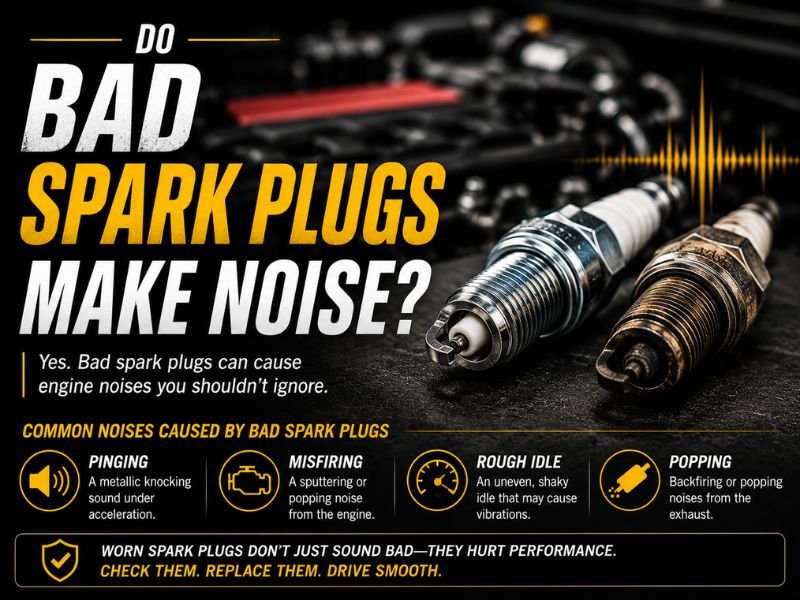
There is no single “bad spark plug sound.”
Instead, defective plugs change combustion inside one or more cylinders. The resulting engine misfire can make the engine sound uneven, rough, or inconsistent.
Depending on the failure, you might notice:
| Sound or Behavior | Could Spark Plugs Be Involved? |
| Rough, uneven idle | Yes |
| Coughing or sputtering | Yes |
| Popping during acceleration | Possible |
| Intermittent engine stumble | Yes |
| Ticking near a spark plug | Possible if plug is loose |
| Metallic knocking/pinging | Possible indirectly, but investigate other causes |
| Deep engine knock | Usually not a spark plug itself |
| Rattling from accessories | Usually unrelated |
Champion specifically notes that a fouled spark plug can cause an engine to sound rough while idling, while its diagnostic guidance also associates coughing or spitting noises with possible ignition trouble involving dirty or fouled plugs.
The sound therefore comes primarily from poor combustion, not because the spark plug itself has moving parts that begin rattling when worn.
Why Bad Spark Plugs Can Change Engine Noise
A gasoline engine depends on each cylinder firing at approximately the correct moment.
The ignition coil supplies high voltage to the spark plug. That voltage creates an electrical discharge across the plug gap, igniting the compressed air-fuel mixture. DENSO describes this electrical discharge across the center and ground electrodes as the basic mechanism that produces ignition.
If one cylinder fails to ignite properly, the engine loses one of its normal combustion events.
Instead of producing smooth, evenly spaced power pulses, the engine may hesitate or shake. That difference can be heard as a rough idle, stumble, sputter, or irregular exhaust note.
The worse the misfire becomes, the more obvious the change in sound and vibration may be.
A rough idle is one of the strongest ways spark plug problems can become audible.
The engine may sound as though its rhythm is inconsistent rather than maintaining a steady idle. You might also feel vibration through the steering wheel, seat, or body of the vehicle.
DENSO associates carbon-fouled, oil-fouled, and fuel-fouled spark plugs with misfiring during idle or normal running. It also identifies excessive electrode wear and excessive plug gap as potential causes of poor starting and poor acceleration.
Champion similarly lists rough idle among symptoms associated with fouled plugs.
However, rough idle is not proof that the plugs are bad. Ignition coils, fuel injectors, vacuum leaks, compression problems, and other faults can create similar behavior.
Can Bad Spark Plugs Cause Popping or Sputtering?
Yes, an ignition misfire can contribute to popping, coughing, or sputtering sounds.
When combustion does not happen normally in a cylinder, engine and exhaust behavior can become irregular.
Champion’s diagnostic material states that coughing or spitting noises can be associated with ignition problems involving fouled or dirty spark plugs.
You may notice the problem most when:
The engine is first started, it is idling, you accelerate from a stop, or the engine is placed under heavier load.
A plug that functions adequately at idle can sometimes misfire more easily when cylinder pressure increases during acceleration. DENSO’s troubleshooting material identifies spark plug conditions that can cause misfiring specifically during rapid acceleration or high-load operation.
Repeated popping should still be diagnosed rather than automatically treated as a spark plug problem.
Can a Loose Spark Plug Make a Ticking Noise?
A loose spark plug deserves separate attention from a worn or fouled plug.
DENSO warns that insufficient spark plug fastening can create excessive vibration, while NGK states that proper installation requires tightening the spark plug to the specified torque or turning angle.
If a plug is not sealing correctly against the cylinder head, combustion pressure can potentially escape around the plug area. In practice, this may be perceived as a rhythmic ticking, puffing, or tapping-type sound that follows engine speed.
Do not simply keep tightening a suspected loose plug without knowing the correct procedure.
Spark plugs installed in aluminum cylinder heads can be damaged by excessive torque, and damaged threads can turn a relatively simple maintenance issue into a significant cylinder-head repair.
Check the vehicle or spark plug manufacturer’s specified installation procedure.
Can Bad Spark Plugs Cause Knocking or Pinging?
This answer requires more care.
Spark knock or pinging is abnormal combustion inside the cylinder, not normally the sound of a physically worn plug rattling.
NGK notes that an overly lean mixture, incorrect heat range, excessive combustion temperatures, low-octane fuel, and other conditions can contribute to knock or pre-ignition. An inappropriate spark plug heat range can also contribute to excessive plug temperature.
Champion also lists pinging or knocking during acceleration among symptoms that can appear alongside spark plug-related problems.
But knocking should never automatically be diagnosed as “bad spark plugs.”
Other causes can be much more important, including fuel octane, ignition timing, carbon deposits, mixture problems, overheating, sensor faults, or mechanical engine problems.
A heavy metallic knock from deep inside the engine needs more urgent diagnosis than simply installing new plugs.
Why Worn Spark Plugs Can Make an Engine Run Rough
Spark plugs do not remain dimensionally identical throughout their service life.
As the electrodes wear, the gap gradually becomes larger. DENSO explains that a widening electrode gap requires higher discharge voltage and makes misfiring more likely.
NGK likewise notes that worn spark plugs require greater ignition voltage as their gap increases.
Eventually, the ignition system may not reliably generate a spark under every operating condition.
The result can be intermittent.
Your car might idle normally one minute and stumble the next. It may run reasonably well at low load but misfire when accelerating. The engine sound can therefore change without producing a constant, easily identifiable noise.
Fouled Spark Plugs Can Sound Worse Than Simply Worn Ones
A fouled plug has material deposited around its firing end.
Carbon fouling can create a conductive path that allows electrical energy to travel somewhere other than across the intended electrode gap. NGK explains that sufficiently heavy carbon deposits can cause the spark to travel along the insulator instead of across the gap, leading to a misfire.
DENSO also identifies carbon, oil, and fuel fouling as causes of poor starting and misfiring.
Because fouling can cause significant or repeated misfires, the engine may sound much rougher than it would with plugs that have only mild electrode wear.
Fouling is also frequently a symptom rather than the complete problem.
If a plug is covered in oil or repeatedly becomes black with carbon, determine why before assuming that continually replacing or cleaning plugs will permanently solve the issue.
Does Clicking During Starting Mean Bad Spark Plugs?
Usually not.
Rapid clicking when you turn the key or press the start button more commonly points toward a battery or starting-circuit problem rather than spark plugs.
Spark plugs do not operate the starter motor.
If the engine does not actually rotate and you hear only clicks, investigate the battery state of charge, battery terminals, electrical connections, starter relay, and starter circuit.
Spark plug diagnosis becomes more relevant when the engine cranks normally but starts poorly, misfires, or runs roughly.
This distinction can prevent unnecessary plug replacement.
What About a Tapping Noise After Changing Spark Plugs?
If an unfamiliar noise appears immediately after spark plug replacement, do not assume new plugs are defective.
Check the installation.
NGK emphasizes that correct tightening torque or specified turning angle is essential during installation. DENSO likewise associates insufficient fastening with excessive vibration and identifies incorrectly tightened spark plugs among conditions associated with abnormal operation.
Potential installation-related issues include an inadequately tightened plug, damaged plug, improperly seated ignition coil or boot, incorrect plug specification, or damaged threads.
If you are uncertain about the installation or hear obvious gas leakage around the plug area, stop and inspect it before continuing to drive.
How to Tell Whether the Noise Is Really From Spark Plugs
Start with the symptoms surrounding the sound.
If the noise accompanies rough idle, hesitation, loss of power, difficult starting, or a check-engine light, an ignition misfire becomes more plausible.
DENSO identifies plug problems such as fouling, excessive electrode wear, excessive gap, and insulator damage as causes of misfiring and poor engine operation.
A diagnostic scan can add useful information.
A cylinder-specific misfire code may help identify which cylinder needs investigation, but the code does not prove the spark plug itself is bad. A failed ignition coil, injector problem, compression issue, or wiring fault can create similar misfire symptoms.
If the sound is instead a heavy knock, sharp metallic tap, accessory squeal, or chain-like rattle without corresponding misfire symptoms, broaden the diagnosis beyond the spark plugs.
Should You Remove the Spark Plugs to Inspect Them?
When spark plugs are reasonably suspected and removal is appropriate for your engine, inspecting their firing ends can provide useful clues.
NGK explains that a normally operating plug commonly shows a light tan or gray firing-end appearance, while heavy wet or dry deposits can indicate abnormal operating conditions.
DENSO’s diagnostic guide similarly distinguishes normal plugs from carbon-fouled, oil-fouled, fuel-fouled, excessively worn, overheated, and physically damaged plugs.
Inspection can therefore help answer two questions:
Is the plug itself capable of firing normally, and is the plug showing evidence of another engine problem?
That second question is important because simply replacing a contaminated plug may not prevent the new one from developing the same deposits.
When Should Bad Spark Plugs Be Replaced?
Replacement makes sense when plugs are worn beyond their intended service life, damaged, excessively fouled, or otherwise incapable of reliable ignition.
DENSO explains that electrode wear can interfere with stable ignition and recommends spark plug replacement when wear requires it.
The correct replacement interval varies substantially with plug design and vehicle manufacturer requirements.
Do not rely on a universal mileage figure.
Some engines use conventional plugs while others use long-life precious-metal plugs such as platinum or iridium. Follow the maintenance schedule specified for your exact vehicle and plug type.
Frequently Asked Questions
What Noise Does a Bad Spark Plug Make?
Bad plugs most commonly contribute to a rough, uneven engine sound, sputtering, coughing, or popping because they cause combustion misfires. A worn plug normally does not produce a mechanical noise by itself.
Can Bad Spark Plugs Cause a Ticking Sound?
A worn or fouled plug does not normally create a distinct ticking sound itself. A loose or improperly installed plug, however, warrants inspection because insufficient fastening can cause excessive vibration and improper sealing.
Can Bad Spark Plugs Make an Engine Knock?
Spark plugs can be involved in abnormal combustion under certain conditions, particularly if the plug heat range or combustion conditions are inappropriate. However, knocking has many possible causes and should not automatically be blamed on worn plugs.
Do Bad Spark Plugs Cause Popping?
They can contribute to popping or sputtering when ignition misfires occur. Champion associates coughing or spitting noises with possible ignition trouble caused by dirty or fouled plugs.
Can Bad Spark Plugs Make the Car Shake?
Yes. A misfiring cylinder can make the engine idle unevenly and produce noticeable vibration. Fouling and damaged plugs are recognized causes of misfiring.
Can One Bad Spark Plug Change the Engine Sound?
Yes. One misfiring cylinder can disturb the engine’s normal firing rhythm, making idle or exhaust sound noticeably uneven.
Does Clicking When Starting Mean Bad Spark Plugs?
Usually not. If the engine does not crank and you hear rapid clicking, the battery or starting circuit is more likely to need attention. Spark plug problems are more relevant when the engine actually cranks but starts poorly or misfires.
Why Is My Engine Loud After Replacing Spark Plugs?
Check that the plugs are the correct specification and were installed according to the proper torque or turning-angle procedure. Incorrect installation can cause problems, and both NGK and DENSO emphasize correct spark plug fastening.
Will New Spark Plugs Make an Engine Quieter?
They may restore a smoother engine sound if worn or fouled plugs were causing misfires. They will not repair unrelated mechanical noises from components such as bearings, valves, belts, or timing-system parts.
How Can I Confirm the Spark Plugs Are Bad?
Combine the symptoms with diagnostic trouble codes and physical plug inspection. Look for excessive gap, electrode wear, carbon or oil fouling, cracked insulation, or other abnormal plug conditions rather than diagnosing from noise alone.
Do Bad Spark Plugs Make Noise?
Bad spark plugs can make your engine sound rough, uneven, sputtery, or occasionally pop because poor spark causes combustion misfires. In most cases, however, the sound is produced by the engine running incorrectly rather than by the spark plug physically making noise.
Pay particular attention to rough idle, hesitation, misfire, difficult starting, and loss of power occurring alongside the sound. Those symptoms make an ignition problem more plausible.
A distinct ticking sound deserves a check for a loose or improperly installed plug, while heavy knocking, metallic tapping, squealing, or rattling should prompt a broader engine diagnosis rather than an automatic spark plug replacement.
The most reliable approach is to use the sound as a clue, then confirm the cause through misfire diagnosis and spark plug inspection before replacing parts.