
You generally should not spray carb cleaner directly into a spark plug hole unless a specific repair procedure calls for it. The spark plug hole opens directly into the combustion chamber, and too much carb cleaner can wash oil from the cylinder walls, create a temporary flooding condition, contaminate engine oil, or prevent the engine from turning safely if enough liquid accumulates.
A very small accidental amount will often evaporate, but intentionally filling or repeatedly spraying the cylinder is unnecessary for most repairs. If your goal is to clean a spark plug, loosen carbon, diagnose a no-start condition, or free a stuck component, there are usually safer and more controlled methods.
Understanding where the cleaner goes and what happens after it enters the cylinder can help you decide what to do.
What Happens When You Spray Carb Cleaner Into a Spark Plug Hole?
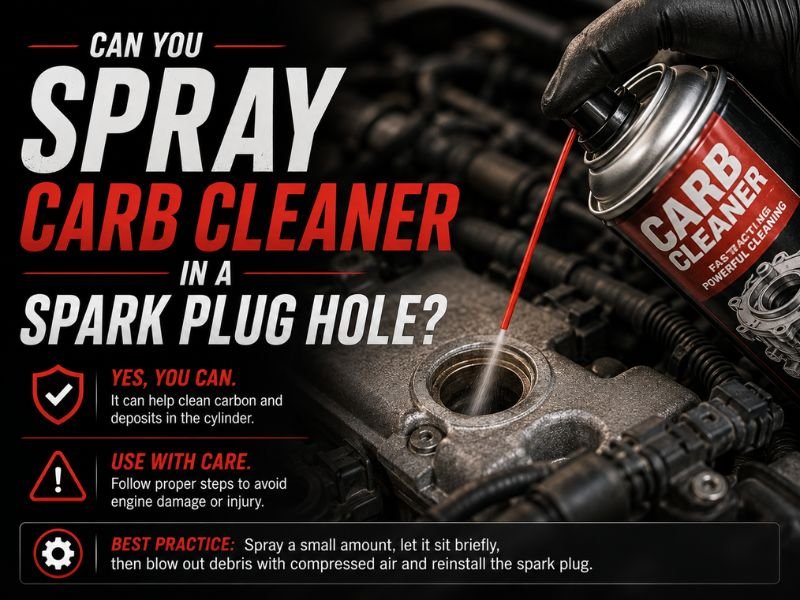
Removing a spark plug leaves an opening directly into the engine’s combustion chamber.
If you spray carburetor cleaner through that hole, the solvent can land on:
- The piston crown
- Cylinder walls
- Intake or exhaust valve surfaces, depending on valve position
- Carbon deposits inside the combustion chamber
Some of the cleaner may evaporate quickly. Some may remain as liquid, and a portion may work past the piston rings into the crankcase.
Carburetor cleaner is designed primarily for cleaning carburetor components and fuel-related deposits. It is not normally intended to be used as a general-purpose cylinder wash.
A small amount may not immediately damage a healthy engine, but that does not make spraying large quantities into the combustion chamber a good cleaning method.
Why Spraying Carb Cleaner Into the Cylinder Can Be Risky
Several issues can occur depending on how much cleaner is used and what you do afterward.
It Can Wash Oil From the Cylinder Walls
Cylinder walls depend on a thin film of engine oil for lubrication.
Strong solvents can remove or dilute some of that oil film. If the engine is immediately cranked or started after a large amount of solvent has been introduced, the piston rings and cylinder walls may temporarily have less lubrication than intended.
A tiny amount of cleaner is different from repeatedly soaking the cylinder.
The more solvent you add, the greater the reason for caution.
Too Much Liquid Can Cause Hydrolock
Liquid does not compress the way the air-fuel mixture inside an engine normally does.
If enough carb cleaner accumulates in the combustion chamber and the piston moves upward on the compression stroke, the liquid can prevent the piston from completing its travel.
This condition is commonly called hydrolock.
Attempting to force an engine to turn against a liquid-filled cylinder can potentially damage internal components.
A few drops or a brief light spray are unlikely to fill a normal combustion chamber, but pouring or heavily spraying cleaner through the spark plug hole creates unnecessary risk.
Cleaner Can Enter the Engine Oil
Some solvent may pass between the piston rings and cylinder wall and reach the crankcase.
A small amount may evaporate or become insignificant once mixed with the engine oil. A substantial amount, however, can dilute the oil and reduce its lubricating properties.
If a large volume of solvent has entered a cylinder, checking the oil and considering an oil change may be appropriate before operating the engine.
Carb Cleaner Is Highly Flammable
Carburetor cleaners commonly contain fast-evaporating, flammable solvents.
Spraying them around an engine introduces both liquid and vapor that can ignite if exposed to:
- Sparks
- Open flames
- Hot surfaces
- Electrical ignition sources
Never use a torch or open flame to accelerate evaporation.
Work in a well-ventilated area and follow the product manufacturer’s safety directions.
Can Carb Cleaner Remove Carbon Through the Spark Plug Hole?
Carb cleaner may soften some combustion deposits, but spraying it through the spark plug opening is not a particularly controlled or complete method of cleaning combustion-chamber carbon.
You cannot easily see where the cleaner lands, how much carbon it removes, or where loosened deposits go.
Heavy combustion-chamber deposits may require a different service procedure depending on the engine.
For example, carbon buildup on intake valves in certain engines is not necessarily reachable simply by spraying cleaner into the cylinder. The location and type of deposit matter.
If carbon buildup is causing an actual drivability problem, identify the affected component before selecting a cleaning method.
Can You Use Carb Cleaner to Clean a Spark Plug?
Yes, cleaning the removed spark plug is different from spraying cleaner into the spark plug hole.
If a spark plug has light fuel, oil, or carbon contamination, a suitable solvent may help remove it.
A basic method is:
- Remove the spark plug after the engine has cooled.
- Inspect it for cracks, worn electrodes, or physical damage.
- Spray a small amount of cleaner onto the firing end.
- Allow the deposits to soften.
- Gently remove loose contamination with a soft nylon brush if necessary.
- Let the plug dry completely.
- Check the gap and condition before reinstalling it.
Avoid aggressive sanding, grinding, or scraping, especially on iridium and platinum spark plugs.
If a plug is heavily fouled, damaged, or near its replacement interval, installing a new plug is generally more reliable than repeatedly cleaning the old one.
Can Carb Cleaner Help Start an Engine Through the Spark Plug Hole?
Using carb cleaner through a spark plug hole as a starting aid is not a recommended general diagnostic method.
For one thing, reinstalling the spark plug after spraying a flammable solvent directly into the cylinder can create an unpredictable mixture.
It also does not tell you much about the cause of the no-start condition.
An engine that will not start could have problems involving:
- Fuel delivery
- Ignition
- Compression
- Engine timing
- Sensors
- Electrical power
- Injector operation
If you are diagnosing a no-start engine, use a systematic test procedure appropriate to the vehicle instead of repeatedly introducing cleaner into individual cylinders.
What If You Already Sprayed Carb Cleaner in the Spark Plug Hole?
The correct response depends mainly on how much was used.
If You Used Only a Small Spray
If only a very small amount entered the cylinder, the cleaner may evaporate on its own.
Keep the spark plug removed and allow adequate ventilation and evaporation before reinstalling it.
Do not introduce flames, heat guns, cigarettes, or other ignition sources.
If you are uncertain whether liquid remains inside the cylinder, do not immediately start the engine.
If You Sprayed a Large Amount
If a substantial amount of cleaner was sprayed or poured into the cylinder, avoid attempting to start the engine immediately.
The safer approach is to make sure excess liquid is removed before the spark plug is reinstalled.
Depending on the situation, this may involve leaving the plug removed and allowing the volatile solvent to evaporate or using an appropriate extraction procedure.
If the engine must be cranked with the spark plug removed as part of a service procedure, fuel and ignition should be disabled so the engine cannot start unexpectedly.
Be aware that liquid can be expelled from an open spark plug hole while the engine is cranked. Keep your face and hands away from the opening, protect surrounding components, and eliminate ignition sources.
If a large amount may have passed into the crankcase, inspect the engine oil before running the engine.
When there is uncertainty about the amount of liquid in the cylinder, professional assistance is safer than experimenting with the starter.
Should You Put Oil in the Cylinder After Using Carb Cleaner?
Not automatically.
A small amount of solvent usually does not mean you need to add oil through the spark plug hole.
However, if a cylinder has been deliberately soaked with a strong solvent during a specialized repair procedure, additional lubrication may sometimes be part of that procedure.
Adding too much oil creates its own problems, including liquid accumulation in the combustion chamber.
Do not pour oil into the cylinder simply because carb cleaner was briefly sprayed inside.
If significant solvent exposure occurred, follow the appropriate engine service procedure or seek professional advice for that specific engine.
Can Carb Cleaner Damage Piston Rings?
Brief exposure to a small amount of appropriate solvent does not automatically mean piston rings will be damaged.
The larger concern is repeated or excessive solvent use removing lubrication and potentially contaminating the engine oil.
Piston rings rely on proper lubrication while moving against the cylinder wall.
Using a cylinder as a container for large quantities of carb cleaner is therefore very different from accidentally getting a small spray inside.
Can Carb Cleaner Damage Spark Plug Threads?
Carb cleaner itself is unlikely to damage normal metal spark plug threads from brief exposure.
The more common risks around spark plug holes involve improper plug removal or installation.
Problems can occur from:
- Cross-threading the spark plug
- Overtightening
- Installing the plug at an angle
- Allowing debris into the cylinder
- Working on a very hot aluminum cylinder head
- Using the wrong spark plug
Before removing a spark plug, clean loose dirt from around the plug well so debris does not fall through the opening.
What Should You Use Instead of Carb Cleaner in a Spark Plug Hole?
The correct alternative depends on what you are trying to accomplish.
| Goal | Better Approach |
| Clean a dirty spark plug | Remove the plug and clean it separately |
| Fix a fuel-fouled plug | Dry or replace the plug and diagnose flooding |
| Remove oil from a plug | Clean or replace it and diagnose oil consumption |
| Diagnose a misfire | Test ignition, fuel delivery, and compression |
| Remove combustion deposits | Use the engine-specific approved cleaning procedure |
| Free a stuck engine component | Follow an appropriate mechanical service procedure |
| Diagnose a no-start | Check spark, fuel, compression, and timing systematically |
The key is to treat the actual problem rather than using solvent in the cylinder as a general-purpose fix.
Carb Cleaner vs. Throttle Body Cleaner in a Spark Plug Hole
Neither product should normally be sprayed freely into a spark plug hole.
Carb cleaner and throttle body cleaner both contain solvents, but their formulations and intended uses differ.
Throttle body cleaner is designed primarily for deposits around throttle bodies and related intake components. Carb cleaner is intended primarily for carburetor deposits.
Once either cleaner is sprayed through the spark plug opening, however, it is entering the combustion chamber rather than the component for which it was designed.
The concerns about excessive liquid, cylinder-wall lubrication, flammability, and oil contamination still apply.
Common Mistakes to Avoid
One common mistake is assuming that because carb cleaner evaporates quickly, any amount is safe to spray into a cylinder.
Evaporation takes time, and liquid can remain trapped depending on piston position, temperature, and how much cleaner was used.
Other mistakes include:
- Filling the cylinder with cleaner
- Immediately reinstalling the spark plug and starting the engine
- Using an open flame to dry the cylinder
- Cranking an engine that may contain excessive liquid
- Ignoring oil contamination
- Using cleaner to hide recurring spark plug fouling
- Spraying solvent into the cylinder without knowing what problem it is supposed to solve
A controlled repair method is usually better than adding more chemical cleaner.
When Should You Stop DIY Diagnosis?
A small accidental spray of carb cleaner is generally much different from an engine that has been heavily soaked.
Consider professional help if:
- A large quantity of cleaner entered the cylinder
- The engine suddenly will not rotate
- You suspect hydrolock
- The oil level unexpectedly increased
- The oil smells strongly of solvent or fuel
- Multiple cylinders were filled with cleaner
- The engine has low compression
- Spark plugs repeatedly become oil-fouled
- You are unsure how to disable the ignition and fuel systems safely
Trying to force the engine to crank when liquid may be trapped inside can turn a minor mistake into an expensive repair.
Frequently Asked Questions
Can You Spray Carb Cleaner in a Spark Plug Hole?
You physically can, but it is generally not recommended unless a specific service procedure requires it. Excess cleaner can wash lubrication from the cylinder wall, contaminate engine oil, or accumulate as liquid inside the combustion chamber.
What Happens If Carb Cleaner Gets Into a Cylinder?
A small amount may evaporate. Larger amounts can wet the cylinder walls, pass into the crankcase, dilute engine oil, or create a risk of liquid preventing normal piston movement.
Will Carb Cleaner Evaporate From a Cylinder?
Carb cleaner contains volatile solvents and will generally evaporate, but the time required depends on the formulation, amount used, temperature, airflow, and cylinder position. Do not assume a heavily soaked cylinder is immediately dry.
Can Carb Cleaner Cause Hydrolock?
Any sufficiently large quantity of liquid in a combustion chamber can potentially cause hydrolock because liquid is not readily compressible. A brief mist is very different from pouring or heavily spraying cleaner into the cylinder.
Can You Spray Carb Cleaner on a Spark Plug?
A removed spark plug can sometimes be cleaned with an appropriate solvent. Spray the firing end lightly, gently remove loose deposits if necessary, and allow the plug to dry completely before reinstalling it.
Can You Start an Engine After Spraying Carb Cleaner in the Cylinder?
Do not immediately start an engine if a significant amount of cleaner has entered the cylinder. First make sure excess liquid has evaporated or been safely removed.
Does Carb Cleaner Remove Carbon From Pistons?
It may soften some deposits, but spraying carb cleaner through the spark plug hole is not a controlled or complete carbon-cleaning method. Use an appropriate cleaning procedure for the particular engine and deposit location.
Can Carb Cleaner Get Into Engine Oil?
Yes. Solvent can potentially pass the piston rings and reach the crankcase, particularly if a large amount is left in the cylinder. Significant contamination may require checking or replacing the engine oil.
Is Throttle Body Cleaner Safer in a Spark Plug Hole?
Not necessarily. Although the formulations differ, both are solvents intended primarily for components outside the combustion chamber. Excessive liquid inside a cylinder presents similar concerns.
What Should You Do If You Put Too Much Carb Cleaner in a Cylinder?
Do not immediately install the plug and attempt to start the engine. Make sure excess liquid is safely removed or evaporated first, and inspect the engine oil if a substantial quantity may have entered the crankcase.
Conclusion
You generally should not spray carb cleaner in a spark plug hole as a routine cleaning or diagnostic method. A tiny accidental amount may simply evaporate, but larger quantities can remove cylinder-wall lubrication, contaminate engine oil, create a highly flammable vapor mixture, and potentially cause hydrolock if enough liquid remains inside.
If your goal is to clean a spark plug, remove it and clean it separately. If you are trying to solve carbon buildup, oil fouling, a misfire, or a no-start condition, diagnose the actual cause and use the appropriate repair procedure.
If a substantial amount of carb cleaner has already entered the cylinder, avoid immediately trying to start the engine. Make sure excessive liquid is no longer present and address possible oil contamination first.
The safest rule is simple: use carb cleaner on components it is designed to clean, and avoid treating the combustion chamber as a place to soak parts with solvent.