
Spark plugs generally do not go bad simply because they get older; most normal deterioration comes from firing cycles, combustion heat, electrode erosion, and engine operating conditions. However, calendar age can still matter when plugs remain installed for years because corrosion, contamination, moisture, and long-term engine storage can affect their condition.
A ten-year-old unused spark plug stored clean and dry may still be perfectly serviceable, while a much newer plug that has accumulated thousands of miles in a poorly running engine may already need replacement. The best way to judge spark plug life is therefore to consider mileage, service interval, physical condition, engine history, and storage environment together.
Spark Plugs Usually Wear From Use, Not From Time
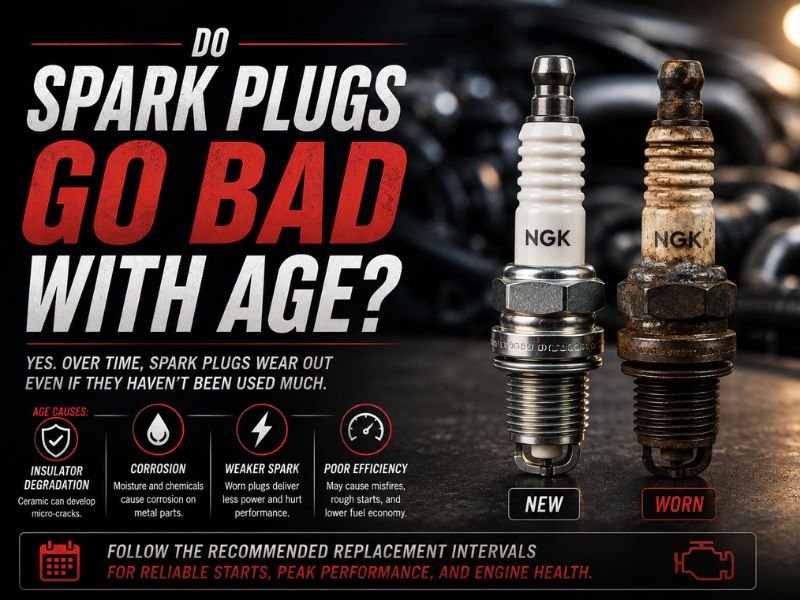
Normal spark plug wear occurs primarily while the engine is operating.
Every time a plug fires, an electrical discharge crosses the gap between its center electrode and ground electrode. The electrodes are repeatedly exposed to high combustion temperatures and electrical erosion.
DENSO explains that the center electrode gradually becomes rounded as a result of spark discharge and oxidation. The amount of wear depends partly on electrode material, which is why manufacturers use materials such as nickel alloys, platinum, and iridium to achieve different service lives.
As the electrodes wear, the gap gradually becomes larger. That increased gap requires greater ignition voltage and makes misfire more likely as deterioration progresses.
If a plug is sitting unused, those firing-related wear mechanisms are largely absent.
That is why spark plugs do not normally have a simple calendar expiration date comparable to products that chemically degrade even while sitting unused.
New Spark Plugs Can Remain Usable for Years
A new plug stored properly can usually remain serviceable for a long time because its electrodes are not being subjected to combustion or electrical discharge.
Storage conditions matter more than the number of years printed on a calendar.
NGK uses corrosion-resistant plating on its spark plug threads to help protect them from moisture and chemicals.
That protection does not make a spark plug immune to poor storage. A plug left loose in a damp garage, exposed toolbox, or corrosive environment deserves inspection before installation.
A properly stored plug should remain:
- Clean and dry
- Free of substantial corrosion
- Free of cracked ceramic
- Free of bent or damaged electrodes
- Correctly gapped for the intended engine
- The correct part number for the application
If those conditions are met, the fact that the plug has been sitting for several years is not by itself a reason to discard it.
Installed Spark Plugs Are a Different Story
A spark plug sitting in its original box is not exposed to the same environment as one installed in an engine.
An installed plug remains threaded into the cylinder head, with its firing end exposed to the combustion chamber. If the vehicle sits unused for a long period, moisture, pre-existing combustion deposits, oil contamination, or corrosion can affect the engine and plug.
This means a low-mileage plug may still deserve inspection after very long vehicle storage.
For example, a plug that was already carbon fouled before the vehicle was parked will still be fouled when the vehicle is restarted. A plug exposed to abnormal moisture or corrosion may also deteriorate even though it has not accumulated additional firing cycles.
NGK identifies corrosion and oxidation as possible causes of abnormal electrode erosion and excessive gap growth.
So while normal aging alone is rarely the problem, the environment accompanying that aging can matter.
Mileage Is Usually More Important Than Calendar Age
Imagine two cars using the same spark plugs.
The first travels 20,000 miles per year and reaches 100,000 miles in five years.
The second travels only 4,000 miles per year and reaches 20,000 miles over the same period.
The first vehicle’s plugs have undergone far more firing events and combustion cycles even though both sets are the same calendar age.
That is why electrode wear is generally associated more closely with engine operation and mileage than simple elapsed time.
NGK explains that worn plugs develop rounded electrodes and increasing gap, forcing the ignition system to produce greater voltage. The company recommends following the vehicle manufacturer’s replacement schedule because intervals vary by vehicle.
A five-year-old plug with heavy mileage can therefore be much more worn than a ten-year-old plug in a low-mileage vehicle.
But Some Vehicles Also Have Time-Based Maintenance
Mileage should not be treated as the only possible maintenance trigger.
Some automakers specify maintenance in terms of miles, months, years, or whichever occurs first. If the vehicle manufacturer includes a time-based spark plug requirement, follow that schedule even when mileage remains low.
The reason is broader than pure electrode erosion. Manufacturers establish maintenance schedules around the complete operating environment and expected reliability of the vehicle.
Do not replace a plug solely because it has reached an arbitrary age found online, but do not ignore a legitimate manufacturer time-based interval either.
Your owner’s manual or factory maintenance schedule remains the strongest reference.
How Electrode Material Changes Spark Plug Lifespan
Spark plugs using different electrode materials can age very differently under use.
Conventional Nickel-Alloy Plugs
Standard plugs typically use nickel-alloy firing surfaces. They are durable enough for normal operation but generally experience electrode wear faster than modern precious-metal designs.
As mileage accumulates, gap growth eventually increases the voltage required for reliable ignition.
Platinum Spark Plugs
Platinum is more resistant to erosion and high-temperature wear, allowing manufacturers to design plugs with longer service intervals.
It is especially useful when precious metal is applied to the surfaces experiencing the greatest electrical erosion.
Iridium Spark Plugs
Iridium offers very high resistance to heat and wear. DENSO notes that iridium’s properties allow manufacturers to use a very fine electrode while maintaining durability.
However, iridium does not make a spark plug immortal.
DENSO specifically notes that iridium still experiences spark erosion and high-temperature oxidation wear.
NGK also distinguishes between different iridium designs: its Iridium IX plugs are typically intended for around 40,000–50,000 miles, while OE-style Laser Iridium plugs are typically designed for approximately 80,000–100,000 miles.
So material influences lifespan, but the specific plug design and vehicle application still determine the appropriate interval.
Can Spark Plugs Corrode With Age?
Yes, under unfavorable conditions.
Corrosion is one of the main ways calendar time can matter even when firing wear is low.
NGK identifies corrosion and oxidation as possible causes of abnormal electrode deterioration. It also uses corrosion-resistant plating on its plugs to help protect the threaded shell from environmental exposure.
A plug deserves closer inspection if it has been stored or installed for years in a humid environment.
Minor discoloration does not automatically mean failure. More concerning signs include heavy rust, pitting, deteriorated threads, electrode corrosion, or damaged sealing surfaces.
If corrosion has significantly affected a plug’s threads or firing end, replacing it is generally more sensible than trying to recover it.
Do Spark Plugs Go Bad in a Car That Rarely Gets Driven?
Not necessarily, but the way the vehicle is used matters.
Occasional full-temperature drives are different from repeatedly starting an engine for only a few minutes.
NGK explains that spark plugs need to reach an appropriate operating temperature to burn away certain deposits. Low-speed operation and conditions that keep the plug too cool can contribute to carbon fouling.
Therefore, a low-mileage car that is constantly used only for very short trips can develop plug problems despite having relatively little mileage.
This is not because the plugs are old.
It is because their operating conditions promote fouling.
The distinction matters when diagnosing an older low-mileage vehicle.
Can Spark Plugs Go Bad Just Sitting in an Engine?
They can develop problems while sitting, but age itself is usually not the direct mechanism.
A plug that was healthy when the engine was parked may remain usable for years if the engine is stored properly.
Potential concerns increase when the engine experiences:
Moisture intrusion, corrosion, oil contamination, fuel residue, or poor storage conditions.
If a car, motorcycle, lawn mower, generator, or other gasoline engine has sat unused for several years, removing and inspecting the plugs can provide useful information before returning the engine to regular service.
A clean plug with good electrodes, correct gap, undamaged ceramic, and clean threads may remain perfectly usable.
A heavily corroded or contaminated one should not be trusted simply because it has low mileage.
Does a Spark Plug’s Gap Change With Age?
Normal gap growth primarily occurs through electrode wear during operation, not simply through sitting.
DENSO explains that spark plug gap widens gradually as electrode material wears away, increasing the voltage required for discharge.
A stored plug’s gap can still change if it is physically damaged.
For example, dropping a plug or allowing the ground electrode to strike another object can bend it.
This is one reason older new plugs should be inspected before installation even if they have never been fired.
Do not assume “unused” means “undamaged.”
Does a Spark Plug Become Brittle With Age?
The ceramic insulator does not normally become unusable simply because the plug reaches a particular age.
Physical damage is a much larger concern.
Cracks can develop from impacts, incorrect installation, abnormal combustion, or excessive mechanical stress. If you see a cracked ceramic insulator, replace the plug regardless of mileage or age.
Similarly, damaged threads, a bent ground electrode, or loose physical components make a plug unsuitable for continued service.
Age should therefore prompt inspection, not an automatic assumption of failure.
A Spark Plug Can Be Old and Still Good—or New and Already Bad
This is one of the most useful ways to think about spark plug age.
An unused ten-year-old plug stored correctly may still be essentially new.
A two-year-old plug installed in an engine with severe oil consumption may already be badly fouled.
A three-year-old plug in a high-mileage vehicle may have accumulated substantial electrode erosion.
Another plug can fail prematurely because it was cracked during installation.
Calendar age alone cannot distinguish these situations.
Physical condition and actual operating history are much more informative.
When Should Old Spark Plugs Be Replaced?
Replace plugs when they reach the manufacturer’s service interval or when inspection shows that they are no longer suitable for reliable operation.
DENSO describes rounded center electrodes as a sign of wear that interferes with stable ignition and can contribute to reduced engine performance.
Other replacement reasons include excessive gap, serious carbon or oil fouling, damaged electrodes, cracked ceramic, overheating damage, or substantial corrosion.
Do not extend the interval indefinitely simply because the engine still starts.
DENSO warns that continuing to use worn plugs places greater demand on the ignition coil and can shorten coil life.
Scheduled replacement is designed to occur before plugs reach the end of their physical ability to produce any spark at all.
What About Old Spark Plugs Still in the Box?
If you find an old box of unused plugs in your garage, inspect before installing them.
First verify the part number. The vehicle you originally purchased them for may no longer be the vehicle you intend to use them in.
Check the metal shell for serious corrosion and examine the ceramic for cracks. Inspect both electrodes and confirm that the ground electrode has not been bent.
Then verify the specified gap for the exact application.
NGK notes that one spark plug part number can fit numerous engines with different gap requirements, so the correct application-specific specification matters.
If the plug is clean, undamaged, correctly specified, and properly gapped, age alone does not usually make replacement necessary.
Frequently Asked Questions
Do Spark Plugs Expire With Age?
Spark plugs generally do not have a simple expiration date. Their normal wear comes mainly from electrode erosion during firing, although corrosion, contamination, or physical damage can make an old plug unusable.
Can Spark Plugs Last 10 Years?
They can, depending on mileage, plug design, operating conditions, and the vehicle manufacturer’s maintenance schedule. A ten-year-old low-mileage plug may have less firing wear than a much newer high-mileage plug.
Do Unused Spark Plugs Go Bad?
Properly stored unused plugs generally do not deteriorate simply from lack of use. Inspect them for corrosion, cracks, damaged electrodes, and correct application before installation.
Do Iridium Spark Plugs Go Bad With Age?
Iridium plugs still wear during engine operation, but calendar age alone does not normally destroy the iridium firing tip. NGK notes that different iridium designs have substantially different service intervals.
Can Spark Plugs Rust While Sitting?
Yes. Corrosion can occur under unfavorable storage or engine conditions, although manufacturers use protective plating to reduce exposure-related corrosion.
Should I Replace Spark Plugs Based on Years or Miles?
Follow your vehicle manufacturer’s maintenance schedule. Some vehicles use mileage alone, while others may include time-based requirements. NGK recommends using the manufacturer’s specified service interval.
Do Spark Plugs Wear Out if the Car Is Not Driven?
Normal electrode wear largely stops because the plugs are not firing. However, long-term storage can still expose installed plugs to corrosion, contamination, or other engine-related conditions.
Can Old Spark Plugs Cause Misfires?
Yes, if the electrodes have accumulated substantial wear, the gap has enlarged, the plug is fouled, or corrosion or physical damage interferes with ignition. Increasing gap raises the required firing voltage and can make misfires more likely.
Should I Replace Spark Plugs in a Car That Has Sat for Years?
Not automatically. Inspect the plugs, review their mileage before storage, and check the vehicle’s maintenance schedule. Replace plugs showing significant corrosion, deposits, electrode wear, damaged ceramic, or excessive gap.
Can a Spark Plug Still Work Past Its Service Interval?
Yes, but “still produces a spark” does not mean the plug is still within its ideal service life. DENSO warns that worn plugs can increase ignition-coil stress and recommends replacement before their physical limit is reached.
Do Spark Plugs Go Bad With Age Overall?
Spark plugs generally do not go bad from calendar age alone; normal deterioration is driven mainly by firing cycles, electrode erosion, combustion temperature, deposits, and engine operating conditions. A properly stored unused plug can remain serviceable for years because it is not experiencing the spark discharge and high-temperature oxidation responsible for normal electrode wear.
Age can still matter indirectly.
A plug left installed in an unused engine may encounter corrosion, moisture, oil or fuel contamination, and other storage-related conditions, while an old unused plug can suffer physical or environmental damage if stored poorly.
For plugs already in service, follow the vehicle manufacturer’s replacement interval rather than waiting for complete failure. For old unused plugs, judge them by correct application, physical condition, gap, corrosion, and storage history rather than the date they were purchased.
The practical takeaway is simple: spark plugs usually wear from use more than age—but an old plug should still earn a quick inspection before you trust it.