
Lawn mower spark plugs commonly last about one mowing season or around 100 operating hours on many small engines, but that is not a universal replacement interval. Briggs & Stratton recommends changing plugs every 100 hours or every season, whichever comes first, while some mower and engine manufacturers specify substantially different schedules.
For that reason, the best answer to how long do lawn mower spark plugs last comes from the maintenance schedule for your exact mower and engine. A residential push mower, riding mower, and commercial machine can use very different spark plug service intervals.
Why Lawn Mower Spark Plug Life Is Usually Measured in Hours
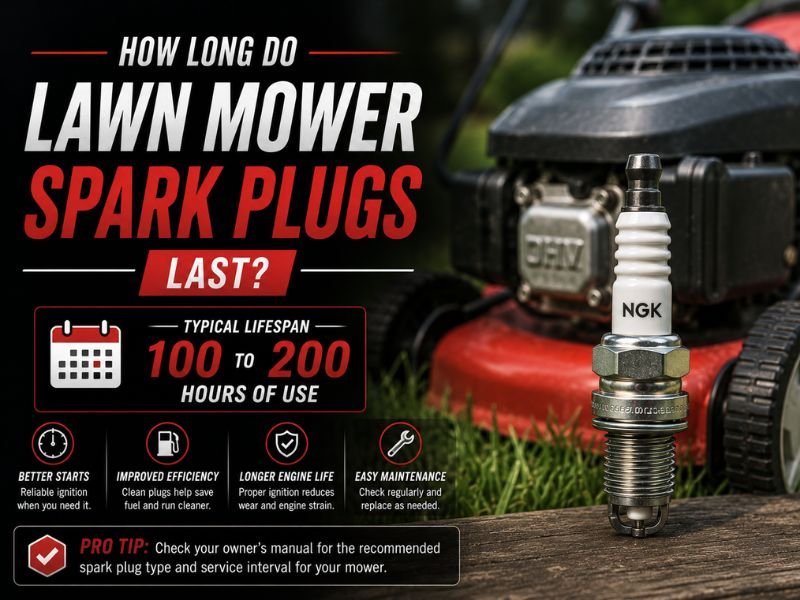
Cars are normally maintained according to miles because distance roughly tracks how long the engine has operated. Lawn mowers do not have odometers, so manufacturers commonly use engine hours and mowing seasons instead.
A homeowner might use a push mower for only 20–30 hours in an entire summer, while a landscaping company can accumulate hundreds of engine hours during the same period.
This makes a statement such as “a lawn mower spark plug lasts three years” unreliable.
Briggs & Stratton recommends replacing spark plugs every 100 operating hours or once per season for its outdoor power equipment engines. Husqvarna has also published mower manuals calling for replacement at the beginning of each mowing season or every 100 hours, whichever comes first.
For a lightly used residential mower, the seasonal recommendation may therefore arrive long before 100 hours.
Is 100 Hours the Standard Lawn Mower Spark Plug Lifespan?
It is a useful rule of thumb, but not an industry-wide rule.
Briggs & Stratton specifically recommends 100 hours or every season, and several Husqvarna walk-behind mower manuals use the same interval.
Other equipment can be very different.
For example, one Toro riding mower manual calls for checking spark plug condition and gap every 200 hours and replacing the plugs every 500 hours.
That does not mean every Toro mower has a 500-hour plug interval. It demonstrates why the exact owner’s manual matters.
A practical comparison looks like this:
| Mower Situation | Typical Maintenance Approach |
| Many Briggs & Stratton small engines | Replace at 100 hours or every season |
| Some Husqvarna walk-behind mowers | Replace every season or 100 hours |
| Certain riding mower applications | May have much longer hour-based intervals |
| Spark plug fouled or damaged | Replace before scheduled interval |
| Unknown engine/model | Check engine or mower manual |
The plug installed in a mower should therefore be serviced according to the engine specification, not an arbitrary number found on the internet.
How Long Can a Spark Plug Physically Keep Working?
A spark plug can sometimes continue firing beyond its scheduled maintenance interval.
That does not mean extending the interval is always worthwhile.
Every time the engine fires, electrical discharge occurs between the center electrode and ground electrode. Over time, the electrodes wear and the gap can change. Once the plug becomes sufficiently worn or contaminated, ignition becomes less reliable.
Manufacturers recommend preventative replacement because lawn mower engines need dependable starting, particularly after seasonal storage.
Briggs & Stratton says regular spark plug replacement supports consistent spark and more reliable starting.
Waiting until the plug completely stops firing turns simple routine maintenance into a no-start diagnosis.
Why Lawn Mower Spark Plugs Can Wear Out Faster Than Expected
Operating hours are only part of the story.
A spark plug can require replacement earlier if combustion conditions cause fouling, overheating, electrode wear, or physical damage.
Small mower engines often spend long periods operating at relatively steady load while exposed to dust, grass debris, and changing outdoor temperatures. Problems with the air filter or fuel system can influence combustion and therefore plug condition.
Husqvarna advises inspecting the plug when an engine is difficult to start, has low power, or does not idle correctly. It also notes that an incorrect fuel mixture or dirty air filter can contribute to unwanted deposits on the electrodes.
If a replacement plug quickly becomes dirty again, the underlying engine condition deserves attention.
Once a Year Is Often Sensible for Residential Push Mowers
For many homeowners, replacing a mower spark plug once per season is a simple maintenance strategy.
Suppose you mow for one hour each week for 25 weeks.
That is only about 25 operating hours during the season, well below a 100-hour threshold. Yet Briggs & Stratton still recommends replacement every season or 100 hours, whichever occurs first.
Seasonal replacement can be particularly convenient because spark plugs are relatively easy to access on many walk-behind mower engines.
It also gives you an opportunity to inspect the old plug for unusual deposits before the heavy mowing season begins.
Still, check your manual. If your engine manufacturer specifies inspection rather than annual replacement, follow that requirement.
Riding Mower Spark Plugs May Last Much Longer
Riding mowers complicate the “replace every year” rule.
Some larger engines use different plug designs and maintenance schedules. They may also have two cylinders and therefore two spark plugs.
The Toro manual cited earlier provides a good example: that particular machine specifies spark plug inspection at 200 hours and replacement at 500 hours.
For an owner using that mower 50 hours per year, replacing the plugs annually would be dramatically earlier than the manual requires.
This is why push mower and riding mower spark plug life should not automatically be treated as identical.
Use the mower’s service schedule, and where the mower manufacturer refers you to a separate engine manual, check that document as well.
Commercial Lawn Mowers Are Different Again
Commercial mowers can accumulate hours much faster than residential equipment.
A homeowner may never reach 100 hours in one season. A professional operator can reach that figure relatively quickly.
That means a commercial mower may need plug service several times during the period when a residential machine would still be on its first plug.
Hour meters are particularly useful on riding and commercial equipment because they allow maintenance to be based on actual engine run time rather than guessing from calendar age.
For machines with an hour meter, record the reading when maintenance is completed.
Signs a Lawn Mower Spark Plug May Need Replacement Early
Do not ignore an obvious running problem simply because the plug has fewer than 100 hours.
Briggs & Stratton recommends inspecting a mower plug when the equipment will not start and replacing plugs that have stubborn deposits, cracked porcelain, or burned-away electrodes.
Husqvarna likewise recommends examining the plug when the engine has low power, is hard to start, or does not operate properly at idle.
Warning signs can include:
- Hard starting
- Uneven or rough running
- Reduced engine power
- Repeated stalling
- Heavy deposits on the firing end
- Cracked ceramic
- Worn or damaged electrodes
- Incorrect spark plug gap
These symptoms are reasons to inspect the plug, not proof that it is the only possible problem.
Stale fuel, a dirty carburetor, clogged air filter, ignition-coil trouble, or compression problems can produce similar symptoms.
What Does a Worn Lawn Mower Spark Plug Look Like?
Remove the plug only after the engine is off and cool, and disconnect the spark plug lead before servicing.
Briggs & Stratton recommends cleaning around the plug before removal so debris does not fall into the combustion chamber.
Once removed, inspect the firing end.
A plug should generally be replaced if the ceramic is cracked, the electrodes are badly damaged, or deposits cannot reasonably be removed. Briggs & Stratton specifically lists cracked porcelain and burned-away electrodes as replacement conditions.
Some mower manuals are even more conservative. The Toro riding mower manual cited above instructs owners to replace plugs showing a black coating, worn electrodes, oily film, or cracks rather than cleaning them.
Always follow the maintenance instructions for your actual engine.
Can You Clean a Lawn Mower Spark Plug Instead of Replacing It?
Sometimes, but cleaning does not reverse normal electrode wear.
Briggs & Stratton states that light deposits can be cleaned using a wire brush and spark plug cleaner, while abrasive or shot-blasting methods should not be used.
Cleaning may therefore help if a relatively serviceable plug has light contamination.
It will not repair:
Cracked ceramic, burned electrodes, substantial electrode erosion, or serious physical damage.
And if the plug has already reached its scheduled replacement interval, installing a new plug is generally more sensible than trying to extend the old one.
Check the Gap, Not Just the Appearance
Spark plug condition includes the electrode gap.
Briggs & Stratton notes that many small engines use a 0.030-inch gap but explicitly tells owners to check the specification for their individual model.
Do not interpret 0.030 inch as a universal mower specification.
Different engines can require different plug part numbers and gaps.
Husqvarna similarly advises checking the electrode gap against the product manual when servicing a mower spark plug.
If a plug has been in operation for a long time, correcting the gap does not necessarily restore worn electrode surfaces to new condition.
Should You Replace the Spark Plug Before Every Mowing Season?
For engines whose manufacturer specifies seasonal replacement, yes.
Briggs & Stratton recommends changing its outdoor power equipment spark plugs every season or 100 hours.
A Husqvarna walk-behind mower manual likewise states that the spark plug should be replaced at the beginning of each mowing season or after 100 hours, whichever occurs first.
For a mower with a different official interval, however, annual replacement may be unnecessary.
That is why “every spring” is a good maintenance habit for many small residential engines but should not be presented as a requirement for every mower.
Does a Lawn Mower Spark Plug Go Bad While Sitting All Winter?
The plug does not accumulate normal firing wear while the mower is stored because the engine is not running.
However, storage can expose the mower to moisture, corrosion, stale fuel issues, and existing deposits.
A plug that was already fouled at the end of the season will still be fouled when spring arrives.
If the mower becomes difficult to start after storage, inspect the spark plug—but also consider the fuel system. A no-start condition after months of storage is not automatically caused by the plug.
Briggs & Stratton lists spark plug inspection as part of standard mower maintenance and also notes that no-start problems may lie elsewhere in the fuel, carburetor, valve, or ignition systems.
Does Spark Plug Brand Change How Long It Lasts?
The exact plug specification and construction matter more than buying based on brand reputation alone.
Use the plug type specified by the mower or engine manufacturer.
Husqvarna explicitly warns that an incorrect spark plug type can damage the product.
Do not assume that installing an automotive iridium plug with a theoretically longer lifespan lets you extend a lawn mower’s factory service interval.
Small-engine plugs are selected according to characteristics such as thread dimensions, heat range, electrode design, and engine requirements.
Use the correct replacement part or approved equivalent and retain the manufacturer’s maintenance interval.
How to Make a Lawn Mower Spark Plug Last Its Normal Life
The spark plug itself is only one part of good combustion.
Maintain the air filter and fuel system, use the specified fuel, and avoid operating the engine with known carburetion or ignition problems.
Husqvarna specifically links electrode contamination with fuel-mixture condition and air-filter cleanliness.
Also avoid damaging the plug during installation.
Thread the replacement correctly, use the required gap, and tighten according to your engine manual. Never force a cross-threaded plug into the cylinder head.
Routine engine maintenance gives the spark plug the best chance of reaching its intended interval without premature fouling.
Frequently Asked Questions
How Often Should You Replace a Lawn Mower Spark Plug?
Many small engines use a 100-hour or once-per-season replacement recommendation. Briggs & Stratton specifically recommends whichever comes first, but your mower’s manual can specify a different interval.
Can a Lawn Mower Spark Plug Last More Than One Year?
Yes. A plug may physically remain functional for several years on a lightly used mower, especially when the engine manufacturer specifies a longer interval. Follow the official maintenance schedule rather than age alone.
Is 100 Hours a Lot for a Lawn Mower Spark Plug?
For many residential small engines, 100 hours is a normal replacement point. Briggs & Stratton and some Husqvarna walk-behind mower manuals use approximately this interval.
How Long Do Riding Lawn Mower Spark Plugs Last?
It varies considerably. Some riding mower applications have much longer service intervals than small push mowers. One Toro manual specifies inspection at 200 hours and replacement at 500 hours.
How Do I Know if My Mower Spark Plug Is Bad?
Inspect it for stubborn deposits, cracked porcelain, badly worn or burned electrodes, oily contamination, and incorrect gap. Hard starting, low power, or poor idle can also justify inspection.
Can You Clean and Reuse a Lawn Mower Spark Plug?
Sometimes. Briggs & Stratton allows cleaning light deposits with a wire brush or spark plug cleaner, but cracked or badly damaged plugs should be replaced.
Why Does My New Lawn Mower Spark Plug Keep Fouling?
Repeated fouling may indicate an underlying combustion problem. Husqvarna recommends checking fuel-mixture condition and air-filter cleanliness when deposits repeatedly accumulate on the electrodes.
Should I Change the Spark Plug if My Mower Won’t Start?
Inspecting or replacing the plug is a reasonable diagnostic step, but it may not be the cause. Briggs & Stratton notes that fuel, carburetor, valve, and other ignition-system problems can also produce a no-start condition.
What Gap Should a Lawn Mower Spark Plug Have?
There is no universal gap. Briggs & Stratton notes that many small engines use 0.030 inch but instructs owners to check the specification for their exact model.
Should I Replace a Lawn Mower Spark Plug Before Winter Storage?
Not necessarily. Many owners include plug inspection or replacement in seasonal maintenance, but the correct timing depends on the engine’s service schedule. Replacement before the next mowing season is commonly recommended on engines with annual service intervals.
How Long Do Lawn Mower Spark Plugs Last Overall?
Lawn mower spark plugs commonly last about 100 operating hours or one mowing season on many residential small engines, but the correct lifespan depends on the mower and engine manufacturer. Briggs & Stratton recommends replacement every 100 hours or every season, and some Husqvarna walk-behind manuals use the same schedule.
That interval should not be applied blindly to every machine. Some larger riding mower applications have substantially longer schedules; one Toro manual, for example, specifies plug replacement at 500 hours.
Use engine hours and the owner’s manual as your primary guides. Replace the plug sooner if it is cracked, badly fouled, heavily worn, oily, damaged, or associated with a confirmed ignition problem.
For a typical residential push mower, checking the spark plug during preseason maintenance and replacing it according to the 100-hour/seasonal recommendation when applicable is a practical way to maintain reliable starting without guessing how many calendar years the plug should last.