
You should change spark plugs after 40K miles if your vehicle’s maintenance schedule or the specific plug design calls for replacement around that mileage. For long-life platinum or iridium plugs with a much longer factory interval, 40,000 miles may be too early unless the plugs are worn, fouled, damaged, or causing ignition problems.
The important point is that 40,000 miles is not a universal spark plug replacement interval. NGK, for example, says its Iridium IX plugs are typically designed for about 40,000–50,000 miles, while its OE-style Laser Iridium plugs are generally designed for roughly 80,000–100,000 miles.
Is 40,000 Miles a Good Time to Change Spark Plugs?
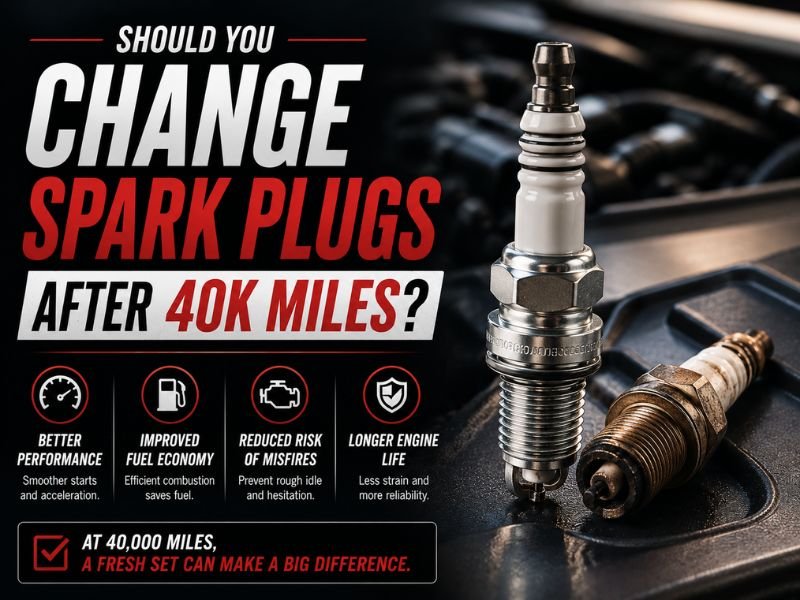
For some vehicles and plug types, yes.
For others, replacing plugs at 40,000 miles means removing components that still have a substantial amount of service life remaining.
The easiest way to make the decision is to compare your current mileage with the vehicle manufacturer’s scheduled spark plug interval and identify what type of plugs are installed.
| Situation at 40,000 Miles | Practical Decision |
| Factory interval is 30,000–40,000 miles | Replace them |
| Plug manufacturer specifies roughly 40,000–50,000 miles | Replacement is approaching or appropriate |
| Factory interval is 60,000 miles | Usually continue unless symptoms or inspection indicate trouble |
| Long-life OE plug has an 80,000–100,000-mile interval | Usually too early |
| Vehicle has misfires or hard starting | Diagnose regardless of mileage |
| Maintenance history is unknown | Identify plugs and inspect condition |
The vehicle schedule should take priority over a generic internet rule because spark plug designs and ignition systems differ considerably.
Why 40K Is Exactly Right for Some Iridium Plugs
One reason 40,000 miles appears frequently in spark plug discussions is that not every iridium spark plug is designed for maximum service life.
NGK makes two significantly different types of iridium automotive plugs.
Its Iridium IX is a single precious-metal aftermarket performance plug, and NGK says this line is typically designed for about 40,000–50,000 miles. Its Laser Iridium plugs are OE-style dual precious-metal designs typically intended for about 80,000–100,000 miles.
That means replacing Iridium IX plugs around 40K can be entirely reasonable.
Replacing long-life OE Laser Iridium plugs at the same mileage—without symptoms or a shorter factory schedule—could be unnecessarily early.
The word iridium alone therefore does not tell you how long a plug should remain installed.
What Actually Happens to Spark Plugs by 40,000 Miles?
Spark plugs wear every time they fire.
Electrical discharge and combustion conditions gradually erode the center electrode and ground electrode. DENSO explains that the center electrode becomes rounded as wear progresses, which can interfere with stable ignition.
Electrode wear also enlarges the spark gap.
As that gap increases, the ignition coil must produce higher voltage to make the spark jump between the electrodes. DENSO notes that increasing gap raises the required discharge voltage and makes misfire more likely.
How much wear occurs by 40,000 miles depends heavily on plug construction and engine operation.
A conventional plug can be relatively far through its useful service life, while a premium long-life precious-metal plug may still be in good condition.
40,000 Miles Doesn’t Mean the Spark Plugs Are Bad
A maintenance interval and a failure point are not the same thing.
Spark plugs typically deteriorate gradually rather than suddenly stopping at an exact odometer reading.
At 39,900 miles, a plug does not suddenly become defective when the vehicle reaches 40,000.
The question is whether it still maintains acceptable electrode geometry, spark gap, insulation, and combustion performance.
A plug approaching its designed service interval may still start the engine and appear to run normally while requiring more ignition voltage than it did when new. NGK explains that worn plugs develop larger gaps and place greater demand on the ignition system.
Scheduled replacement is therefore preventative maintenance rather than a response to complete plug failure.
When You Should Change Them at 40K
The strongest reason is simple: your owner’s manual says so.
If the manufacturer specifies spark plug replacement at or before 40,000 miles, there is little benefit in deliberately extending the interval simply because the engine still runs.
Another strong case is when the installed plug itself has a service-life target near 40K.
NGK’s Iridium IX is a clear example, with its typical 40,000–50,000-mile design life.
Replacement at 40K also becomes more reasonable when the plugs show actual deterioration such as excessive electrode rounding, an enlarged gap, carbon fouling, oil fouling, damaged ceramic, or overheating.
DENSO associates extreme electrode wear and excessive gap with poor starting and acceleration, while carbon and oil fouling can contribute to starting trouble and misfires.
When You Probably Shouldn’t Change Them Yet
Suppose your vehicle came from the factory with long-life plugs and its maintenance schedule specifies replacement at 80,000, 100,000, or another significantly higher mileage.
If the engine is running correctly at 40K, replacing them solely because the odometer reached that number may provide little practical benefit.
This is particularly true for dual precious-metal OE plugs, which are specifically designed to reduce electrode erosion.
NGK explains that its OE-style Laser Iridium construction uses precious metal on both firing surfaces to increase service life, resulting in its typical 80,000–100,000-mile design target.
The smarter approach is to follow the required interval unless symptoms, inspection, or unusual operating conditions provide a reason to intervene earlier.
Don’t Wait for a Misfire if the Plugs Are Already Due
Although unnecessary early replacement wastes money, stretching overdue spark plugs indefinitely has its own disadvantages.
Electrode erosion enlarges the gap. A larger gap requires more ignition voltage, progressively reducing ignition margin.
DENSO identifies excessively worn electrodes as a maintenance-related condition that can cause poor starting and acceleration.
Waiting until the check-engine light flashes or the engine develops an obvious misfire means you have moved from preventative maintenance into fault diagnosis.
If your plugs are scheduled for replacement around 40K, replacing them while the engine still runs correctly is generally the point of the maintenance interval.
Signs Spark Plugs May Need Replacement Before 40K
Mileage should not prevent you from investigating an actual engine problem.
A spark plug can become unusable prematurely because of fouling, physical damage, overheating, incorrect gap, or an abnormal engine condition.
NGK identifies carbon fouling as a cause of misfires and notes that repeated short trips or continuous low-speed driving can contribute because the plug may not reach its self-cleaning temperature.
DENSO identifies several plug conditions associated with poor starting or misfire, including carbon fouling, oil fouling, fuel fouling, excessive electrode wear, oversized gap, and cracked insulation.
Symptoms worth investigating include rough idle, hard starting, hesitation, loss of power, and cylinder misfires.
However, those symptoms do not automatically prove the spark plugs are responsible. Ignition coils, injectors, wiring, compression problems, and other faults can produce similar behavior.
What if Your Car Has Only 40K Miles but the Plugs Are Old?
Mileage is usually a major factor in spark plug wear because the electrodes deteriorate through repeated firing.
But you should still check whether your manufacturer uses a time-based maintenance interval in addition to mileage.
A low-mileage vehicle can also experience unusual conditions such as repeated short trips, prolonged storage, fouling, or corrosion.
Therefore, a ten-year-old vehicle with only 40,000 miles should not automatically be treated exactly like a two-year-old vehicle with 40,000 miles.
Follow the maintenance schedule and inspect condition when the vehicle’s age or operating history creates uncertainty.
Should You Inspect Spark Plugs at 40K Instead?
Inspection can be useful when the normal replacement interval is substantially longer and there is a reason to suspect a problem.
A healthy plug commonly shows relatively modest electrode wear and a normal-looking firing end. DENSO describes normal plugs as generally having light gray or tan deposits with slight electrode erosion.
Look for excessive rounding of the electrodes, an obviously enlarged gap, black carbon, wet oil contamination, cracked ceramic, or signs of abnormal heat.
NGK likewise notes that a brown or light-gray firing end generally indicates normal operation, while heavy wet or dry deposits can point toward abnormal engine conditions.
One caution: removing a plug merely to inspect it is not always necessary if the manufacturer does not call for inspection and the engine has no symptoms. Follow model-specific maintenance guidance.
Should You Just Regap Worn Plugs Instead?
Usually not when the plugs have actually reached their service life.
If electrode erosion has enlarged the gap, bending the ground electrode back toward specification changes the measurement but does not restore the lost electrode material or original sharp firing surfaces.
DENSO explains that worn, rounded electrodes interfere with stable ignition and recommends replacement when plug wear has reached that stage.
Regapping is therefore not a substitute for replacing genuinely worn plugs.
This is especially important with fine-wire iridium or platinum plugs, where careless adjustment can damage the delicate center electrode. NGK specifically warns against applying pressure or prying force to fine-wire precious-metal center electrodes during gap adjustment.
Does Driving Style Affect Whether 40K Is Too Soon?
Operating conditions can influence plug condition even before the normal wear interval is reached.
NGK identifies repeated short trips and continuous low-speed driving as contributors to carbon fouling because the firing end may remain below its self-cleaning temperature.
An engine with oil-control problems can also contaminate plugs independently of normal electrode life. DENSO associates oil-fouled plugs with poor starting and misfires and notes that underlying engine wear can be responsible.
In those situations, simply shortening the replacement interval may not solve the root problem.
If plugs repeatedly become fouled well before their normal service mileage, diagnose why.
Modified and High-Performance Engines Are Different
A factory replacement schedule assumes a substantially factory-configured engine.
Higher boost, altered fueling, changed ignition timing, increased cylinder pressure, or different plug heat ranges can change what the ignition system requires.
That means a modified engine may justify a different inspection or replacement strategy from a stock vehicle.
In those cases, follow the guidance for the actual spark plug, tune, and engine configuration rather than relying blindly on either 40,000 miles or the original factory interval.
The Best 40K-Mile Decision Rule
At 40,000 miles, ask one question before buying plugs:
What interval applies to the plugs and engine I actually have?
If the answer is 40,000 miles, replace them.
If you have NGK Iridium IX plugs approaching their typical 40,000–50,000-mile range, replacement is reasonable.
If your vehicle uses an 80,000–100,000-mile long-life OE plug and has no symptoms, 40K may simply be the midpoint of its service life.
If you do not know what plugs are installed or have no maintenance history, identify the correct factory specification and inspect the service records rather than choosing an arbitrary mileage.
Frequently Asked Questions
Should Spark Plugs Be Replaced Every 40,000 Miles?
Not universally. Some plug designs are due around 40K, while long-life OE iridium plugs may have substantially longer intervals. Follow the vehicle manufacturer’s schedule and the specification of the installed plug.
Is 40K Miles Too Early for Iridium Spark Plugs?
It depends on the iridium design. NGK says Iridium IX typically lasts about 40,000–50,000 miles, while Laser Iridium is typically designed for roughly 80,000–100,000 miles.
Can Spark Plugs Be Bad at 40,000 Miles?
Yes. Fouling, overheating, excessive gap, physical damage, or abnormal engine operation can cause problems before a normal service interval is reached.
What Happens if I Don’t Change Plugs at 40K?
If 40K is the required interval, continued electrode wear can increase the spark gap and required ignition voltage, potentially contributing to poor starting or misfires.
Should I Change Spark Plugs if the Car Runs Fine?
If they have reached the manufacturer-specified service interval, yes. Scheduled replacement is designed to occur before obvious failure. If they are far below the scheduled interval, good engine operation generally does not justify arbitrary replacement.
Can Spark Plugs Last 100,000 Miles?
Some can. NGK states that its OE-style Laser Iridium plugs are typically designed for approximately 80,000–100,000 miles, although the vehicle-specific maintenance schedule still takes priority.
Is It Better to Replace Spark Plugs Early?
Slightly early replacement generally provides little benefit if the plugs are healthy and well within their scheduled life. Replace early when diagnosis or operating conditions give you a specific reason.
Can Worn Spark Plugs Damage Ignition Coils?
Worn plugs enlarge the firing gap and require higher ignition voltage, increasing demand on the ignition system.
Should I Change Plugs at 40K if I Bought the Car Used?
Check the maintenance history first. If you cannot confirm when or what type of plugs were installed, verify the factory requirement and inspect as appropriate rather than assuming the odometer alone tells you their age.
How Do I Know What Spark Plug Interval My Car Uses?
Check the owner’s manual or factory maintenance schedule for your exact year, model, and engine. NGK likewise recommends following the vehicle manufacturer’s specified replacement interval.
Should You Change the Spark Plugs After 40K Miles?
You should change the spark plugs after 40K miles when 40,000 miles is at or near the scheduled interval for your vehicle or installed plug type. It is not a universal replacement point: NGK Iridium IX plugs are typically designed for approximately 40,000–50,000 miles, while long-life Laser Iridium plugs can be designed for roughly 80,000–100,000 miles.
Do not replace healthy long-life plugs at 40K solely because the odometer reached a round number. At the same time, do not keep short-life plugs installed far beyond their specified interval simply because the engine still starts.
Use the factory service schedule first, then consider plug construction, actual condition, engine symptoms, and operating history.
The simplest rule is: if 40K matches the scheduled interval, replace them; if your plugs are designed to go much longer, keep them unless inspection or diagnosis gives you a reason not to.