Spark plugs are essential components in gasoline engines because they create the spark needed to ignite the air-fuel mixture inside each cylinder. However, many vehicle owners are unsure about one simple question: how many spark plugs does a car have?
The answer mainly depends on the number of cylinders in the engine. Most gasoline engines use one spark plug per cylinder, which means a four-cylinder car usually has four spark plugs, while a V6 or V8 engine typically requires six or eight spark plugs. However, some specialized engines use different ignition designs that may require more spark plugs.
Knowing how many spark plugs your vehicle needs is useful when planning maintenance, buying replacement parts, or understanding your engine configuration. Buying too few spark plugs can delay maintenance, while purchasing the wrong quantity may lead to unnecessary costs.
In this complete guide, you will learn how spark plug count is determined, how many spark plugs common engine types use, why some engines like the 5.7 HEMI have unique spark plug systems, and how to find the correct number of spark plugs for your vehicle.
What You Will Learn From This Guide
In this guide, you will discover:
- How engine cylinder count determines spark plug quantity
- How many spark plugs different engine types require
- How many spark plugs V6 and V8 engines have
- Why some HEMI engines use special spark plug configurations
- How to find the correct number of spark plugs for your vehicle
- The difference between gasoline engines, diesel engines, and electric vehicles
Understanding spark plug quantity starts with understanding your engine design. The number of cylinders is usually the most important factor, but other technologies and manufacturer choices can also influence spark plug requirements.
At SparkPlugGuide, Chris Turner explains automotive topics in a simple and practical way to help drivers better understand their vehicles and make smarter maintenance decisions.
How Many Spark Plugs Does a Car Have?
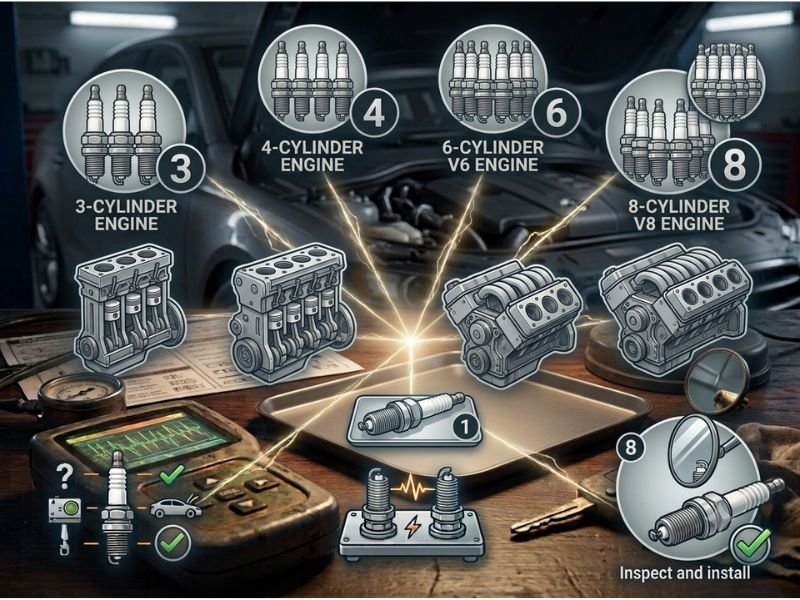
Most gasoline cars have one spark plug for each engine cylinder. This means the number of spark plugs in a vehicle is usually determined by the number of cylinders in the engine.
For example:
- A 3-cylinder engine usually has 3 spark plugs
- A 4-cylinder engine usually has 4 spark plugs
- A V6 engine usually has 6 spark plugs
- A V8 engine usually has 8 spark plugs
Each spark plug is responsible for creating the ignition spark inside its specific cylinder. When the spark plug ignites the air-fuel mixture, it creates the combustion process that produces engine power.
One Spark Plug Per Cylinder Rule
The basic rule for most gasoline engines is:
One cylinder = one spark plug
Each cylinder needs its own ignition source because the combustion process happens separately inside each cylinder.
For example, a four-cylinder engine has four combustion chambers. Each chamber requires its own spark plug to ignite the fuel mixture at the correct time.
Why Cylinder Count Determines Spark Plug Number
The engine cylinder count represents how many separate combustion spaces are inside the engine.
More cylinders generally mean:
- More combustion chambers
- More spark plugs required
- More ignition points
The spark plug count is therefore directly connected to engine design rather than the vehicle’s size or price.
A small car with a four-cylinder engine may use four spark plugs, while a large performance vehicle with a V8 engine may require eight or more spark plugs.
Are All Cars Designed With One Spark Plug Per Cylinder?
Most gasoline-powered vehicles follow the one-spark-plug-per-cylinder design, but there are exceptions.
Some engines use:
- Dual spark plug systems
- Multiple ignition points
- Specialized combustion designs
These systems are designed to improve combustion efficiency, emissions performance, or engine operation.
Because of these differences, the exact spark plug count should always be confirmed using the vehicle specifications.
Why Knowing Spark Plug Count Matters
Knowing the correct number of spark plugs helps with:
- Buying replacement spark plugs
- Planning maintenance costs
- Understanding engine requirements
For example, replacing spark plugs on a V8 engine requires purchasing eight spark plugs, not four. Understanding your engine configuration prevents mistakes when preparing for maintenance.
How Cylinder Count Determines Spark Plug Number
The number of cylinders in an engine is the main factor that determines how many spark plugs it needs. Each cylinder requires a spark source to ignite the air-fuel mixture, which is why engines with more cylinders generally use more spark plugs.
Understanding common engine configurations makes it easier to estimate spark plug quantity.
3-Cylinder Engine
A three-cylinder engine typically uses three spark plugs.
These engines are commonly found in:
- Compact vehicles
- Small economy cars
- Fuel-efficient models
Since there are three combustion chambers, each cylinder requires one spark plug.
4-Cylinder Engine
A four-cylinder engine usually has four spark plugs and is one of the most common engine configurations.
Four-cylinder engines are widely used because they provide a balance between:
- Fuel efficiency
- Reliability
- Performance
Common examples include many:
- Compact cars
- Sedans
- Small SUVs
6-Cylinder Engine
A six-cylinder engine typically uses six spark plugs.
Many six-cylinder engines use a V6 layout, where cylinders are arranged in two banks.
A V6 engine has:
- Three cylinders on one side
- Three cylinders on the other side
- Six total spark plugs
8-Cylinder Engine
A standard V8 engine usually requires eight spark plugs.
A V8 engine contains:
- Four cylinders on each side
- Eight total combustion chambers
- Eight spark plugs
V8 engines are commonly found in:
- Performance vehicles
- Trucks
- Large SUVs
Does Engine Size Determine Spark Plug Count?
No. Engine displacement does not directly determine spark plug quantity.
For example, two engines may have similar sizes but different cylinder configurations.
The number of cylinders is the main factor that determines spark plug count.
Special Engine Designs
Some engines use unique ignition systems that do not follow the standard one-spark-plug-per-cylinder rule.
Examples include:
- Dual spark plug engines
- High-performance ignition systems
These designs may require additional spark plugs to improve combustion efficiency.
How Many Spark Plugs Does a V6 Have?
A V6 engine typically has six spark plugs because it contains six cylinders. Since most gasoline engines use one spark plug per cylinder, a standard V6 engine requires six spark plugs for normal operation.
The exact spark plug specification may vary between manufacturers, but the basic spark plug count is determined by the six-cylinder design.
V6 Engine Spark Plug Layout
A V6 engine contains two rows or banks of cylinders.
The typical arrangement is:
- Three cylinders on one engine bank
- Three cylinders on the opposite bank
Each cylinder requires one spark plug, resulting in a total of six spark plugs.
Why V6 Engines Use Six Spark Plugs
Each cylinder performs its own combustion cycle, which means each one needs an individual ignition source.
Without the correct number of spark plugs:
- Some cylinders would not ignite fuel
- Engine power would be reduced
- Combustion would become incomplete
The six spark plugs work together to maintain balanced engine operation.
Are All V6 Engines the Same?
No. While most V6 engines use six spark plugs, different manufacturers may use different designs.
Differences can include:
- Spark plug location
- Ignition system design
- Spark plug type
- Maintenance requirements
Some V6 engines may also have unique configurations depending on their technology and production year.
How Many Spark Plugs Does a V6 Need?
For a typical gasoline V6 engine:
Required spark plugs = 6
When replacing spark plugs, vehicle owners should usually purchase a complete set of six unless the manufacturer specifies otherwise.
Knowing the engine configuration makes it easier to estimate maintenance needs and choose the correct number of replacement spark plugs.
How Many Spark Plugs Are in a V8?
A standard V8 engine usually has eight spark plugs because it contains eight cylinders. Since most gasoline engines use one spark plug per cylinder, a typical V8 requires one spark plug for each of its eight combustion chambers.
V8 engines are commonly used in performance cars, trucks, and larger SUVs because they provide strong power output and smooth operation.
V8 Spark Plug Arrangement
A V8 engine has two banks of cylinders:
- Four cylinders on one side
- Four cylinders on the opposite side
Each cylinder requires its own spark plug, resulting in a total of eight spark plugs.
The spark plugs work together to ignite the air-fuel mixture inside each cylinder and maintain balanced engine performance.
Why V8 Engines Need Eight Spark Plugs
Each cylinder in a V8 engine completes its own combustion process.
The spark plugs are responsible for:
- Igniting fuel inside each cylinder
- Supporting smooth combustion
- Maintaining engine power
If one spark plug fails, the related cylinder may not burn fuel properly, which can affect engine performance.
Are All V8 Engines the Same?
No. While most V8 engines use eight spark plugs, some manufacturers use unique ignition designs.
Differences may include:
- Dual spark plug systems
- Different spark plug locations
- Special combustion technologies
Because of these variations, the exact spark plug requirements should always be confirmed using the vehicle’s specifications.
How Many Spark Plugs Do I Need for a V8?
For a standard gasoline V8 engine:
Required spark plugs = 8
When replacing spark plugs, it is usually recommended to replace the complete set to maintain consistent ignition performance across all cylinders.
How Many Spark Plugs Does a 5.7 HEMI Have?
The 5.7 HEMI engine is a V8 engine that typically uses eight spark plugs, but some HEMI engines are known for using a dual spark plug design. This means certain versions may use two spark plugs per cylinder, resulting in a higher total spark plug count.
The exact number depends on the specific engine model and production year.
Why Does the 5.7 HEMI Use Multiple Spark Plugs?
Some HEMI engines use a dual spark plug system to improve combustion efficiency.
Multiple spark plugs can help with:
- More complete fuel burning
- Improved emissions performance
- Smoother engine operation
The design helps ignite the air-fuel mixture more effectively inside the combustion chamber.
How Many Spark Plugs Does a 5.7 HEMI Have?
For many 5.7 HEMI applications:
- 8 cylinders
- 2 spark plugs per cylinder
- Total of 16 spark plugs
However, the exact configuration depends on the specific vehicle and engine generation.
How Many Spark Plugs in a V8 5.7 HEMI?
A 5.7 HEMI is still a V8 engine, but the spark plug count may differ from a standard V8 because of its ignition design.
A regular V8 usually has:
- 8 cylinders
- 8 spark plugs
A HEMI with a dual spark plug system may have:
- 8 cylinders
- 16 spark plugs
This is why checking the exact engine specification is important before purchasing replacement spark plugs.
5.7 HEMI Spark Plug Replacement Considerations
Replacing spark plugs on a 5.7 HEMI requires planning because some versions need more spark plugs than traditional V8 engines.
Vehicle owners should consider:
- Correct spark plug quantity
- Recommended spark plug type
- Manufacturer maintenance schedule
Using the correct number of spark plugs helps maintain proper engine performance.
How Many Spark Plugs Does a Scat Pack Have?
A Dodge Scat Pack typically uses a high-performance V8 engine, meaning it usually requires eight spark plugs. However, the exact spark plug requirements depend on the specific engine generation and model year.
Since Scat Pack models are designed for performance, maintaining the ignition system properly is important for reliable power delivery.
Scat Pack Engine Configuration
Most modern Scat Pack models use the 6.4L HEMI V8 engine.
This engine configuration includes:
- Eight cylinders
- Eight combustion chambers
- Spark ignition system
The standard spark plug count is based on the engine cylinder design.
How Many Spark Plugs Does a Scat Pack Need?
A typical Scat Pack with a 6.4L HEMI V8 requires:
8 spark plugs
However, vehicle owners should confirm the exact requirement based on:
- Model year
- Engine specification
- Manufacturer information
Why Spark Plug Maintenance Matters in Performance Cars
Performance engines operate under higher demands compared with regular vehicles.
Proper spark plug maintenance helps support:
- Consistent ignition
- Efficient combustion
- Smooth acceleration
- Reliable engine performance
Worn or incorrect spark plugs can reduce performance and affect engine operation.
Replacing Spark Plugs in a Scat Pack
When replacing spark plugs in a performance vehicle, it is important to use:
- Correct spark plug model
- Recommended specifications
- Proper replacement interval
Using the wrong spark plug or incorrect quantity can affect the engine’s intended performance characteristics.
How Many Spark Plugs Do I Need?
The number of spark plugs you need depends on your vehicle’s engine configuration. In most gasoline engines, the spark plug quantity matches the number of cylinders because each cylinder requires its own spark plug to ignite the air-fuel mixture.
For example:
- 3-cylinder engine → 3 spark plugs
- 4-cylinder engine → 4 spark plugs
- V6 engine → 6 spark plugs
- V8 engine → 8 spark plugs
However, some engines use unique ignition designs that may require more spark plugs than the cylinder count suggests.
How to Find the Correct Spark Plug Quantity
The easiest ways to determine how many spark plugs your car needs include:
- Checking the owner’s manual
- Looking up the vehicle specifications
- Confirming the engine cylinder configuration
- Checking manufacturer maintenance information
The vehicle’s engine design provides the most reliable indication of spark plug quantity.
Should You Buy All Spark Plugs at Once?
In most cases, spark plugs should be replaced as a complete set.
Replacing all spark plugs together helps maintain:
- Balanced ignition performance
- Consistent combustion
- Even wear between cylinders
Replacing only one spark plug may create uneven performance if the remaining plugs are significantly older.
How Many Spark Plugs Should I Buy for Maintenance?
The required number depends on the engine.
Common examples:
- Four-cylinder car → Buy 4 spark plugs
- V6 car → Buy 6 spark plugs
- V8 car → Buy 8 spark plugs
Always confirm the exact number before purchasing because some specialized engines may require additional spark plugs.
Does Spark Plug Count Depend on Vehicle Size?
No. Vehicle size does not determine spark plug quantity.
A large SUV may have a six-cylinder engine with six spark plugs, while a smaller performance car may have a V8 engine requiring eight spark plugs.
The engine configuration is what determines spark plug count.
Do Diesel Cars Have Spark Plugs?
Diesel engines do not use traditional spark plugs because they operate differently from gasoline engines. Instead of using an external spark to ignite fuel, diesel engines rely on compression ignition, where high pressure and temperature inside the cylinder ignite the fuel.
This means diesel vehicles do not require spark plugs for normal combustion.
Gasoline Engine vs Diesel Engine Ignition
Gasoline engines use:
- Spark plugs
- Ignition coils
- Air-fuel mixture ignition
Diesel engines use:
- High compression
- Fuel injection
- Heat generated during compression
The combustion process is different, which is why diesel engines do not need spark plugs.
What Do Diesel Engines Use Instead of Spark Plugs?
Diesel engines commonly use glow plugs.
Glow plugs help with:
- Cold engine starting
- Heating the combustion chamber
- Improving initial combustion
However, glow plugs do not create a spark like gasoline spark plugs.
How Many Glow Plugs Does a Diesel Engine Have?
Diesel engines typically have one glow plug per cylinder.
For example:
- 4-cylinder diesel → usually 4 glow plugs
- 6-cylinder diesel → usually 6 glow plugs
The number depends on the cylinder configuration.
Why Spark Plug Count Questions Usually Apply to Gasoline Cars
When people ask “how many spark plugs does a car have,” they are usually referring to gasoline-powered vehicles.
Gasoline engines need spark plugs because the fuel mixture requires an ignition spark to start combustion.
Diesel engines use a different combustion method, so their maintenance requirements are different.
Do Hybrid Cars Have Spark Plugs?
Hybrid vehicles can have spark plugs if they use a gasoline engine as part of their power system. A hybrid vehicle combines an internal combustion engine with an electric motor, and the gasoline engine still requires spark plugs for ignition.
However, fully electric vehicles do not use spark plugs because they do not have combustion engines.
Gasoline Hybrid Vehicles
Most hybrid vehicles use a gasoline engine combined with electric components.
Because they have a gasoline engine, they typically require:
- Spark plugs
- Fuel system components
- Ignition system components
The number of spark plugs depends on the gasoline engine cylinder count.
Examples:
- 4-cylinder hybrid → usually 4 spark plugs
- 6-cylinder hybrid → usually 6 spark plugs
Electric Vehicles and Spark Plugs
Fully electric vehicles do not have spark plugs.
They use:
- Electric motors
- Battery systems
- Power electronics
Since there is no combustion process, there is no need for ignition components.
Plug-In Hybrids and Spark Plugs
Plug-in hybrid vehicles may also use spark plugs if they include a gasoline engine.
The spark plug requirement depends on:
- Engine type
- Cylinder count
- Manufacturer design
The electric driving system does not change the spark plug requirements of the gasoline engine.
Why Hybrid Spark Plug Maintenance Is Important
Hybrid vehicles often run their gasoline engines differently from traditional vehicles.
Because the engine may turn on and off frequently, proper spark plug maintenance helps maintain:
- Reliable starting
- Efficient combustion
- Smooth engine operation
The exact spark plug quantity should always be confirmed based on the specific hybrid model.
Do More Spark Plugs Mean More Power?
Having more spark plugs does not automatically mean an engine produces more power. The number of spark plugs is mainly determined by engine design, cylinder count, and ignition system requirements rather than horsepower output.
A high-performance engine may use more advanced ignition technology, but power depends on many factors including engine size, airflow, fuel delivery, compression, and overall design.
Spark Plug Count vs Engine Performance
Spark plug count and engine performance are related, but they do not work in a simple way.
For example:
- A four-cylinder engine may have four spark plugs and produce strong performance
- A V8 engine may have eight spark plugs but not always outperform every smaller engine
The engine’s overall design determines power output, not just the number of spark plugs.
Why Some Engines Use Multiple Spark Plugs
Some engines use multiple spark plugs per cylinder to improve combustion efficiency.
Benefits may include:
- Faster fuel ignition
- More complete combustion
- Reduced emissions
- Smoother engine operation
These systems are designed for specific engine goals rather than simply increasing power.
Spark Plug Quality Matters More Than Quantity
The type and condition of spark plugs often matter more than the number installed.
Important factors include:
- Correct spark plug specification
- Proper heat range
- Suitable electrode material
- Correct maintenance schedule
A properly maintained ignition system helps the engine perform as designed.
Performance Engines and Spark Plug Requirements
Performance engines often require carefully selected spark plugs because they operate under higher stress.
Factors that influence spark plug requirements include:
- Engine compression
- Operating temperature
- Fuel system
- Driving conditions
The correct spark plug setup helps maintain reliable combustion and performance.
How to Know How Many Spark Plugs Your Car Needs
Finding the correct number of spark plugs for your vehicle is usually simple once you understand the engine configuration. In most gasoline vehicles, the spark plug count matches the number of cylinders, but some engines have special designs that require additional spark plugs.
Checking the exact vehicle specifications is the best way to avoid purchasing the wrong quantity.
Check the Vehicle Owner’s Manual
The owner’s manual is one of the most reliable sources for spark plug information.
It can provide details about:
- Engine type
- Spark plug specifications
- Recommended maintenance intervals
- Required quantity
Manufacturers include this information to help owners maintain their vehicles correctly.
Identify the Engine Cylinder Count
The engine cylinder count is usually the easiest way to estimate spark plug quantity.
Common examples:
- 4-cylinder engine → 4 spark plugs
- V6 engine → 6 spark plugs
- V8 engine → 8 spark plugs
However, special engines may require confirmation because some use unique ignition designs.
Check Vehicle Identification Information
Vehicle identification information can help determine exact spark plug requirements.
Useful details include:
- Vehicle year
- Make and model
- Engine size
- Engine code
This information helps distinguish between different engine versions that may have different spark plug requirements.
Ask a Professional When Unsure
If the vehicle has a unique engine design, professional advice can help confirm:
- Correct spark plug quantity
- Correct spark plug type
- Proper replacement information
Using the right number of spark plugs helps ensure reliable engine operation.
Common Questions About Spark Plug Count
Understanding spark plug quantity can be confusing because different engine types use different designs. These frequently asked questions explain how spark plug count is determined for common vehicles and engines.
How Many Spark Plugs Does a 4 Cylinder Car Have?
A typical four-cylinder gasoline car has four spark plugs.
Each cylinder requires one spark plug to ignite the air-fuel mixture, so the spark plug count usually matches the number of cylinders.
How Many Spark Plugs Does a V6 Engine Need?
A standard V6 engine usually requires six spark plugs.
Because the engine has six cylinders, each cylinder needs its own spark plug for combustion.
How Many Spark Plugs Does a V8 Have?
A standard V8 engine typically has eight spark plugs.
Each of the eight cylinders requires one spark plug to create the ignition spark needed for combustion.
Does Every Cylinder Have a Spark Plug?
Most gasoline engines have one spark plug per cylinder.
However, some engines use special designs, such as dual spark plug systems, where a cylinder may have more than one spark plug.
Can a Car Run With Fewer Spark Plugs?
A gasoline engine cannot operate properly if some cylinders do not have working spark plugs.
Missing or failed spark plugs can cause:
- Misfires
- Loss of power
- Poor fuel combustion
- Engine damage over time
Do Diesel Engines Use Spark Plugs?
No. Diesel engines do not use traditional spark plugs.
They use compression ignition and may use glow plugs to assist with starting in cold conditions.
How Many Spark Plugs Should I Buy for My Car?
The number depends on the engine configuration.
Common examples:
- Four-cylinder engine → 4 spark plugs
- V6 engine → 6 spark plugs
- V8 engine → 8 spark plugs
Always confirm the exact requirement before purchasing.
Are HEMI Engines Different From Regular V8 Engines?
Yes. Some HEMI engines use special ignition designs that may require more spark plugs than a standard V8.
For example, certain HEMI engines use multiple spark plugs per cylinder to improve combustion efficiency.
Conclusion
Understanding how many spark plugs a car has starts with knowing the engine’s cylinder configuration. In most gasoline engines, the spark plug count matches the number of cylinders, meaning four-cylinder engines usually need four spark plugs, V6 engines need six, and standard V8 engines need eight.
However, some specialized engines use unique ignition systems that require additional spark plugs. Engines such as certain HEMI models may have different spark plug requirements compared with traditional V8 engines.
Knowing the correct spark plug quantity helps vehicle owners prepare for maintenance, purchase the right replacement parts, and better understand how their engine operates. Before buying spark plugs, always confirm the exact engine specifications to ensure the correct fit.
At SparkPlugGuide, Chris Turner explains automotive maintenance topics in a simple and practical way, helping drivers make informed decisions about spark plugs, engine care, and vehicle maintenance.