
Yes, you can usually change spark plugs without changing the coil packs. Spark plugs and ignition coils are separate components with different service lives, and coil packs generally do not need replacement unless they are faulty, damaged, or showing signs of failure.
If your engine uses coil-on-plug ignition, the ignition coil usually sits directly over each spark plug. You have to remove the coil to reach the plug, but removing a coil does not mean you need to replace it.
If the coil works properly, has no cracks or corrosion, and the engine has no coil-related misfire problems, it can normally be reinstalled.
However, spark plug replacement is a good time to inspect the coils, boots, electrical connectors, and plug wells. Worn spark plugs can make ignition coils work harder, and oil or moisture around the plugs can damage coil boots over time.
This guide explains when coil packs can be reused, when replacement makes sense, what signs indicate a bad ignition coil, and how spark plugs and coils affect each other.
Can You Change Spark Plugs Without Changing Coil Packs?
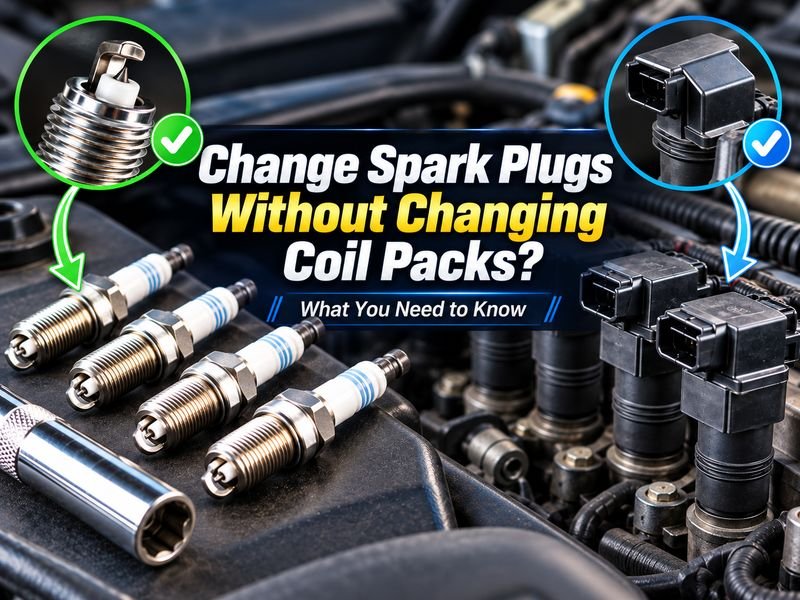
Yes. In most vehicles, you can change spark plugs without changing coil packs.
Spark plugs are normal maintenance items and may have a scheduled replacement interval. Ignition coils usually do not.
A typical spark plug replacement involves:
- Disconnecting the ignition coil electrical connector.
- Removing the coil retaining bolt if equipped.
- Pulling the ignition coil or coil boot off the spark plug.
- Removing and replacing the spark plug.
- Reinstalling the original ignition coil.
As long as the coil remains in good condition, there is usually no reason to replace it.
Why Spark Plugs and Coil Packs Are Different Parts
The spark plug and ignition coil work together, but they perform different jobs.
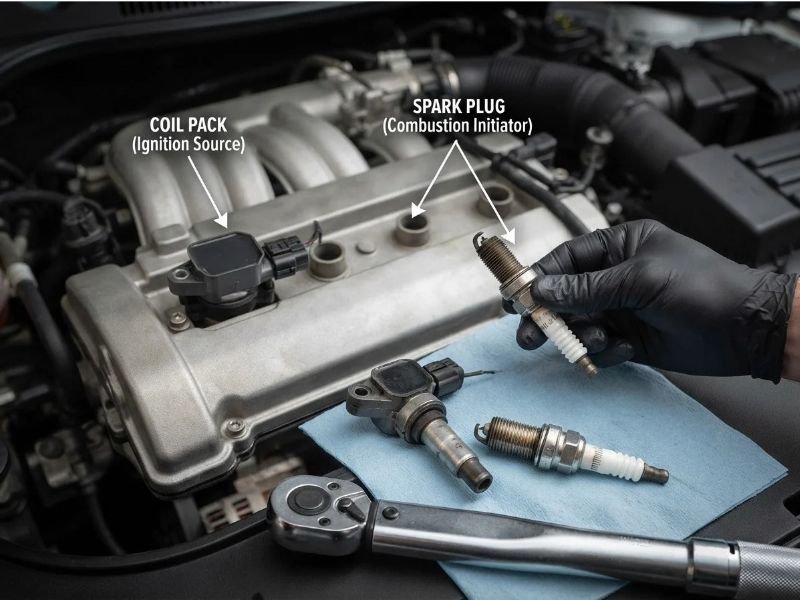
The ignition coil converts the vehicle’s low-voltage electrical supply into the high voltage needed to create a spark.
The spark plug receives that high voltage and produces the spark inside the combustion chamber.
The spark ignites the air-fuel mixture so the engine can produce power.
Because the spark plug is exposed directly to combustion heat, pressure, and deposits, it normally wears out sooner than the ignition coil.
That is why spark plugs commonly have scheduled replacement intervals while ignition coils are usually replaced based on condition.
Do Coil Packs Need to Be Changed With Spark Plugs?
No. Coil packs do not normally need to be replaced every time spark plugs are changed.
If the coils are functioning correctly, replacing them simply because new spark plugs are being installed usually adds unnecessary cost.
A functioning ignition coil can often remain in service through several spark plug replacements.
However, there are situations where replacing one or more coils at the same time can make sense.
When Should You Replace a Coil Pack During Spark Plug Replacement?
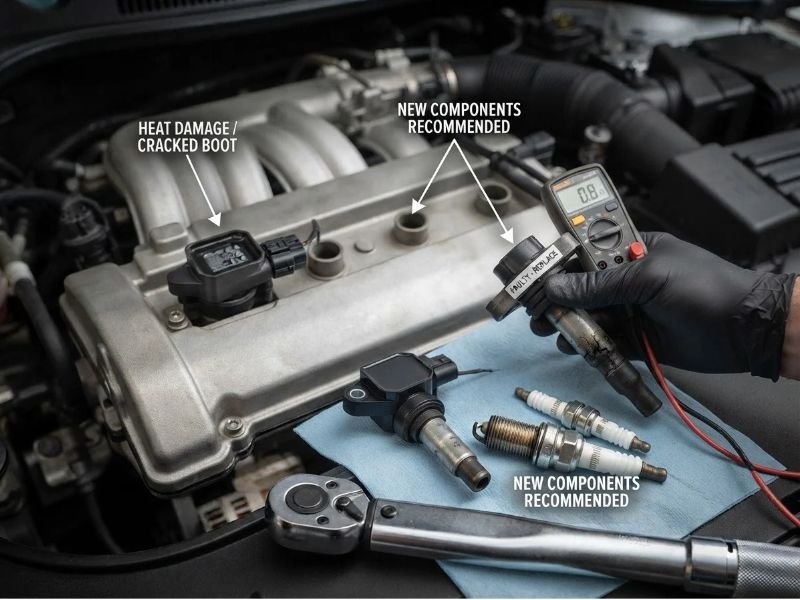
Replace a coil if testing or inspection shows that it is faulty.
Common reasons include:
- Misfire linked to a specific cylinder
- Cracked coil housing
- Torn or damaged coil boot
- Heavy corrosion
- Burn marks or carbon tracking
- Electrical connector damage
- Internal coil failure
- Persistent ignition-related trouble codes
If the coil works correctly and looks healthy, it can usually be reused.
Signs of a Bad Ignition Coil
A failing ignition coil can produce symptoms similar to worn spark plugs.
Common signs include:
- Check engine light
- Engine misfire
- Rough idle
- Hesitation
- Loss of power
- Hard starting
- Poor acceleration
- Increased fuel consumption
- Engine shaking under load
A flashing check engine light can indicate an active misfire severe enough to risk catalytic converter damage.
If that happens, reduce driving and have the problem diagnosed promptly.
How Can You Tell Whether the Spark Plug or Coil Is Bad?
Spark plugs and coils can create nearly identical symptoms, so diagnosis is important.
One common method on coil-on-plug engines is a coil swap test.
Suppose diagnostic trouble code P0302 indicates a misfire on cylinder 2.
A technician may move the ignition coil from cylinder 2 to another cylinder and clear or monitor the fault.
If the misfire moves with the coil, the coil becomes a strong suspect.
If the misfire remains on cylinder 2, the cause may instead involve:
- Spark plug
- Fuel injector
- Compression
- Wiring
- Vacuum leak
- Other engine problem
Do not replace coils based only on a generic misfire code.
Can Worn Spark Plugs Damage Coil Packs?
Worn spark plugs can increase the electrical demand placed on ignition coils.
As the spark plug gap increases with wear, the ignition system may require more voltage to jump the gap.
This can make the ignition coil work harder.
Over time, excessive electrical stress may contribute to coil failure, particularly if the plugs are severely overdue for replacement.
This is one reason following the recommended spark plug maintenance interval is important.
Replacing worn plugs can reduce unnecessary stress on the ignition system.
Should You Replace All Coil Packs at Once?
Not necessarily.
Unlike spark plugs, ignition coils are often replaced individually when they fail.
If one coil fails and the others test correctly, replacing only the defective coil may be perfectly reasonable.
However, replacing all coils may be considered when:
- Vehicle has very high mileage
- Multiple coils have already failed
- Access is extremely difficult
- Several coils show deterioration
- Labor cost is high because major components must be removed
Even then, replacement should be based on condition, reliability goals, and cost rather than a rule that all coils must always be replaced together.
Should Spark Plugs Be Replaced as a Set?
Usually, yes.
Spark plugs generally wear at similar rates, so they are normally replaced as a complete engine set.
If your engine has four cylinders, that generally means replacing four plugs.
A six-cylinder engine generally has six, although certain engine designs use more than one spark plug per cylinder.
Replacing the full set helps maintain consistent ignition performance across all cylinders.
What Should You Inspect When Removing Coil Packs?
Spark plug replacement gives you convenient access to several ignition-system components.
Inspect each ignition coil before reinstalling it.
Check the Coil Boot
The rubber boot connects the ignition coil to the spark plug.
Look for:
- Cracks
- Tears
- Hardening
- Swelling
- Burn marks
- Carbon tracks
A damaged boot can allow high voltage to leak before it reaches the spark plug.
Check for Oil in the Spark Plug Well
Oil around the ignition coil or spark plug may indicate a leaking valve cover gasket or spark plug tube seal.
Installing new spark plugs without fixing a significant oil leak can allow the new plug and coil boot to become contaminated again.
Check for Water or Moisture
Water inside a spark plug well can cause misfires and corrosion.
If moisture is present, identify why it entered before reassembly.
Inspect the Electrical Connector
Check the coil connector for broken locking tabs, corrosion, loose terminals, or damaged wiring.
A perfectly good coil cannot operate correctly if the electrical connection is poor.
Can You Reuse Ignition Coil Boots?
Yes, if they are still flexible, undamaged, and clean.
Some coil designs allow the boot to be replaced separately.
If a boot is cracked, burned, swollen, or heavily contaminated, replacing the boot may be enough if the actual coil is still good.
Not every ignition coil has a separately serviceable boot, so check the design used on your vehicle.
Should You Put Dielectric Grease on Coil Boots?
A small amount of dielectric grease may be used on certain ignition coil boot applications if recommended by the vehicle or coil manufacturer.
It is typically applied inside the boot near the opening to help with moisture protection and future removal.
Do not coat the spark plug terminal or entire electrical contact area with excessive grease.
Dielectric grease is electrically insulating, so more is not better.
Follow the service procedure for your specific vehicle.
Can You Replace Spark Plugs Without Disconnecting the Battery?
Many vehicles do not require battery disconnection for a routine spark plug replacement, but procedures vary.
At minimum:
- Turn the ignition off.
- Keep the key or start control away from accidental activation.
- Disconnect coil electrical connectors carefully.
If the manufacturer’s service procedure calls for battery disconnection, follow it.
Battery disconnection can also reset certain learned settings on some vehicles, so it should not automatically be treated as necessary for every spark plug job.
Can You Change Spark Plugs Without Removing Coil Packs?
On a coil-on-plug engine, usually not.
The ignition coil sits directly above the spark plug and must be removed to access it.
However, that coil can normally be reinstalled after the new spark plug is fitted.
Older ignition systems may use plug wires or a separate coil pack instead of individual coils mounted directly over each spark plug.
In those systems, spark plug wires may be removed rather than the coil itself.
What Happens If You Install New Spark Plugs With Bad Coil Packs?
The new spark plugs may not solve the engine problem.
A defective coil may continue causing:
- Misfires
- Rough running
- Poor acceleration
- Check engine light
- Hard starting
A bad coil can prevent the new spark plug from receiving adequate ignition voltage.
If the engine had a misfire before plug replacement, diagnose the ignition system rather than assuming new spark plugs will automatically fix it.
What Happens If You Install New Coil Packs but Keep Bad Spark Plugs?
This is also a poor approach.
Severely worn spark plugs may require higher firing voltage and place unnecessary stress on the new coils.
If the plugs are overdue for service, replace them while addressing ignition coil problems.
This can help protect the replacement coils and restore proper ignition performance.
Spark Plugs vs Coil Packs: Replacement Differences
| Component | Spark Plug | Ignition Coil |
| Routine maintenance item | Usually yes | Usually no |
| Wears from combustion | Yes | No direct combustion exposure |
| Normally replaced as a set | Yes | Not always |
| Can cause misfire | Yes | Yes |
| May have scheduled interval | Yes | Usually no |
| Replace when failed | Yes | Yes |
| Must often be removed to access plugs | N/A | Yes on coil-on-plug engines |
How Long Do Ignition Coils Last?
Ignition coils do not have one universal lifespan.
Some last well beyond 100,000 miles, while others fail earlier because of heat, vibration, electrical stress, oil contamination, or manufacturing problems.
They should generally be replaced based on diagnosis rather than mileage alone.
If the engine has high mileage and several coils have already failed, replacing additional aging coils may become a practical reliability decision.
How Long Do Spark Plugs Last?
Spark plug life varies significantly depending on the plug material and vehicle design.
Modern vehicles may use:
- Copper plugs
- Platinum plugs
- Double-platinum plugs
- Iridium plugs
Manufacturer-recommended replacement intervals can vary widely.
Do not assume a universal 30,000-, 60,000-, or 100,000-mile interval applies to every vehicle.
Use the maintenance schedule for your exact year, make, model, and engine.
Do New Spark Plugs Improve Coil Pack Life?
Replacing worn spark plugs on schedule can reduce unnecessary electrical stress on ignition coils.
As plug gaps become excessively worn, the coil may need to generate higher voltage to create a spark.
Keeping the plugs in good condition helps the ignition system operate within its intended range.
However, replacing spark plugs cannot prevent every coil failure.
Heat, age, wiring problems, contamination, and internal electrical failures can still damage coils.
Should You Replace Coil Packs Preventively?
Usually, no.
If the coils work correctly, preventive replacement is generally unnecessary.
There are exceptions when preventive replacement may be reasonable, such as a difficult-to-access engine where labor is extensive and the coils are already very old.
But for most vehicles, keeping healthy original coils is perfectly acceptable.
Quality original equipment coils can sometimes outlast low-quality replacement parts.
Common Mistakes When Changing Spark Plugs
One common mistake is replacing all ignition coils automatically even though none has failed.
Another is pulling hard on the coil wiring instead of releasing the connector properly.
You should also avoid:
- Dropping debris into spark plug wells
- Installing the wrong spark plug
- Cross-threading plugs
- Overtightening plugs
- Using incorrect plug gap
- Damaging coil boots
- Mixing coil connectors between cylinders
Spark plug torque is particularly important, especially in aluminum cylinder heads.
Use the vehicle or spark plug manufacturer’s torque specification.
When Should You Replace Spark Plugs and Coil Packs Together?
Replacing both at the same time makes sense when the spark plugs are due and one or more coils have confirmed faults.
For example, suppose the vehicle has reached its recommended spark plug interval and also has a cylinder-specific misfire caused by a failed coil.
In that case, replacing the complete set of plugs plus the faulty coil can be practical.
Replacing every remaining coil is still not automatically necessary.
Is It Safe to Drive With a Bad Coil Pack?
A minor intermittent misfire may still allow the car to move, but driving with a known ignition coil failure is not recommended.
An active misfire can send unburned fuel into the exhaust.
This can overheat and damage the catalytic converter.
If the check engine light is flashing, the engine is shaking severely, or power has dropped significantly, avoid unnecessary driving and have the problem diagnosed promptly.
FAQs About Can You Change Spark Plugs Without Changing Coil Packs
Do You Have to Change Coil Packs When Changing Spark Plugs?
No. If the ignition coils are functioning correctly, they can normally be removed and reinstalled during spark plug replacement.
Replace coils only when they are defective or damaged.
Is It Better to Change Spark Plugs and Coils Together?
Not necessarily.
Spark plugs are maintenance items, while ignition coils are normally replaced when they fail.
Changing both together only makes sense when the plugs are due and the coils are also faulty or deteriorated.
Can Old Coil Packs Work With New Spark Plugs?
Yes.
Healthy ignition coils can work perfectly well with new spark plugs.
There is no requirement that the two components be the same age.
Should I Replace Coil Boots When Changing Spark Plugs?
Only if they are cracked, hardened, burned, swollen, contaminated, or otherwise damaged.
Good boots can normally be reused.
Will New Spark Plugs Fix a Bad Ignition Coil?
No.
A defective ignition coil will continue causing problems even with new spark plugs.
The faulty coil must be repaired or replaced.
Can Bad Spark Plugs Ruin New Coil Packs?
Severely worn plugs can increase the voltage required to create a spark and may place additional stress on ignition coils.
Replacing overdue plugs can help reduce that stress.
Do All Coil Packs Need to Be Replaced If One Goes Bad?
No.
It is common to replace only the failed coil while leaving properly functioning coils in service.
Inspect the others and replace them only if their condition or diagnostic results justify it.
How Do I Know If My Coil Packs Are Still Good?
A properly functioning coil should not produce cylinder-specific ignition problems.
Diagnosis may include trouble codes, coil-swap testing, electrical testing, visual inspection, and checking engine operation.
Can I Reuse the Same Coils After Removing Them?
Yes.
Removing a coil to access a spark plug does not damage it when the coil and connector are handled correctly.
Reinstall it in the proper position after the new plug is fitted.
Conclusion
So, can you change spark plugs without changing coil packs? Yes. In most vehicles, spark plugs can and should be replaced independently when they reach their maintenance interval, while healthy ignition coils can simply be removed and reinstalled.
Use the spark plug job as an opportunity to inspect the coil packs, boots, connectors, and plug wells for cracks, corrosion, oil, moisture, or other damage.
If a coil has a confirmed fault, replace it. If it is functioning properly, there is usually no benefit to replacing it simply because you are installing new spark plugs.