
Spark plugs are small parts, but they play a major role in how a gasoline engine starts, idles, accelerates, and uses fuel. Every time the engine runs, each spark plug repeatedly creates the electrical spark that ignites the air-fuel mixture inside its cylinder.
So, what happens if you dont change spark plugs when they are worn out? The engine may gradually develop hard starting, rough idle, hesitation, reduced power, poor fuel economy, and misfires. If severely worn plugs are ignored long enough, they can put additional stress on ignition coils and may contribute to catalytic converter damage when repeated misfires allow unburned fuel into the exhaust.
Spark plugs do not all have the same service life. Replacement intervals depend on the plug material, engine design, vehicle manufacturer, and operating conditions. Some modern plugs can remain in service for many tens of thousands of miles, while other designs require replacement much sooner.
The key is to follow the maintenance schedule for your specific vehicle and recognize the warning signs of worn or fouled plugs before drivability problems become more serious.
What Happens If You Dont Change Spark Plugs?
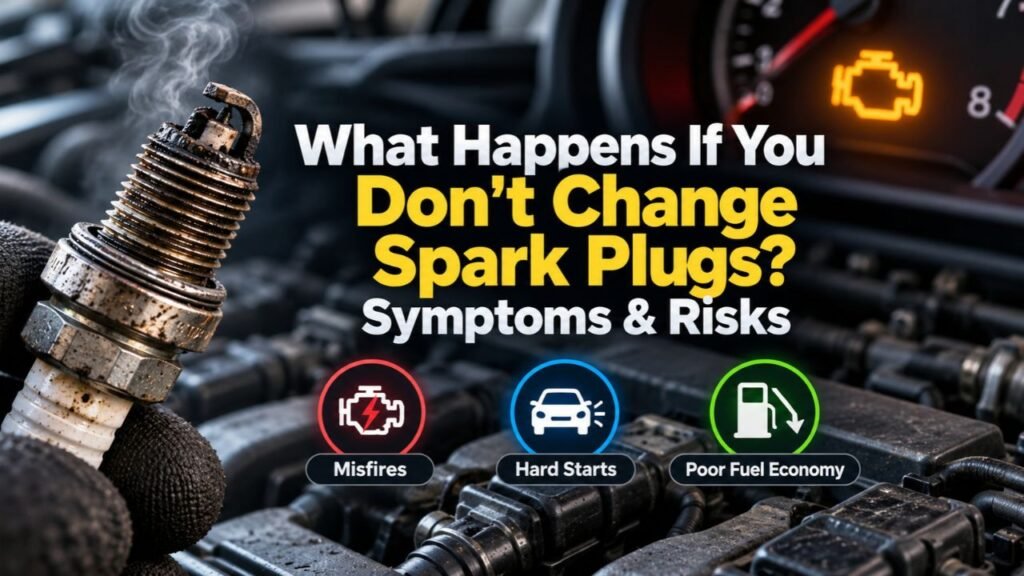
If you do not replace worn spark plugs, the spark can gradually become weaker or less reliable. The engine may begin having trouble igniting the air-fuel mixture correctly, resulting in misfires, reduced performance, harder starting, and increased fuel consumption.
As spark plug electrodes wear, the spark plug gap can become larger. The ignition system must then produce greater voltage to jump that gap.
Eventually, the plug may not fire reliably under certain conditions.
The problem may first appear during:
- Cold starts
- Hard acceleration
- Heavy engine load
- Highway passing
- Climbing hills
As wear becomes worse, symptoms may also appear at idle and during normal driving.
What Do Spark Plugs Actually Do?
A spark plug sits in the cylinder head with its firing end exposed to the combustion chamber.
When commanded by the engine computer, the ignition coil sends high voltage to the plug.
Electricity jumps across the small gap between the center electrode and ground electrode, producing a spark.
That spark ignites the compressed air-fuel mixture.
The expanding gases then push the piston downward and produce engine power.
This sequence occurs extremely quickly and repeatedly while the engine is running.
A spark plug that cannot consistently create the correct spark can interfere with the entire combustion process.
Do Spark Plugs Wear Out?
Yes.
Spark plugs operate inside an extremely hot, high-pressure environment. Their electrodes gradually erode after millions of ignition events.
Over time, several things can happen:
- Electrode edges wear away
- Spark gap becomes wider
- Deposits accumulate
- Insulator becomes contaminated
- Plug can foul with fuel or oil
- Electrical resistance can change
- Corrosion can develop
Modern iridium and platinum spark plugs generally resist electrode wear better than traditional copper-style plugs, but even long-life plugs eventually require replacement.
What Are the Symptoms of Worn Spark Plugs?
Spark plug wear often develops slowly, so drivers may not immediately notice the performance change.
Common symptoms include:
- Hard starting
- Rough idle
- Engine misfire
- Hesitation during acceleration
- Reduced engine power
- Poor fuel economy
- Check engine light
- Engine vibration
- Sluggish throttle response
These symptoms can also come from ignition coils, fuel injectors, vacuum leaks, sensors, or other engine problems.
Spark plugs should therefore be inspected or tested rather than blamed automatically.
Can Old Spark Plugs Cause Engine Misfires?
Yes. Engine misfire is one of the most common problems associated with badly worn or fouled spark plugs.
A misfire occurs when combustion does not happen correctly in one or more cylinders.
If the spark plug cannot produce a strong spark at the correct time, the air-fuel mixture may fail to ignite properly.
A misfire may feel like:
- Shaking at idle
- Jerking during acceleration
- Brief loss of power
- Engine stumbling
- Uneven exhaust sound
The engine computer may also store diagnostic trouble codes such as cylinder-specific misfire codes.
However, a misfire does not automatically mean the spark plug is bad.
Ignition coils, fuel delivery, compression, and air leaks can produce similar symptoms.
Can Worn Spark Plugs Cause a Check Engine Light?
Yes.
If a worn spark plug causes enough misfires, the engine control module may detect irregular crankshaft acceleration and turn on the check engine light.
The vehicle may store codes identifying:
- Random misfires
- Misfire on a specific cylinder
- Multiple-cylinder misfires
A steady check engine light indicates a fault that should be diagnosed.
A flashing check engine light is more urgent because it commonly indicates an active severe misfire that may overheat and damage the catalytic converter.
If the light flashes while the engine runs badly, reduce driving and have the problem diagnosed promptly.
Can Bad Spark Plugs Make the Engine Hard to Start?
Yes.
Starting an engine requires reliable ignition under conditions that can already be difficult, especially when the engine is cold.
A badly worn spark plug may require more voltage than the ignition system can reliably provide.
The result may be:
- Longer cranking
- Several starting attempts
- Rough running immediately after startup
Hard starting can also result from a weak battery, fuel-pressure problems, faulty sensors, ignition coils, or other causes.
What Happens to the Spark Plug Gap as Plugs Wear?
The gap generally becomes larger as electrode material gradually wears away.
The spark plug gap is the distance electricity must jump to create the ignition spark.
A larger gap requires higher voltage.
The ignition coil may initially compensate, which is one reason worn spark plugs can continue working for a surprisingly long time.
Eventually, however, the increased voltage requirement can contribute to:
- Misfires
- Hard starting
- Coil stress
- Weak ignition under load
Using the correct plug type and specified gap is important when replacement time arrives.
Can Old Spark Plugs Damage Ignition Coils?
They can contribute to additional ignition-coil stress.
As the spark plug gap increases, the ignition coil may have to generate higher voltage to fire the plug.
A healthy ignition system can tolerate normal spark plug wear, but severely worn plugs can make the coils work harder.
This does not mean old spark plugs automatically destroy ignition coils.
Coils can fail for many independent reasons.
However, replacing spark plugs on schedule helps prevent the ignition system from operating unnecessarily far outside its intended conditions.
Can Bad Spark Plugs Damage the Catalytic Converter?
Persistent misfires can potentially damage the catalytic converter.
When combustion fails, some unburned fuel may pass into the exhaust system.
The catalytic converter may then attempt to oxidize that fuel.
This can generate excessive heat.
Repeated severe misfires can overheat the catalyst material and eventually damage it.
A catalytic converter is generally much more expensive to replace than a set of spark plugs, so persistent misfires should not be ignored.
Can Worn Spark Plugs Reduce Fuel Economy?
Yes.
Poor ignition can reduce combustion efficiency.
If the engine does not burn the air-fuel mixture effectively, the vehicle may require more fuel to produce the same amount of usable power.
You may notice:
- Lower miles per gallon
- More frequent fuel stops
- Sluggish acceleration
However, fuel economy is affected by many factors, including:
- Tire pressure
- Driving habits
- Weather
- Vehicle load
- Fuel quality
- Air filter condition
- Sensors
- Injectors
A small MPG change by itself is not enough to diagnose spark plugs.
Can Old Spark Plugs Cause Loss of Power?
Yes.
If one or more cylinders are not firing efficiently, the engine cannot produce its normal power.
The loss may be most noticeable during:
- Acceleration
- Merging onto a highway
- Driving uphill
- Towing
- Carrying a heavy load
The vehicle may feel sluggish or hesitate when you press the accelerator.
A heavily misfiring engine can lose a significant amount of usable power.
Can Bad Spark Plugs Cause Rough Idle?
Yes.
At idle, the engine operates at relatively low speed and each cylinder’s combustion event has a noticeable effect on smoothness.
A spark plug that occasionally fails to ignite the mixture can make the engine feel uneven.
You may notice:
- Shaking steering wheel
- Vibrating seats
- Fluctuating idle
- Uneven exhaust note
A rough idle can also result from vacuum leaks, dirty throttle bodies, fuel injectors, motor mounts, or other problems, so diagnosis is still important.
Can Bad Spark Plugs Cause Hesitation?
Yes.
A worn spark plug may work reasonably well under light load but struggle when cylinder pressure increases during hard acceleration.
This happens because firing the spark across the plug gap can become more difficult under higher combustion-chamber pressure.
You may press the accelerator and experience:
- Brief hesitation
- Stumbling
- Jerking
- Delayed acceleration
This type of problem can sometimes be more obvious when climbing a hill or accelerating at highway speed.
What Happens If You Never Change Spark Plugs?
If spark plugs are left in service indefinitely, they can eventually become severely worn, fouled, or difficult to remove.
Possible consequences include:
- Frequent misfires
- Very poor performance
- Hard starting
- Reduced fuel economy
- Coil stress
- Catalytic converter damage from severe misfires
- Spark plugs becoming difficult to remove
Leaving plugs installed far beyond their service interval can sometimes create additional removal problems due to corrosion, deposits, or long-term heat cycling.
This does not mean every overdue plug will become stuck, but extremely delayed maintenance can make servicing more difficult.
Can You Keep Driving With Worn Spark Plugs?
A vehicle may continue running with moderately worn spark plugs, but that does not mean continued driving is a good idea.
If the engine runs smoothly and the plugs are simply due for scheduled maintenance, replacement can usually be planned soon.
Driving becomes more concerning when you have:
- Severe misfire
- Flashing check engine light
- Significant loss of power
- Heavy shaking
- Repeated stalling
- Strong fuel smell
A severe active misfire should be addressed promptly because of the risk to the catalytic converter and overall drivability.
How Long Do Spark Plugs Last?
There is no universal replacement interval.
Spark plug life depends heavily on plug design and manufacturer recommendations.
Broadly, vehicles may use:
- Traditional nickel or copper-core designs with shorter service intervals
- Platinum plugs with longer service life
- Iridium plugs designed for extended intervals
Some modern vehicles specify spark plug replacement intervals approaching or exceeding 100,000 miles, while other engines require replacement substantially sooner.
The correct interval is the one specified in your vehicle’s owner’s manual or maintenance schedule.
Do not assume that every iridium plug automatically lasts the same mileage.
Should You Replace Spark Plugs Based on Mileage or Symptoms?
Ideally, replace them according to scheduled maintenance rather than waiting for symptoms.
By the time badly worn plugs cause obvious misfires or starting problems, they are already beyond the condition you want for normal engine operation.
Scheduled replacement helps maintain:
- Reliable starting
- Consistent combustion
- Normal fuel economy
- Smooth engine operation
- Proper ignition-system load
If symptoms occur before the scheduled interval, diagnose the cause rather than waiting for the mileage recommendation.
Do All Spark Plugs Need to Be Changed at the Same Time?
Usually, yes.
Spark plugs in the same engine generally experience similar operating time, so they are normally replaced as a complete set according to the maintenance schedule.
Replacing only one plug can make sense when diagnosing an unusual isolated problem, such as a physically damaged plug.
For normal scheduled maintenance, replacing the entire set provides consistent plug type, gap, and wear across all cylinders.
Do You Have to Replace Ignition Coils With Spark Plugs?
No.
Ignition coils do not normally need to be replaced simply because the spark plugs are being changed.
If the coils are operating correctly and show no signs of damage, they can usually remain in service.
Replace an ignition coil when there is evidence it has failed or is failing.
Possible signs include:
- Cylinder-specific misfire
- Visible cracking
- Electrical failure
- Damaged coil boot
- Confirmed weak or absent spark
Replacing all good coils every time spark plugs are serviced is generally unnecessary unless the manufacturer specifies otherwise or there is another specific reason.
What About Spark Plug Wires?
Vehicles with traditional spark plug wires may need the wires inspected when the plugs are replaced.
Check for:
- Cracks
- Burn marks
- Damaged boots
- Excessive resistance
- Oil contamination
Many modern vehicles use coil-on-plug ignition and have no conventional spark plug wires.
In those engines, each ignition coil usually connects directly to its spark plug through a coil boot.
Can Spark Plugs Become Fouled Before They Wear Out?
Yes.
A spark plug can fail from contamination even if its electrodes are not worn out.
Common types of fouling include:
Carbon Fouling
Black carbon deposits can form when combustion is too rich or incomplete.
Oil Fouling
Engine oil entering the combustion chamber can coat the plug.
Possible underlying causes include worn piston rings, valve-related problems, or other internal engine issues.
Fuel Fouling
Repeated unsuccessful starting attempts or an excessively rich mixture can wet the plug with gasoline.
Simply replacing a fouled spark plug may not permanently solve the problem if another engine condition caused the fouling.
Can Worn Spark Plugs Cause Engine Damage?
Worn spark plugs themselves do not normally cause major internal engine damage simply because their electrodes are old.
The bigger concern is what happens when they begin causing severe or prolonged misfires.
Those misfires can:
- Increase emissions
- Reduce power
- Stress ignition components
- Overheat the catalytic converter
Certain unusual spark plug failures, such as a physically broken plug, can create more serious issues, but these are different from normal gradual wear.
What Does a Worn Spark Plug Look Like?
A normally worn plug may have rounded electrode edges and a visibly larger gap than a new plug.
Other appearances can provide diagnostic clues.
For example:
- Dry black deposits may indicate carbon fouling
- Wet oily deposits may indicate oil entering the combustion chamber
- Heavy deposits may affect spark performance
- Physical damage may indicate a more serious problem
Spark plug appearance should be interpreted carefully because operating conditions and plug design affect normal coloration.
What Happens If You Install the Wrong Spark Plugs?
Using the wrong spark plugs can create problems even if they physically fit the cylinder head.
Important specifications include:
- Thread size
- Reach
- Heat range
- Electrode design
- Resistance
- Required gap
A plug with incorrect reach can potentially interfere with combustion-chamber components or position the spark incorrectly.
An incorrect heat range can contribute to fouling or excessive plug temperature.
Always use plugs specified for the exact engine.
Can You Clean Spark Plugs Instead of Replacing Them?
Cleaning is generally not a substitute for replacing plugs that have reached their scheduled service life.
Cleaning may remove certain deposits, but it cannot restore electrode material that has physically worn away.
Modern fine-wire platinum and iridium plugs can also have delicate electrode designs that should not be aggressively filed or wire-brushed.
If plugs are worn out, correct replacement is the better solution.
How Much Difference Can New Spark Plugs Make?
If the old plugs were severely worn, new plugs can noticeably improve:
- Starting
- Idle quality
- Acceleration
- Throttle response
If the original plugs were still working normally and simply replaced as preventive maintenance, the difference may be much less noticeable.
Spark plugs do not create extra power beyond what the engine was designed to produce.
Their job is to restore and maintain reliable ignition.
Can Changing Spark Plugs Fix a Misfire?
Yes, if worn, fouled, or damaged plugs caused the misfire.
But changing plugs will not fix a misfire caused by:
- Failed ignition coil
- Bad fuel injector
- Vacuum leak
- Low compression
- Valve problem
- Wiring fault
- Fuel-pressure issue
Diagnostic trouble codes can help identify which cylinder is affected, but additional testing may still be needed to determine why it is misfiring.
When Should You Have Spark Plugs Checked?
Spark plugs should be considered when:
- They have reached the scheduled replacement interval
- Engine misfires
- Starting becomes difficult
- Fuel economy noticeably falls
- Acceleration becomes hesitant
- Engine idles roughly
- Check engine light shows misfire codes
A mechanic can inspect the plugs and use their condition as one part of the overall diagnosis.
Common Mistakes When Replacing Spark Plugs
Spark plug replacement is straightforward on some engines but much more difficult on others.
Common mistakes include:
- Installing the wrong plug
- Cross-threading the plug
- Overtightening
- Undertightening
- Damaging ignition coil connectors
- Allowing dirt into the spark plug hole
- Setting an incorrect gap
- Applying products not recommended by the vehicle or plug manufacturer
Spark plugs thread directly into the cylinder head, which is often aluminum.
Starting each plug carefully by hand helps reduce the risk of damaged threads.
Always follow the specified installation procedure and torque value for the engine.
FAQs About What Happens If You Dont Change Spark Plugs
How long can you go without changing spark plugs?
That depends on the vehicle and spark plug type. Some engines require plugs relatively frequently, while certain modern long-life plugs may have service intervals around 100,000 miles or more.
Follow the maintenance schedule for your exact vehicle rather than a universal mileage rule.
What happens if spark plugs are overdue?
Overdue spark plugs may gradually develop larger gaps and reduced ignition reliability.
Possible results include misfires, poor fuel economy, hard starting, rough idle, and reduced performance.
Can you drive 100,000 miles without changing spark plugs?
Some vehicles are specifically designed with spark plug intervals around that range, while others are not.
Check the manufacturer’s maintenance schedule before deciding whether 100,000 miles is appropriate.
Will old spark plugs eventually stop working?
They can.
As electrode wear and deposits increase, a plug may eventually become unable to produce a reliable spark under certain engine conditions.
Can bad spark plugs cause your car to shake?
Yes. If worn plugs cause one or more cylinders to misfire, the engine may shake noticeably, especially at idle.
However, engine mounts and several other faults can also cause vibration.
Can worn spark plugs ruin ignition coils?
Worn plugs can require higher firing voltage and may place additional demand on ignition coils. This can contribute to stress, but worn plugs do not guarantee coil failure.
Will changing spark plugs improve gas mileage?
If worn plugs are causing poor combustion or misfires, replacing them can help restore normal fuel economy.
Replacing already healthy plugs usually will not create a dramatic MPG improvement.
What happens if one spark plug goes bad?
One bad plug can cause its cylinder to misfire, resulting in rough running, reduced power, a check engine light, and potentially catalytic converter damage if the severe misfire continues.
Conclusion
Understanding what happens if you dont change spark plugs comes down to how essential a reliable spark is for combustion. As spark plugs wear, their gaps can increase and ignition becomes harder, eventually causing problems such as misfires, rough idle, difficult starting, hesitation, reduced power, and poor fuel economy.
Ignoring a severe spark-related misfire can also place unnecessary stress on ignition components and potentially overheat the catalytic converter.
You do not need to replace spark plugs early simply because they have accumulated mileage, but you also should not wait until the engine runs badly. Follow the replacement interval specified for your vehicle, use the correct plugs, and investigate misfire symptoms promptly.