
Spark plug wires sometimes come longer than necessary, especially when you buy a universal or cut-to-fit ignition wire set. Extra wire can make an engine bay look untidy and may leave the wires resting against hot exhaust components, sharp edges, or moving parts.
Learning how to shorten spark plug wires correctly is mainly about knowing whether your wires are designed to be cut and reterminated. Universal performance wire sets often are.
Many factory-style replacement wires, however, arrive with molded or factory-installed terminals and should not be shortened unless the manufacturer specifically allows it.
The job involves more than simply cutting the cable. After shortening the wire, you must strip the insulation without damaging the conductive core, position the conductor correctly, install a compatible terminal, crimp it securely, and reinstall the boot.
A poor connection can create high resistance, misfires, weak spark, radio-frequency interference, or an intermittent ignition problem.
This guide explains which spark plug wires can be shortened, the tools you need, how to measure and cut them correctly, and how to make a reliable new terminal connection.
How to Shorten Spark Plug Wires Correctly
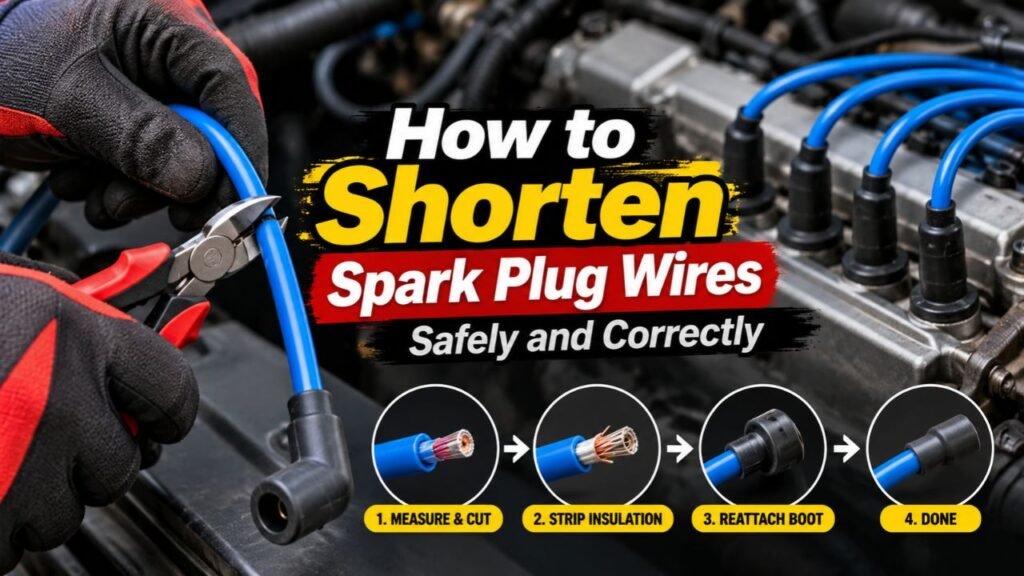
To shorten spark plug wires, first confirm that the wire set is designed to be cut to length. Route the wire where it will be installed, mark the correct length with enough slack for engine movement, cut it cleanly, strip the insulation according to the terminal manufacturer’s specifications, fold or position the conductive core correctly, crimp on a new spark plug or distributor terminal, and reinstall the boot.
Do not simply cut a finished spark plug wire and splice the two ends together.
For a cut-to-fit wire set, the basic process is:
- Confirm the wire can be reterminated.
- Route it from the distributor or coil to the spark plug.
- Leave enough slack for engine movement and service.
- Mark the desired length.
- Remove the wire before cutting.
- Make a clean, square cut.
- Strip only the required amount of insulation.
- Position the conductive core as specified.
- Install the correct terminal.
- Crimp the terminal with the proper tool.
- Install the boot.
- Check terminal engagement and wire routing.
The exact stripping length and terminal orientation vary among ignition-wire kits, so use the instructions supplied with your wire and terminal set.
Can All Spark Plug Wires Be Shortened?
No.
This is the most important thing to determine before cutting anything.
Cut-to-Fit Spark Plug Wires
Universal performance ignition-wire sets are commonly designed to be shortened during installation.
These kits typically include:
- Extra-long ignition wires
- Loose terminals
- Distributor or coil boots
- Spark plug boots
- Crimping instructions
You route each wire, cut it to the required length, and install the terminal yourself.
These are the best candidates for shortening.
Factory-Style Preassembled Wires
Many direct-fit replacement wires already have:
- Installed terminals
- Molded boots
- Correct factory lengths
These wires may not be intended for retermination.
Cutting them can leave you without a proper terminal connection or may damage a wire construction that requires specialized assembly equipment.
If the wire was sold as a direct replacement for a specific vehicle, replacing it with a correctly sized wire is often better than modifying it.
Permanently Molded or Specialized Wires
Some ignition systems use wires with molded coil ends, integrated resistors, or specialized terminals.
Do not cut these unless the manufacturer specifically provides a retermination method.
Why Would You Shorten Spark Plug Wires?
Shorter wires can improve routing when the original wires are unnecessarily long.
Possible reasons include:
- Cleaning up engine-bay appearance
- Keeping wires away from exhaust headers
- Preventing wires from rubbing against brackets
- Reducing unnecessary loops
- Fitting a custom distributor or ignition system
- Installing a universal performance wire kit
- Replacing excessively long custom wires
Shortening a wire does not normally create a meaningful horsepower increase by itself.
The main benefits are better fit, cleaner routing, and reduced exposure to heat or physical damage.
Tools You May Need
A typical cut-to-fit installation may require:
- Ignition-wire cutter
- Wire stripping tool
- Spark plug wire crimping tool
- Compatible terminals
- Correct boots
- Silicone boot lubricant or dielectric grease if recommended
- Marker or masking tape
- Measuring tape
- Multimeter for resistance checks
Some ignition-wire kits include a simple crimping fixture that can be used with a vise.
A dedicated ignition-wire crimper usually produces a more consistent terminal than ordinary pliers.
Understand the Construction of the Wire
Spark plug wires are not ordinary electrical cables.
Depending on the design, the center conductor may be:
- Carbon-impregnated fiber
- Spiral-wound suppression conductor
- Metallic conductor
- Specialty low-resistance core
Around the conductor are layers of insulation designed to contain the high voltage produced by the ignition system.
Modern performance wires often use a spiral-wound conductor because it combines relatively low resistance with electromagnetic interference suppression.
The conductive core must make reliable contact with the new terminal after shortening.
Measure Before You Cut
Measure each wire individually on the engine.
Do not assume all cylinders need similar lengths.
Route the wire exactly where you intend to leave it.
Follow existing separators, looms, or clips where possible.
The wire should reach the spark plug or distributor without being:
- Stretched tight
- Sharply bent
- Pulled sideways on the boot
- Resting against the exhaust
- Wrapped around moving parts
Leave a small amount of extra length for engine movement and future servicing.
Cutting a wire slightly too long is easy to correct.
Cutting it too short usually means replacing the wire.
How Much Slack Should You Leave?
There is no universal measurement because engine layouts differ.
The wire should have enough slack that vibration and engine movement do not pull on either terminal.
At the same time, avoid large loops.
A properly routed spark plug wire should look relaxed rather than tight or excessively loose.
Pay particular attention to engines where the distributor is mounted far from some cylinders.
Remove the Wire Before Cutting
Once you have marked the correct length, remove the wire from the engine.
This makes it easier to:
- Cut squarely
- Strip accurately
- Position the terminal
- Crimp evenly
- Prevent debris from entering the boot
Pull spark plug wires by the boot rather than yanking on the cable itself.
If you are working with multiple wires, complete one wire at a time so you do not accidentally change the firing order.
Make a Clean Cut
Use a sharp wire cutter designed for ignition cable or similar heavy insulated wire.
Cut straight across the cable.
A crushed or angled end makes stripping and terminal installation more difficult.
Avoid using dull side cutters that badly flatten the insulation.
How to Strip Spark Plug Wire Insulation
The next step is exposing the amount of conductor required by the terminal design.
Follow the wire manufacturer’s specified strip length.
Depending on the kit, you may remove roughly a short section of outer insulation and then fold the exposed conductor back over the insulation before the terminal is crimped.
The important part is to avoid cutting through the conductive core.
Why the Core Must Stay Intact
If you cut or partially sever the conductor, the wire may develop:
- High resistance
- Intermittent spark
- Misfire
- Difficult starting
- Weak ignition under load
Take shallow cuts through the insulation rather than cutting deeply toward the center.
A spark-plug-wire stripping tool makes this much easier.
Folding the Conductive Core
Many cut-to-fit ignition wires use a terminal installation method where the exposed conductor is folded back along the outside of the insulation.
The terminal then clamps over both the insulation and folded conductor.
This creates electrical contact between the wire core and terminal.
However, not every wire set uses exactly the same method.
Some terminals and wire constructions require a different preparation procedure.
Always use the assembly instructions supplied with the ignition wire.
Installing the Terminal
Spark plug wire terminals vary depending on where the wire connects.
Common terminal styles include:
- Spark plug terminals
- HEI distributor terminals
- Socket-style distributor terminals
- Coil tower terminals
Make sure you are installing the correct terminal on the correct end of the wire.
Position the terminal so the conductive core contacts the metal portion exactly as specified.
How to Crimp the Terminal
Place the terminal and wire into the appropriate cavity of the ignition-wire crimping tool.
The crimp normally needs to secure:
- The terminal to the insulation
- The electrical connection to the conductor
Crimp firmly and evenly.
The completed connection should be mechanically strong, but the terminal should not be crushed beyond its intended shape.
Give the wire a gentle pull after crimping.
The terminal should remain securely attached.
If it slips off easily, redo the connection with a new terminal.
Why Ordinary Pliers Are a Poor Choice
Pliers can squeeze a terminal, but they do not create a controlled crimp shape.
An inconsistent crimp can cause:
- Loose connection
- Broken conductor
- Terminal distortion
- Poor boot fit
- Intermittent ignition
A proper ignition-wire crimper is inexpensive compared with the time spent diagnosing a misfire caused by a bad terminal.
Installing the Boot
Some kits require the boot to be slid over the cable before installing the terminal.
Others allow the terminal to pass through the boot afterward.
Check the kit instructions before crimping.
A very small amount of dielectric grease or silicone boot lubricant may help the wire move through the boot if the manufacturer recommends it.
Dielectric grease is an electrical insulator, so it should not be used as a substitute for a proper metal-to-conductor connection.
Its primary uses around spark plug boots include sealing out moisture and making boots easier to remove.
How to Check the Finished Connection
After assembling the wire, inspect it closely.
Confirm that:
- Terminal is fully crimped.
- Conductor is correctly positioned.
- Insulation is not badly cut.
- Boot is fully seated.
- Terminal does not pull off easily.
- Wire is not kinked.
You can also compare resistance with the specifications for your ignition-wire type.
Testing Spark Plug Wire Resistance
A digital multimeter can help identify a damaged or incorrectly terminated wire.
Set the meter to resistance and measure from one terminal to the other.
Different spark plug wire designs have very different normal resistance values.
For example, some suppression wires intentionally contain significant resistance, while performance spiral-core wires can have much lower resistance.
Because of these differences, compare your result with the wire manufacturer’s specification rather than using one universal resistance number.
A reading showing an open circuit or dramatically higher resistance than similar wires may indicate a poor termination or broken conductor.
Reinstall the Spark Plug Wire
Push the spark plug terminal onto the plug until it fully seats.
Depending on the terminal style, you may feel or hear a click as it engages the top of the plug.
Connect the distributor or coil end securely as well.
Do not leave either end partially installed.
A loose connection can create arcing and misfires.
Route the Wire Away From Heat
Proper routing matters just as much as wire length.
Spark plug wires operate near very hot engine components.
Keep them away from:
- Exhaust manifolds
- Headers
- Turbochargers
- EGR tubes
- Hot shields
Excess heat can damage insulation and eventually allow high voltage to leak through the wire.
Use separators, clips, or heat-resistant protective sleeves if required.
Keep Spark Plug Wires Separated
Avoid bundling ignition wires tightly together over long distances.
High-voltage wires can induce electrical energy into neighboring wires.
On some engines, this can contribute to crossfire, where one cylinder receives unwanted ignition energy from an adjacent wire.
Factory routing often separates wires or controls which cylinders run alongside each other for this reason.
Retain the original separators whenever practical.
Do Not Pull the Wire Tight
A newly shortened wire may look neat when stretched tightly between the distributor and plug, but this is not good routing.
Engines move on their mounts.
A wire that is barely long enough can:
- Pull free
- Damage its terminal
- Tear internally
- Stress the boot
Leave enough slack for movement without creating unnecessary loops.
Can You Splice a Spark Plug Wire to Shorten It?
There is generally no reason to splice a wire when shortening it.
A proper shortening procedure removes excess cable and installs a new terminal directly on the shortened end.
Spark plug wires carry thousands of volts.
Ordinary electrical splices, butt connectors, household wire nuts, and twisted-wire connections are not appropriate.
A poorly insulated splice may arc to nearby metal.
Can You Cut Spark Plug Wires With Scissors?
Heavy-duty scissors may physically cut some ignition cable, but a sharp cable cutter is preferable.
A proper cutter produces a cleaner, more square end without badly crushing the insulation or conductor.
Clean cutting makes terminal preparation easier and more reliable.
Can Shorter Spark Plug Wires Improve Performance?
Normally, shortening excessively long wires does not produce a noticeable power increase if the original wires were functioning correctly.
A shorter wire may have slightly less electrical resistance depending on conductor design, but the difference is generally small.
Performance is more strongly affected by:
- Wire condition
- Correct resistance
- Terminal quality
- Insulation integrity
- Spark plugs
- Coil output
- Ignition timing
Shorten wires primarily for correct fit and routing, not as a horsepower modification.
What Happens If a Spark Plug Wire Is Too Short?
A wire that is too short can put constant tension on the terminals.
This can cause:
- Wire pulling off the spark plug
- Distributor terminal loosening
- Internal conductor damage
- Torn boots
- Misfires during engine movement
If you accidentally shorten a wire too much, replacing that wire is usually better than attempting to splice an extension into it.
What Happens If You Damage the Core?
A damaged conductor may still work at idle but fail under higher engine load.
This can happen because cylinder pressure increases the voltage required for the spark to jump the plug gap.
Possible symptoms include:
- Misfire under acceleration
- Rough idle
- Hard starting
- Check engine light
- Reduced power
- Poor fuel economy
If you suspect the core was damaged during stripping, cut back to undamaged cable and terminate it again if enough length remains.
Otherwise, replace the wire.
Common Mistakes When Shortening Spark Plug Wires
Cutting Before Routing
Measuring away from the engine can easily produce a wire that is too short.
Route first, mark second, and cut last.
Removing Too Much Insulation
Excess exposed conductor can interfere with the boot or terminal.
Follow the terminal manufacturer’s strip-length specification.
Cutting the Conductive Core
Use a proper stripping tool and shallow pressure.
Using the Wrong Terminal
Distributor, coil, and spark plug terminals are not always interchangeable.
Crimping With Pliers
A weak or uneven crimp can cause intermittent ignition problems.
Forgetting to Install the Boot First
Some boot designs cannot be installed after the terminal has been crimped.
Check before assembling the end.
Making the Wire Too Tight
Always leave enough slack for engine movement.
Changing the Firing Order
Complete one wire at a time or clearly label each cylinder.
Connecting wires to the wrong distributor towers can cause severe misfiring or prevent the engine from starting.
When You Should Replace Instead of Shorten
Replacing the wire is generally better when:
- It is a molded factory wire not designed for retermination.
- Insulation is cracked.
- Wire has burn damage.
- Terminal is heavily corroded.
- Core has been damaged.
- Wire is already too short.
- Resistance is outside manufacturer specifications.
- Boots are deteriorated.
On engines using conventional spark plug wires, replacing the complete set can also make sense if all of the wires are old and deteriorating.
FAQs About How to Shorten Spark Plug Wires
Can you cut spark plug wires shorter?
Yes, if they are part of a cut-to-fit spark plug wire set or the manufacturer specifically permits retermination.
Factory preassembled wires should generally not be cut unless they are designed for it.
How do you cut spark plug wires without damaging them?
Use a sharp ignition-wire or cable cutter to make a square cut.
Then use an appropriate stripping tool to remove only the required insulation without cutting the conductive core.
Can I reuse the original spark plug wire terminal?
A new compatible terminal is generally preferable when shortening a wire.
Old terminals can become distorted during removal and may not crimp securely a second time.
Do spark plug wires need to be the same length?
No.
Each wire only needs to be long enough to reach its correct spark plug with safe routing and adequate slack.
Engines commonly use different wire lengths for different cylinders.
Is it better to have shorter spark plug wires?
Only when shorter wires improve routing.
A wire should be short enough to avoid unnecessary loops but long enough to avoid tension, hot components, and sharp bends.
Can a bad crimp cause an engine misfire?
Yes.
A loose or poorly installed terminal can create high resistance or an intermittent electrical connection, resulting in weak spark or misfires.
Should I use dielectric grease on spark plug wire terminals?
A small amount may be used inside the boot when recommended to help exclude moisture and ease removal.
Do not use dielectric grease as a replacement for proper metal-to-metal electrical contact.
Can you splice a spark plug wire if you cut it too short?
Splicing is generally not recommended.
Spark plug wires carry very high voltage, and an improvised splice can create resistance or allow electrical arcing. Replacing the short wire is the better solution.
Conclusion
Knowing how to shorten spark plug wires starts with confirming that your ignition wires are actually designed to be cut and reterminated. Universal cut-to-fit wire sets make the process straightforward, while molded factory-style wires are generally better replaced with the correct length.
Measure each wire on the engine, leave enough slack for movement, make a clean cut, strip the insulation without damaging the conductor, and install a compatible terminal using a proper ignition-wire crimper. After assembly, make sure the terminal is secure and route the wire away from exhaust heat and moving components.
A carefully shortened spark plug wire can provide cleaner routing and a professional-looking installation. A poorly terminated one can create difficult-to-diagnose ignition problems, so accurate measuring and a solid crimp are more important than making the wire as short as possible.