
A gasoline engine depends on spark plugs to ignite the compressed air-fuel mixture inside its cylinders. Because an engine may be running at thousands of revolutions per minute, spark plugs fire extremely rapidly, which can make it seem as though they are producing sparks continuously.
However, the spark is not truly continuous. Each spark plug fires at a specific moment in the engine cycle, based on commands from the ignition system and engine computer. At higher engine speeds, those individual sparks occur so frequently that the process happens many times every second.
If you are wondering do spark plugs continuously fire, the answer depends on what you mean by “continuously.” They keep firing repeatedly while a gasoline engine is running, but each plug creates separate, precisely timed sparks rather than one uninterrupted electrical arc.
Understanding when and how often spark plugs fire helps explain ignition timing, engine RPM, misfires, ignition coils, and why spark plugs wear out over time.
Do Spark Plugs Continuously Fire While the Engine Is Running?
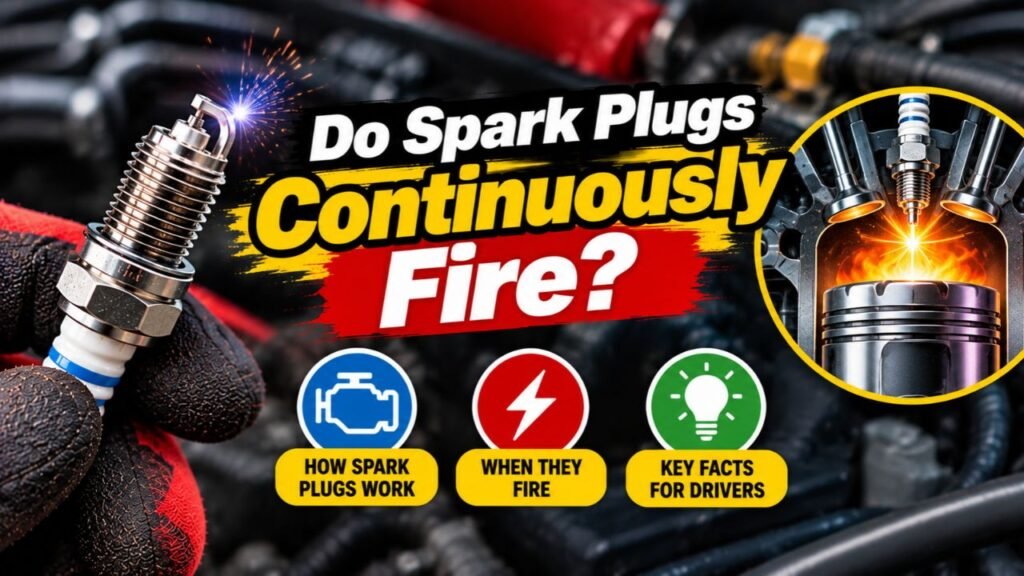
Spark plugs fire repeatedly while the engine is running, but they do not produce a continuous spark.
Each spark is a brief electrical discharge that occurs at a specific point in the combustion cycle.
In a typical modern four-stroke gasoline engine, a spark plug normally fires near the end of the compression stroke, shortly before the piston reaches the top of the cylinder.
The spark ignites the compressed air-fuel mixture so expanding combustion gases can push the piston downward during the power stroke.
After that spark, the plug waits until the next appropriate combustion cycle before firing again.
How Does a Spark Plug Actually Fire?
A spark plug does not generate electricity by itself.
The ignition system supplies high voltage to the plug.
The general process is:
- The engine’s computer determines when ignition should occur.
- An ignition coil creates very high voltage.
- That voltage travels to the spark plug.
- Electricity jumps across the gap between the spark plug electrodes.
- The electrical arc creates a spark.
- The spark ignites the compressed air-fuel mixture.
This entire event happens extremely quickly.
The plug then waits for the next ignition command.
How Often Does a Spark Plug Fire?
How often a spark plug fires depends primarily on engine speed and ignition-system design.
In a normal four-stroke engine, each cylinder completes one combustion cycle every two crankshaft revolutions.
That means each spark plug normally fires once for every two crankshaft revolutions.
For example, at 2,000 RPM:
- The crankshaft makes 2,000 revolutions per minute.
- Each cylinder completes approximately 1,000 combustion cycles per minute.
- Each spark plug therefore fires about 1,000 times per minute.
- That equals roughly 16.7 sparks per second per plug.
At 6,000 RPM, each plug may fire about 3,000 times per minute, or roughly 50 times per second.
These numbers apply to a conventional four-stroke setup where the plug fires once per combustion event.
Some ignition systems operate differently.
Why Doesn’t a Spark Plug Fire on Every Revolution?
A four-stroke engine requires four piston strokes to complete one cycle:
- Intake
- Compression
- Power
- Exhaust
These four strokes require two complete crankshaft revolutions.
The useful ignition event occurs near the end of the compression stroke.
Therefore, the spark plug generally does not need to fire during every crankshaft revolution.
There is one important exception: some engines use a waste-spark ignition system.
What Is a Waste-Spark Ignition System?
A waste-spark system intentionally fires a spark plug on every crankshaft revolution.
One spark occurs during the cylinder’s compression stroke and ignites the air-fuel mixture.
The other occurs during the exhaust stroke, when there is normally no combustible compressed mixture to ignite.
That second spark is called a wasted spark.
In some waste-spark systems, one ignition coil fires two spark plugs simultaneously:
- One cylinder receives its useful ignition spark.
- Another cylinder receives a spark during its exhaust stroke.
On the next crankshaft revolution, their roles reverse.
So a plug in a waste-spark system may fire twice as often as a plug in a conventional sequential ignition system.
Do Modern Cars Use Waste Spark?
Some do, particularly older electronic ignition designs.
Many newer engines use coil-on-plug ignition, where each spark plug has its own ignition coil.
Coil-on-plug systems give the engine control module more precise control over individual cylinders and typically do not need a traditional waste-spark arrangement.
However, ignition-system design varies among manufacturers and engines.
What Is Coil-on-Plug Ignition?
Coil-on-plug, often abbreviated COP, places an individual ignition coil directly above each spark plug.
For example, a four-cylinder engine usually has:
- Four spark plugs
- Four ignition coils
The engine computer controls each coil individually.
Benefits can include:
- Precise ignition timing
- Fewer high-voltage ignition wires
- Better control at high engine speed
- Easier cylinder-specific misfire diagnosis
The spark plugs still fire as individual events rather than continuously.
How Does the Engine Know When to Fire Each Spark Plug?
Modern engines use sensors and an engine control module (ECM) or powertrain control module (PCM).
Important sensors can include:
- Crankshaft position sensor
- Camshaft position sensor
- Throttle-position information
- Intake-air measurements
- Engine coolant temperature
- Knock sensor
The crankshaft and camshaft sensors tell the computer where the pistons and valves are in the engine cycle.
The computer then determines the correct time to trigger each ignition coil.
What Is Ignition Timing?
Ignition timing refers to when the spark occurs relative to piston position.
The spark usually occurs slightly before the piston reaches top dead center (TDC) on the compression stroke.
This is called ignition advance.
Why fire before the piston reaches the top?
Because combustion is not instantaneous.
The flame takes a small amount of time to spread through the air-fuel mixture.
Starting combustion slightly early allows peak cylinder pressure to occur at a useful point after the piston begins moving downward.
Does Spark Timing Change With Engine Speed?
Yes.
Modern engine computers continuously adjust ignition timing based on operating conditions.
Timing may change with:
- Engine RPM
- Engine load
- Throttle position
- Temperature
- Fuel quality
- Knock detection
- Intake pressure
At higher RPM, the piston moves faster, so ignition may need to begin earlier in the cycle.
This adjustment is commonly called spark advance.
Do Spark Plugs Fire While Starting the Engine?
Yes.
When you crank a gasoline engine with the starter motor, the ignition system begins firing the spark plugs.
At the same time:
- The starter rotates the crankshaft.
- Fuel is supplied.
- Air enters the cylinders.
- Spark plugs ignite the compressed mixture.
Once combustion becomes self-sustaining, the engine begins running without the starter motor.
If there is no spark during cranking, the engine may crank normally but fail to start.
Do Spark Plugs Fire at Idle?
Yes.
As long as a gasoline engine is running normally, the spark plugs continue firing according to the engine’s ignition sequence.
At idle, they fire less frequently than they do at high RPM because the crankshaft is turning more slowly.
For example, an engine idling around 700 RPM completes far fewer combustion cycles per minute than the same engine operating at 4,000 RPM.
Do Spark Plugs Fire Faster When You Accelerate?
Usually, yes.
As engine RPM increases, combustion cycles happen more frequently.
Therefore, each spark plug must fire more times per second.
Acceleration may also increase cylinder pressure and engine load, which places greater demand on the ignition system.
A weak ignition coil or worn spark plug may therefore cause misfires under acceleration even if the engine seems reasonably smooth at idle.
Does Every Spark Plug Fire at the Same Time?
Usually, no.
In most multi-cylinder engines, cylinders fire in a specific sequence called the firing order.
For example, a four-cylinder engine may use a firing order such as 1-3-4-2, although the exact sequence depends on the engine.
The firing order helps the engine deliver power smoothly and minimizes vibration.
Each cylinder’s spark plug fires when that cylinder reaches the correct point in its compression stroke.
In a waste-spark system, two plugs may fire at the same time, but only one of those sparks is normally responsible for a combustion event.
What Is a Firing Order?
The firing order is the sequence in which the engine’s cylinders produce power strokes.
Engine designers choose firing orders based on factors such as:
- Engine balance
- Crankshaft design
- Vibration control
- Intake and exhaust behavior
- Smooth power delivery
Using the wrong firing order on an older engine with plug wires can result in severe misfiring or prevent the engine from starting.
Modern coil-on-plug systems are electronically controlled, so there are usually no plug wires to arrange manually.
How Long Does Each Spark Last?
A spark plug’s electrical discharge is very brief, typically lasting only a tiny fraction of a second.
The exact duration depends on:
- Ignition-system design
- Coil characteristics
- Spark plug gap
- Cylinder pressure
- Electrical resistance
The important point is that the plug does not stay electrically arcing between ignition events.
Each discharge starts and stops rapidly.
How Much Voltage Does a Spark Plug Need?
Spark plugs require high voltage because electricity must jump across an air gap under pressure inside the combustion chamber.
Ignition systems can generate tens of thousands of volts, although the actual voltage required to create a spark changes depending on conditions.
Factors affecting required voltage include:
- Spark plug gap
- Cylinder pressure
- Electrode condition
- Air-fuel mixture
- Engine load
- Ignition-system condition
A larger gap or higher cylinder pressure generally requires more voltage.
Why Do Spark Plugs Wear Out If the Spark Is So Short?
Even though each individual spark lasts only a short time, a spark plug may experience millions of ignition events during its service life.
Every spark creates:
- Electrical stress
- High temperature
- Small amounts of electrode erosion
The plug also operates inside a combustion chamber exposed to:
- Extreme heat
- High pressure
- Fuel
- Oil vapors
- Combustion deposits
Over time, the electrode gap can widen and deposits can accumulate.
This is why spark plugs eventually require replacement according to the vehicle manufacturer’s maintenance recommendations.
What Happens If a Spark Plug Stops Firing?
If a plug fails to create a usable spark, the affected cylinder may not burn its air-fuel mixture correctly.
This causes a misfire.
Possible symptoms include:
- Rough idle
- Engine shaking
- Poor acceleration
- Reduced fuel economy
- Check engine light
- Hard starting
- Loss of power
- Increased exhaust emissions
A misfire does not automatically mean the spark plug itself is bad.
Other possible causes include:
- Failed ignition coil
- Damaged wiring
- Fuel injector problem
- Compression loss
- Vacuum leak
- Incorrect air-fuel mixture
Proper diagnosis is important before replacing parts.
Can a Spark Plug Fire Outside the Cylinder but Fail Inside?
Yes.
A spark plug may produce a visible spark when tested outside the engine but fail under actual cylinder pressure.
Inside the combustion chamber, compressed gases make it harder for electricity to jump across the electrode gap.
A weak ignition coil, excessive plug gap, or damaged ignition component may therefore appear acceptable during a simple open-air test while still causing a misfire under load.
Why Does a Spark Plug Misfire Under Acceleration?
During acceleration, cylinder pressure increases.
Higher pressure makes the spark gap harder to bridge electrically.
A marginal ignition system may work at idle but fail when the engine is under load.
Possible causes include:
- Worn spark plugs
- Excessive spark plug gap
- Weak ignition coil
- Damaged plug wires on applicable engines
- Contaminated spark plugs
This is one reason ignition problems often become more noticeable during hard acceleration.
Do Spark Plugs Keep Firing When You Let Off the Gas?
Usually, yes, as long as the engine is still running and combustion is required.
However, modern engine computers may temporarily reduce or completely cut fuel injection during deceleration under certain conditions.
This is known as deceleration fuel cutoff.
When fuel is intentionally cut, ignition strategy can vary by engine design and operating condition.
The engine computer manages these processes automatically.
Do Spark Plugs Fire When the Engine Is Turned Off?
No.
Once the engine is shut down, the ignition system stops triggering normal spark events.
The crankshaft is no longer rotating and there is no need for combustion.
If a vehicle continues running after the ignition is switched off, it has another problem that should be diagnosed.
Can Spark Plugs Fire Too Early?
Yes.
If ignition occurs too early, cylinder pressure may rise while the piston is still moving upward.
Excessive ignition advance can contribute to engine knock or detonation and increase mechanical stress.
Modern engine computers use knock sensors and other information to adjust timing and reduce the likelihood of damaging combustion.
Can Spark Plugs Fire Too Late?
Yes.
Late ignition can reduce engine efficiency and power because combustion pressure develops too late in the piston stroke.
Possible effects can include:
- Reduced power
- Higher exhaust temperature
- Poor fuel economy
- Sluggish response
Modern electronic ignition systems continuously manage spark timing to avoid these problems under normal conditions.
Do Diesel Engines Have Continuously Firing Spark Plugs?
No.
Conventional diesel engines do not use spark plugs for normal combustion.
Diesel engines rely on compression ignition, where highly compressed air becomes hot enough to ignite injected diesel fuel.
Many diesel engines have glow plugs, but glow plugs produce heat rather than repeated sparks.
FAQs About Do Spark Plugs Continuously Fire
Do spark plugs fire all the time when the engine is running?
They fire repeatedly whenever the engine requires combustion, but each spark is a separate, brief electrical event.
They do not maintain one continuous electrical arc.
How many times does a spark plug fire per minute?
In a conventional four-stroke engine, each plug normally fires once for every two crankshaft revolutions.
At 2,000 RPM, that is roughly 1,000 ignition events per minute for each cylinder.
Does a spark plug fire on every piston stroke?
No.
A normal four-stroke cylinder has intake, compression, power, and exhaust strokes.
The useful spark occurs near the end of the compression stroke.
Does a spark plug fire every crankshaft revolution?
Usually not in a sequential four-stroke ignition system.
However, a waste-spark system may fire the plug every crankshaft revolution, with one spark being unnecessary for combustion.
Do all spark plugs fire at once?
Generally, no.
Cylinders fire according to the engine’s firing order.
Some waste-spark systems fire pairs of spark plugs simultaneously.
Do spark plugs fire faster at higher RPM?
Yes.
As engine speed increases, combustion cycles occur more frequently, so each spark plug fires more times per second.
Can a spark plug keep firing if there is no fuel?
The ignition system may still command sparks under some operating conditions even if the cylinder is not receiving fuel.
However, without a combustible air-fuel mixture, the spark cannot produce a normal power stroke.
What controls when spark plugs fire?
In modern vehicles, the engine control module uses information from sensors such as the crankshaft and camshaft position sensors to determine when to activate the ignition coils and fire the plugs.
Conclusion
If you are asking do spark plugs continuously fire, the answer is that they fire repeatedly but not continuously. Each plug creates a very brief, precisely timed spark near the appropriate point in the engine’s combustion cycle.
In a conventional four-stroke gasoline engine, each spark plug typically produces one useful ignition spark for every two crankshaft revolutions. As engine RPM increases, those sparks occur more frequently—often dozens of times per second.
Modern ignition systems coordinate each spark using the engine computer, ignition coils, and crankshaft and camshaft position information. This precise timing allows the air-fuel mixture to burn efficiently and keeps the engine producing smooth, controlled power.