
Yes, you can replace one spark plug at a time if only one plug is damaged or faulty, but in many cases replacing the entire set is the better choice—especially when all the plugs have similar mileage and wear.
If you are wondering can you replace one spark plug at a time, the answer depends on why that particular plug needs replacement. A single spark plug can fail because of physical damage, contamination, an installation problem, or another issue affecting only one cylinder. In that situation, replacing just that plug can be reasonable after finding and correcting the underlying cause.
However, spark plugs normally wear gradually as a set because they operate for approximately the same number of engine cycles. If one plug has reached the end of its normal service life, the others may not be far behind. Replacing only one could mean removing the same engine covers, ignition coils, or intake components again when another plug begins causing trouble.
There is also more to consider than simply whether the engine will run with one new plug and several older ones. Plug type, heat range, gap, mileage, engine design, and the reason for failure all matter. This guide explains when replacing one spark plug is acceptable, when you should replace all of them, and how to avoid causing new ignition problems.
Can You Replace One Spark Plug at a Time Safely?
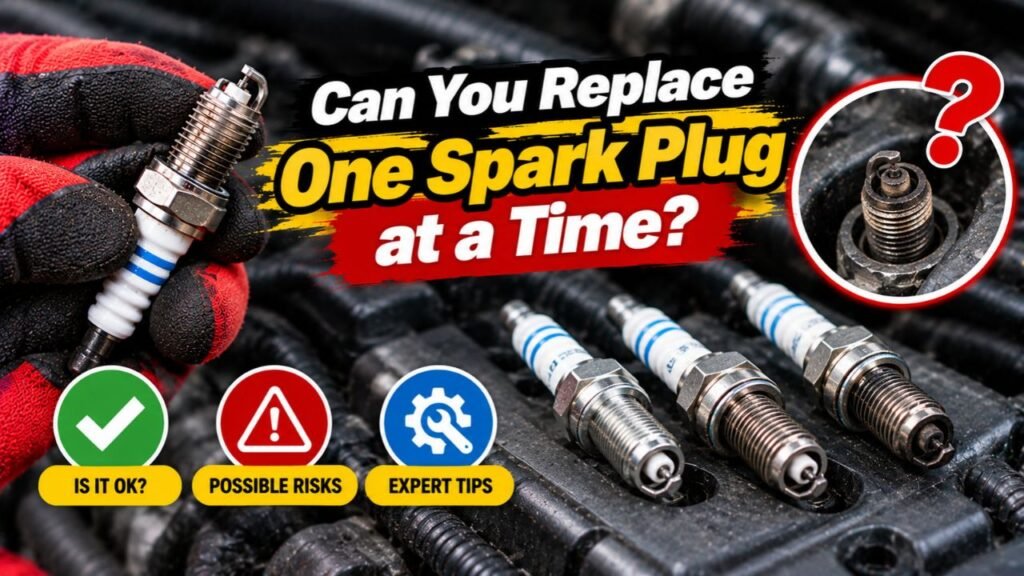
Yes, you can replace one spark plug at a time as long as the replacement plug is the correct specification for the engine and the other plugs are still in good condition.
There is no requirement that every spark plug must always be replaced simultaneously just because one is removed.
Replacing one plug makes sense when:
- One relatively new plug is physically damaged.
- A plug was accidentally cracked during service.
- One plug was contaminated because of a temporary problem that has been corrected.
- A recently installed plug is defective.
- The remaining plugs have low mileage and are in good condition.
- You are replacing one incorrect plug installed during previous service.
If all the plugs are old or close to the manufacturer’s replacement interval, however, replacing the entire set is usually more practical.
Why Are Spark Plugs Usually Replaced as a Set?
Spark plugs in the same engine normally experience similar operating time.
For example, if an engine has six cylinders and the plugs have traveled 80,000 miles, all six plugs have been firing throughout those 80,000 miles.
Their exact condition may differ slightly because individual cylinders can have differences in:
- Fuel mixture
- Oil consumption
- Combustion temperature
- Injector performance
- Ignition-coil condition
Even so, normal electrode wear tends to affect the entire set over time.
Replacing all the plugs during scheduled maintenance gives each cylinder fresh plugs with similar electrode condition and performance.
It also reduces the likelihood that another old plug will fail shortly afterward.
When Is Replacing Just One Spark Plug Okay?
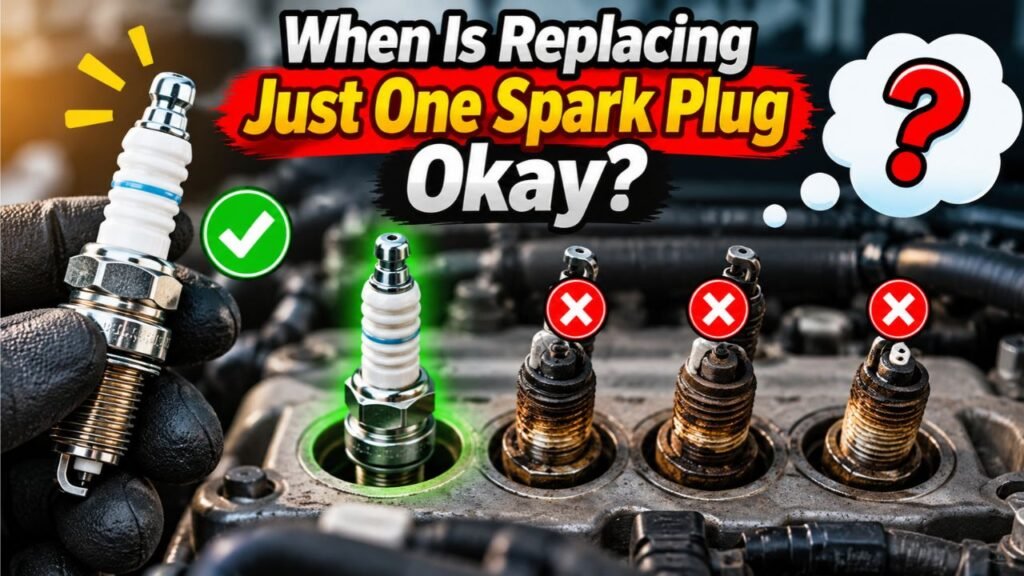
There are several situations where replacing only one plug is completely reasonable.
One New Spark Plug Is Damaged
Suppose you recently installed a complete set of spark plugs and one ceramic insulator becomes cracked during another repair.
There is little reason to replace the other nearly new plugs.
Install one identical replacement plug instead.
One Plug Is Defective
Manufacturing defects are uncommon, but they can occur.
If testing confirms that one recently installed plug is defective while the others are operating normally, replacing only the defective plug is appropriate.
One Plug Was Installed Incorrectly
A plug may have been:
- Incorrectly gapped
- Cross-threaded
- Damaged during installation
- Incorrect for the engine
If the problem is isolated and the other plugs are correct and relatively new, replacing one may be enough.
A Temporary Engine Problem Fouled One Plug
One cylinder may occasionally foul a plug because of a separate fault.
For example, a temporary injector or ignition problem could leave one spark plug contaminated.
If the underlying problem has been properly corrected and the remaining plugs are still serviceable, replacing the affected plug can make sense.
When Should You Replace All the Spark Plugs?
Replacing the entire set is usually better when the plugs have substantial mileage or are already due for scheduled service.
Consider replacing all of them if:
- One plug failed from normal electrode wear.
- The engine has reached its spark-plug service interval.
- Several plugs show significant wear.
- You do not know when the plugs were last changed.
- Multiple cylinders have intermittent misfires.
- Accessing the plugs requires substantial labor.
- You are already removing major components to reach them.
If reaching the spark plugs requires removing an intake manifold, for example, replacing the complete set can prevent paying for or repeating the same labor later.
Can One New Spark Plug Work With Old Spark Plugs?
Yes.
An engine does not require every spark plug to have exactly the same number of miles.
A new plug can operate alongside older plugs if all of them meet the required specifications and the older plugs are still functioning properly.
However, significant differences in plug condition can contribute to differences in ignition performance between cylinders.
A heavily worn plug may require more voltage to produce a spark than a fresh plug because its electrode gap can increase with wear.
That does not necessarily mean the engine immediately runs poorly, but a uniform set is preferable when the existing plugs are near the end of their lifespan.
Should All Spark Plugs Be the Same Brand?
Ideally, all plugs should meet the same manufacturer-specified:
- Part number or equivalent specification
- Heat range
- Electrode design
- Thread dimensions
- Reach
- Seat design
- Gap requirements
- Resistor specification
Using the same brand and part number throughout the engine makes consistency easier.
However, the brand name itself is less important than using plugs that correctly meet the engine manufacturer’s specifications.
Do not install a random spark plug simply because its threads fit the cylinder head.
What Happens If You Use the Wrong Spark Plug?
Using the wrong spark plug can create much more serious problems than mixing an old and new plug.
An incorrect plug may have the wrong:
- Heat range
- Thread reach
- Electrode design
- Seat type
- Resistance
- Gap
- Physical dimensions
A plug with excessive reach could potentially extend too far into the combustion chamber.
The wrong heat range may also cause poor combustion, deposits, overheating, or pre-ignition problems in severe cases.
Always verify the exact recommended plug for your engine.
Does One Bad Spark Plug Mean the Others Are Bad?
Not necessarily.
One spark plug can fail for an isolated reason.
But the condition of the failed plug can provide important clues.
Normal Wear
If the electrode is simply worn after many miles, the rest of the plugs are probably similarly aged.
Replacing the full set usually makes sense.
Oil-Fouled Plug
A spark plug covered with oil may indicate an engine problem such as oil entering the combustion chamber.
Simply replacing the plug may not solve the underlying cause.
Fuel-Fouled Plug
A wet or heavily carbon-fouled plug may indicate:
- Ignition failure
- Injector problems
- Excessively rich fuel mixture
- Repeated unsuccessful starting
The cause should be diagnosed before assuming the plug itself is responsible.
Damaged Ceramic Insulator
If one plug’s ceramic was accidentally cracked during installation or removal, the other plugs may be perfectly fine.
Can One Bad Spark Plug Cause a Misfire?
Yes.
A failed or severely worn spark plug can prevent proper combustion in one cylinder and cause an engine misfire.
Possible symptoms include:
- Rough idle
- Engine shaking
- Poor acceleration
- Reduced power
- Increased fuel consumption
- Check engine light
- Flashing check engine light in severe cases
A diagnostic trouble code such as P0301, P0302, and similar cylinder-specific misfire codes can identify which cylinder is experiencing the misfire, but the code does not prove that the spark plug is the cause.
Other possible causes include:
- Ignition coil
- Fuel injector
- Wiring
- Compression loss
- Vacuum leak
- Mechanical engine problem
Diagnosis is important before replacing parts.
Should You Replace the Ignition Coil With the Spark Plug?
Not automatically.
Ignition coils do not normally need to be replaced every time spark plugs are changed.
If one cylinder is misfiring, technicians may move the ignition coil to another cylinder and see whether the misfire moves with it.
If it does, the coil becomes a stronger suspect.
If the misfire remains on the original cylinder, further diagnosis is required.
Replacing good ignition coils simply because you are replacing spark plugs can add unnecessary expense.
Can You Replace Spark Plugs One at a Time While the Engine Is Running?
No.
Spark plugs should be replaced with the engine switched off and cooled sufficiently for service.
Never remove a spark plug from a running engine.
Depending on the ignition system, high voltage is present while the engine operates, and removing components from a running engine creates unnecessary electrical and mechanical hazards.
Spark plugs are also installed directly into the cylinder head, which can become extremely hot during operation.
Should the Engine Be Cold Before Changing Spark Plugs?
For many modern engines—particularly those with aluminum cylinder heads—it is generally best to work on the spark plugs when the engine is cool unless the vehicle manufacturer specifies another procedure.
Removing plugs from a very hot aluminum cylinder head may increase the risk of thread problems.
Allowing the engine to cool also reduces the chance of burns.
Always follow the service instructions for the exact vehicle.
Should You Change One Plug at a Time During a Full Replacement?
Yes, and this is a different meaning of “one at a time.”
Even when replacing the complete set, changing one cylinder’s spark plug and ignition connection at a time can be a smart method.
For engines with spark plug wires, this helps prevent accidentally connecting wires to the wrong cylinders.
A simple process is:
- Remove one plug wire or ignition coil.
- Remove that spark plug.
- Install the new plug.
- Reinstall the wire or coil.
- Move to the next cylinder.
This keeps ignition components organized.
Do You Need to Gap a Replacement Spark Plug?
That depends on the spark plug and vehicle.
Some modern iridium and platinum plugs come pre-gapped for particular applications, but the gap should still be verified according to the plug manufacturer’s recommendations.
Use care when checking fine-wire plugs.
Aggressively bending or contacting a thin precious-metal center electrode can damage it.
Do not automatically adjust every new plug without knowing whether the manufacturer permits it.
Why Spark Plug Gap Matters
The spark plug gap is the distance between the center electrode and ground electrode.
As the ignition system applies high voltage, electricity jumps across this gap and creates the spark that begins combustion.
A gap that is too large may increase the voltage required to fire the plug.
A gap that is too small can change spark characteristics.
Always use the gap specified for the particular engine and spark-plug application.
Should You Use Anti-Seize on New Spark Plugs?
Do not automatically apply anti-seize compound.
Many modern spark plug manufacturers supply plugs with plated threads and recommend installing them without anti-seize.
Adding lubricant to the threads can change the relationship between applied torque and actual clamping force, potentially leading to over-tightening.
Follow the spark plug and vehicle manufacturer’s instructions.
How Tight Should a Spark Plug Be?
Spark plugs should be tightened to the specified torque or installation procedure.
Under-tightening can allow poor heat transfer or sealing.
Over-tightening can:
- Damage cylinder-head threads
- Distort the spark plug
- Damage the plug seat
- Make future removal difficult
Torque requirements vary substantially by:
- Thread diameter
- Cylinder-head material
- Plug seat design
- Vehicle application
Do not rely on a universal torque number.
What If One Spark Plug Looks Different From the Rest?
Pay attention to it.
Comparing plugs can reveal useful information about individual cylinders.
For example, one plug that is dramatically different from the others may indicate:
- Oil entering that cylinder
- Fuel injector issue
- Ignition problem
- Coolant contamination
- Abnormal combustion
- Compression problem
Replacing the unusual plug without investigating why it looks different may only hide the symptom temporarily.
Is It Bad to Replace Only One Iridium Spark Plug?
Not inherently.
If one nearly new iridium spark plug is damaged and the other plugs are in good condition, replacing just that plug with the correct equivalent is reasonable.
If the entire set has reached its recommended service interval, replace all of them.
The same general principle applies to platinum and conventional nickel plugs.
How Long Do Spark Plugs Last?
Spark-plug service life varies considerably by:
- Plug material
- Engine design
- Ignition system
- Operating conditions
- Manufacturer recommendations
Modern long-life iridium or platinum plugs can often remain in service far longer than older conventional designs, but there is no single replacement interval that applies to every vehicle.
Check the maintenance schedule for the exact year, make, model, and engine.
Is Replacing One Spark Plug Cheaper?
In immediate parts cost, yes.
One spark plug is obviously less expensive than an entire set.
However, labor can change the calculation.
If a V6 or V8 engine requires removal of an intake manifold to access some plugs, paying for extensive labor to replace one old plug may not make financial sense when all the others have similar mileage.
Replacing the complete set while access is already available can save labor later.
Common Mistakes When Replacing a Single Spark Plug
Installing a Different Heat Range
Make sure the replacement matches the engine’s required specification.
Ignoring Why the Original Plug Failed
A fouled plug may be the symptom of another engine problem.
Cross-Threading the Plug
Start the spark plug carefully by hand whenever the service procedure permits. It should thread smoothly.
Over-Tightening
Follow the correct torque specification.
Damaging the Ceramic
Spark plug porcelain can crack if the plug is dropped or struck.
Leaving Dirt Around the Plug Hole
Clean loose debris from around the spark plug area before removing the plug so dirt does not fall into the cylinder.
Mixing Up Ignition Components
Keep coils, electrical connectors, and plug wires properly organized during service.
When Should You Have a Mechanic Check the Vehicle?
Replacing one spark plug is relatively straightforward on some engines but much more difficult on others.
Professional diagnosis is especially useful if:
- The same cylinder repeatedly fouls plugs.
- The check engine light keeps returning.
- A spark plug is stuck.
- Cylinder-head threads are damaged.
- A plug breaks during removal.
- The engine continues misfiring after plug replacement.
- Oil or coolant is visible on the plug.
- Access requires significant engine disassembly.
Repeated spark-plug failure usually indicates that something other than the plug needs attention.
FAQs About Can You Replace One Spark Plug at a Time
Is it okay to replace only one spark plug?
Yes. If only one relatively new plug is damaged or defective and the other plugs are still in good condition, replacing one is acceptable.
If all plugs have high mileage, replacing the full set is usually more practical.
Should I replace all spark plugs if one is bad?
If the plug failed because the entire set is old and worn, replacing all of them is recommended.
If one nearly new plug failed for an isolated reason, replacing only that one may be sufficient.
Can one new spark plug cause problems with older plugs?
Normally no, provided all plugs meet the correct engine specifications.
The bigger concern is that older plugs may already be significantly worn and could fail soon.
Can I replace only the spark plug on the misfiring cylinder?
Yes, but first make sure the plug is actually causing the misfire.
Ignition coils, injectors, wiring, compression problems, and air leaks can also cause cylinder-specific misfires.
Do spark plugs have to match?
They should match the engine manufacturer’s required specifications, including heat range, dimensions, electrode design, and other important characteristics.
Using the same correct part number throughout the engine is generally the simplest approach.
Can I change one spark plug now and the rest later?
Yes.
The engine can generally operate with one new plug and several serviceable older plugs. However, if all the plugs are due for scheduled replacement, changing the complete set saves you from repeating the job later.
Should spark plugs be replaced in pairs?
No.
Unlike some vehicle components, spark plugs do not technically need to be replaced in pairs. They are commonly replaced as a complete engine set because they tend to accumulate similar mileage and wear.
What should I do if one new spark plug keeps failing?
Do not keep replacing the plug without diagnosing the cylinder.
Repeated fouling or failure can indicate an ignition, fuel, oil-consumption, cooling-system, or mechanical engine problem.
Conclusion
If you are asking can you replace one spark plug at a time, the answer is yes. A single spark plug can be replaced safely when it is individually damaged or defective and the remaining plugs are still in good condition.
For an engine with an older set of plugs, however, replacing all the spark plugs at the same time is usually more sensible. They have experienced similar mileage, and completing the entire set can provide more consistent maintenance while reducing the chance of repeating the same labor soon.
Most importantly, if one spark plug looks unusually worn, fouled, or damaged compared with the others, find out why. Sometimes the spark plug is the problem; other times it is simply showing evidence of an ignition, fuel, or mechanical issue elsewhere in that cylinder.