
A spark plug normally threads securely into the cylinder head and remains intact for thousands of miles. Occasionally, however, a spark plug can crack, snap during removal, break at the ceramic insulator, or lose part of its electrode. What happens next depends heavily on which part of the spark plug broke and where the broken piece ended up.
If a spark plug breaks inside the engine, the result can range from a difficult removal job to serious piston, valve, cylinder-head, or cylinder-wall damage. If any metal or ceramic fragments fall into the combustion chamber, do not start or crank the engine until the debris has been removed.
A plug that simply snaps off in the cylinder-head threads is very different from a plug whose electrode or porcelain has fallen through the spark plug hole.
A broken shell may sometimes be extracted without removing the cylinder head. Loose debris inside the cylinder is more concerning because the piston moves extremely close to the cylinder head at high speed.
The safest response is to stop what you are doing, determine exactly what broke, and avoid rotating the engine unnecessarily. This guide explains the possible outcomes, symptoms, damage risks, removal options, and when professional repair is the better choice.
What Happens If a Spark Plug Breaks Inside the Engine?
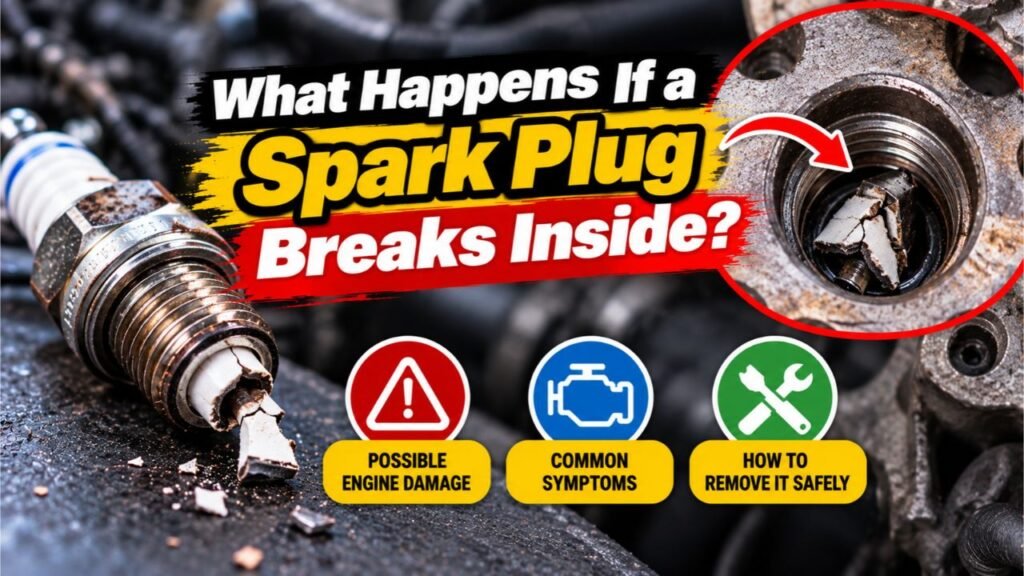
When considering what happens if a spark plug breaks inside, there are three common situations:
- The upper ceramic portion breaks while the metal shell remains threaded into the cylinder head.
- The metal shell or threaded section breaks and becomes stuck in the cylinder head.
- A piece of ceramic, electrode, or metal falls into the combustion chamber.
The first two situations primarily create an extraction problem.
The third situation can create internal engine damage if the engine is cranked or started before the loose material is removed.
Possible consequences include:
- Damaged piston crown
- Bent or damaged valves
- Damaged cylinder head
- Scored cylinder wall
- Damaged spark plug threads
- Loss of compression
- Engine misfire
- Expensive cylinder-head removal
- In severe cases, major engine repair
How serious the situation becomes depends on the location, size, and material of the broken piece.
Different Ways a Spark Plug Can Break
A spark plug consists of several components, including:
- Metal threaded shell
- Ceramic insulator
- Center electrode
- Ground electrode
- Terminal
- Internal resistor on many plugs
Different failures create different risks.
Ceramic Insulator Cracks or Breaks
The white porcelain or ceramic portion can crack from:
- Impact
- Improper installation
- Dropping the plug
- Incorrect socket use
- Excessive side force
- Severe engine conditions
If only the exposed upper ceramic cracks outside the combustion chamber, the engine may simply misfire or leak ignition voltage.
If ceramic fragments fall through the spark plug opening, the situation becomes more serious.
Metal Shell Breaks in the Cylinder Head
Sometimes the upper part of the plug comes out while the threaded metal shell remains stuck in the cylinder head.
This can happen because of:
- Corrosion
- Carbon buildup
- Excessive installation torque
- Cross-threading
- Long service intervals
- Plug design or application issues
The remaining shell normally requires a specialized extractor.
Ground Electrode Breaks Off
The ground electrode is the metal arm that extends over the center electrode.
If it breaks off inside the cylinder, the loose metal can be struck by the piston or trapped around a valve.
This situation should be treated seriously.
Center Electrode Breaks or Melts
A center electrode can sometimes become damaged by severe overheating, detonation, pre-ignition, incorrect spark plug heat range, or other abnormal combustion conditions.
If part of the electrode disappears, the engine should be inspected to determine whether the material entered the combustion chamber and why the plug failed.
What Happens If Spark Plug Porcelain Falls Into the Cylinder?
Ceramic spark plug material is hard and brittle.
If a piece falls into the cylinder and you crank or start the engine, the piston can strike it repeatedly.
Possible results include:
- Dents in the piston
- Damage to the combustion chamber
- Valve damage
- Cracked or chipped surfaces
- Cylinder-wall scoring
- Embedded ceramic fragments
Even a small fragment can cause trouble because the clearance between the piston and cylinder head is limited.
Do not assume the engine will simply blow the debris out through the exhaust valve.
That might happen, but the fragment can cause damage before it ever leaves the cylinder.
What Happens If Metal Falls Into the Cylinder?
Metal fragments are also dangerous.
A broken electrode or part of the threaded shell can become trapped between moving components.
The fragment may be struck by the piston, caught under a valve, or scrape the cylinder wall.
Potential damage includes:
- Piston impact marks
- Bent valve
- Damaged valve seat
- Cylinder-wall scoring
- Loss of compression
If a metal fragment is known to have fallen into the cylinder, avoid rotating the engine until it has been located and removed.
Should You Start the Engine After a Spark Plug Breaks?
Not if there is any reasonable chance that debris entered the combustion chamber.
Starting the engine can turn a manageable extraction problem into internal engine damage.
Do not:
- Start the engine
- Crank it with the starter
- Rotate it unnecessarily by hand
- Use compressed air blindly if it could push debris deeper
First determine what is missing from the spark plug and whether all broken pieces have been accounted for.
Signs Something Fell Into the Cylinder
Sometimes you know immediately that part of the plug is missing.
Other times, the problem becomes apparent only after the engine is started.
Possible symptoms include:
- Metallic tapping
- Knocking
- Sudden misfire
- Rough running
- Loss of compression
- Unusual scraping noise
- Check engine light
- Engine that will not turn normally
If a strange mechanical noise begins immediately after a spark plug breaks, shut the engine off.
Do not continue running it to see whether the noise disappears.
Can a Broken Spark Plug Damage a Piston?
Yes.
The piston travels up and down the cylinder thousands of times per minute while the engine is running.
A loose hard object inside the combustion chamber can be trapped between the piston and cylinder head.
That can leave:
- Dents
- Gouges
- Cracks
- Damaged piston crown surfaces
Minor marks may not destroy the piston, but significant impact damage requires careful inspection.
Can a Broken Spark Plug Damage a Valve?
Yes.
A loose piece can become trapped between a valve and its seat.
If the valve tries to close on the fragment, it can potentially cause:
- Bent valve
- Chipped valve
- Damaged valve seat
- Poor compression
- Burned valve later
Valve damage may require cylinder-head removal.
Can Spark Plug Debris Score the Cylinder Wall?
Yes.
A hard fragment can become trapped between the piston, piston rings, and cylinder wall.
If dragged up and down the bore, it can create vertical scratches or scoring.
Severe cylinder-wall damage may lead to:
- Low compression
- Oil consumption
- Blow-by
- Loss of engine power
This is one reason loose material should be removed before the engine is rotated.
What If Only the Top of the Spark Plug Broke?
If the ceramic above the cylinder head broke but nothing entered the cylinder and the threaded shell remains intact, internal engine damage may not have occurred.
The main problem becomes removing the remaining plug.
Do not keep twisting or prying randomly.
Additional force can:
- Break more ceramic
- Damage the hex
- Damage threads
- Push debris into the cylinder
Determine whether the socket can still engage the metal hex or whether an extractor is required.
What If the Threaded Part Is Stuck in the Head?
A broken threaded shell can sometimes be removed using a purpose-designed spark plug extractor.
The exact procedure depends on the engine and how the plug failed.
A technician may use:
- Broken spark plug extraction tool
- Penetrating lubricant where appropriate
- Specialized internal gripping tool
- Vehicle-specific extraction kit
Some engines are known for particular spark plug removal problems and may have dedicated repair procedures.
Avoid drilling into the broken plug unless you have the correct equipment and understand how to keep metal chips out of the cylinder.
Can You Use an Easy-Out on a Broken Spark Plug?
A screw extractor may work in some situations, but it can also make the repair worse.
Potential problems include:
- Extractor breaks inside the plug
- Shell expands against the cylinder-head threads
- Metal chips enter the combustion chamber
- Cylinder-head threads become damaged
Purpose-designed spark plug extraction tools are generally preferable.
If access is poor or the head is aluminum, professional removal may be safer.
How Can You Remove Debris From Inside the Cylinder?
The best method depends on the material and where it is located.
Possible professional or careful DIY techniques include:
- Flexible borescope inspection
- Small vacuum tube
- Mechanical pickup tool
- Magnetic pickup for suitable ferrous metal
- Specialized retrieval tool
Use a Borescope First
A borescope is one of the most useful tools in this situation.
Insert the camera through the spark plug hole and inspect:
- Piston crown
- Cylinder walls
- Valve area
- Visible debris
Knowing where the fragment is located is much better than blindly trying to retrieve it.
Small Vacuum Tube
A narrow flexible tube attached to a vacuum may retrieve loose debris.
The tube should be small enough to enter through the spark plug hole without becoming stuck.
Magnetic Pickup Tool
A magnet may retrieve some steel fragments.
However, spark plug components are not all magnetic, and ceramic fragments obviously cannot be picked up with a magnet.
Mechanical Grabber
A flexible claw or small retrieval tool can sometimes pick up visible pieces.
Avoid scratching the cylinder wall or piston.
Can You Blow the Broken Piece Out With Compressed Air?
Compressed air is not always a good solution.
Air can move debris to another part of the combustion chamber where it becomes harder to retrieve.
It may also send fragments outward at high speed.
Compressed air is more useful for cleaning dirt around the spark plug hole before removing a plug than for blindly trying to remove debris from inside a cylinder.
If debris is already inside, locating it with a borescope first is preferable.
Can You Turn the Engine to Push Debris Out?
This is risky.
Rotating the engine can allow the piston to crush the fragment against the cylinder head or trap it against a valve.
If debris is known to be inside the cylinder, avoid turning the crankshaft until the object has been removed or a qualified technician determines the correct procedure.
What If You Already Started the Engine?
Shut the engine off if you hear:
- Knocking
- Tapping
- Scraping
- Severe misfire
If the engine was run after debris entered the cylinder, inspection becomes more important.
A technician may use:
- Borescope inspection
- Compression test
- Leak-down test
- Cylinder-head removal if necessary
Even if the engine seems to run normally, visible damage may still be present.
Compression Test After a Broken Spark Plug
A compression test can help determine whether the affected cylinder is sealing normally after the incident.
Low compression may point toward:
- Bent valve
- Damaged valve seat
- Piston damage
- Piston-ring damage
However, normal compression does not guarantee that the piston crown or combustion chamber has no cosmetic damage.
A borescope adds useful visual information.
Leak-Down Test
A cylinder leak-down test provides more detailed information about where pressure is escaping.
Compressed air is introduced into the cylinder with the piston positioned appropriately.
Air escaping through different locations can suggest:
- Intake valve leakage
- Exhaust valve leakage
- Piston ring leakage
This test is useful when internal damage is suspected after a foreign object enters the cylinder.
Why Spark Plugs Break During Removal
Spark plugs can become unusually difficult to remove for several reasons.
Overtightening
A plug installed with excessive torque may become extremely difficult to remove.
Overtightening can also damage:
- Threads
- Plug shell
- Cylinder head
Long Replacement Interval
A plug left installed for many years may develop:
- Carbon buildup
- Corrosion
- Deposits
These can increase removal resistance.
Cross-Threading
A spark plug that was installed at an angle can damage cylinder-head threads and become difficult to remove later.
Removing From an Inappropriate Engine Condition
Service procedures differ by engine.
Some manufacturers specify removing plugs only when the engine is cold, while particular engine designs may have specific removal procedures.
Always follow the vehicle manufacturer’s instructions.
Wrong Spark Plug
Incorrect thread reach, seat design, or plug specification can create removal problems and engine damage.
Why a Spark Plug Electrode Might Break While Driving
If the firing end of a spark plug physically fails during engine operation, investigate the cause rather than simply installing another plug.
Possible causes include:
- Detonation
- Pre-ignition
- Excessive combustion temperature
- Wrong heat range
- Incorrect plug reach
- Foreign-object contact
- Manufacturing defect
- Severe deposits
A plug that extends too far into the combustion chamber can potentially contact internal components in some applications.
Always use the exact plug specification recommended for the engine.
Can a Broken Spark Plug Ruin the Cylinder Head?
Yes, particularly if the threads are damaged during removal.
Cylinder heads on many modern engines are aluminum, while spark plug shells are steel.
Improper extraction can damage the softer aluminum threads.
Possible repairs include:
- Thread repair insert
- Specialized spark plug thread insert
- Cylinder-head removal
- Cylinder-head replacement in severe cases
Thread repairs must be performed accurately so the spark plug seats and seals correctly.
Can You Drive With a Broken Spark Plug?
No, not if the plug is physically broken or unable to seal and function correctly.
Possible consequences include:
- Severe misfire
- Escaping combustion gases
- Ignition coil damage
- Catalytic converter overheating
- Internal engine damage if fragments are present
If part of the spark plug is missing inside the cylinder, do not drive the vehicle.
Broken Spark Plug vs. Blown-Out Spark Plug
These are different problems.
A broken spark plug physically fractures or separates.
A blown-out spark plug is forced out of the cylinder head by combustion pressure, usually because the threads can no longer retain it properly.
A blown-out plug may damage:
- Cylinder-head threads
- Ignition coil
- Plug boot
Both problems require repair before normal driving.
What to Do Immediately If a Spark Plug Breaks
If a plug breaks during removal, use a cautious sequence:
- Stop applying force.
- Do not start the engine.
- Inspect the broken plug.
- Account for all visible pieces.
- Cover the spark plug opening if you pause the repair.
- Use a borescope if material may have fallen inside.
- Remove loose debris before rotating the engine.
- Use the correct extraction tool for a stuck shell.
- Inspect the cylinder-head threads afterward.
- Install the replacement plug to the correct specification and torque.
If you cannot confidently determine whether debris entered the cylinder, professional inspection is the safer option.
When Should You Call a Mechanic?
Professional help is appropriate when:
- Threaded shell is seized in the cylinder head
- Ceramic fell into the cylinder
- Electrode is missing
- Extractor broke in the plug
- Cylinder-head threads are damaged
- Engine was run with debris inside
- Compression is low afterward
- Metallic knocking is present
- You cannot retrieve a visible fragment
A relatively simple extraction can become much more expensive if aggressive DIY attempts damage the cylinder head.
How to Prevent a Spark Plug From Breaking
Proper installation and service can reduce the risk.
Use the Correct Spark Plug
Verify:
- Thread diameter
- Thread reach
- Seat type
- Heat range
- Electrode design
- Manufacturer application
Start the Plug by Hand
Whenever access allows, begin threading the plug by hand or with a suitable extension before using a ratchet.
This reduces the chance of cross-threading.
Use Correct Torque
Spark plugs should be tightened to the engine or plug manufacturer’s specification.
Too loose can allow leakage.
Too tight can damage the plug or cylinder-head threads.
Use the Correct Spark Plug Socket
A proper socket supports the spark plug and helps reduce accidental side loading.
Replace Plugs at the Recommended Interval
Leaving plugs installed far beyond their intended service interval can make later removal more difficult.
Common Mistakes After a Spark Plug Breaks
Immediately Cranking the Engine
This can turn loose debris into damaging projectiles inside the cylinder.
Assuming Small Ceramic Pieces Are Harmless
Even tiny hard fragments can become trapped between moving engine parts.
Drilling Without Controlling Metal Chips
Drilling a broken shell can introduce additional debris.
Using Excessive Extractor Force
A broken hardened-steel extractor can make the repair much more difficult.
Replacing the Plug Without Investigating Electrode Failure
If an electrode broke during normal driving, there may be an underlying combustion or installation issue.
FAQs About What Happens If a Spark Plug Breaks Inside
What happens if spark plug porcelain falls into the engine?
Ceramic fragments can be struck by the piston or trapped near a valve, potentially damaging the piston, cylinder head, valves, or cylinder walls.
Do not start the engine until the fragments have been removed.
Can a broken spark plug destroy an engine?
It can cause serious engine damage if a hard fragment enters the combustion chamber and is repeatedly struck by moving components.
A broken shell stuck in the cylinder head is usually less destructive if the engine is not operated and the shell is removed correctly.
Can a spark plug break off inside the cylinder head?
Yes.
The ceramic and upper body can separate while the threaded metal shell remains installed in the head.
A specialized extraction tool may be needed.
What should I do if a piece of spark plug falls into the cylinder?
Do not crank or start the engine.
Inspect the cylinder with a borescope and retrieve the debris using an appropriate vacuum, pickup, or mechanical tool.
Will a small piece of ceramic just burn up?
No.
Spark plug ceramic is designed to tolerate extremely high combustion temperatures and will not simply burn away like ordinary combustible material.
It should be removed.
Can the engine push spark plug debris out through the exhaust?
It is possible for a very small loose piece eventually to leave through an exhaust valve, but relying on that is risky.
The debris can damage the piston, valve, or cylinder before it exits.
How do you know if a broken spark plug damaged the engine?
A borescope inspection can reveal visible damage. Compression and leak-down testing can help identify valve, ring, or sealing problems.
Abnormal noises or persistent misfires also warrant further inspection.
Can you remove a broken spark plug without removing the cylinder head?
Often, yes.
A broken threaded shell can sometimes be extracted with a specialized tool while the cylinder head remains installed. If debris cannot be retrieved or the threads are severely damaged, cylinder-head removal may become necessary.
Conclusion
Understanding what happens if a spark plug breaks inside depends on determining exactly which part failed. A broken ceramic top or threaded shell can often be handled as an extraction problem, while ceramic or metal fragments inside the combustion chamber create a risk of piston, valve, cylinder-head, and cylinder-wall damage.
If any part of the spark plug may have fallen into the cylinder, do not start or unnecessarily rotate the engine. Inspect the cylinder, remove the debris, and verify that the piston, valves, threads, and combustion chamber remain in good condition.
Handling the problem carefully at the beginning can mean the difference between replacing one broken spark plug and facing a much more expensive internal engine repair.