
If you are wondering what is spark plug gap for lawn mower engines, a common gap is around 0.030 inch, but the correct specification can vary by engine and spark plug. Many mower engines use a gap somewhere around 0.020 to 0.030 inch, while some models specify a value slightly outside that range. The safest approach is always to check the mower or engine owner’s manual, engine decal, or spark plug application information before adjusting a new plug.
Spark plug gap is the small distance between the center electrode and ground electrode at the firing end of the plug. That distance directly affects how much voltage the ignition system needs to create a spark.
If the gap is too narrow, the spark can be weaker or smaller than intended. If it is too wide, the ignition coil may struggle to jump the gap, particularly when starting or when the engine is under load.
For a lawn mower, even a difference of a few thousandths of an inch can affect starting quality, idle smoothness, and overall combustion.
In this guide, I’ll explain the common lawn mower spark plug gap, how to find the correct specification for your engine, how to measure and adjust the gap, what happens when it is wrong, whether new spark plugs come pre-gapped, and when you should replace the plug instead of adjusting it.
What Is the Typical Spark Plug Gap for a Lawn Mower?
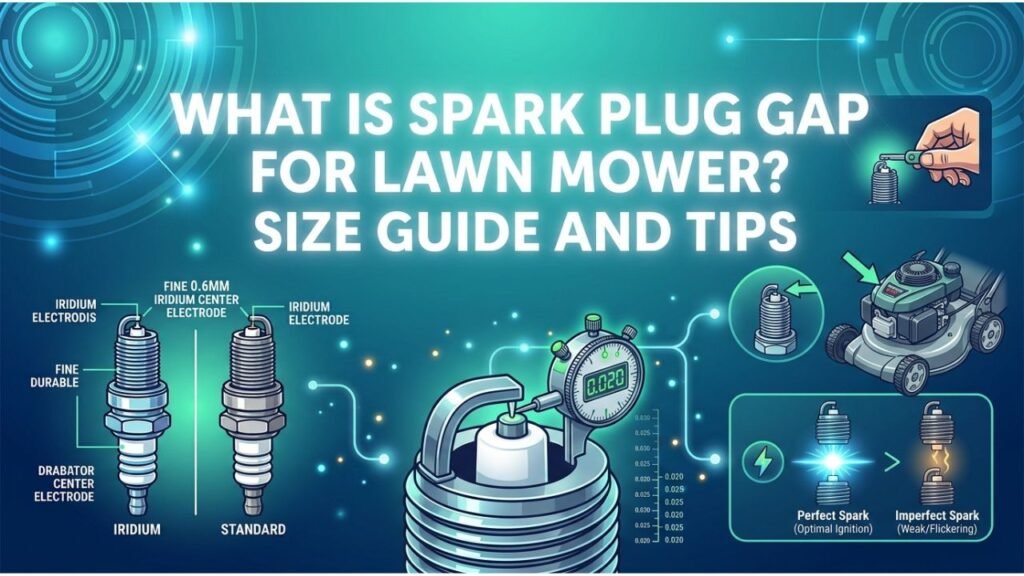
A 0.030-inch spark plug gap is very common on lawn mower engines.
That is equivalent to approximately 0.76 mm.
However, not every lawn mower uses exactly 0.030 inch.
Depending on engine design, ignition system, and plug specification, you may encounter gaps such as:
0.020 inch
0.025 inch
0.028 inch
0.030 inch
0.032 inch
These differences may seem tiny, but they matter.
The ignition coil is designed to produce enough voltage to fire across a particular gap under operating conditions.
For that reason, I do not recommend setting every lawn mower plug to 0.030 inch automatically.
Use 0.030 inch only when it matches the specification for your exact mower or engine.
Why Lawn Mower Spark Plug Gap Matters
The spark plug does more than simply create a visible spark.
It must fire reliably inside a combustion chamber where pressure is much higher than atmospheric pressure.
The greater the electrode gap, the more voltage generally required for the spark to jump across it.
That relationship makes the gap part of the ignition-system design.
If the Gap Is Correct
A properly gapped spark plug helps the engine:
Start reliably.
Idle smoothly.
Accelerate without hesitation.
Burn the air-fuel mixture consistently.
Maintain normal power under load.
The gap does not create more horsepower by itself, but the correct setting helps the ignition system operate as intended.
If the Gap Is Too Wide
An excessively wide gap increases the voltage required to fire the plug.
That can lead to:
Hard starting.
Intermittent spark.
Misfire under load.
Rough operation.
Loss of power.
More stress on the ignition system.
A mower may run acceptably with no load but begin missing when cutting thick grass because cylinder pressure and engine load increase.
If the Gap Is Too Narrow
A narrow gap requires less voltage to jump, but the spark itself may be smaller.
Possible symptoms include:
Poor combustion.
Rough idle.
Reduced performance.
Carbon fouling.
Hard starting in certain conditions.
The mower may still run, but the ignition system is no longer operating at the gap selected by the engine manufacturer.
Key Takeaways:
- Around 0.030 inch is common, but it is not universal.
- Too much gap can cause hard starting and misfires.
- Too little gap can reduce spark effectiveness and combustion quality.
- Always use the specification for the exact mower engine whenever possible.
How to Find the Correct Lawn Mower Spark Plug Gap
There are several reliable ways to determine the correct gap.
Check the Owner’s Manual
The mower or engine owner’s manual should be your first source.
Look under sections such as:
Spark plug.
Engine maintenance.
Ignition system.
Tune-up specifications.
Periodic maintenance.
The manual may list the spark plug model and required electrode gap together.
Check the Engine Model Number
The mower brand and engine brand may be different.
For example, a mower manufactured by one company may use an engine supplied by another engine manufacturer.
When looking up spark plug specifications, the engine model number is often more useful than the mower deck model.
Engine identification information is commonly found on the engine housing, valve cover, blower housing, or nearby identification label.
Check the Existing Spark Plug Specification
If you know the exact correct replacement plug for the engine, its application information can help identify the required gap.
However, do not assume the plug’s factory gap automatically matches every engine that uses that plug.
The same basic spark plug may sometimes be used in more than one application with different gap requirements.
Look for an Engine Decal
Some small engines have maintenance information printed directly on the engine.
This can include:
Recommended spark plug.
Plug gap.
Oil type.
Maintenance intervals.
If your engine has such a label and it is still legible, it is a convenient reference.
Common Lawn Mower Spark Plug Gap Sizes
Although the exact specification varies, the following values are commonly encountered in small gasoline engines:
| Spark Plug Gap | Metric Equivalent | Typical Use |
| 0.020 in. | 0.51 mm | Some small or older engines |
| 0.025 in. | 0.64 mm | Certain small-engine applications |
| 0.028 in. | 0.71 mm | Some mower and outdoor-power engines |
| 0.030 in. | 0.76 mm | Very common lawn mower specification |
| 0.032 in. | 0.81 mm | Some ignition-system applications |
This table should be used only as a general reference.
It is not a substitute for the manufacturer specification.
Two lawn mower engines that look nearly identical can use different plugs or different gaps.
What Does Spark Plug Gap Actually Mean?
The spark plug has two electrodes at its firing end.
The center electrode runs through the middle of the plug.
The ground electrode curves over the center electrode.
Spark plug gap is the distance between them at their closest point.
When the ignition coil generates high voltage, electricity attempts to travel from one electrode to the other.
It cannot normally pass through the air-fuel mixture until the voltage becomes high enough to ionize the gap.
Once that threshold is reached, a spark jumps across.
That spark ignites the compressed mixture in the cylinder.
The gap therefore affects how difficult it is for the ignition system to create the spark.
How to Measure Lawn Mower Spark Plug Gap
Measuring the gap is simple and requires an inexpensive spark plug gap gauge.
Common gauge types include:
Wire-style gauges.
Coin-style ramp gauges.
Feeler gauges.
For precise small-engine work, I prefer a wire-style spark plug gauge because each wire represents a specific thickness and fits naturally between the electrodes.
Step 1: Make Sure the Engine Is Cool
Never remove a spark plug from a very hot aluminum cylinder head if you can avoid it.
Allow the engine to cool first.
Working on a cool engine also reduces burn risk.
Step 2: Disconnect the Spark Plug Wire
Pull the spark plug boot off the plug.
Grip the boot rather than yanking on the ignition wire itself.
Keeping the wire disconnected also helps prevent accidental starting while you work.
Step 3: Remove the Spark Plug
Use the correct spark plug socket.
Clean debris from around the plug before removal so dirt does not fall into the cylinder.
Turn the plug counterclockwise to remove it.
Step 4: Insert the Gauge
Place the correct gauge thickness between the center and ground electrodes.
For example, if the specification is 0.030 inch, try the 0.030-inch gauge.
The gauge should pass through with a slight, controlled drag.
If it falls through loosely, the gap is probably too wide.
If it will not fit, the gap is too narrow.
Step 5: Compare With the Specification
Do not adjust the plug until you know the correct number.
A gap that looks “about right” is not accurate enough.
Spark plug gaps are measured in thousandths of an inch.
How to Adjust Lawn Mower Spark Plug Gap
Most conventional nickel spark plugs allow some gap adjustment.
The basic principle is simple:
Only bend the ground electrode.
Do not pry against the center electrode or ceramic insulator.
If the Gap Is Too Wide
Carefully bend the ground electrode inward.
Use a proper spark plug gapping tool rather than hitting the plug against a hard surface.
Make a very small adjustment.
Then measure again.
If the Gap Is Too Narrow
Use the adjustment feature on your gapping tool to bend the ground electrode outward slightly.
Again, move it only a small amount.
Recheck after every adjustment.
Never Force the Center Electrode
The center electrode is connected through the ceramic insulator.
Side-loading or prying against it can damage the plug even if the crack is not immediately visible.
A damaged insulator can cause misfires or allow the spark to leak internally.
Should You Gap Iridium or Platinum Lawn Mower Spark Plugs?
Use extra care.
Fine-wire iridium and platinum plugs have much smaller and more delicate center electrodes than traditional copper-core or nickel-electrode plugs.
Many are supplied close to their intended gap.
You should still verify the gap if the plug manufacturer permits it, but do not press a hard tool against the fine center electrode.
If adjustment is required, bend only the ground electrode.
If a premium plug arrives dramatically outside the required specification, I would rather exchange it than aggressively reshape the electrode.
For a lawn mower using a conventional plug, adjustment is normally simpler.
Do New Lawn Mower Spark Plugs Come Pre-Gapped?
Many new spark plugs are supplied with a factory-set gap, but you should not assume the factory setting is correct for your engine.
The plug may fit several engines with different requirements.
Shipping and handling can also slightly change the ground electrode position.
For that reason, checking the gap before installation is a good habit.
It takes only a few seconds.
If the factory setting matches the mower specification, install the plug without changing it.
Can You Use a Spark Plug Straight Out of the Box?
You can if you confirm that the gap is correct.
Do not adjust a perfectly correct new spark plug simply because you think every new plug needs to be “gapped.”
Measure first.
Adjust only if necessary.
This avoids unnecessary bending of the ground electrode.
What Happens If Lawn Mower Spark Plug Gap Is Too Wide?
An excessively wide gap requires higher ignition voltage.
A strong ignition coil may still fire it under some conditions, which is why the mower can appear normal at first.
Problems often become more noticeable when:
The engine is cold.
The mixture is rich.
The engine is under heavy cutting load.
The ignition coil is weak.
The spark plug is worn.
Cylinder pressure is higher.
A wide-gap plug may therefore create intermittent symptoms rather than complete no-start failure.
Symptoms of Too-Wide Gap
Common signs include:
Long cranking or repeated pull-start attempts.
Engine stumbling.
Misfires.
Loss of power in tall grass.
Rough running.
Occasional backfiring or incomplete combustion.
Do not diagnose these symptoms solely by spark plug gap, though.
Fuel problems, carburetor faults, dirty air filters, weak coils, stale gasoline, and compression issues can produce similar symptoms.
What Happens If the Gap Is Too Small?
A narrow gap allows the voltage to jump more easily.
That sounds beneficial, but the spark may not expose as much mixture to the ignition kernel.
In some operating conditions, that can reduce combustion reliability.
Possible effects include:
Incomplete combustion.
Roughness.
Fouling.
Reduced power.
Poor throttle response.
The engine may continue running, making a narrow gap harder to notice than a gap that is far too wide.
Does Spark Plug Gap Increase With Wear?
Usually, yes.
Over time, spark plug electrodes wear away.
As material erodes from the center and ground electrodes, the gap can gradually become larger.
A widening gap makes the ignition coil work harder to produce enough voltage to jump the distance.
This is one reason old plugs can cause hard starting or misfire even when they do not appear badly fouled.
Eventually, replacement is better than repeatedly bending a worn ground electrode back toward the center.
Should You Re-Gap an Old Lawn Mower Spark Plug?
You can check and correct a slightly worn conventional plug as part of maintenance.
However, gap adjustment does not reverse electrode wear, erosion, deposits, cracked insulation, or internal plug deterioration.
Replace the plug when:
The electrodes are badly rounded.
The plug is heavily fouled.
The insulator is cracked.
The threads are damaged.
The center electrode is badly eroded.
The plug has reached its recommended service interval.
Spark plugs for lawn mowers are relatively inexpensive, so there is little reason to keep a badly worn one in service.
Key Takeaways:
- Normal electrode wear usually makes the gap wider over time.
- Re-gapping can correct minor changes but cannot restore worn electrodes.
- Replace plugs that are damaged, badly fouled, or heavily eroded.
How Often Should You Check Lawn Mower Spark Plug Gap?
A practical time to inspect the spark plug is during routine seasonal maintenance.
For many homeowners, that means checking it near the beginning of the mowing season.
You may also inspect it after a specified number of operating hours according to the engine maintenance schedule.
Remove the plug and examine:
Electrode condition.
Deposits.
Ceramic condition.
Gap.
Thread condition.
A healthy plug can provide useful clues about how the engine is running.
For example, heavy black deposits may indicate an overly rich mixture, excessive idling, wrong plug heat range, or another combustion issue.
Oily deposits can point toward oil entering the combustion chamber.
Do not simply clean and re-gap a plug repeatedly if it continues fouling. Diagnose the underlying cause.
Can Wrong Spark Plug Gap Cause a Lawn Mower Not to Start?
Yes, especially when the gap is significantly wrong.
A very wide gap may require more voltage than a weak ignition coil can provide reliably.
This can produce little or no spark under compression.
A severely closed gap can also prevent proper ignition.
However, if your mower suddenly refuses to start, do not automatically blame the spark plug gap.
Other common causes include:
Old or contaminated fuel.
Blocked carburetor jets.
Closed fuel valve.
Faulty safety switch.
Dirty air filter.
Weak ignition coil.
Damaged spark plug.
Incorrect choke operation.
Low compression.
Check the spark plug as part of the diagnosis rather than assuming it is always the cause.
Can Incorrect Gap Cause a Lawn Mower to Misfire?
Yes.
Misfire occurs when combustion fails or occurs inconsistently.
If the gap is too wide, the coil may occasionally fail to produce enough voltage to cross it.
This can become especially noticeable when the engine is under load.
If the gap is much too narrow, combustion may also be less consistent.
Before changing the gap, verify that the spark plug itself is the correct model for the engine.
The correct gap cannot compensate for a plug with the wrong heat range, reach, or electrode design.
Does Spark Plug Gap Affect Lawn Mower Power?
Indirectly.
Correct gap helps ensure consistent ignition.
If the gap is far outside specification and causes misfires, combustion becomes incomplete and engine power drops.
A properly gapped mower should therefore run closer to its intended performance.
However, widening the gap beyond specification does not create free horsepower.
The ignition system has a limited voltage capability.
An excessive gap can eventually make performance worse.
Likewise, closing the gap excessively does not make the ignition “stronger.”
Stay with the manufacturer specification.
Does Spark Plug Gap Affect Fuel Consumption?
It can indirectly affect fuel use if the wrong gap causes poor combustion or misfire.
A misfiring engine can waste fuel because some air-fuel mixture is not being burned efficiently.
However, changing spark plug gap should not be treated as a fuel-economy tuning method.
For a lawn mower that is consuming too much fuel, also consider:
Dirty air filter.
Carburetor adjustment or faults.
Choke not opening fully.
Old fuel.
Engine wear.
Excessive load.
Incorrect operating speed.
Use the correct spark plug gap as basic maintenance, not as an experimental efficiency modification.
Lawn Mower Spark Plug Gap in Inches vs. Millimeters
Spark plug specifications may be provided in either inches or millimeters.
Common conversions include:
0.020 inch ≈ 0.51 mm
0.025 inch ≈ 0.64 mm
0.028 inch ≈ 0.71 mm
0.030 inch ≈ 0.76 mm
0.032 inch ≈ 0.81 mm
If your gauge is marked only in millimeters while your manual gives inches, use the closest accurate metric equivalent.
Do not confuse 0.030 inch with 0.30 inch.
A 0.30-inch spark plug gap would be ten times larger and completely inappropriate for a lawn mower spark plug.
What Tool Should You Use to Gap a Lawn Mower Spark Plug?
A dedicated spark plug gap tool is inexpensive and convenient.
My preferred choice is a wire-style gauge with small bending tools built into the body.
A feeler gauge can also provide an accurate measurement.
Coin-style ramp gauges are common and convenient, but avoid pushing the tapered edge aggressively between delicate fine-wire electrodes because doing so can place sideways force on the center electrode.
The most important requirement is that you can measure the actual gap accurately without damaging the plug.
How Tight Should a Lawn Mower Spark Plug Be?
Spark plug gap and installation torque are separate issues, but both matter.
Do not overtighten the plug.
Small mower engines commonly use aluminum cylinder heads, and excessive torque can damage the threads.
At the same time, a plug that is too loose may not transfer heat correctly and can leak combustion pressure.
Use the torque specified by the engine or spark plug manufacturer.
If a torque wrench is unavailable, follow the spark plug manufacturer’s seat-and-turn instructions for the particular plug type.
Gasket-seat and tapered-seat plugs use different tightening procedures.
Never assume one universal number applies to every mower engine.
Can You Change Spark Plug Gap for Better Performance?
I do not recommend intentionally changing the gap away from the manufacturer’s specification on a stock lawn mower.
A wider gap can theoretically expose a larger portion of mixture to the initial spark, but it also demands more voltage.
A narrower gap may fire more easily, but it can reduce spark exposure.
Engine manufacturers choose the gap to balance:
Ignition coil capability.
Compression pressure.
Combustion chamber design.
Engine speed.
Starting requirements.
Spark plug design.
Reliability.
Unless you are building or tuning a modified engine and understand the complete ignition system, the factory specification is the best choice.
Common Mistakes When Gapping Lawn Mower Spark Plugs
One of the most common mistakes is assuming every mower uses a 0.030-inch gap.
That number is very common, but it is not universal.
Another mistake is measuring the plug against the outer shell instead of between the center and ground electrodes.
Some users also pry directly against the center electrode when adjusting the gap.
That can damage the ceramic or fine electrode.
Do not use excessive force.
Small adjustments are all that should be required.
Another mistake is trying to save an obviously worn plug simply by closing the gap.
If the electrodes are badly eroded or rounded, replace the spark plug.
Finally, installing the wrong plug model and then setting it to the “correct” gap does not make it the correct plug.
Thread reach, heat range, seat design, and electrode projection still have to match the engine.
Lawn Mower Spark Plug Safety
Allow the engine to cool before removing the spark plug.
Disconnect the plug wire before working around the mower blade or other moving components.
On an electric-start mower, disconnecting the battery may provide additional protection during service when recommended by the manufacturer.
Never rotate or move the mower blade unnecessarily while the spark plug remains connected because engine movement can potentially create an ignition event.
Clean around the spark plug before removal so dirt cannot fall into the cylinder.
When reinstalling the plug, start the threads by hand.
If it will not turn smoothly, stop.
Cross-threading an aluminum cylinder head can turn a simple maintenance job into an expensive repair.
FAQs about What Is Spark Plug Gap for Lawn Mower
What is the standard lawn mower spark plug gap?
There is no single standard for every mower, but 0.030 inch is one of the most common specifications.
Always check the specification for the exact engine.
Is 0.030 inch a normal lawn mower spark plug gap?
Yes.
A 0.030-inch, or approximately 0.76-mm, gap is very common on small gasoline mower engines.
Can a lawn mower spark plug gap be 0.020 inch?
Yes.
Some small engines specify approximately 0.020 inch.
Do not widen it to 0.030 inch unless the engine manufacturer specifies that setting.
What happens if the spark plug gap is too wide?
The ignition coil must produce more voltage to jump the gap.
Possible symptoms include hard starting, misfiring, rough running, and loss of power under load.
What happens if spark plug gap is too small?
A narrow gap can produce a smaller spark and may contribute to poor combustion, fouling, rough operation, or reduced performance.
How do I know the correct gap for my mower?
Check the mower or engine owner’s manual, engine identification label, manufacturer service information, or spark plug application chart.
Can I measure spark plug gap with a feeler gauge?
Yes.
A feeler gauge works well when used carefully.
A wire-style spark plug gauge is another excellent option.
Do new lawn mower spark plugs need to be gapped?
They should at least be checked.
Many come pre-gapped, but the factory setting may not exactly match your engine’s required specification.
Should I gap an iridium lawn mower spark plug?
Verify the specification, but use extreme care around the fine center electrode.
Adjust only the ground electrode if adjustment is allowed and necessary.
Can the wrong spark plug gap stop a lawn mower from starting?
Yes, if the gap is far enough outside specification.
However, fuel, carburetor, ignition, compression, and safety-system problems can also cause a no-start condition.
Can spark plug gap cause misfire?
Yes.
An excessive gap can require more ignition voltage than the system can reliably provide, particularly under load.
Does spark plug gap get larger over time?
Usually.
Electrode erosion gradually increases the distance between the center and ground electrodes.
Can I just bend the spark plug electrode?
Only the ground electrode should be carefully bent for normal gap adjustment.
Do not pry against the center electrode or ceramic insulator.
What is 0.030 spark plug gap in millimeters?
Approximately 0.76 mm.
What is 0.025 inch in millimeters?
Approximately 0.64 mm.
Can I use any spark plug if the gap is correct?
No.
The plug must also have the correct thread diameter, reach, seat type, heat range, electrode design, and other specifications.
Does a wider gap make a lawn mower more powerful?
Not necessarily.
If the gap becomes wider than the ignition system can reliably fire, performance can actually decrease.
Should I gap the plug before or after installing it?
Measure and adjust the spark plug before installing it in the engine.
This provides better access and reduces the chance of damaging the plug or cylinder-head threads.
Should I replace or re-gap an old lawn mower spark plug?
A lightly used plug in good condition can be re-gapped.
Replace it if the electrodes are badly worn, the ceramic is damaged, it is heavily fouled, or it has reached the recommended service interval.
Conclusion
So, what is spark plug gap for lawn mower engines? A gap of approximately 0.030 inch, or 0.76 mm, is very common, but there is no single correct setting for every lawn mower.
Depending on the engine, the specification may be 0.020, 0.025, 0.028, 0.030, 0.032 inch, or another value chosen by the manufacturer.
That is why I recommend checking the exact engine specification before adjusting the spark plug.
The gap matters because it determines how much voltage is required for the spark to jump between the center and ground electrodes. Too much gap can create hard starting and misfires, while too little gap can reduce spark effectiveness and combustion quality.
Use a proper spark plug gap gauge, measure between the two electrodes, and make only small adjustments to the ground electrode. Never pry directly against the center electrode, especially on fine-wire iridium or platinum plugs.
Also remember that gap is only one part of spark plug selection. The correct plug must have the proper heat range, reach, thread size, seat style, and electrode configuration for the engine.
For most lawn mower maintenance, the best rule is simple: look up the exact specification, verify the new plug before installation, and keep the gap at the manufacturer’s recommended setting rather than trying to tune it wider or narrower for extra performance.