
If you are wondering are Champion spark plugs pre gapped, yes—Champion states that its spark plugs generally come pre-gapped, so adjustment is often unnecessary. However, Champion still recommends checking the gap against your vehicle manufacturer’s specification before installation.
That last part is important. “Pre-gapped” does not necessarily mean every Champion plug comes out of the box at the exact gap required by every engine that can use that part number. Champion notes that a spark plug may be suitable for multiple applications, and the required gap can differ between vehicles. For that reason, checking the gap before installation is still good practice.
You also need to be especially careful when working with fine-wire iridium or platinum spark plugs. These electrodes are relatively delicate, and forcing a traditional gap tool against the center electrode can damage the firing tip.
The safest approach is simple: buy the correct Champion part number for your engine, find the factory gap specification for your exact vehicle or engine, measure the new plug before installation, and adjust only when necessary.
In this guide, I’ll explain whether Champion spark plugs come pre-gapped, what pre-gapped actually means, whether you need to check new plugs, how to measure and adjust the gap correctly, what happens when the gap is wrong, and what to do with Champion copper, platinum, and iridium plugs.
Are Champion Spark Plugs Pre Gapped From the Factory?
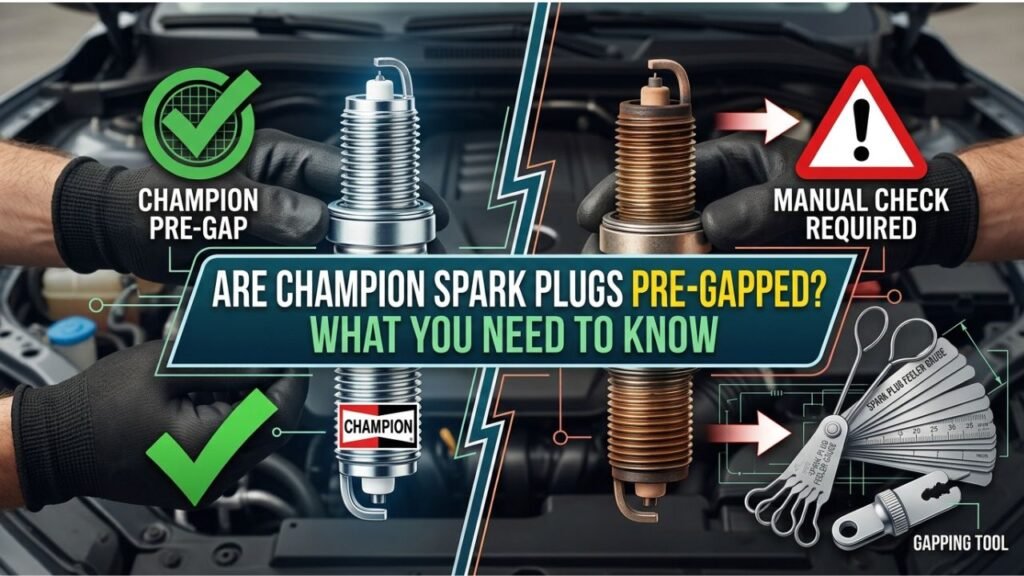
Yes. Champion currently describes its modern spark plugs as coming pre-gapped, which means the ground electrode has already been positioned to provide an intended gap before the plug reaches you.
In many applications, that factory setting will already be correct and no adjustment will be necessary.
However, you should not interpret pre-gapped as “install without ever checking.”
A spark plug can sometimes be used in more than one engine, and those engines may call for different gap specifications. Shipping and handling can also potentially affect the ground electrode if the plug is dropped or poorly protected.
For that reason, Champion recommends verifying the gap before installation.
What Does Pre-Gapped Mean?
The spark plug gap is the small distance between the center electrode and ground electrode.
When the ignition system generates high voltage, electricity jumps across this gap and creates the spark that ignites the compressed air-fuel mixture.
A pre-gapped plug has already had this distance set during manufacturing.
For example, a plug may arrive with a gap close to 0.040 inch. If your engine also specifies 0.040 inch and your measurement confirms that dimension, there is no reason to alter it.
If your vehicle requires a different gap, the situation depends on the specific spark plug design and whether Champion permits adjustment for that application.
Why Champion Still Says to Check the Gap
Champion’s current technical guidance specifically recommends checking the vehicle owner’s manual for the correct specification and double-checking the new plug before installation.
This is sensible because the gap affects the voltage required to create the spark.
You want the spark plug, ignition coil, combustion pressure, and engine calibration working together as designed.
Key Takeaways:
- Champion spark plugs generally arrive pre-gapped.
- You should still verify the gap against your exact engine specification.
- Do not change the gap unless measurement shows that adjustment is actually needed.
Do You Need to Gap New Champion Spark Plugs?
Usually, you need to check them, but you may not need to adjust them.
That distinction prevents a lot of unnecessary work.
If you open a box of new Champion plugs and immediately start bending every ground electrode because older spark plugs always had to be manually gapped, you could turn correctly set plugs into incorrectly set ones.
Instead, measure first.
If the gap matches the manufacturer’s specification, leave it alone.
If the gap is slightly incorrect and the plug design allows adjustment, make a careful correction and measure again.
Check Every Plug, Not Just One
If you are replacing four, six, or eight spark plugs, I recommend checking each one individually.
Do not measure the first plug and assume all remaining plugs are identical.
Factory quality control is generally good, but checking takes only a few seconds and can also reveal a plug that was damaged in shipping.
Look for a bent ground electrode, cracked insulator, damaged terminal, or abnormal firing tip before installation.
How to Find the Correct Gap for Champion Spark Plugs
The correct gap is determined by the engine application, not simply by the Champion brand.
Your best reference is the specification for the exact year, make, model, engine, or equipment application.
Possible references include the vehicle owner’s manual, factory service information, emissions label where applicable, or an application-specific Champion parts listing.
Do not copy the gap from another engine merely because it uses the same displacement or similar-looking plug.
One Champion Plug Can Have More Than One Application
This is one reason pre-gapped plugs still need verification.
A particular spark plug design may physically and thermally suit several engines, yet the manufacturers of those engines may specify different electrode gaps.
Champion explicitly notes that a pre-gapped plug may work in multiple engines and therefore may not already be set for your particular vehicle.
That means the part number and the gap specification are both important.
How to Check the Gap on a Champion Spark Plug
You need an appropriate spark plug gap gauge or feeler gauge.
The basic process is straightforward.
First, confirm the required gap for your engine.
Then carefully insert the correctly sized gauge between the center electrode and ground electrode.
You want to feel light, controlled resistance.
If the gauge will not pass through, the gap may be too narrow.
If it passes through with excessive clearance, the gap may be too wide.
Champion describes essentially this same measuring process in its current spark-plug gapping guidance.
Feeler Gauge vs. Coin-Style Gap Tool
A wire-type gauge or suitable feeler gauge is often easier to use accurately, particularly with fine-wire plugs.
Traditional coin-style ramp gauges can measure many conventional plugs, but you need to be careful that the measuring or adjustment method does not place pressure on a delicate center electrode.
For precious-metal plugs, I prefer a tool that lets you measure the gap without prying against the center tip.
Measure at the Correct Location
Measure between the firing surfaces of the center and ground electrodes.
Do not measure at an angle or near an unrelated part of the ground strap.
A crooked gauge can give you an incorrect impression of the actual firing gap.
How to Adjust the Gap on a Champion Spark Plug
If adjustment is necessary and permitted for the plug, bend only the ground electrode.
Do not lever directly against the center electrode.
To reduce the gap, gently move the ground electrode closer to the center electrode.
To increase the gap, carefully move the ground electrode farther away.
Then measure again.
Champion warns that excessive prying can damage the center electrode and specifically notes that iridium and platinum center electrodes can be delicate.
Make Small Adjustments
Do not try to change the gap dramatically in one movement.
A spark plug ground electrode is designed to tolerate limited adjustment, but repeated heavy bending can weaken it or alter the relationship between the firing surfaces.
Move it slightly, measure, and repeat if necessary.
If a brand-new plug is dramatically different from your required specification, first confirm that you actually bought the correct part number.
A major gap difference can be a sign that the plug is intended for another application.
Do Not Hammer the Electrode
Tapping the ground electrode against a workbench or hard surface is a poor adjustment technique.
It gives you little control and risks damaging the plug.
Use a proper gapping tool that acts only on the ground electrode.
Do Champion Iridium Spark Plugs Come Pre Gapped?
Champion iridium plugs are supplied as application-ready spark plugs and, like Champion’s other modern plugs, are generally pre-gapped.
However, I would still verify the gap before installation.
Iridium plugs deserve additional care because their fine-wire center electrode is much smaller than the conventional nickel center electrode found on many standard plugs.
Champion describes its iridium design as using a fine-wire iridium center electrode and a platinum-equipped ground electrode to improve durability and maintain the gap over time.
Be Careful Adjusting Iridium
Never place the gap tool directly against the delicate iridium firing tip and pry on it.
If the gap needs correction, move the ground electrode only.
If your plug manufacturer or application guidance says the plug should not be adjusted, follow that instruction.
A damaged iridium center electrode can turn an expensive new plug into a replacement part before it ever reaches the engine.
Do Champion Platinum Spark Plugs Come Pre Gapped?
Champion platinum plugs are also commonly supplied pre-gapped.
Again, measure them before installation.
Champion’s double-platinum designs use platinum at both the center and ground firing surfaces for increased wear resistance.
These precious-metal surfaces are intended to preserve the firing geometry for far longer than a conventional nickel electrode.
That is another reason to treat them carefully during gap inspection and adjustment.
What About Champion Copper Spark Plugs?
So-called Champion copper plugs generally use a copper core for heat and electrical conduction, while the actual exposed firing surface is typically made from a more durable alloy.
They may also come pre-gapped, but conventional designs are generally more tolerant of normal gap adjustment than delicate fine-wire precious-metal plugs.
Even so, the basic procedure does not change.
Measure first.
Adjust only the ground electrode when necessary.
Verify the final dimension before installing the plug.
Why the Spark Plug Gap Matters
The gap changes the electrical demands placed on the ignition system and affects how the spark forms inside the combustion chamber.
If the gap is wider, a higher voltage is generally required for the spark to jump between the electrodes.
If the gap is too narrow, the spark occurs over a smaller distance.
Neither extreme is desirable when the engine was designed around a specific setting.
If the Gap Is Too Wide
An excessively wide gap can require more firing voltage than the ignition system can reliably provide under difficult conditions.
This can contribute to misfires, particularly when cylinder pressure is high.
You might notice rough acceleration, hesitation, misfire under load, hard starting, or a check-engine light depending on severity.
Champion notes that an incorrect wide gap can cause firing problems and misfires, particularly under demanding operation.
If the Gap Is Too Small
A gap that is significantly too narrow can produce a smaller spark kernel.
That may reduce the ignition system’s ability to initiate combustion effectively under certain operating conditions.
Again, the solution is not to choose the widest gap possible.
The correct target is the engine manufacturer’s specification.
Key Takeaways:
- Spark plug gap directly affects the voltage and spark characteristics of the ignition event.
- Wider is not automatically better, and narrower is not automatically safer.
- Use the exact application specification instead of guessing.
Can Shipping Change the Gap on a Pre-Gapped Spark Plug?
It is possible.
The ground electrode projects beyond the end of the plug and can be moved if the plug suffers a hard impact.
Quality packaging helps protect it, but a quick measurement before installation is still worthwhile.
If the box looks crushed or the ground strap visibly appears bent, inspect the plug especially carefully.
Also examine the ceramic insulator for cracks.
Do not install a damaged plug merely because the electrode can be bent back into position.
Can You Install Champion Spark Plugs Straight From the Box?
You often can, but only after verifying them.
A better installation routine is:
Confirm the correct Champion part number, check the specified gap, visually inspect each plug, measure the gap, and then install it if everything matches.
This adds only a few minutes to a normal plug replacement.
It is especially worthwhile on engines where spark plug access requires removing an intake manifold or other components. You do not want to repeat several hours of labor because one plug had the wrong gap.
Should All Spark Plugs Have Exactly the Same Gap?
If they are being installed in cylinders of the same engine under the same specification, yes, they should normally be set consistently to the specified value.
One plug with a noticeably different gap may have a different firing voltage requirement from the others.
Small measurement variation is unavoidable, but there is no benefit in intentionally giving different cylinders random plug gaps unless a specialized engine application specifically calls for it.
For a normal production vehicle, match every plug to the factory specification.
Is the Gap Printed on the Champion Spark Plug?
You may encounter Champion part-number markings that provide information about the spark plug design, and some Champion naming systems include gap-related designations.
However, you should not rely solely on decoding markings when servicing a vehicle.
Champion’s own part-number information shows that some numbers can indicate wide-gap designs, but application-specific verification is still the better approach.
Use the vehicle specification or approved application catalog to confirm what your particular engine requires.
Do You Need to Regap Spark Plugs for a Modified Engine?
Possibly.
This is one situation where factory pre-gap may intentionally not be the final setting.
High-boost turbocharged or supercharged engines can create greater cylinder pressures, making it more difficult for the spark to jump a wide gap.
Some tuners therefore specify a reduced spark plug gap for modified engines.
That does not mean every turbo engine should automatically have its plugs closed down.
Changing the gap is part of the overall ignition and calibration strategy.
If the engine is modified, use the specification provided by a competent tuner or engine builder familiar with that setup.
Do not copy a gap measurement from a different vehicle just because it has a similar boost level.
What Gap Tool Should You Use?
For conventional plugs, several proper spark plug gauges can work.
For iridium and platinum fine-wire plugs, I prefer a wire-style gauge or suitable feeler gauge combined with a separate ground-electrode adjustment tool.
The objective is to measure accurately without scraping or loading the center electrode.
Champion emphasizes using the proper tool and being particularly careful with delicate precious-metal center electrodes.
Avoid using screwdrivers, pliers, pocketknives, or improvised metal objects to establish the gap.
Spark plugs are relatively inexpensive compared with the labor required to diagnose an ignition problem caused by a damaged electrode.
Common Mistakes When Gapping Champion Spark Plugs
One common mistake is assuming “pre-gapped” means “never check.”
Another is adjusting every plug automatically even when the gap is already correct.
A third mistake is using the plug’s current gap as proof that it must be the correct specification for the engine.
The biggest physical mistake is prying against the center electrode, particularly on iridium and platinum plugs.
People also sometimes confuse spark plug gap with heat range. Changing the gap does not convert a plug into a hotter or colder heat range.
Heat range is determined by plug construction and how heat transfers from the firing end into the cylinder head.
Don’t Guess the Gap From the Old Plug
An old plug is not a reliable measuring standard.
Its electrodes wear during service, which can increase the gap.
If the old plug measures 0.050 inch, that does not prove the replacement should be set to 0.050 inch.
Always compare with the actual specification.
Installing Champion Spark Plugs After Checking the Gap
Once the gap is correct, keep the electrode clean and avoid dropping the plug.
Start threading the plug by hand to reduce the chance of cross-threading.
Once it seats, tighten it according to the engine or spark plug manufacturer’s torque procedure.
Do not automatically apply anti-seize to the threads. Modern spark plug threads may have coatings that affect installation friction, and adding lubricant can alter the relationship between torque and clamping load.
Follow the instructions for your particular plug and engine.
Also make sure the ignition coil boot or spark plug wire is fully seated after installation.
A perfectly gapped plug will not operate correctly if the electrical connection is poor.
Key Takeaways:
- Pre-gap does not eliminate the need for inspection.
- Never use an old spark plug’s worn gap as your specification.
- After gapping, proper installation torque and electrical connection still matter.
FAQs about are Champion spark plugs pre gapped
Are Champion spark plugs pre gapped?
Yes. Champion states that its modern spark plugs generally come pre-gapped, although it still recommends checking the gap against your vehicle’s required specification before installation.
Do I need to gap Champion spark plugs before installing them?
You should check them.
If the measured gap already matches your engine specification, no adjustment is needed.
Why do I need to check a pre-gapped spark plug?
A spark plug may fit multiple vehicle applications that use different gap specifications, and the ground electrode can potentially be disturbed during handling.
Checking confirms that the plug is correct for your specific engine.
Are Champion iridium spark plugs pre gapped?
They are generally supplied pre-gapped.
Measure them carefully before installation and avoid putting adjustment pressure on the fine iridium center electrode.
Are Champion platinum spark plugs pre gapped?
Yes, Champion platinum plugs are generally supplied with a factory-set gap.
Verify the measurement before installation just as you would with any other new plug.
Are Champion copper spark plugs pre gapped?
Modern Champion conventional spark plugs are generally supplied pre-gapped as well.
Check the actual measurement against your engine specification before installing them.
Can I change the gap on a Champion spark plug?
Many conventional spark plugs can be adjusted when necessary.
Move only the ground electrode and use a proper gapping tool.
For specialized or fine-wire designs, follow the plug manufacturer’s instructions.
How do I know what gap my Champion spark plug needs?
Use the specification for your exact vehicle or engine, such as the owner’s manual, factory service information, or a reliable Champion application catalog.
Does the spark plug part number determine the gap?
The part number describes important plug characteristics, and some numbering systems may contain gap-related information.
However, you should still verify the required gap for the exact engine application.
Can the same Champion spark plug use different gaps in different cars?
Yes. Champion notes that some pre-gapped plugs may be suitable for multiple engines, which is one reason the final gap should be checked against the vehicle specification.
What happens if the Champion spark plug gap is too wide?
The plug can require more voltage to fire.
If the ignition system cannot reliably provide it under operating conditions, misfires or hesitation can occur.
What happens if the gap is too small?
A gap that is too narrow can produce a smaller spark and may negatively affect combustion performance.
Use the specified dimension rather than intentionally reducing the gap on a stock engine.
Can a spark plug gap change during shipping?
Yes, the ground electrode can potentially be bent if the plug experiences impact.
That is another reason to inspect and measure new plugs before installation.
What is the best tool for measuring a spark plug gap?
A proper spark plug wire gauge or suitable feeler gauge works well.
For fine-wire iridium or platinum plugs, use a method that does not place damaging pressure on the center electrode.
Can I use a coin-style gap tool?
It may work for certain conventional plugs, but use caution with delicate fine-wire electrodes.
A wire or feeler-style measuring tool gives you more control.
Should I bend the center electrode to adjust the gap?
No.
Adjustment should be made by carefully moving the ground electrode.
Do not bend or pry against the center electrode.
Can I install Champion plugs without checking them?
They may already be correctly gapped, but I do not recommend skipping the check.
It takes only seconds and confirms that the plug matches the engine specification.
Do new spark plugs need to be gapped if the box says pre-gapped?
They should still be measured.
“Pre-gapped” means the manufacturer has already established a gap, not necessarily that you should ignore the application-specific specification.
Should I reduce the gap on a turbocharged engine?
Only if the factory specification or a qualified tuner calls for it.
Do not automatically reduce the gap simply because an engine has a turbocharger.
Can the wrong gap cause a misfire?
Yes.
An incorrect spark plug gap can contribute to misfire, poor running, reduced power, or difficult ignition under certain conditions.
Should every Champion spark plug in the engine have the same gap?
For a normal engine where every cylinder uses the same plug specification, each plug should be set consistently to the specified gap.
Conclusion
If you are asking are Champion spark plugs pre gapped, the answer is yes—Champion says its modern spark plugs generally come pre-gapped, so they often require no adjustment before installation. However, Champion also recommends checking every new plug against the correct gap specification for your vehicle.
That is the approach I recommend.
Do not automatically bend the electrodes because you assume every new plug needs manual gapping. First confirm that you have the correct Champion part number, find the factory gap specification for your engine, and measure the new plug.
If it already matches, leave it alone.
If adjustment is genuinely necessary and the plug design permits it, use a proper spark plug gap tool and move only the ground electrode. Be especially careful with Champion iridium and platinum plugs because their fine-wire precious-metal center electrodes can be damaged by careless prying.
Pre-gapped therefore means factory-set, not inspection-free.
Checking the gap takes only a few seconds per plug, and it helps ensure that your ignition system operates with the electrode spacing the engine manufacturer intended. For a normal replacement job, that quick verification is much easier than troubleshooting a misfire after all the new spark plugs have already been installed.