
If you are wondering are Autolite spark plugs pre gapped, the answer is yes—Autolite spark plugs are generally manufactured with a factory-set gap in common sizes, but that does not guarantee the gap is correct for every vehicle that can use that plug. Autolite specifically recommends checking the gap at installation and adjusting it when necessary to match the vehicle or engine specification.
This distinction is important. “Pre-gapped” does not always mean “install it directly from the box without measuring it.” One Autolite spark plug part number may be suitable for more than one engine application, and those applications can sometimes call for different electrode gaps.
The plug may also have been handled during manufacturing, packaging, shipping, and storage. The ground electrode can potentially move slightly if the plug receives an impact.
There are also exceptions within the Autolite lineup. For example, Autolite currently describes its High Thread Pro plugs as pre-gapped and not requiring gap adjustment. That makes it especially important to follow the instructions for the exact plug family rather than assuming every Autolite plug should be treated identically.
In this guide, I’ll explain whether Autolite copper, platinum, double-platinum, and iridium spark plugs come pre-gapped, why you should still verify the specification, how to check the gap correctly, how to adjust a plug without damaging its electrodes, and what happens when the gap is wrong.
Are Autolite Spark Plugs Pre Gapped From the Factory?
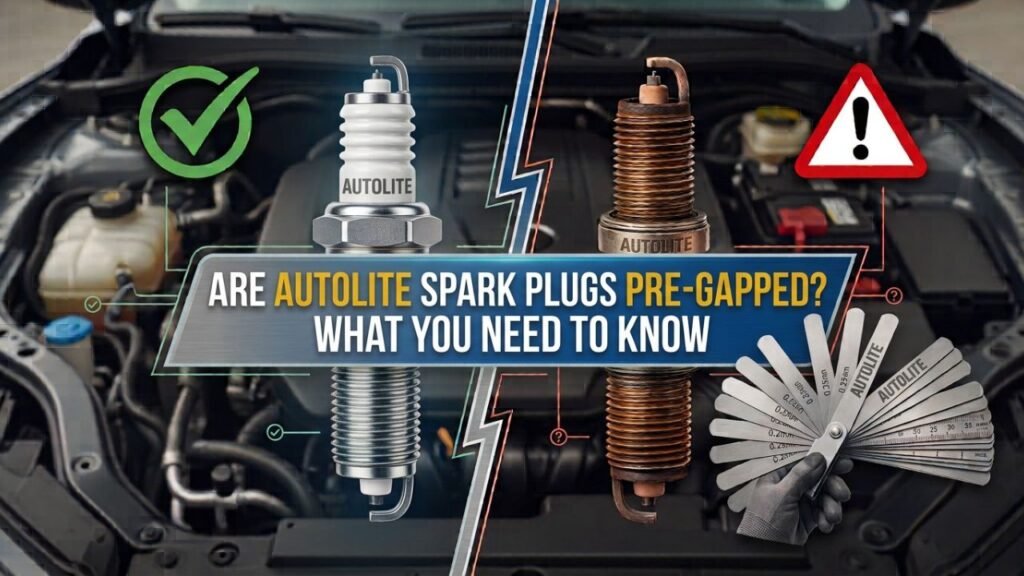
Yes.
Autolite states that its spark plugs, like plugs from other manufacturers, are supplied pre-gapped in popular gap sizes. However, Autolite also makes an important qualification: there are too many engine-specific gap requirements for every plug to arrive correctly gapped for every possible application.
Autolite therefore recommends checking the gap and adjusting it as needed when installing the plug.
That gives you the most accurate way to understand the phrase pre-gapped.
The factory has already positioned the ground electrode at a predetermined gap.
But you are still responsible for verifying that this gap matches your particular engine.
For example, imagine an Autolite plug arrives at approximately 0.044 inch.
If your vehicle specification also requires 0.044 inch, no adjustment is necessary.
If your engine requires 0.040 inch, the factory position needs to be checked and, if the plug design allows it, carefully corrected.
Do not change the gap merely because you think a new plug must always be adjusted. Measure first.
Pre-Gapped Does Not Mean Universal Gap
Spark plug compatibility involves much more than thread size.
The same general spark plug design can appear in several applications with differences in ignition-system design, combustion pressure, coil output, emissions calibration, and manufacturer requirements.
That is why there is no universal Autolite spark plug gap.
Common automotive gaps may include values such as 0.028, 0.032, 0.035, 0.040, 0.044, 0.050, or 0.054 inch, but none of those should be treated as the default for every engine.
The correct number is the specification for your exact year, make, model, and engine.
Key Takeaways:
- Autolite plugs are generally supplied with a factory gap.
- The factory gap may not match every application that uses the plug.
- Autolite recommends checking the gap at installation.
- Measure first and adjust only when the engine specification requires it.
Why Should You Check a Pre-Gapped Autolite Spark Plug?
Checking a pre-gapped plug takes only a few seconds and eliminates several possible installation problems.
The main reason is application variation.
The second reason is physical handling.
The ground electrode protrudes over the center electrode at the firing end of the plug. Although the plug is protected by packaging, the electrode is still a relatively small metal component that can be moved if it takes a significant impact.
Even a tiny movement can alter the gap by several thousandths of an inch.
A Box Can Be Dropped
Suppose a spark plug was originally set correctly at the factory but the package was dropped during transportation.
The ceramic insulator might remain completely intact while the ground electrode moves slightly inward.
You cannot reliably judge a difference of 0.005 inch by eye.
A gap gauge can.
Part Numbers May Serve Multiple Applications
Another reason to verify the gap is that the plug itself and the vehicle specification are separate pieces of information.
The spark plug manufacturer supplies a part with particular physical and thermal characteristics.
The engine manufacturer specifies how that plug should be used in its ignition system.
Autolite’s installation instructions explicitly tell users to gap new plugs according to the owner’s manual or Autolite catalog and to verify the distance using a spark plug gapping tool.
That is much more reliable than assuming the number printed on the box means the plug is ready for every engine.
Are Autolite Copper Spark Plugs Pre Gapped?
Autolite copper-core spark plugs are supplied with a factory-set gap, but they should still be checked against the engine specification before installation.
Autolite’s installation information for its copper spark plugs instructs installers to verify the gap and correct it when necessary.
Traditional nickel-alloy or copper-core-style plugs are generally the easiest to adjust because their electrodes are relatively robust compared with very fine iridium center electrodes.
That does not mean you should bend them casually.
Only the ground electrode should be moved.
Do not push or pry directly against the center electrode or ceramic insulator.
Are Autolite Platinum Spark Plugs Pre Gapped?
Yes, Autolite platinum plugs are supplied with a factory gap, but Autolite still advises checking the gap for the intended vehicle before installation.
A platinum plug uses precious metal to improve electrode durability compared with a conventional nickel design.
The presence of platinum does not mean the plug automatically knows the correct gap for every engine.
It also does not mean you should ignore a clearly incorrect gap.
Use a suitable gauge and compare the measurement with the vehicle specification.
If adjustment is needed, make it through the ground electrode rather than levering against the center electrode.
Are Autolite Double Platinum Spark Plugs Pre Gapped?
Autolite Double Platinum plugs also arrive with a factory-set electrode position, but Autolite’s current installation guidance still tells installers to verify and correct the gap as required for the application.
Double-platinum plugs typically use precious-metal surfaces on both sides of the spark gap.
This design is particularly relevant in ignition systems where polarity causes electrode wear to occur differently between cylinders.
Because these precious-metal areas are small and precisely positioned, avoid aggressive gapping techniques.
A small necessary correction is very different from attempting to move the electrode dramatically.
If a new double-platinum plug is far outside specification, inspect it carefully for shipping damage or confirm that you purchased the correct part number before forcing it into shape.
Are Autolite Iridium Spark Plugs Pre Gapped?
Yes. Autolite Iridium XP and Iridium Ultra plugs are supplied with an initial factory gap, but Autolite’s published installation instructions still call for checking the new plug against the specified gap.
Iridium plugs require more care because the center electrode is extremely fine.
That fine electrode is one of the reasons iridium plugs can require relatively low firing voltage while maintaining long service life.
It is also easier to damage through improper gapping.
Be Careful With Fine-Wire Iridium Electrodes
Do not push a thick coin-style gauge forcefully between the electrodes if doing so requires levering against the center electrode.
Do not pry the ground electrode outward by placing a tool against the iridium tip.
Use a proper spark plug gapping tool that allows you to move only the ground strap.
Check the clearance gently.
If the gap needs only a small correction, adjust the ground electrode a little at a time and remeasure.
If an iridium plug arrives dramatically bent, replacing it is safer than attempting major reshaping.
Do Any Autolite Spark Plugs Not Need Gap Adjustment?
Yes, there can be application-specific exceptions.
Autolite currently describes its High Thread Pro spark plugs as pre-gapped and says they do not require gap adjustment.
This illustrates why generic advice such as “always gap every Autolite spark plug” is too broad.
The more accurate rule is:
Verify what Autolite and the vehicle manufacturer specify for the exact plug you are installing.
For most conventional Autolite products, checking the gap is good practice.
For a plug family specifically marketed as requiring no gap adjustment, follow that product’s instructions.
How Do You Know the Correct Autolite Spark Plug Gap?
Do not use the gap of the old plug as your primary reference.
An old spark plug normally wears during service, and the gap often becomes wider as electrode material erodes.
Instead, use a reliable specification.
The best references are usually the vehicle owner’s manual, manufacturer service information, the emissions or tune-up label under the hood when applicable, or the Autolite application catalog.
Autolite itself directs installers to the owner’s manual or its spark plug catalog for the recommended gap.
Search by the Exact Engine
Do not stop at vehicle make and model if multiple engines were available.
A vehicle could have been sold with several engine options that use different spark plugs or gaps.
Use:
Model year.
Make.
Model.
Engine size.
Engine code when relevant.
The exact spark plug part number.
This is particularly important when dealing with turbocharged engines, performance versions, or vehicles whose ignition specifications changed during a production run.
How to Check the Gap on an Autolite Spark Plug
You need a spark plug gap gauge.
A wire-style gauge is an excellent choice because it measures the actual clearance between the two electrodes without requiring you to force a tapered ramp through a delicate gap.
Feeler gauges can also work.
Step 1: Confirm the Specification
Before touching the electrodes, find the required gap.
For illustration, assume the specification is 0.044 inch.
That number is only an example—you should use your engine’s actual specification.
Step 2: Inspect the New Plug
Look at the porcelain insulator and firing end.
Do not install a plug with:
Cracked ceramic.
A visibly bent ground strap.
Damaged threads.
A loose terminal.
Impact damage.
A new plug that appears physically damaged should generally be replaced rather than repaired.
Step 3: Insert the Correct Gauge
Slide the correct gauge between the center electrode and ground electrode.
You want a slight drag.
The gauge should not fall through loosely.
You also should not have to force it through hard enough to bend an electrode.
Step 4: Compare the Reading
If the specified gauge fits with the correct slight drag, leave the plug alone.
It is already correctly gapped.
If a smaller gauge barely fits, the gap is too tight.
If the specified gauge moves through with excessive clearance, the gap is too wide.
Step 5: Adjust Only if Necessary
Use the gapping tool’s electrode-adjustment feature to move the ground strap in very small increments.
Then measure again.
Do not attempt to estimate how far you moved it.
Gap adjustment is a measure-adjust-measure process.
Key Takeaways:
- Determine the specification before measuring the plug.
- Use a proper spark plug gap gauge rather than judging by eye.
- A correct factory gap should be left alone.
- Adjust only the ground electrode and make small changes.
How to Adjust an Autolite Spark Plug That Is Gapped Too Wide
If the gap is wider than required, the ground electrode needs to move slightly toward the center electrode.
Use a dedicated gapping tool.
Apply gentle pressure to the ground strap itself.
Do not hit the spark plug against a workbench or hard surface.
People sometimes tap a plug on a metal object to close the gap quickly, but this gives very poor control and can damage the plug.
After making a tiny adjustment, remeasure.
If you overshoot and make the gap too narrow, you will have to bend the strap back out, which adds unnecessary stress.
Work slowly.
How to Adjust an Autolite Plug That Is Gapped Too Narrow
If the gap is too tight, use the adjustment slot or hook on a proper spark plug tool to pull the ground electrode outward slightly.
The key word is ground electrode.
Never wedge the gauge between the electrodes and force it sideways against the center electrode.
This is especially important with fine-wire platinum and iridium designs.
Move the strap a very small distance.
Then measure again.
Continue until the gauge passes with light drag.
Should You Use a Coin-Style Spark Plug Gap Tool?
Coin-style gauges are inexpensive and common.
They have a tapered edge with increasing measurements marked around the circumference.
They work reasonably well with robust conventional spark plugs when used carefully.
However, I prefer a wire gauge for checking delicate precious-metal plugs.
The problem is not that a coin gauge cannot measure a gap.
The problem occurs when someone pushes the progressively thicker edge through the gap as though the gauge itself were an adjustment tool.
That can place force on the center electrode.
For a fine-wire iridium plug, that is exactly what you want to avoid.
Use the measuring tool gently and adjust the ground strap separately.
What Happens if an Autolite Spark Plug Gap Is Too Wide?
A wider gap requires greater ignition voltage.
The coil must build enough voltage for the electrical discharge to jump the increased distance.
If the gap is only slightly wider than specification and the ignition system is strong, you may not notice anything immediately.
As the gap grows, potential symptoms include:
Hard starting.
Misfire under load.
Rough idle.
Hesitation.
Reduced acceleration.
Check-engine light.
Ignition coil stress.
The problem may become most noticeable under high cylinder pressure, such as hard acceleration or heavy engine load.
Cylinder pressure makes the spark harder to initiate.
That is why a plug may appear to spark normally when tested outside the engine but still misfire under load.
What Happens if the Spark Plug Gap Is Too Small?
A narrow gap is easier for the ignition voltage to cross.
However, easier is not automatically better.
The spark is concentrated across a smaller distance, which can reduce the size of the initial ignition kernel.
An excessively tight gap can contribute to:
Rough running.
Incomplete combustion.
Poor throttle response.
Fouling.
Reduced performance.
You should not intentionally close the gap below specification to “help” an old ignition coil.
If the ignition system cannot fire the factory-specified gap, diagnose the ignition problem rather than compensating with an incorrect plug setting.
Can Wrong Gap Cause a Check Engine Light?
Yes.
If incorrect spark plug gap causes a cylinder to misfire consistently enough, the engine computer can detect variations in crankshaft speed and set a diagnostic trouble code.
You may see codes such as a general random-misfire code or a cylinder-specific misfire code.
However, spark plug gap is only one possible cause.
Misfires can also result from:
A worn spark plug.
Bad ignition coil.
Damaged coil boot.
Fuel injector fault.
Vacuum leak.
Low compression.
Fuel-pressure problems.
Wiring faults.
Incorrect timing.
Do not automatically re-gap plugs every time a misfire code appears.
Diagnose the system logically.
Can You Install Autolite Spark Plugs Straight From the Box?
Sometimes, yes—but only after verification.
If you measure the plug and it already matches the required specification, there is no reason to alter it.
In that sense, many Autolite spark plugs really are ready to install straight out of the box.
The important part is that you checked.
The correct procedure is:
Confirm the correct plug part number.
Confirm the required gap.
Measure the new plug.
Install it if correct.
Adjust only if necessary.
This requires very little extra time and prevents unnecessary troubleshooting later.
Should All Spark Plugs in the Engine Have the Same Gap?
For most conventional engines, all plugs in the same engine use the same specified gap.
Check every new plug anyway.
Do not verify one plug from an eight-plug box and assume the other seven must be identical.
Factory quality control is generally excellent, but shipping or handling can affect an individual electrode.
Measuring every plug ensures consistency across all cylinders.
The process may add only a minute or two to an entire spark plug replacement job.
Should You Gap New Plugs Based on the Old Plugs?
No.
Old plugs are useful diagnostic evidence, but they are poor gap references.
Electrode erosion normally causes gap growth during service.
For example, if your engine calls for 0.040 inch but your old plugs measure 0.048 inch, that does not mean the replacement plugs should also be set to 0.048.
It means the old electrodes have likely worn.
Set the new plugs to the current manufacturer specification.
Does Spark Plug Material Change the Required Gap?
Not necessarily.
The engine’s ignition and combustion requirements determine the specified gap, while electrode material affects characteristics such as durability and firing behavior.
An Autolite copper, platinum, or iridium replacement listed for the same engine may be designed to operate at the engine’s specified gap.
However, you should never assume two plugs are interchangeable merely because you can set them to the same gap.
Heat range, reach, seat style, thread diameter, electrode projection, resistor value, and other design features also matter.
Correct gap cannot make an incorrect spark plug suitable for the engine.
Do Autolite Spark Plugs Have Different Factory Gaps?
Yes.
Autolite itself says plugs are supplied pre-gapped in popular sizes rather than one universal setting.
That means two Autolite part numbers can arrive with very different factory gaps.
It also means two boxes that look nearly identical should not be treated as having the same specification.
Always work from the exact part number and intended vehicle application.
Can You Damage an Autolite Spark Plug While Gapping It?
Yes.
Incorrect adjustment can damage the electrodes or ceramic.
Common mistakes include prying against the center electrode, striking the ground strap against a workbench, applying excessive bending force, or forcing a gauge through a fine-wire electrode gap.
Damage is particularly concerning on iridium plugs because the center electrode is so small.
A damaged plug may create:
Weak or inconsistent spark.
Misfire.
Premature electrode wear.
Cracked insulation.
Complete plug failure.
If a new plug requires a large amount of adjustment, stop and confirm that it is the correct part.
A dramatically incorrect gap may be a sign of damage or incorrect application.
Key Takeaways:
- Incorrect gapping technique can damage a brand-new plug.
- Fine-wire iridium and platinum electrodes require particularly gentle handling.
- A new plug that needs a large adjustment deserves closer inspection before installation.
Should You Gap Spark Plugs Before or After Installing Them?
Always check the gap before installing the spark plugs.
Once the plug is threaded into the cylinder head, the electrodes are inside the combustion chamber and inaccessible.
Pre-installation is also the ideal time to inspect the plug for shipping damage and confirm the part number.
After setting the gap, install the plug carefully.
Start the threads by hand so you can feel whether the plug is threading correctly.
This is especially important with aluminum cylinder heads because cross-threading can create an expensive repair.
Spark Plug Gap and Installation Torque Are Different
Correct gap does not compensate for incorrect installation torque.
The spark plug also needs to be tightened according to the appropriate specification.
Too little torque can prevent the plug from seating correctly and may interfere with heat transfer.
Too much torque can damage the spark plug or cylinder-head threads.
Autolite’s installation instructions recommend tightening spark plugs according to manufacturer torque requirements and warn that both under-tightening and over-tightening can cause problems. Autolite also advises against applying lubricant to spark plug threads because it can affect tightening torque.
So the complete installation involves both:
Correct electrode gap.
Correct installation torque.
Treat them as separate specifications.
Are Autolite Spark Plugs Good if the Factory Gap Is Slightly Off?
A small difference in factory gap does not automatically indicate a defective spark plug.
If the plug is the correct part number, undamaged, and designed to be adjustable, a minor correction is normal.
That is one reason Autolite explicitly instructs installers to check and adjust plugs as necessary.
What deserves more concern is a dramatically bent ground electrode, cracked ceramic, damaged box, or a gap far outside what you would expect.
In that situation, replacing the plug is usually smarter than trying to repair substantial physical damage.
Common Mistakes When Installing Pre-Gapped Autolite Spark Plugs
The first mistake is assuming “pre-gapped” means “never check.”
Autolite specifically recommends checking most plugs at installation.
The opposite mistake is adjusting every plug automatically.
If the plug already matches specification, leave it alone.
Another common mistake is gapping the plug to information found for a different engine.
Always verify year, engine, and application.
Using the old spark plug as the specification is also unreliable because electrode wear changes gap over time.
Finally, avoid aggressive adjustment of precious-metal plugs.
A few seconds of careful measuring is much safer than damaging a new iridium electrode.
FAQs about Are Autolite Spark Plugs Pre Gapped
Do Autolite spark plugs come pre-gapped?
Yes. Autolite says its spark plugs are offered with factory-set gaps in popular sizes, but the company recommends checking and adjusting them when necessary because one factory gap cannot match every application.
Can I install Autolite spark plugs straight out of the box?
Yes, if you verify that the factory gap matches your vehicle’s specification.
Do not assume it is correct without checking.
Do Autolite spark plugs need to be gapped?
Many should at least be checked. Adjustment is necessary only if the measured gap does not match the specification and the plug is designed to be adjusted.
Are Autolite Iridium XP spark plugs pre-gapped?
They are supplied with a factory-set gap, but Autolite’s installation guidance still instructs users to verify the gap for the application.
Are Autolite Iridium Ultra plugs pre-gapped?
Yes, but Autolite still provides installation instructions calling for gap verification against the vehicle or catalog specification.
Are Autolite platinum spark plugs pre-gapped?
Yes. They have a factory gap, but you should verify it before installation.
Are Autolite double-platinum plugs pre-gapped?
Yes, but the gap should still be confirmed for the specific engine before installation.
Are Autolite copper spark plugs pre-gapped?
Yes. Autolite copper plugs arrive with an initial factory gap, but Autolite’s installation guidance recommends checking and correcting it as required.
Do any Autolite plugs require no gap adjustment?
Autolite currently describes its High Thread Pro plugs as pre-gapped and not requiring adjustment. Follow the instructions for the exact plug family you purchase.
What gap should Autolite spark plugs be set to?
There is no universal Autolite gap.
Use the specification for your exact year, make, model, and engine.
Is 0.044 inch the standard Autolite gap?
No.
0.044 inch is common in some automotive applications, but other engines use different specifications.
Is 0.054 inch a normal spark plug gap?
It is used in some applications, but it should never be applied automatically.
Use it only if your vehicle specifies that gap.
Can I gap Autolite iridium spark plugs?
Small corrections may be possible when required, but handle the fine center electrode carefully and adjust only the ground electrode.
Follow the instructions for the exact Autolite product.
How do I check an Autolite spark plug gap?
Insert the correct wire or feeler gauge between the center and ground electrodes.
A properly sized gauge should pass with slight drag.
Can I use a coin gap tool on Autolite plugs?
You can use one carefully on many conventional plugs, but a wire gauge is often safer for measuring fine-wire platinum or iridium electrodes because it reduces the temptation to force a tapered tool against the center electrode.
What happens if the gap is too wide?
A wide gap requires more ignition voltage and can contribute to hard starting, hesitation, or misfires, especially under load.
What happens if the gap is too narrow?
An excessively narrow gap can reduce the effective spark size and may contribute to poor combustion, fouling, or rough operation.
Can incorrect plug gap cause a misfire code?
Yes. If the gap causes repeated ignition failure, the ECU may detect a misfire and illuminate the check-engine light.
Should all new Autolite plugs measure exactly the same?
Plugs installed in the same engine should normally be set to the same engine-specified gap unless the manufacturer says otherwise.
Check every plug individually.
Can spark plug gap change during shipping?
It can if the ground electrode receives enough impact, which is another reason measuring the gap before installation is good practice.
Should I copy the gap from my old plugs?
No.
Old electrodes wear and their gap can increase. Use the current manufacturer specification instead.
Can adjusting the gap damage a new spark plug?
Yes. Prying against the center electrode or making large, forceful changes can damage the plug, particularly fine-wire iridium and platinum designs.
Conclusion
So, are Autolite spark plugs pre gapped? Yes, Autolite spark plugs generally leave the factory with a preset gap, but that does not mean every plug is automatically gapped correctly for every vehicle that can use it.
Autolite itself explains that spark plugs are supplied in popular factory gap sizes, while different applications require many different specifications. The company therefore recommends checking the gap and adjusting it as necessary during installation.
The best approach is simple.
First, verify that you have the correct Autolite part number for your exact engine. Then find the required gap in the vehicle owner’s manual, service information, or Autolite application data. Measure every new plug with a proper spark plug gap gauge.
If the measurement is correct, do not adjust it.
If it is slightly incorrect and the plug is intended to be adjustable, move only the ground electrode and recheck the measurement after every small change.
Take additional care with Autolite platinum and iridium fine-wire plugs because their center electrodes are more delicate than conventional nickel designs.
Also pay attention to product-specific instructions. Certain Autolite products, such as High Thread Pro plugs, are specifically described by Autolite as pre-gapped without requiring adjustment.
The practical rule is therefore not “all Autolite plugs must be gapped” and not “all Autolite plugs can be installed untouched.”
It is: Autolite spark plugs are pre-gapped, but verify the gap for your engine before installation and adjust only when the particular plug and application require it.