
If you are replacing ignition parts, you may wonder, are all spark plug wires the same? No. Spark plug wires can differ in length, resistance, insulation, core material, terminal design, boot angle, diameter, and compatibility with the vehicle’s ignition system.
Two wire sets may look almost identical but still not be interchangeable.
Using the wrong wires can cause poor fitment, weak spark, electrical interference, misfires, or premature wire failure. The safest choice is usually a wire set designed specifically for your vehicle’s engine and ignition system.
This guide explains the main differences between spark plug wires, how to identify the correct type, what resistance means, and when universal wires may or may not work.
Are All Spark Plug Wires the Same?
No. Spark plug wires are not all the same.
They all perform the same basic job—carrying high-voltage electricity from the ignition coil, distributor, or coil pack to the spark plug—but their construction and specifications can vary considerably.
Important differences include:
- Wire length
- Core material
- Electrical resistance
- Insulation quality
- Boot shape
- Terminal style
- Wire diameter
- Heat resistance
- Vehicle-specific routing
A spark plug wire that fits one engine may be too short, too long, have the wrong connector, or have incorrect electrical characteristics for another engine.
That is why spark plug wires should usually be selected by year, make, model, engine size, and ignition-system type.
What Does a Spark Plug Wire Do?
A spark plug wire carries high-voltage electricity to the spark plug.
Depending on the ignition-system design, that voltage may come from:
- A distributor
- An ignition coil
- A coil pack
The spark plug wire transfers the electrical energy to the spark plug so the plug can create a spark across its electrode gap.
That spark ignites the compressed air-fuel mixture inside the combustion chamber.
Although the job sounds simple, a spark plug wire must safely carry very high voltage while resisting:
- Engine heat
- Vibration
- Oil contamination
- Moisture
- Electrical interference
- Abrasion
A damaged or poorly matched wire can interrupt this process and cause an engine misfire.
Why Are Spark Plug Wires Different?
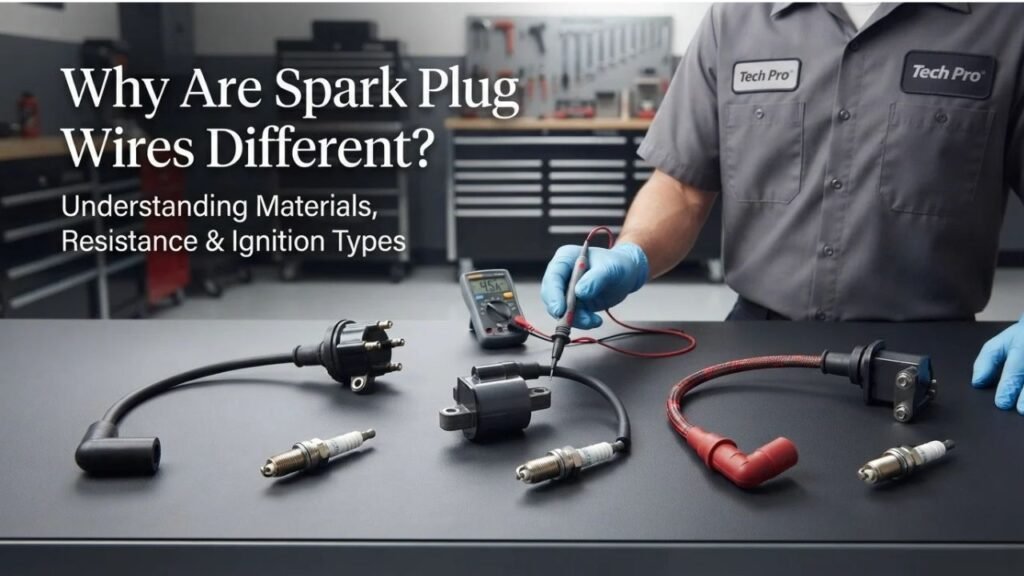
Spark plug wires are designed around the needs of a specific ignition system and engine layout.
For example, one engine may need long wires that route around the intake manifold, while another may need much shorter wires.
The spark plug location can also affect the design. Some plugs sit deep inside cylinder heads, while others are mounted at an angle.
Manufacturers therefore vary several characteristics of the wire set.
Spark Plug Wire Length
Length is one of the most obvious differences.
Each wire must be long enough to reach its spark plug without being stretched, but not so long that it hangs loosely around hot or moving components.
A wire that is too short can:
- Pull on the terminal
- Disconnect from the plug
- Damage the boot
- Place stress on the conductor
A wire that is excessively long may:
- Touch exhaust components
- Rub against brackets
- Become tangled
- Be difficult to route correctly
Vehicle-specific sets usually include wires cut to the correct individual lengths.
Spark Plug Wire Core Types
The conductor inside the wire can be made in different ways.
The main types include:
- Carbon-core wires
- Spiral-core wires
- Solid-core wires
These designs have different levels of resistance and electromagnetic interference suppression.
Carbon-Core Spark Plug Wires
Carbon-core wires are common on many factory ignition systems.
They use a carbon-impregnated conductor that naturally creates electrical resistance.
That resistance helps suppress radio-frequency interference, often called RFI.
Reducing RFI is important because ignition systems generate electrical noise that can interfere with:
- Radios
- Engine-control electronics
- Sensors
- Communication systems
Carbon-core wires work well for many street vehicles, although the conductive core can deteriorate with age.
Spiral-Core Spark Plug Wires
Spiral-core wires use a fine conductive wire wrapped around a central core.
They are popular in both factory-style and performance applications because they can provide relatively low resistance while still suppressing electrical interference.
A quality spiral-core design can provide strong ignition performance without creating excessive RFI.
Solid-Core Spark Plug Wires
Solid-core wires use a continuous metal conductor.
They have very low electrical resistance, but they can create significant electromagnetic interference.
For that reason, solid-core wires are generally not recommended for most modern street vehicles with sensitive electronic systems.
They are more commonly associated with specialized or older applications.
Does Spark Plug Wire Resistance Matter?
Yes. Spark plug wire resistance matters because the ignition system is designed to operate within a certain electrical range.
Resistance helps control electrical interference and affects how voltage is delivered through the ignition system.
However, lower resistance is not automatically better.
A wire with extremely low resistance may create electrical noise that interferes with electronic components. A wire with excessively high resistance may weaken the ignition energy reaching the spark plug.
The correct resistance depends on the specific wire design and ignition system.
When testing wires, manufacturers often specify resistance as a certain number of ohms per foot or per wire length.
Because wire lengths vary, two good wires from the same set may show different total resistance readings.
Are Thicker Spark Plug Wires Better?
Not necessarily.
Spark plug wires are often described by their outside diameter, such as:
- 7 mm
- 8 mm
- 8.5 mm
- 9 mm
A thicker wire may have more insulation, which can improve protection against heat and voltage leakage.
However, the outside diameter does not tell you everything about electrical performance.
A properly designed 7 mm wire can work perfectly on an engine that does not need a larger wire.
A thicker 8.5 mm or 9 mm wire may be useful in:
- High-performance ignition systems
- High-heat engine compartments
- Racing applications
- Engines with upgraded ignition components
For a stock street vehicle, the correct factory-style wire is usually more important than simply choosing the thickest option.
Are Spark Plug Wire Boots All the Same?
No.
The spark plug boot is the insulated end that connects the wire to the spark plug.
Boots come in several shapes, including:
- Straight
- 45-degree
- 90-degree
- Long-reach
- Short-reach
The correct angle depends on the spark plug’s position and the available clearance around the cylinder head and exhaust system.
Using the wrong boot angle can make the wire difficult to install or cause it to contact hot exhaust components.
The coil or distributor end can also use different boot and terminal designs.
Are Spark Plug Wire Terminals Universal?
No.
The metal terminal inside the boot must match the connector it attaches to.
Different ignition systems may use:
- Distributor-style terminals
- HEI-style terminals
- Coil-pack terminals
- Special vehicle-specific connectors
Even if the wire itself seems suitable, an incorrect terminal can prevent a secure electrical connection.
A loose connection may cause:
- Arcing
- Misfires
- Hard starting
- Intermittent ignition problems
This is another reason vehicle-specific wire sets are usually the easiest and safest choice.
Are Spark Plug Wires Interchangeable Between Cars?
Usually not.
Spark plug wires from two different vehicles may have similar diameters and even similar lengths, but that does not mean they are interchangeable.
Differences may include:
- Terminal design
- Resistance specification
- Boot angle
- Heat protection
- Wire length
- Routing
- Cylinder-head design
If two vehicles use the exact same wire-set part number, then the wires may be compatible.
Otherwise, compatibility should be verified before installation.
Can You Use Universal Spark Plug Wires?
Yes, universal spark plug wire kits can work, but they are not ideal for every situation.
A universal kit often requires you to:
- Measure the required wire length.
- Cut the wire to size.
- Install or crimp the correct terminal.
- Install the boot.
- Route the finished wire properly.
Universal kits are common in:
- Custom vehicles
- Engine swaps
- Hot rods
- Performance builds
- Older engines
For an ordinary factory vehicle, a pre-cut vehicle-specific set is usually easier to install and less likely to create fitment problems.
Incorrectly crimped terminals in a universal set can also cause high resistance or intermittent electrical contact.
Are Performance Spark Plug Wires Different?
Yes, performance spark plug wires may use different materials and construction.
They may offer:
- Thicker insulation
- Lower resistance
- Better heat protection
- Improved RFI suppression
- Stronger boots
- More durable outer jackets
These features can be useful on modified engines with higher-output ignition systems.
However, installing performance wires on an otherwise stock engine does not automatically increase horsepower.
A healthy factory ignition system already provides enough spark energy for normal combustion.
Replacing worn wires with good-quality new wires may restore lost performance, but simply using thicker or more expensive wires does not guarantee additional engine power.
Can Spark Plug Wires Affect Engine Performance?
Yes, especially if they are worn, damaged, or incorrectly matched.
A defective spark plug wire may allow electrical energy to leak before it reaches the spark plug.
This can cause:
- Engine misfires
- Rough idle
- Hesitation
- Hard starting
- Poor acceleration
- Reduced fuel economy
- Check-engine light
- Weak performance under load
Problems can become more noticeable during damp weather because moisture can make voltage leakage easier.
A damaged wire may also arc to a nearby metal engine component instead of sending the full ignition voltage to the spark plug.
How Can You Tell If Spark Plug Wires Are Bad?
Spark plug wires can deteriorate from age, heat, vibration, and contamination.
Signs of trouble may include:
- Cracked insulation
- Burn marks
- Melted sections
- Loose terminals
- Torn boots
- Oil contamination
- Visible arcing
- High electrical resistance
- Cylinder misfires
A visual inspection is a useful first step.
Technicians may also measure resistance with a digital multimeter if the manufacturer provides a resistance specification.
A wire should not automatically be declared bad simply because its resistance differs from another wire. Longer wires naturally tend to have more total resistance.
Can You Mix Different Spark Plug Wires?
It is usually better to avoid mixing different wire types unless you know their specifications are compatible.
For example, mixing wires with significantly different resistance or construction may create inconsistent ignition performance.
Using one replacement wire from a matching manufacturer and set may sometimes be acceptable if only one wire is damaged.
However, if the entire set is old, replacing the complete set usually provides more consistent performance and reliability.
Do Spark Plug Wires Have to Be Installed in a Certain Order?
Yes.
Spark plug wires must connect the correct ignition output to the correct cylinder.
On engines with distributors or multi-output coil packs, mixing the wires can change the firing order.
That can cause:
- No-start condition
- Severe misfires
- Backfiring
- Rough running
- Poor engine performance
A good practice is to replace one wire at a time.
Remove one old wire, install the matching new wire, and then move to the next cylinder.
This reduces the chance of connecting wires incorrectly.
Does Spark Plug Wire Routing Matter?
Yes.
Correct routing helps protect the wires and reduces electrical interference.
Spark plug wires should be kept away from:
- Exhaust manifolds
- Sharp metal edges
- Belts
- Pulleys
- Moving linkages
Wire separators or factory clips should be reused when possible.
It is also generally best to avoid running ignition wires tightly together for long distances, especially on systems where crossfire may be a concern.
Always follow the factory routing pattern when available.
Do Modern Cars Still Use Spark Plug Wires?
Many modern cars do not use traditional spark plug wires.
Instead, they use coil-on-plug ignition, where an individual ignition coil sits directly on top of each spark plug.
This design eliminates the long high-voltage wire between the coil and spark plug.
However, many older vehicles and some specific engine designs still use:
- Spark plug wires
- Coil packs
- Distributor ignition systems
So whether your car has spark plug wires depends on its engine and ignition-system design.
Spark Plug Wires vs. Ignition Coils
Spark plug wires and ignition coils are not the same thing.
The ignition coil generates the high voltage required for ignition.
The spark plug wire carries that voltage from the coil or distributor to the spark plug.
The spark plug then creates the spark inside the combustion chamber.
In simple terms:
Ignition coil → spark plug wire → spark plug
Modern coil-on-plug systems often eliminate the middle component because the ignition coil connects directly to the spark plug.
How to Choose the Correct Spark Plug Wires
The easiest way to choose the correct wires is to match them to your specific vehicle.
Check:
- Model year
- Make
- Model
- Engine size
- Engine code when applicable
- Ignition-system type
A direct-fit wire set should have the proper:
- Wire lengths
- Boot angles
- Terminals
- Resistance characteristics
- Heat protection
Avoid choosing wires based only on diameter or appearance.
Two wires can look almost identical but be designed for completely different ignition systems.
Should You Replace Spark Plug Wires With Spark Plugs?
It depends on their condition and the vehicle’s maintenance requirements.
If the spark plug wires are still in good condition and testing shows normal performance, they may not need replacement every time the spark plugs are changed.
However, replacement may be reasonable if the wires are:
- Old
- Cracked
- Brittle
- Burned
- Oil-soaked
- Showing high resistance
- Causing misfires
Because the wires are already being handled during spark plug service, it is a good opportunity to inspect them carefully.
FAQs About Are All Spark Plug Wires the Same?
Can I Use Any Spark Plug Wire That Fits?
No.
Physical fit is only one requirement. The wire should also have the correct terminal design, insulation, resistance, boot style, and ignition-system compatibility.
A wire that physically connects may still be electrically unsuitable.
Are All 8 mm Spark Plug Wires the Same?
No.
The 8 mm measurement usually refers to the outside diameter.
Two 8 mm wires can have completely different core materials, resistance levels, insulation quality, terminals, and heat ratings.
Does Spark Plug Wire Length Affect Performance?
It can.
Longer wires may have more total electrical resistance depending on their construction.
More importantly, the wire needs to be the correct length for safe routing.
A wire that is too short or too long can create installation and reliability problems.
Can You Put Performance Spark Plug Wires on a Stock Engine?
Yes, if the wires are compatible with the ignition system.
However, performance wires usually do not create noticeable extra power on a healthy stock engine by themselves.
Their main benefits may be improved durability, insulation, heat resistance, or lower resistance.
Are Spark Plug Wires Cylinder-Specific?
In many pre-cut sets, yes.
Individual wires are made in different lengths so each one reaches a particular cylinder.
They may not always be labeled by cylinder, so matching the new wire length to the old wire is a useful installation method.
Can Wrong Spark Plug Wires Cause a Misfire?
Yes.
Wires with incorrect terminals, excessive resistance, poor insulation, or incorrect routing can cause weak or inconsistent spark delivery.
That can result in an engine misfire.
Can Spark Plug Wires Be Too Long?
Yes.
Extra-long wires can hang near hot exhaust parts, rub against components, or create messy routing.
The correct length helps keep the wire secure and protected.
Should I Replace One Spark Plug Wire or the Whole Set?
If one relatively new wire is physically damaged, replacing only that wire may be reasonable if an exact match is available.
If the entire set is old or deteriorated, replacing the complete set is usually more practical because the remaining wires may be close to failure as well.
Conclusion
So, are all spark plug wires the same? No. Spark plug wires differ in length, resistance, conductor material, insulation, boot design, terminals, diameter, and vehicle compatibility.
The best replacement is usually a vehicle-specific spark plug wire set designed for your exact engine and ignition system.
Universal and performance wires can work in the right application, but they should be chosen based on electrical and fitment requirements—not just appearance or wire thickness.
Using the correct spark plug wires helps maintain reliable spark delivery, proper engine performance, and consistent ignition-system operation.