
Are Bosch spark plugs good? Yes. Bosch makes high-quality spark plugs, and its current lineup includes OE-style Iridium, Double Iridium, Platinum, Double Platinum, EVO, and conventional nickel designs for a wide variety of engines. When the correct Bosch part number is specified for your vehicle, I would consider Bosch a reliable choice for normal replacement, long service life, and consistent ignition performance.
The important phrase is correct part number.
A premium Bosch Double Iridium plug installed in an engine that requires a different heat range, electrode configuration, or projection is not an upgrade. Spark plug compatibility matters more than the brand name or electrode material.
Bosch’s premium plugs use fine-wire precious-metal electrodes, factory-set gaps, nickel-plated threads, and application-specific designs. Bosch also currently offers its EVO line for demanding modern turbocharged gasoline direct-injection engines.
That does not mean Bosch is automatically better than NGK, DENSO, Champion, or every original-equipment plug. Several manufacturers produce excellent spark plugs. For most vehicles, I recommend prioritizing the manufacturer’s specified plug design and verified application over trying to identify one universally “best” brand.
In this guide, I’ll explain whether Bosch spark plugs are good, which Bosch plug types are best, how long they can last, whether they improve performance or fuel economy, how Bosch compares with other premium spark plugs, and when I would—or would not—choose Bosch for a vehicle.
Are Bosch Spark Plugs Good?
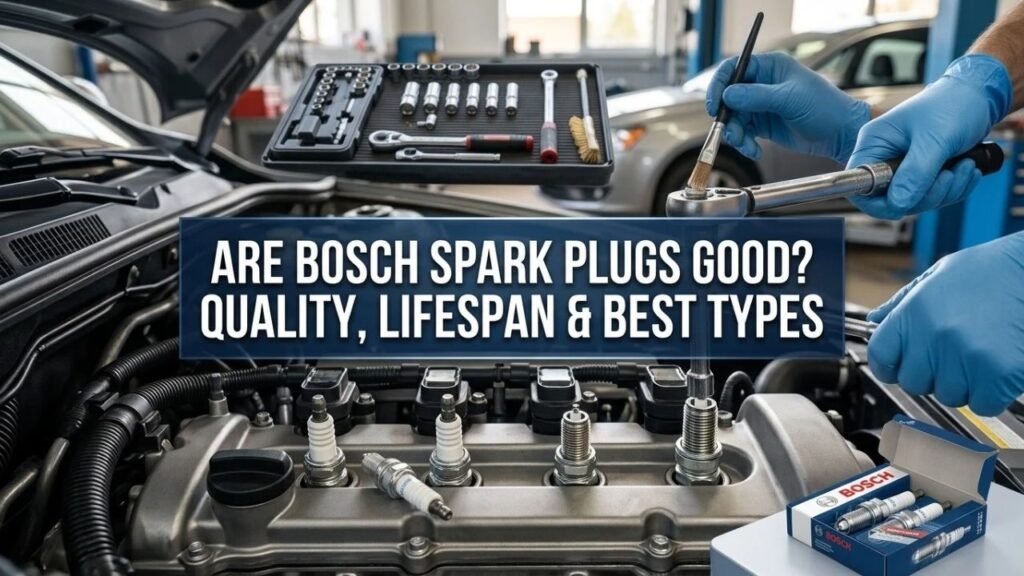
Yes, Bosch spark plugs are generally a good and reputable choice when Bosch lists the exact plug for your engine.
Bosch produces both conventional and premium spark plug technologies, so evaluating the entire brand based on one plug type is not especially useful.
Its current automotive lineup includes products such as:
- Bosch EVO
- Double Iridium
- Double Iridium Pin-to-Pin
- Iridium
- Double Platinum
- Platinum
- Nickel with Copper
- Platinum+4
The different products are intended for different engine designs, performance requirements, and service-life expectations.
A simple nickel plug may be exactly what an older engine requires, while a newer turbocharged direct-injection engine may use a sophisticated fine-wire precious-metal plug.
The most expensive option is therefore not automatically the best option.
Quick Bosch Spark Plug Verdict
| Bosch Plug Type | General Strength | Best Use |
| EVO | Modern high-demand design | Compatible turbo/GDI engines |
| Double Iridium | Long life and fine-wire ignition | Modern vehicles and OE-style replacement |
| Iridium | High ignitability and durability | Compatible modern engines |
| Double Platinum | Long service life | Applications designed for platinum |
| Platinum | Good premium replacement | Appropriate platinum applications |
| Nickel/Copper | Affordable conventional design | Older or specified engines |
| Platinum+4 | Multi-ground design | Specific compatible applications |
If Bosch catalogs one of these plugs for your exact engine, I would have no general concern about using the brand.
Key Takeaways:
- Bosch is a legitimate premium spark plug manufacturer with a broad current product range.
- Correct application is more important than choosing the most expensive Bosch plug.
- Bosch Double Iridium and EVO are particularly relevant to many modern engines.
Why Bosch Spark Plugs Are Considered Good
Several design characteristics make Bosch plugs competitive with other major manufacturers.
Application-Specific Engineering
Modern spark plugs are not universal parts.
Manufacturers vary electrode projection, firing-tip size, heat range, ground-electrode shape, thread reach, seat type, and many other characteristics according to engine requirements.
Bosch’s precious-metal plugs are designed around original-equipment-style requirements rather than simply using iridium or platinum as a marketing feature.
That matters because the plug has to work with the combustion chamber and ignition system as a complete package.
Fine-Wire Electrodes
Bosch Iridium and Double Iridium plugs use fine center-electrode designs.
A small firing tip concentrates the electrical field, allowing the spark to initiate efficiently.
Bosch states that some of its OE Fine Wire designs require less firing voltage than conventional designs.
Lower required firing voltage can provide useful ignition margin, particularly as an engine operates under changing temperature, pressure, and load.
This does not mean the plug magically generates more ignition energy. Rather, its electrode geometry makes initiating the spark easier.
Durable Precious Metals
Iridium and platinum resist spark erosion much better than conventional nickel electrode materials.
This allows a very small electrode to remain usable for a long period.
Bosch Double Iridium places precious material on both major firing surfaces, while Double Platinum similarly uses platinum on both electrode sides.
Reducing wear at both firing surfaces helps preserve the electrode geometry and gap over an extended service period.
Factory-Set Gaps
Bosch premium fine-wire spark plugs are supplied with factory-set gaps for their intended applications.
For the Bosch OE Fine Wire Iridium and platinum families, Bosch advises against adjusting the factory gap because improper adjustment can damage the delicate center electrode.
This simplifies installation when you have purchased the correct application.
Nickel-Plated Threads
Many modern Bosch plugs use nickel-plated threads.
This helps prevent corrosion and allows installation without automatically adding anti-seize compound.
Using unnecessary anti-seize can alter thread friction and affect the relationship between torque-wrench reading and actual clamping force.
For these plugs, following Bosch’s installation instructions is better than automatically applying lubricants based on older habits.
Are Bosch Double Iridium Spark Plugs Good?
Yes. Bosch Double Iridium is one of the strongest choices in the company’s current conventional passenger-vehicle lineup.
These plugs use iridium at the center firing pin and precious-metal material at the ground-electrode firing surface.
Bosch describes its Double Iridium plugs as OE-style fine-wire technology intended to provide both strong ignition performance and long service life.
Bosch currently claims up to approximately four times the service life of its conventional copper-reference plugs for this line.
That comparison should not be interpreted as a universal mileage guarantee. Actual replacement intervals should still come from your vehicle’s maintenance schedule.
Who Should Choose Double Iridium?
I would consider Bosch Double Iridium when:
your vehicle is specifically listed for the plug, you want a long-life replacement, the plugs are difficult to access, or the original equipment already uses a comparable fine-wire precious-metal design.
The labor factor can be important.
On some V6 engines, changing the rear-bank plugs requires removing an intake manifold. A high-quality long-life plug can make more economic sense when the labor is substantial.
On an engine where all four plugs can be replaced in 15 minutes, maximum longevity may matter less.
Key Takeaways:
- Bosch Double Iridium is a strong choice for compatible modern applications.
- Its biggest advantages are fine-wire ignitability and wear resistance rather than dramatic horsepower gains.
- Follow the vehicle’s replacement interval even when the plug manufacturer advertises extended durability.
Are Bosch Iridium Spark Plugs Good?
Yes.
Bosch Iridium plugs use a fine-wire iridium center electrode designed for reliable ignition and good durability.
Iridium’s high wear resistance allows the center electrode to be significantly smaller than a traditional nickel electrode without wearing away rapidly.
That creates a good combination of ignitability and service life.
A Bosch Iridium plug can therefore be an excellent choice when it is the recommended application for the engine.
However, I would not automatically replace a factory dual-iridium or dual-precious-metal plug with a simpler single-iridium design merely because both say “iridium.”
The full electrode construction matters.
Are Bosch Platinum Spark Plugs Good?
Yes, particularly in engines that are designed for platinum plugs.
Bosch currently offers both Platinum and Double Platinum designs.
Bosch markets its standard Platinum line as providing greater service life than conventional copper-reference plugs, while its Double Platinum line is positioned for even greater longevity.
Again, the important question is not whether platinum is objectively better than nickel or iridium.
The question is what the engine was designed to use.
Double Platinum Can Be Important in Certain Ignition Systems
Some ignition systems historically placed different electrical stress on paired spark plugs, making durable firing surfaces on both electrodes useful.
A dual-precious-metal design can resist wear regardless of which surface experiences the greater erosion.
For an application requiring Double Platinum, replacing it with a cheap conventional plug may shorten service life even if the engine initially runs normally.
What Are Bosch EVO Spark Plugs?
Bosch EVO is a newer spark plug family developed for demanding modern gasoline engines, particularly turbocharged gasoline direct-injection applications.
These engines can place unusually high demands on spark plugs because of elevated cylinder pressures, high temperatures, and abnormal combustion events.
Bosch specifically highlights an improved insulator design and high dielectric strength for EVO plugs.
This helps the plug tolerate the severe electrical and thermal environment found in modern high-output engines.
Are Bosch EVO Spark Plugs Worth It?
If EVO is the specified Bosch application for your engine, yes.
I would not install an EVO plug simply because you own a turbocharged car, however.
The exact part still needs the proper heat range, thread dimensions, projection, and other specifications.
“Designed for turbo engines” does not mean one EVO plug works in every turbo engine.
How Long Do Bosch Spark Plugs Last?
There is no single Bosch spark plug lifespan.
It depends heavily on the electrode material, engine, plug design, operating conditions, and vehicle manufacturer’s replacement schedule.
A conventional nickel-electrode plug generally has a shorter service interval than a modern double-iridium plug.
Bosch’s own product comparisons position its premium lines approximately as follows relative to conventional copper-reference spark plugs:
| Bosch Technology | Bosch’s Relative Durability Positioning |
| Nickel/Copper | Conventional baseline |
| Platinum | Up to about 2× baseline |
| Double Platinum | Up to about 3× baseline |
| Double Iridium | Up to about 4× baseline |
These are useful product comparisons, not a reason to invent a maintenance interval.
If your owner’s manual specifies replacement at 60,000 miles, 100,000 miles, or another interval, use that information for the actual vehicle.
Conditions That Can Shorten Spark Plug Life
Even an excellent spark plug can fail or foul early if the engine has another problem.
Examples include:
oil consumption, excessive fuel enrichment, coolant entering the cylinder, persistent misfires, severe detonation, incorrect plug heat range, or abnormal combustion.
A premium plug cannot compensate indefinitely for an unhealthy engine.
Do Bosch Spark Plugs Improve Performance?
They can restore or maintain performance, but do not expect a meaningful horsepower increase simply from changing brands.
Suppose an engine currently has severely worn plugs with enlarged gaps.
The ignition coils have to work harder to fire them, and occasional misfires may occur under acceleration.
Replacing those plugs with correctly specified Bosch plugs can make the engine feel substantially better.
You might notice:
smoother idle, easier starts, cleaner acceleration, reduced hesitation, and restored power.
Those improvements come primarily from replacing worn components.
If you replace nearly new, correctly functioning OEM plugs with Bosch equivalents, the difference may be impossible to feel.
Will Bosch Iridium Plugs Add Horsepower?
Not meaningfully in a healthy stock engine.
Once the air-fuel mixture is already being ignited reliably, a different electrode material cannot create large amounts of additional engine power.
Performance depends on airflow, fuel mass, compression, combustion efficiency, ignition timing, and many other factors.
Think of a premium spark plug as a way to provide reliable ignition—not as a bolt-on horsepower modification.
Do Bosch Spark Plugs Improve Gas Mileage?
Possibly when replacing worn or fouled plugs.
Misfires and weak combustion can reduce fuel efficiency.
Restoring the ignition system to proper condition can therefore improve MPG when the old plugs were causing a problem.
But installing Bosch plugs in an engine whose existing plugs are healthy will not normally produce a dramatic fuel-economy increase.
Driving conditions, tire pressure, fuel mixture, temperature, vehicle speed, transmission operation, and dozens of other variables have much greater effects.
Fuel economy should be considered a maintenance benefit rather than a reason to expect a quick return on the cost of premium plugs.
Bosch vs NGK Spark Plugs
Both companies produce excellent spark plugs.
I would not universally rank one above the other.
NGK has extremely broad OEM and aftermarket coverage and offers many highly regarded iridium, ruthenium, platinum, and conventional designs.
Bosch also has extensive OE engineering experience and a strong lineup of application-specific premium plugs.
The better choice for a particular vehicle often comes down to which plug most closely matches its original specification.
If the vehicle originally came with a specific NGK plug and the manufacturer’s service information continues to specify it, I see little reason to change brands merely for variety.
If Bosch lists an OE-equivalent replacement with the correct specifications, Bosch is also a legitimate choice.
Fitment Beats Brand Loyalty
The wrong premium plug from a favorite manufacturer is still the wrong plug.
The correct heat range and geometry matter much more than the logo printed on the insulator.
Bosch vs DENSO Spark Plugs
The same principle applies to DENSO.
DENSO produces excellent OE and aftermarket spark plugs, including fine-wire iridium designs.
There is no useful blanket rule stating that Bosch is always better or worse.
I would compare:
the exact original specification, electrode configuration, heat range, verified application, recommended service interval, and availability from a trustworthy seller.
When both options are properly engineered for the application, either can be a good choice.
Are Bosch Spark Plugs Good for German Cars?
Bosch is naturally associated with European and German vehicles, and Bosch plugs are excellent choices for many of those applications.
But you should not choose a Bosch plug solely because the vehicle is German.
BMW, Mercedes-Benz, Volkswagen, Audi, Porsche, and other manufacturers can use plugs supplied by different OEM companies depending on engine and production period.
Use the specified part number for the actual engine.
Likewise, Bosch plugs are not limited to European vehicles. Bosch catalogs plugs for numerous American, Asian, and other applications.
Are Bosch Spark Plugs Good for Turbo Engines?
Yes, when properly specified.
Bosch’s EVO family is specifically intended to address the demanding conditions found in modern turbocharged gasoline direct-injection engines.
Bosch also offers other fine-wire products compatible with turbo applications.
Turbo engines create high cylinder pressure, which raises the voltage required to initiate a spark.
A fine electrode can help improve ignitability under these demanding conditions.
However, a modified high-boost engine is a separate case.
If boost pressure, fuel type, compression, or tuning has changed substantially, follow the engine builder or tuner’s recommendation for heat range and gap.
A stock-replacement plug is not necessarily optimal for a heavily modified engine just because it is premium.
Are Bosch Spark Plugs Pre-Gapped?
Yes. Bosch spark plugs are supplied with a factory-set gap.
For most applications, the plug listed for the vehicle is ready to install without changing the gap.
Bosch specifically states that its OE Fine Wire Iridium and platinum plugs should not have their gaps adjusted because adjustment can damage the fine electrode.
You can still visually inspect the plug for shipping damage and verify that you purchased the correct part.
A severely abnormal-looking gap should prompt you to check the part number or replace a damaged plug rather than immediately bending a delicate electrode.
Do Bosch Spark Plugs Need Anti-Seize?
Bosch premium plugs with nickel-plated threads generally do not require anti-seize.
This is important because anti-seize changes thread friction and can cause overtightening when you use the dry-thread torque specification.
Follow Bosch and vehicle-manufacturer instructions rather than automatically lubricating every spark plug.
Correct installation torque is important because it affects both mechanical retention and heat transfer from the plug to the cylinder head.
Are Bosch Spark Plugs Good for High-Mileage Cars?
They can be excellent for high-mileage vehicles, but mileage alone does not determine which plug you need.
If a 180,000-mile engine originally requires a double-iridium plug and is mechanically healthy, continuing to use the appropriate double-iridium specification makes sense.
Do not automatically change to a hotter spark plug or different electrode type just because the odometer is high.
If the engine burns oil and repeatedly fouls plugs, the underlying mechanical issue needs to be diagnosed.
An expensive spark plug may resist electrode wear but cannot prevent oil from entering the cylinder.
What Are the Disadvantages of Bosch Spark Plugs?
The biggest disadvantage is not specific to Bosch: premium spark plugs cost more than conventional plugs.
An Iridium or Double Iridium plug can be considerably more expensive than a basic nickel plug.
That additional cost is worthwhile only if the engine benefits from the technology or requires it.
Another issue is application selection.
Because Bosch offers many different designs, it is possible to buy the wrong plug if you shop by dimensions or electrode material rather than exact fitment.
Finally, counterfeit automotive parts are a concern across major premium brands.
Purchasing from a trustworthy retailer or distributor is important, particularly when a price looks dramatically lower than normal.
Key Takeaways:
- Bosch’s premium plugs cost more, but their durability can justify the price in appropriate applications.
- Do not use premium electrode material as a substitute for correct heat range and geometry.
- Buy from reputable sources and verify the exact Bosch part number.
How to Choose the Best Bosch Spark Plug for Your Car
Start with your year, make, model, and engine.
If there are multiple engines available for the same vehicle, make sure you select the correct one.
Then use Bosch’s vehicle application information to identify compatible part numbers.
Do not simply move from Platinum to Double Iridium because it sounds like an upgrade.
A plug should match the combustion chamber and ignition system.
Check these characteristics:
thread size and reach, seat type, heat range, electrode projection, resistor design, electrode configuration, and intended gap.
You normally do not have to calculate these individually when you use a reliable application catalog, but they explain why random cross-referencing is risky.
Should You Stay With the Original Plug Brand?
If your engine is running properly and the manufacturer specifies a particular OE plug, staying with that exact specification is the lowest-risk choice.
There is no need to change brands just because another product advertises newer electrode technology.
However, Bosch can be a suitable replacement when its catalog specifically lists the plug as OE-equivalent for the application.
How to Tell if Your Bosch Spark Plugs Need Replacement
Do not wait for complete failure.
The recommended service interval is your primary guide.
Possible signs of worn or failing plugs include:
hard starting, rough idle, hesitation, misfires under acceleration, reduced performance, check-engine light, or increasing fuel consumption.
None of those symptoms proves the plugs are bad.
A weak coil, injector problem, vacuum leak, compression issue, or fuel-system fault can create very similar symptoms.
If the service interval is not due, diagnose the engine before replacing parts randomly.
Inspect the Old Plugs
Removed spark plugs can provide useful clues.
Normal plugs usually show relatively modest deposits.
Dry black soot can indicate carbon fouling or rich operation.
Wet oily deposits can point toward oil entering the combustion chamber.
A severely white, blistered, or damaged firing end can indicate overheating or abnormal combustion.
Replacing the plugs without understanding an unusual appearance can cause the same problem to return.
Are Cheap Bosch Spark Plugs Online a Good Deal?
They can be if they come from a reliable authorized or established parts seller.
However, I would be cautious about unusually inexpensive premium plugs from unknown marketplace sellers.
Spark plugs are small, easy to ship, and major brands can attract counterfeit products.
A counterfeit plug may imitate the packaging while using inferior electrode material, ceramics, internal resistors, or manufacturing tolerances.
A few dollars saved per plug is not worth risking a misfire or having to repeat the job.
For vehicles where plug replacement requires several hours of labor, source quality becomes even more important.
When Would I Choose Bosch Spark Plugs?
I would choose Bosch when the company has a verified application matching the vehicle, particularly if the engine originally uses a comparable precious-metal technology.
Double Iridium is attractive when I want a long-life modern fine-wire design.
Double Platinum makes sense where a platinum application is specified.
EVO is especially interesting for compatible modern turbocharged direct-injection applications.
Conventional Bosch nickel plugs remain perfectly valid when an older or simpler engine requires that technology.
When Would I Choose Something Else?
I would stay with another brand if the vehicle manufacturer specifically calls for a particular OE plug and there is no compelling reason to change.
I would also avoid Bosch—or any brand—if the catalog does not clearly list the exact engine application.
Brand reputation cannot compensate for incorrect fitment.
FAQs about Are Bosch Spark Plugs Good
Are Bosch spark plugs reliable?
Yes. Bosch produces OE-style and aftermarket spark plugs ranging from conventional nickel designs to modern Double Iridium and EVO technologies.
Correct application and installation remain essential.
Are Bosch Iridium spark plugs good?
Yes.
They offer fine-wire electrode technology, good ignitability, and strong wear resistance for compatible engines.
Are Bosch Double Iridium spark plugs worth it?
They can be, especially in modern engines where long service life is important or spark-plug replacement requires significant labor.
Do not upgrade unless Bosch lists the plug for your application.
Are Bosch Platinum spark plugs good?
Yes.
Bosch Platinum and Double Platinum plugs are good choices for engines designed to use those technologies.
Are Bosch EVO spark plugs good?
Yes, for compatible applications.
The EVO line is engineered specifically for the demanding conditions found in modern turbocharged gasoline direct-injection engines.
Which is better, Bosch or NGK?
Neither brand is universally better.
Both produce high-quality plugs. I recommend whichever exact part best matches the vehicle manufacturer’s specification.
Which is better, Bosch or DENSO?
Both are respected spark plug manufacturers.
Application-specific fitment and OE requirements matter more than choosing one brand in every situation.
How long do Bosch Iridium spark plugs last?
Service life varies by plug and vehicle.
Bosch promotes its Double Iridium line as having substantially greater durability than conventional copper-reference plugs, but the vehicle manufacturer’s maintenance interval should determine actual replacement timing.
Do Bosch spark plugs improve gas mileage?
Replacing worn plugs can restore lost fuel economy.
Changing from healthy, correctly specified plugs to Bosch generally will not produce a dramatic MPG increase solely because of the brand.
Do Bosch spark plugs increase horsepower?
Not meaningfully in a healthy stock engine.
Fresh plugs can restore power lost to worn or misfiring plugs, but spark-plug brand alone does not create substantial additional horsepower.
Are Bosch spark plugs pre-gapped?
Yes.
Bosch supplies its plugs with factory-set gaps. Bosch fine-wire precious-metal plugs generally should not have their gaps manually adjusted.
Do Bosch spark plugs need anti-seize?
Bosch plugs with nickel-plated threads generally do not require anti-seize unless specifically instructed otherwise.
Follow the installation guidance for the exact application.
Are Bosch spark plugs good for BMW?
Bosch manufactures suitable spark plugs for many BMW engines, but use the exact plug specified for your particular engine.
Not every BMW uses the same brand or spark plug design.
Are Bosch spark plugs good for Mercedes?
Yes, Bosch plugs are appropriate for many Mercedes-Benz applications when listed for the exact engine.
Use vehicle-specific fitment information.
Are Bosch plugs good for turbocharged cars?
Yes. Bosch produces several plugs suitable for turbocharged applications, including EVO designs developed for demanding modern turbo-GDI engines.
Conclusion
So, are Bosch spark plugs good? Yes. Bosch is a strong spark plug manufacturer with conventional, Platinum, Double Platinum, Iridium, Double Iridium, and modern EVO products covering a wide range of gasoline engines.
For compatible vehicles, Bosch premium fine-wire plugs provide excellent ignitability, wear resistance, and long-term ignition consistency. Double Iridium is particularly attractive as a modern long-life replacement, while EVO is designed for demanding turbocharged direct-injection applications.
However, I would not choose Bosch—or any other spark plug manufacturer—based on brand reputation alone.
The most important factor is whether the exact spark plug is specified for your engine. Heat range, thread reach, electrode projection, resistor construction, gap, and firing-tip geometry all matter.
A basic Bosch nickel plug that exactly matches an older engine can be a better choice than an expensive Double Iridium plug that does not.
Likewise, if your vehicle’s original-equipment specification calls for a particular NGK, DENSO, or other plug and that plug is working well, you do not need to change brands simply because Bosch offers premium technology.
My recommendation is to use Bosch confidently when its application catalog lists the correct plug for your engine, buy from a reputable source, and install it according to the proper torque and gap guidance.
Under those conditions, Bosch spark plugs are absolutely a good choice for both routine maintenance and many modern high-demand engines.