
If you are wondering are spark plugs covered under warranty, the answer is sometimes—but ordinary spark plug wear is usually considered routine maintenance and is often excluded from a vehicle warranty. A spark plug that fails unusually early because of a manufacturing defect may be covered under a new-vehicle warranty, replacement-parts warranty, or the spark plug manufacturer’s own warranty, depending on the circumstances and the specific warranty terms.
The most important distinction is normal wear versus a defect.
Spark plugs naturally wear as the electrodes fire thousands of times every minute. Their gaps gradually increase, deposits can build up, and eventually they reach their scheduled replacement interval. A warranty generally is not intended to pay for that normal maintenance.
But if a spark plug cracks, develops an internal defect, loses an electrode, or otherwise fails far earlier than reasonably expected without abuse or an external engine problem causing the damage, warranty coverage may be possible.
Coverage also depends on where the plug came from. Factory-installed OEM spark plugs, replacement plugs installed by a dealership, and aftermarket spark plugs bought from a parts store can all have different warranty rules.
In this guide, I’ll explain when spark plugs may be covered under warranty, why wear items are usually excluded, how new-car and powertrain warranties treat spark plugs, whether labor may be covered, what happens when another engine problem destroys the plugs, and how to improve your chances of a successful warranty claim.
Are Spark Plugs Usually Covered Under a New Car Warranty?
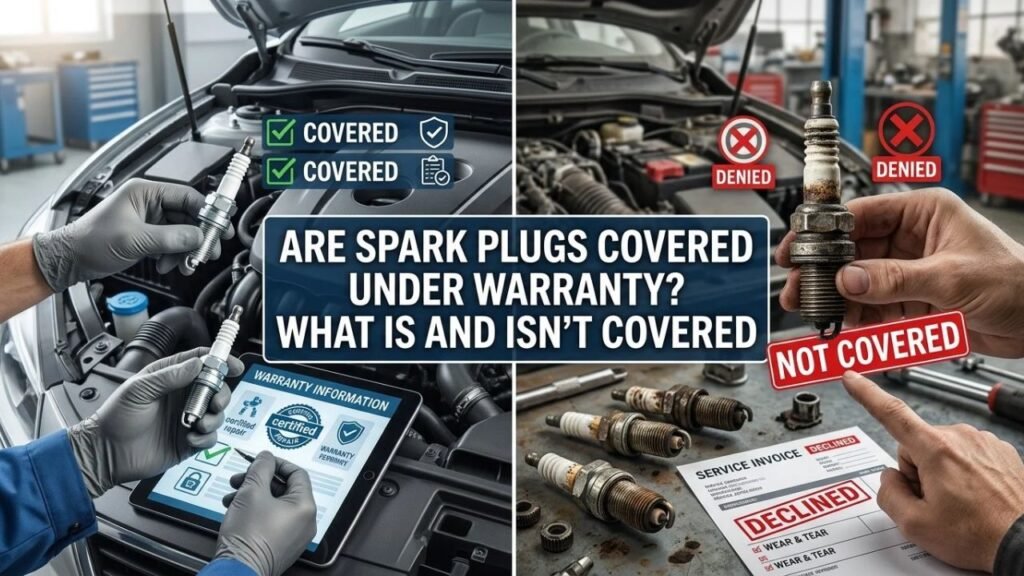
Not for ordinary replacement due to normal wear.
Most vehicle warranties distinguish between defects in materials or workmanship and scheduled maintenance or wear items.
A new vehicle warranty is generally intended to correct something that was defective when manufactured or that failed prematurely because of a warrantable problem.
Spark plugs, however, are consumable engine components.
Like brake pads, filters, wiper blades, and some fluids, they have a finite service life.
If your owner’s manual says the spark plugs should be replaced at a particular mileage or service interval, that scheduled replacement is normally the owner’s responsibility.
For example, if the maintenance schedule calls for new spark plugs at 60,000 miles and the vehicle reaches that mileage with normally worn plugs, you should not expect the warranty to pay for a tune-up simply because the original vehicle warranty has not yet expired.
Premature Failure Is Different
Suppose the vehicle has only 8,000 miles and one factory-installed spark plug develops an internal electrical failure.
That is not the same thing as an electrode that has slowly worn out after years of operation.
If the dealer determines that the spark plug itself was defective, it may be covered under the applicable warranty.
The exact decision depends on the automaker’s warranty terms and the cause of failure.
Key Takeaways:
- Normal spark plug wear is usually maintenance, not a warranty repair.
- A premature manufacturing defect may qualify for coverage.
- The dealer or manufacturer normally needs to determine why the plug failed before approving the claim.
Why Spark Plugs Are Considered Wear Items
Every time a spark plug fires, electrical energy jumps across the electrode gap.
This gradually erodes electrode material.
Over thousands of miles, the center and ground electrodes can become worn or rounded.
The gap may slowly increase.
Combustion deposits can also build up.
These changes are expected during normal engine operation.
The rate of wear depends partly on spark plug construction.
Traditional nickel plugs generally have shorter service lives than many platinum and iridium designs.
Long-life precious-metal plugs can sometimes remain in service for very high mileages, but they still eventually wear.
Because this deterioration is expected, warranties generally do not treat scheduled replacement as a manufacturing failure.
The same principle applies to many automotive consumables.
A tire wearing down after thousands of miles does not necessarily mean the tire was defective.
A brake pad becoming thin after normal braking does not automatically create a vehicle warranty claim.
Spark plugs work similarly.
What Does a Spark Plug Warranty Actually Cover?
A spark plug manufacturer’s warranty typically focuses on defects in materials or workmanship, not every reason a spark plug might stop working correctly.
Potentially warrantable defects could include problems such as an internal construction failure, defective terminal, manufacturing flaw, faulty ceramic, or another issue clearly attributable to the plug itself.
However, coverage commonly excludes damage caused by outside conditions.
Examples can include:
Incorrect installation.
Wrong plug application.
Incorrect torque.
Cross-threading.
Impact damage.
Engine overheating.
Detonation or pre-ignition.
Oil fouling.
Coolant contamination.
Fuel-system problems.
Improper modification.
Physical electrode damage.
A spark plug manufacturer cannot reasonably warranty a plug destroyed because an engine was burning large quantities of oil.
The plug is only showing the consequences of another problem.
Are Factory Spark Plugs Covered Under the Bumper-to-Bumper Warranty?
Possibly if they are defective, but usually not when they are simply worn out.
A comprehensive or bumper-to-bumper warranty generally covers many factory-installed components against manufacturing defects.
That does not mean every component receives free replacement whenever it wears.
Maintenance parts and normal wear are often excluded or limited.
If a factory spark plug fails prematurely while the vehicle is still within the basic warranty period, the dealer may inspect the plug and surrounding ignition system.
If the technician determines that the plug suffered a genuine defect rather than normal wear or outside damage, coverage may be approved.
If the plug is simply worn after substantial mileage, replacement is much more likely to be considered normal maintenance.
Are Spark Plugs Covered Under a Powertrain Warranty?
Usually, you should not assume they are.
A powertrain warranty commonly focuses on major engine, transmission, and drivetrain components.
Spark plugs are replaceable ignition components and routine service items.
They are generally treated differently from an engine block, crankshaft, internal bearings, pistons, transmission gears, or similar major components.
Even though a spark plug is installed in the engine, that does not automatically make it a powertrain-warranty component.
Always read the actual warranty booklet.
The word “powertrain” can sound broader than the legal coverage actually is.
What If an Engine Failure Damages the Spark Plug?
This situation is different.
Suppose an internally failed engine component covered by the powertrain warranty causes abnormal combustion and destroys a spark plug.
The spark plug itself may be secondary damage.
Whether it is included as part of the repair depends on the warranty terms and the manufacturer’s claim decision.
In that case, the issue is not really a worn spark plug.
The issue is a warrantable engine failure that also affected the plug.
Are Spark Plugs Covered Under an Extended Warranty?
It depends heavily on the contract.
“Extended warranty” can refer to several different products.
It may be:
Manufacturer-backed extended coverage.
A vehicle service contract.
A dealership protection plan.
Third-party mechanical breakdown coverage.
These plans can have very different exclusions.
Wear items and maintenance components are commonly excluded.
Spark plugs may therefore not be covered as ordinary replacements.
However, some higher-level maintenance packages specifically include tune-up services or scheduled maintenance.
That is not the same as a traditional mechanical warranty.
If you purchased additional coverage, look for sections titled:
Maintenance.
Wear items.
Exclusions.
Ignition system.
Covered components.
Deductibles.
Do not rely only on the salesperson’s phrase “full coverage.”
The written contract determines what the plan actually pays for.
Are Spark Plugs Covered by the Spark Plug Manufacturer?
Many major spark plug manufacturers provide some form of limited warranty against manufacturing defects.
That does not mean they guarantee the plug will last forever or pay for every engine problem related to ignition.
If a new plug is genuinely defective, you may be able to obtain a replacement or another remedy according to the manufacturer’s warranty terms.
You may need:
Proof of purchase.
The original plug.
The packaging or part number.
Vehicle information.
Mileage at installation.
Mileage at failure.
Evidence of correct application.
The manufacturer may inspect the returned plug before approving the claim.
Warranty Does Not Equal Guaranteed Mileage
A long-life spark plug may be marketed for extended service, but a warranty and a recommended service interval are not the same thing.
A plug can foul early because of an engine problem even if the electrodes are capable of lasting far longer under healthy operating conditions.
Similarly, no manufacturer can guarantee normal plug life when the engine suffers from oil burning, coolant leakage, excessive fuel, detonation, or overheating.
Are Aftermarket Spark Plugs Covered Under Warranty?
They can be.
If you buy replacement spark plugs from an auto-parts retailer or online seller, there may be multiple layers of possible coverage.
The retailer may offer a return or replacement policy.
The spark plug manufacturer may provide a limited product warranty.
A professional repair shop may separately warranty its labor.
These are different forms of protection.
For example, suppose a repair shop installs a new aftermarket spark plug and one plug fails because of a manufacturing defect shortly afterward.
The plug manufacturer may cover the part.
The repair shop may or may not cover the labor needed to remove and replace it, depending on the shop’s own warranty.
Always keep your invoice.
Will a Spark Plug Warranty Cover Labor?
Not necessarily.
A parts warranty and a labor warranty are different.
A spark plug manufacturer may agree to replace a defective $10 plug but not pay the labor required to access it.
On some engines, replacing one plug is simple.
On others, access can require removing intake components, ignition coils, covers, or other parts.
Labor can cost far more than the plug itself.
If a dealership installed the plug as part of a covered warranty repair and that plug subsequently proves defective, labor may be covered under the applicable repair warranty.
If you installed the plug yourself, a manufacturer parts warranty generally should not be assumed to pay for your time or professional labor afterward.
Ask specifically whether the warranty covers:
The replacement plug.
Diagnostic labor.
Removal and installation.
Related damage.
Towing.
Do not assume all of those are included.
What Spark Plug Problems Are Usually Not Covered?
Normal electrode wear is the most obvious example.
Several other conditions are also commonly considered external damage rather than spark plug defects.
Oil-Fouled Spark Plugs
An oil-fouled plug usually indicates that engine oil is entering the combustion chamber.
Possible causes include worn piston rings, valve-seal problems, cylinder wear, or another engine fault.
Replacing the plug may temporarily restore firing, but the plug itself did not cause the oil.
A spark plug manufacturer would not generally be expected to cover repeated oil fouling as a plug defect.
Fuel-Fouled Spark Plugs
A leaking injector, failed sensor, excessive fuel pressure, ignition problem, or repeated unsuccessful starting can soak a spark plug in fuel.
Again, the plug may stop firing correctly, but the root cause exists elsewhere.
Carbon Fouling
Heavy deposits can result from an overly rich mixture, excessive idling, incorrect heat range, poor ignition, or engine operating conditions.
Carbon buildup does not automatically mean the plug was defective.
Overheated or Melted Electrodes
A plug exposed to detonation, pre-ignition, excessive combustion temperature, wrong heat range, or severe engine tuning may suffer electrode damage.
That is usually considered an operating or application problem rather than a manufacturing defect.
Broken Ceramic From Installation
A cracked ceramic insulator can cause misfire, but the cause matters.
If the ceramic cracked because a socket was held at an angle or the plug was dropped onto a hard floor, that is installation damage.
It is very different from a ceramic defect that develops without outside impact.
Key Takeaways:
- A warranty usually covers defects, not fouling caused by engine problems.
- Oil, fuel, overheating, and incorrect installation can invalidate a plug-related claim.
- The cause of failure matters more than the appearance of the bad plug alone.
Does Incorrect Spark Plug Installation Void the Warranty?
It can affect coverage for the damaged spark plug.
Spark plugs must be installed correctly.
Common installation errors include overtightening, undertightening, cross-threading, incorrect gap adjustment, using the wrong plug, and damaging a fine-wire electrode.
For example, if someone overtightens a plug until the shell is distorted, the resulting failure is not a manufacturing defect.
Similarly, installing a plug with the wrong reach or heat range can cause serious problems.
Always verify:
Correct part number.
Thread diameter.
Thread reach.
Seat type.
Heat range.
Resistor specification.
Electrode design.
Gap.
Installation torque.
Correct installation also gives you a stronger position if a legitimate warranty issue later occurs.
Can Using Aftermarket Spark Plugs Void Your Vehicle Warranty?
Installing an aftermarket spark plug does not automatically mean your entire vehicle warranty disappears.
However, the replacement plug needs to be correct for the application.
If an aftermarket plug meets the required specifications and is installed properly, its mere use does not automatically prove that unrelated vehicle repairs should be denied.
The situation changes if the wrong or defective aftermarket plug actually causes damage.
For example, installing a plug with excessive reach could potentially create mechanical interference inside the cylinder.
A manufacturer could reasonably question coverage for damage directly caused by that incorrect part.
The practical approach is to use reputable plugs that are specifically cataloged for the engine.
Keep receipts and part-number information.
What If the Dealer Says Spark Plugs Are Not Covered?
Ask why.
There is a major difference between:
“Spark plugs are maintenance items.”
and
“This plug failed because of normal wear.”
If you believe the plug suffered an unusual early defect, ask the dealer to explain the diagnosis.
Useful questions include whether the plug is worn, fouled, cracked, electrically open, physically damaged, or affected by another engine problem.
If the vehicle is still under warranty and the plug failed unusually early, you can also review the warranty booklet and ask whether the manufacturer provides a claim escalation process.
Stay focused on the failure cause.
Simply saying “spark plugs are wear items” may not fully address a genuine manufacturing defect.
Can a Defective Spark Plug Damage an Ignition Coil?
It is possible for abnormal plug conditions to increase ignition-system stress.
For example, an excessively wide plug gap can require higher firing voltage.
However, proving that a defective spark plug directly caused another component to fail can be difficult.
Warranty claims involving consequential damage usually require diagnosis.
A technician may need to determine whether the spark plug failed first, whether the coil failed first, or whether another problem affected both.
Do not throw away the suspected defective plug if you expect to pursue a claim.
The old part may be important evidence.
What If a Spark Plug Breaks Inside the Engine?
Coverage depends entirely on why it broke.
If a properly installed factory plug suffers an unusual manufacturing failure while the vehicle is under warranty, the resulting repair may potentially be considered for coverage.
If the plug broke because it was overtightened, cross-threaded, improperly removed, or physically damaged during DIY service, the situation is very different.
A broken spark plug can leave part of the shell or electrode inside the cylinder head.
In difficult cases, removal can require specialized extraction tools or significant engine disassembly.
Before authorizing an expensive repair, determine whether the vehicle, previous repair, or spark plug itself has applicable warranty protection.
Are Spark Plug Misfires Covered Under Warranty?
A misfire is a symptom, not a component.
Whether it is covered depends on its cause.
If the misfire is caused by a defective ignition coil covered under the vehicle warranty, the repair may be covered.
If it is caused by a defective factory spark plug, coverage may also be possible.
If it occurs because the spark plugs reached their scheduled replacement interval, that is normally maintenance.
If oil-fouled plugs result from a warrantable internal engine defect, the larger engine repair may be covered even though replacing the plugs alone would ordinarily be maintenance.
Diagnosis is therefore critical.
What If the Spark Plugs Wear Out Earlier Than Expected?
Early wear does not automatically prove a defect.
Several engine conditions can shorten spark plug life dramatically.
These include:
Rich air-fuel mixture.
Oil consumption.
Coolant entering the cylinder.
Incorrect heat range.
Excessive combustion temperature.
Detonation.
Weak ignition.
Frequent short trips.
Incorrect gap.
Engine modifications.
If every plug shows similar abnormal deposits, the engine may have an underlying operating problem.
If one plug alone has a clear manufacturing defect while the others look normal, that may strengthen the argument for a product issue.
How Long Should Spark Plugs Last?
There is no universal mileage.
Service life depends heavily on electrode material and engine design.
Conventional plugs can require relatively frequent replacement.
Platinum and iridium plugs are often designed for much longer service intervals.
Some engines specify replacement well below 100,000 miles, while others may have intervals around or above that figure.
Always follow the maintenance schedule for the exact vehicle.
A plug advertised as “long life” should not be left installed indefinitely if the vehicle manufacturer specifies an earlier replacement interval.
The engine manufacturer’s schedule takes priority for maintenance planning.
Should You Keep Spark Plug Replacement Receipts?
Yes.
Receipts can be extremely useful if a warranty question arises later.
Keep records showing:
Purchase date.
Spark plug part number.
Vehicle mileage.
Installer or repair shop.
Installation date.
Service invoice.
This documentation helps demonstrate that the engine received the correct maintenance at the appropriate time.
It also makes a spark plug manufacturer’s product-warranty claim much easier if a plug fails unexpectedly.
If you perform the work yourself, keep the parts receipt and record the vehicle mileage.
How to Make a Spark Plug Warranty Claim
Start by determining which warranty may apply.
If the plugs are original factory equipment and the vehicle is still within its applicable warranty period, contact the dealership or automaker.
If the plugs were bought separately, contact the retailer or spark plug manufacturer.
Do not throw away the failed plug.
Clean only what is necessary for handling.
Aggressively wire-brushing or altering the plug can remove useful failure evidence.
Have your receipt and vehicle information available.
Explain the symptoms, mileage, installation date, and how the failure was diagnosed.
If the manufacturer requests the old plug for inspection, follow its return procedure.
Do Not Modify a Suspected Defective Plug
Avoid filing, cutting, side-gapping, grinding, or otherwise modifying a plug you intend to submit for warranty inspection.
Once modified, it becomes difficult to determine whether the defect existed before the modification.
The same applies to damaged threads or electrodes.
Preserve the part as close as possible to its failed condition.
Key Takeaways:
- Keep the failed spark plug and proof of purchase.
- Identify whether you are making a vehicle-warranty, retailer, repair-shop, or manufacturer claim.
- Document mileage and symptoms before discarding or modifying anything.
FAQs About Are Spark Plugs Covered Under Warranty
Are spark plugs covered under a factory warranty?
They may be covered if they fail because of a manufacturing defect during the applicable warranty period.
Normal wear and scheduled replacement are usually considered maintenance.
Are worn spark plugs covered under warranty?
Usually not.
Electrode wear is expected during normal operation and is considered routine maintenance.
Are spark plugs covered under a bumper-to-bumper warranty?
A defective factory plug may potentially be covered, but normal spark plug wear is generally excluded as maintenance.
Check the vehicle’s specific warranty terms.
Are spark plugs covered under a powertrain warranty?
Do not assume they are.
Spark plugs are generally treated as replaceable ignition or maintenance components rather than major powertrain components.
Are spark plugs covered by extended warranty?
It depends on the contract.
Many extended warranties exclude maintenance and wear items, while some separate maintenance plans may include scheduled spark plug replacement.
Do spark plug manufacturers offer warranties?
Many offer limited warranties against defects in materials or workmanship.
Coverage terms vary by manufacturer and product.
Is premature spark plug failure covered?
Potentially.
If the plug failed prematurely because of a manufacturing defect and not because of engine problems or incorrect installation, it may qualify.
Is spark plug fouling covered under warranty?
Usually not if the fouling was caused by oil consumption, excessive fuel, coolant, or another engine condition.
If a warrantable engine defect caused the fouling, the larger repair may be handled differently.
Are iridium spark plugs covered under warranty?
They can have manufacturer warranty coverage against defects, but normal electrode wear and contamination are typically not manufacturing defects.
Are platinum spark plugs covered?
The same general rule applies.
A defective plug may be covered, while ordinary wear or outside damage usually is not.
Does the warranty pay for spark plug replacement labor?
Not always.
A parts warranty may provide only a replacement part.
Labor coverage depends on who installed the plug and the terms of the repair or vehicle warranty.
Can a dealership charge me for spark plugs under warranty?
Yes, if the plugs require routine replacement or are not covered under the applicable warranty.
A genuine warrantable defect may be treated differently.
Can aftermarket spark plugs void my car warranty?
Using aftermarket plugs does not automatically eliminate all vehicle warranty coverage.
However, damage directly caused by an incorrect or unsuitable plug may not be covered.
What if the wrong spark plug damages my engine?
Coverage may be denied for damage caused by installing an incorrect part, particularly when the plug’s reach, heat range, or other specifications were wrong.
Does changing my own spark plugs void the warranty?
DIY maintenance does not automatically mean every vehicle warranty disappears.
However, damage caused by incorrect installation may not be covered.
Keep parts receipts and use the correct procedures.
What happens if a spark plug cracks during the warranty period?
The cause must be determined.
A material defect may qualify for coverage, while impact, overtightening, or improper installation generally would not.
Is a broken spark plug covered under warranty?
Possibly if the breakage resulted from a verified manufacturing defect.
Breakage caused during removal or installation is normally treated differently.
Can oil-fouled spark plugs be replaced under warranty?
The spark plugs themselves are unlikely to be covered simply because they became oil-fouled.
However, an internal engine defect causing excessive oil consumption may have its own warranty coverage.
Are misfires covered under warranty?
A misfire may be covered if its underlying cause is a warrantable component.
A misfire caused solely by normally worn spark plugs is usually considered maintenance.
Should I save the old spark plug for a warranty claim?
Yes.
The manufacturer, retailer, or dealer may want to inspect it before approving coverage.
What documents should I keep?
Keep the purchase receipt, repair invoice, part number, mileage records, and any diagnostic report showing the cause of failure.
Conclusion
So, are spark plugs covered under warranty? Sometimes—but normal spark plug wear is usually considered routine maintenance rather than a warranty repair.
Spark plugs are consumable components.
Their electrodes gradually wear every time the engine fires, which is why manufacturers specify periodic replacement intervals.
If your plugs simply reach the end of their expected service life, you should normally expect to pay for the replacement yourself.
The situation is different when a spark plug fails prematurely because of a genuine manufacturing defect. Depending on the vehicle age, mileage, plug manufacturer, installation history, and warranty terms, the defective plug may qualify for replacement under a factory warranty, parts warranty, repair-shop warranty, or spark plug manufacturer’s warranty.
The reason for failure is the deciding factor.
A defective ceramic, internal electrical failure, or another verified manufacturing issue is very different from a plug damaged by overtightening, incorrect application, oil burning, overheating, detonation, or an excessively rich fuel mixture.
Labor is also separate from parts coverage. Even if the manufacturer replaces the spark plug itself, diagnostic or installation labor may not necessarily be included.
My recommendation is to keep your receipts, record the installation mileage, use the exact plug specified for the engine, install it correctly, and save any plug that fails unusually early.
If a plug fails while the vehicle is still under warranty, let the dealer or manufacturer determine the cause before discarding it.
The simplest rule is: worn-out spark plugs are usually your maintenance responsibility; genuinely defective spark plugs may be covered.