
Can a glow plug cause loss of power? Yes, a faulty glow plug can contribute to loss of power, especially while a diesel engine is cold, but a failed glow plug usually does not directly reduce power once a healthy engine is fully warmed up. Modern glow plugs, however, also support post-glow combustion and diesel particulate filter regeneration, so a glow-system fault can indirectly cause more persistent power loss if it contributes to DPF blockage or triggers an engine-management fault.
This distinction is important because drivers sometimes replace glow plugs after noticing poor acceleration only to discover that the actual problem is a clogged DPF, turbocharger fault, EGR problem, injector issue, low fuel pressure, or another diesel-system failure.
On an older diesel, the glow plugs primarily assist cold starting. Once combustion chambers become hot enough, the engine can normally continue running without them.
Modern diesels are different. Their glow plugs may continue operating after startup and can be activated again while driving. Manufacturers use this additional heating to improve combustion during warm-up, reduce smoke and emissions, prevent excessive carbon accumulation, and help create the exhaust temperature required for DPF regeneration.
Therefore, whether a bad glow plug causes noticeable power loss depends heavily on when the power loss occurs and what type of diesel system you have.
In this guide, I’ll explain how glow plugs can cause loss of power, why a diesel may feel weak when cold, how failed glow plugs affect DPF regeneration, what other problems commonly imitate glow plug failure, and how to diagnose the problem before replacing parts.
Can a Glow Plug Cause Loss of Power?
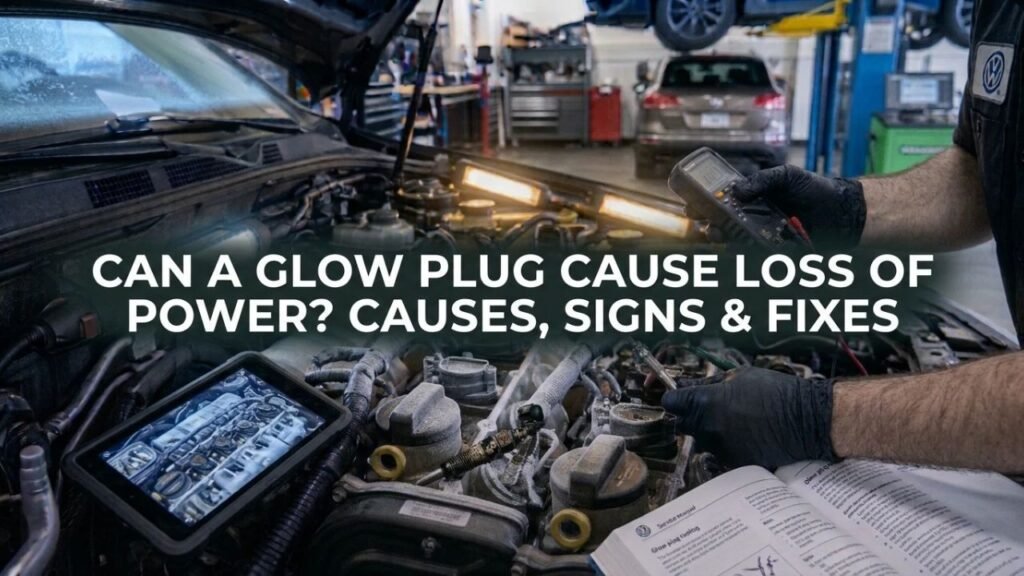
Yes, but the effect can be either direct or indirect.
A bad glow plug can directly affect power while the engine is cold because the cylinder containing that plug may not burn its fuel efficiently.
Instead of producing the same torque as the other cylinders, it may misfire or contribute less power until combustion temperatures rise naturally.
The driver may experience rough running, hesitation, sluggish acceleration, vibration, white smoke, and an overall feeling that the engine is down on power.
Once the engine is fully warm, compression heat is normally enough to ignite diesel fuel without glow plug assistance. On many engines, the immediate power difference then disappears.
Modern diesels introduce another possibility.
If failed glow plugs prevent successful DPF regeneration, soot can gradually clog the particulate filter. Exhaust flow becomes increasingly restricted, and the engine may eventually suffer substantial power loss.
Some vehicles can also enter a reduced-power or limp strategy when the engine control system detects certain emissions or engine-management faults associated with the glow system.
Quick Diagnosis by When the Power Loss Occurs
| When Power Is Lost | How Likely Glow Plugs Are Involved |
| Only immediately after a cold start | Quite possible |
| Power improves as engine warms | Glow plugs worth testing |
| Rough cold idle plus white smoke | Stronger glow-system suspicion |
| Full power loss when completely warm | Glow plugs alone less likely |
| DPF warning plus reduced power | Glow system may be an indirect contributor |
| Flashing glow plug light plus limp mode | Scan for codes; may be another engine fault |
| Constant poor acceleration with no cold-start issues | Check turbo, fuel, DPF, EGR and other systems |
That table shows why you should not diagnose the vehicle from the words “glow plug” on the dashboard alone.
Key Takeaways:
- Failed glow plugs can cause temporary power loss while a diesel engine is cold.
- A warm diesel normally does not rely on conventional pre-glow for basic combustion.
- On modern diesels, bad glow plugs can indirectly cause serious power loss by interfering with emissions and DPF regeneration.
How Glow Plugs Affect Diesel Engine Power
A diesel engine does not use spark plugs to ignite fuel.
Instead, the piston compresses air until its temperature becomes high enough to ignite injected diesel fuel.
When the engine is already hot, this process works very effectively.
During a cold start, however, the cylinder head, piston, and combustion chamber absorb heat from the compressed air.
That can make reliable ignition difficult.
A glow plug heats the area around the combustion chamber so injected fuel can ignite more readily.
If one plug does not heat, that cylinder starts at a disadvantage.
What Happens in a Cylinder With a Bad Glow Plug?
Imagine a four-cylinder diesel with one failed glow plug.
Three cylinders receive the additional heat they need during cold starting.
The fourth remains considerably colder.
When fuel enters that cylinder, ignition may be delayed or incomplete.
The cylinder may misfire completely during some combustion cycles or burn the fuel too late to produce normal torque.
Instead of four cylinders contributing evenly, the engine temporarily behaves as though one is producing substantially less power.
That is why a glow plug problem can feel like an engine power problem even though the plug itself is not a traditional power-producing component.
Why the Loss of Power Is Usually Worse When Cold
Glow plugs matter most when combustion chamber temperature is low.
On a freezing morning, several failed plugs can make a diesel extremely difficult to start.
If it eventually starts, the engine may shake, stumble, smoke, and respond poorly to the accelerator.
As combustion continues, the pistons, cylinder walls, cylinder head, and compressed intake air become hotter.
Eventually the combustion chambers reach a temperature where diesel fuel can ignite consistently without much assistance.
At that point, power may return almost completely.
This pattern is diagnostically useful.
If the vehicle is weak for the first minute or two and then runs normally, glow plugs deserve attention.
If the diesel starts perfectly cold but suddenly loses half its power after driving for an hour, failed glow plugs by themselves are much less likely to be the main problem.
Can One Bad Glow Plug Cause Loss of Power?
Yes, particularly during a cold start.
The severity depends on the number of cylinders and ambient temperature.
One failed plug in an eight-cylinder diesel may be relatively difficult to notice in mild weather.
One failed plug in a three- or four-cylinder engine can be much more obvious.
The affected cylinder may produce little useful torque until it warms.
You may feel an uneven idle and sluggish initial acceleration.
If two or three glow plugs fail, the difference becomes much greater.
The engine may crank for a long time before starting, run extremely roughly, and produce substantial white or gray smoke.
Why White Smoke Often Appears
During cold misfire, fuel may be injected normally but fail to burn completely.
Some partially burned or unburned diesel leaves through the exhaust.
This can appear as white or pale gray smoke.
Once the cylinder warms and begins firing properly, the smoke may disappear.
This combination of hard cold starting, rough running, temporary loss of power, and white smoke is much more suggestive of a glow-system problem than power loss alone.
Do Glow Plugs Work After the Engine Starts?
Modern glow plugs often do.
This is a major difference between older and newer diesel systems.
Many modern engines use post-glow, meaning the glow plugs continue heating for a period after the engine has started.
The additional heat improves cold combustion quality.
The engine can run more smoothly, warm faster, create less smoke, and produce fewer harmful emissions.
Advanced glow systems can also activate plugs intermittently after the initial warm-up period.
Therefore, saying that glow plugs “do nothing after the engine starts” is no longer accurate for many modern diesels.
How Post-Glow Can Affect Performance
If the ECU expects post-glow but one or more plugs are dead, combustion may be less stable during the warm-up phase.
The result may include roughness, increased smoke, poor throttle response, and somewhat reduced torque until the engine reaches normal temperature.
This still does not usually explain major continuous power loss once the engine is fully warm.
For that, you need to consider indirect effects or another engine fault.
Glow Plugs and DPF Regeneration
This is where glow plugs can become important even after the engine is fully warmed.
A diesel particulate filter captures soot from the exhaust.
Because the filter has finite capacity, the soot must periodically be burned away in a process called regeneration.
Successful active regeneration requires very high exhaust temperature.
Modern diesel engine-control systems use several strategies to create that heat.
Depending on the vehicle, one of those strategies can include activating the glow plugs.
The plugs become extremely hot and help increase combustion temperature, which in turn helps raise exhaust temperature.
What Happens if the Glow Plugs Cannot Support Regeneration?
On some diesel vehicles, the ECU may prevent or interrupt active DPF regeneration when glow-system faults are present.
The filter then continues collecting soot.
Eventually, soot loading becomes excessive.
A clogged DPF creates increased exhaust restriction.
The turbocharger and engine cannot move exhaust gases efficiently, and available power can decrease substantially.
At this point, the original glow plug fault has caused an indirect power-loss problem.
The sequence can look like this:
Failed glow plug → regeneration failure → increasing DPF soot → exhaust restriction → reduced engine power.
Replacing the glow plug after the DPF becomes heavily loaded may not immediately restore full performance because the particulate filter also needs proper regeneration, professional cleaning, or other repair.
Key Takeaways:
- Glow plugs on modern diesels can operate during more than cold starting.
- Some systems use glow plug heat to support DPF regeneration.
- A failed glow system can indirectly lead to serious power loss if the DPF becomes restricted.
Can a Bad Glow Plug Put a Diesel Into Limp Mode?
Possibly, depending on the vehicle and the fault.
Modern engine computers monitor the glow plugs and glow plug control module.
If the ECU identifies a circuit failure, it can store diagnostic trouble codes.
Whether that fault by itself triggers limp mode depends on the manufacturer and control strategy.
More commonly, significant reduced power develops because the glow-system problem is accompanied by an emissions fault such as failed DPF regeneration.
There is another important complication.
On some diesel vehicles, particularly certain European models, a glow plug warning light can also function as a broader engine-management warning.
A flashing glow plug symbol while driving does not necessarily mean the plugs themselves have failed.
Turbocharger, boost-control, EGR, fuel-pressure, sensor, brake-switch, DPF, and other faults may illuminate or flash the same warning.
Therefore, if the glow plug light appears at the same time as major loss of power, read the diagnostic trouble codes before purchasing glow plugs.
Can Bad Glow Plugs Cause Poor Acceleration?
They can when the engine is cold.
A cylinder that is misfiring or burning fuel poorly contributes less torque.
When you press the accelerator, the engine may feel hesitant or lazy until combustion stabilizes.
Once fully warm, poor acceleration from glow plugs alone should normally become much less noticeable.
Persistent acceleration problems should lead you toward additional diagnosis.
A restricted DPF, boost leak, turbocharger problem, EGR malfunction, faulty mass airflow sensor, injector issue, or low fuel pressure is generally more capable of causing severe continuous acceleration loss.
Can Bad Glow Plugs Cause a Diesel Misfire?
Yes.
The misfire is most likely during a cold start and warm-up.
Without sufficient heat, injected diesel may not ignite at the correct moment.
The engine can shake noticeably because cylinder torque is uneven.
A modern ECU may record individual-cylinder combustion or glow-plug-related faults.
Once the affected cylinder reaches sufficient temperature, the misfire may disappear.
What if the Misfire Continues When Hot?
A hot diesel that continues misfiring needs broader diagnosis.
Possible causes include a defective fuel injector, low compression, fuel-pressure problems, wiring faults, valve problems, incorrect injection, or other mechanical issues.
A failed glow plug can coexist with those faults, but replacing it should not be assumed to cure a persistent hot-engine misfire.
Do Bad Glow Plugs Affect Fuel Economy?
They can, especially during warm-up.
Incomplete combustion wastes fuel.
The ECU may also use strategies intended to stabilize or heat the engine that influence fuel consumption.
If glow-system problems interfere with DPF regeneration, repeated unsuccessful regeneration attempts can further increase fuel use on some vehicles.
However, a dramatic long-term fuel-economy decrease should not automatically be blamed on glow plugs.
DPF problems, injectors, EGR operation, boost leaks, low tire pressure, thermostat faults, and numerous other factors can increase diesel consumption.
Can Bad Glow Plugs Affect Turbo Performance?
A defective conventional glow plug does not directly control the turbocharger.
It cannot mechanically prevent the turbo from spinning.
However, if the engine enters a protective reduced-power state or develops severe DPF restriction, the ECU may limit turbo boost.
The driver then experiences poor acceleration and assumes the turbo has failed.
The relationship is indirect.
A heavily clogged DPF can also make turbocharger operation more difficult by increasing exhaust backpressure.
When diagnosing a low-boost condition, therefore, both the turbo system and exhaust restriction should be evaluated.
Can Bad Glow Plugs Cause Black Smoke?
Glow plug faults are more commonly associated with white or gray smoke during cold starting, because fuel is failing to ignite completely.
Black smoke usually suggests an air-fuel imbalance in which too much fuel is being burned relative to available air.
Common causes include boost leaks, turbo problems, EGR faults, injector issues, intake restrictions, and other combustion problems.
However, diesel symptoms overlap.
Do not diagnose glow plugs based solely on smoke color.
Consider smoke behavior together with temperature, starting difficulty, engine codes, and whether the symptoms disappear after warm-up.
Glow Plug Failure vs Clogged DPF
These two problems can become connected but produce somewhat different symptoms.
A straightforward glow plug failure often produces:
hard cold starting, rough cold idle, white smoke, and poor initial response.
A heavily restricted DPF more often produces:
persistent weak acceleration, inability to reach normal RPM or boost, warning lights, frequent regeneration attempts, and potentially limp mode.
If the vehicle has both sets of symptoms, it is possible that a neglected glow-system fault has contributed to a DPF problem.
The DPF should then be diagnosed rather than assuming new plugs will automatically restore power.
Other Problems That Commonly Cause Diesel Power Loss
Glow plugs are not near the top of the list when a fully warmed diesel suddenly loses power.
Several other systems deserve serious consideration.
Clogged DPF
A heavily loaded particulate filter restricts exhaust flow.
This can produce major power loss and reduced turbo performance.
Turbocharger or Boost Leak
A split intercooler hose, loose clamp, actuator fault, variable-geometry mechanism problem, or turbocharger failure can significantly reduce boost.
The engine then receives less air and produces less torque.
EGR Problems
An EGR valve stuck in an inappropriate position can disturb airflow and combustion.
Heavy carbon buildup is common in diesel EGR systems.
Fuel Delivery Problems
A clogged fuel filter, failing high-pressure pump, fuel-pressure regulator problem, or injector fault can limit available fuel under load.
The engine may idle normally but lose power during acceleration.
MAF or MAP Sensor Faults
Incorrect airflow or boost-pressure information can cause improper fuel and turbo control.
Low Compression
Worn piston rings, valve problems, or other mechanical issues can reduce cylinder pressure and combustion efficiency.
This can also create hard starting that resembles glow plug failure.
The difference is that low-compression problems usually do not disappear simply because the engine becomes warm.
How to Tell Whether Glow Plugs Are Causing Your Power Loss
Start by observing when the problem occurs.
If the vehicle starts poorly on a cold morning, produces white smoke, shakes, and feels weak for the first minute but later drives normally, glow plugs should move high on the diagnostic list.
If it starts immediately but cannot accelerate properly after 30 minutes of driving, the plugs alone are a much weaker explanation.
Next, scan the engine control module.
Do not replace parts before reading stored codes.
Glow plug circuit codes commonly fall within the P0670 family, although exact definitions differ among engines.
A scan can also reveal DPF, boost, airflow, fuel-pressure, injector, or EGR faults that explain the actual power loss.
Test the Glow Plugs
Glow plugs can often be electrically tested without removal.
Depending on the vehicle, diagnosis may involve resistance measurement, current-draw testing, individual control-module data, or specialized diagnostic equipment.
Modern glow plugs can have extremely low resistance, so a cheap multimeter may not provide reliable comparisons.
Never assume every glow plug should show the same generic resistance value.
Ceramic and metal plugs can use very different electrical specifications.
Do Not Test Unknown Glow Plugs With a 12-Volt Battery
Direct battery testing is especially risky on modern diesel engines.
A 12-volt vehicle can use glow plugs designed for much lower operating voltage.
The glow control module regulates power electronically.
Connecting a low-voltage plug directly to the battery can cause it to overheat or fail within seconds.
Use the testing method specified for the particular engine and plug.
Should You Replace One Bad Glow Plug or All of Them?
If an older set has accumulated substantial mileage and one plug has failed, replacing all of them is often sensible.
The remaining plugs have experienced approximately the same number of thermal cycles.
They may not be far behind.
A matched new set also helps provide even heating among cylinders.
However, if one nearly new plug failed because of an isolated wiring or manufacturing problem, replacing the entire set may not always be necessary.
Before installing new plugs, investigate why the old one failed.
A faulty glow control module, incorrect voltage, injector problem, or wrong plug specification can quickly damage the replacements.
Key Takeaways:
- Diagnose glow plugs electrically instead of relying on symptoms alone.
- If power loss continues after the diesel is fully warm, look beyond the glow plugs.
- Repeated glow plug failures require diagnosis of the control system, injectors, and engine condition.
Will Replacing Glow Plugs Restore Lost Power?
It depends on the cause.
If poor cold combustion is the reason the engine feels weak, installing functioning plugs can restore smooth starting and normal cold performance.
The difference can be very noticeable.
If the glow plugs have indirectly allowed a DPF to clog, new plugs alone may not restore power immediately.
The DPF may still require regeneration or cleaning.
Likewise, new glow plugs will not repair a damaged turbocharger, leaking boost hose, bad injector, weak fuel pump, or low-compression cylinder.
This is why diagnosis is more important than simply changing the easiest suspected component.
Is It Safe to Drive With a Bad Glow Plug?
A diesel can often still be driven with one failed glow plug, especially in warm weather.
That does not mean the fault should be ignored.
Cold combustion can become rougher, smoke can increase, and modern emissions strategies may not operate correctly.
If your particular engine uses the glow plugs during DPF regeneration, delaying the repair can contribute to more expensive exhaust-system problems.
A vehicle that has entered limp mode, has severe power loss, or displays a DPF warning needs prompt diagnosis.
Do not continue driving for long periods hoping the glow plug will somehow recover.
When Power Loss Means You Should Stop Driving
Mild roughness for a few seconds during a cold start is different from severe power reduction while driving.
If the engine suddenly loses most of its power, develops a flashing warning light, produces excessive smoke, overheats, or cannot maintain traffic speed safely, limit further driving.
Read the fault codes and identify the cause.
Major diesel power loss can involve turbocharger failure, excessive DPF restriction, fuel-pressure problems, or another fault more serious than a simple glow plug.
Use the exact glow plug specified for the engine.
Modern plugs differ substantially in voltage, resistance, heating speed, dimensions, and control requirements.
Keep the battery and charging system healthy because glow systems draw considerable electrical current.
Address injector faults promptly because abnormal fuel spray can damage glow plug tips.
For DPF-equipped vehicles, avoid ignoring emissions-system warning lights or repeatedly interrupting regeneration.
And when glow plug codes appear, investigate them rather than waiting until cold weather makes starting difficult.
FAQs about Can a Glow Plug Cause Loss of Power
Can a bad glow plug make a diesel lose power?
Yes, particularly while the engine is cold.
The affected cylinder may burn fuel poorly or misfire until combustion temperature rises.
Can a bad glow plug cause power loss when the engine is warm?
Glow plugs alone are less likely to cause direct power loss once a healthy engine is fully warm.
However, modern glow plug faults can indirectly affect DPF regeneration or engine-management strategies.
Can one bad glow plug affect acceleration?
Yes, especially immediately after a cold start.
One cylinder may contribute less torque until it becomes sufficiently warm.
Can bad glow plugs cause limp mode?
It depends on the vehicle.
Certain glow or emissions-system faults can contribute to reduced-power strategies, but a glow plug warning light does not always mean the plugs themselves caused limp mode.
Can bad glow plugs clog the DPF?
They can contribute.
Some modern diesel systems require functioning glow plugs to support active DPF regeneration. Failed regeneration can eventually allow excessive soot accumulation.
Can a clogged DPF cause loss of power?
Yes.
Severe DPF restriction can substantially reduce acceleration and may trigger reduced-power or limp operation.
Do glow plugs affect turbo boost?
Not directly.
However, DPF restriction or an ECU protective strategy associated with engine faults can result in reduced boost.
Can bad glow plugs cause a diesel misfire?
Yes, especially during cold starting and warm-up.
A cold cylinder may not ignite fuel consistently without adequate glow assistance.
Can bad glow plugs cause rough idle?
Yes.
Rough idle immediately after cold starting is one of the classic symptoms of one or more failed glow plugs.
Can bad glow plugs cause white smoke?
Yes.
Unburned or incompletely burned diesel during a cold start can produce white or light-gray smoke.
Can bad glow plugs cause black smoke?
They are more commonly associated with white cold-start smoke.
Persistent black smoke usually deserves investigation of fueling, airflow, turbocharger, EGR, or injector problems.
Can bad glow plugs increase fuel consumption?
They can contribute to inefficient combustion during warm-up and may indirectly affect DPF regeneration.
A large continuous MPG loss, however, may have another cause.
Will a diesel run without glow plugs?
A warm diesel can often run without glow plug assistance because compression creates enough heat for ignition.
Cold starting may become very difficult or impossible when several plugs are faulty.
Why does my diesel regain power after warming up?
If the initial problem is poor cold combustion caused by failed glow plugs, the cylinders can begin firing normally once engine temperature rises naturally.
Why is my glow plug light flashing and the car losing power?
Do not assume the glow plugs are necessarily bad.
On some vehicles, a flashing glow plug symbol is a general engine-management warning. Scan the vehicle for trouble codes before replacing parts.
Will changing glow plugs improve performance?
If faulty glow plugs are causing cold misfires or poor combustion, replacement can restore normal performance.
They will not create extra horsepower in an otherwise healthy diesel.
Should all glow plugs be replaced if one is bad?
Often yes when the plugs are old and have similar mileage.
If the plugs are relatively new, diagnosis of the failed cylinder and control system may justify replacing only the defective one.
Conclusion
So, can a glow plug cause loss of power? Yes—but the timing and type of power loss are important.
A failed glow plug can directly reduce performance immediately after a cold start because the affected cylinder does not receive enough heat for clean, timely combustion. The engine may misfire, shake, smoke, hesitate, and feel noticeably weaker until it warms up.
Once a healthy diesel reaches normal operating temperature, the engine usually relies primarily on compression heat rather than glow plug heat for combustion. That means persistent full-temperature power loss is unlikely to be caused solely by one ordinary failed glow plug.
Modern diesel engines make the situation more complicated because glow plugs can continue operating after startup and may support emissions functions such as DPF regeneration.
If a glow-system fault prevents successful regeneration, soot can progressively clog the DPF. A restricted DPF can then produce serious, persistent power loss and may cause the vehicle to enter a reduced-power mode.
My recommendation is to pay close attention to when the loss of power occurs.
If the diesel is difficult to start cold, runs roughly, produces white smoke, and feels weak until it warms, test the glow plugs and glow control system.
If the vehicle starts well but has major power loss while fully warm, investigate the DPF, turbocharger and boost system, EGR, fuel pressure, injectors, airflow sensors, and other engine-management faults as well.
And if a glow plug warning light is flashing while the engine is down on power, do not automatically purchase new glow plugs. On some diesel vehicles that warning symbol can indicate a much broader engine-management problem.
Reading diagnostic trouble codes and testing the glow system first is the fastest way to determine whether the glow plugs are actually responsible—or whether the power loss is coming from another diesel system entirely.