
Yes, you can clean spark plugs with throttle body cleaner in many cases, particularly when you need to remove light oil, fuel residue, or carbon deposits. However, throttle body cleaner should be used carefully, and heavily fouled, damaged, or worn spark plugs should generally be replaced rather than repeatedly cleaned.
Throttle body cleaner contains solvents designed to dissolve deposits found around throttle plates and intake components. Those same solvents can sometimes loosen contamination on a removed spark plug. The important part is using the cleaner as a temporary cleaning method—not assuming that a freshly cleaned plug is automatically a healthy plug.
If a spark plug keeps becoming black, oily, or fuel-soaked, the underlying engine problem needs attention.
Is Throttle Body Cleaner Safe for Spark Plugs?
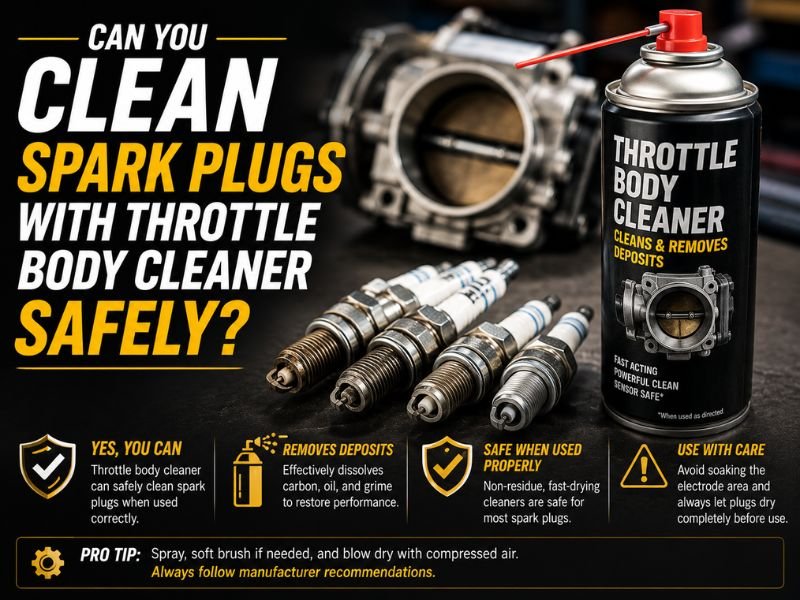
Throttle body cleaner can generally be used on the firing end of a removed spark plug if the cleaner is compatible with the materials involved and is allowed to evaporate completely before the plug is reinstalled.
Most throttle body cleaners are formulated to break down varnish, oil, gum, and carbon-like deposits. This can make them useful when a spark plug has relatively light contamination.
However, formulas differ between products. Always read the cleaner manufacturer’s directions and safety warnings before applying it somewhere other than its primary intended use.
You should also consider the type of spark plug.
Conventional plugs with larger electrodes tolerate gentle cleaning reasonably well. Fine-wire iridium and platinum plugs require greater care because aggressive brushing, scraping, or sanding can damage their small precious-metal electrodes.
The cleaner itself is often less concerning than the method used to remove the softened deposits.
When Does Cleaning a Spark Plug Make Sense?
Cleaning is most reasonable when the plug is still mechanically sound and has become temporarily contaminated.
Examples include:
- A plug wet with excess fuel after repeated starting attempts
- Light carbon buildup
- Minor oily contamination
- Deposits caused by extended idling or short trips
- A relatively new plug contaminated during another engine problem
Cleaning becomes less worthwhile when the plug has significant wear or damage.
If the electrodes are worn, the porcelain is cracked, the threads are damaged, or the plug has already reached its replacement interval, a cleaner cannot restore it.
Why Do Spark Plugs Get Dirty?
Before cleaning a spark plug, it helps to understand why the contamination appeared.
Carbon Fouling
A carbon-fouled spark plug usually has dry, dark, or black deposits around the firing end.
Possible causes include:
- An excessively rich air-fuel mixture
- Repeated short trips
- Excessive idling
- Frequent cold starts
- A weak ignition system
- Incorrect spark plug heat range
- Engine temperature problems
Throttle body cleaner may remove some carbon deposits, but recurring carbon fouling usually requires diagnosis.
Fuel Fouling
A spark plug may become wet with gasoline when fuel enters the cylinder but does not burn properly.
This can happen after repeated unsuccessful starting attempts or because of an ignition or fueling problem.
A temporarily fuel-fouled plug may sometimes be dried and cleaned successfully. If it repeatedly becomes wet, however, investigate the cause rather than continually cleaning it.
Oil Fouling
An oil-fouled plug normally appears wet, greasy, or heavily coated.
Possible causes can include:
- Worn piston rings
- Cylinder wear
- Valve-seal problems
- Excessive oil consumption
- Other internal engine issues
Throttle body cleaner may remove the oil from the plug, but it cannot prevent more oil from entering the combustion chamber.
Ash and Heavy Deposits
Hard, crusty deposits may develop from burned oil, fuel additives, or other contaminants.
If these deposits cannot be removed without aggressive scraping or abrasion, replacing the spark plug is usually safer than trying to restore it.
What You Need to Clean Spark Plugs With Throttle Body Cleaner
The process does not require many tools.
You may need:
- Throttle body cleaner
- Spark plug socket
- Ratchet and extension
- Clean lint-free cloth
- Soft nylon brush
- Compressed air
- Safety glasses
- Protective gloves
- Spark plug gap gauge
- Torque wrench for installation
Avoid starting with sandpaper, files, rotary tools, or aggressive wire brushes. A spark plug does not need to look polished to function correctly.
How to Clean Spark Plugs With Throttle Body Cleaner
Step 1: Let the Engine Cool
Allow the engine to cool before removing the spark plugs.
Removing plugs from a very hot aluminum cylinder head can increase the possibility of thread damage, particularly if excessive force is used.
Follow any engine-specific removal instructions provided by the vehicle manufacturer.
Step 2: Clean Around the Spark Plug Area
Dirt can collect around ignition coils and spark plug wells.
Before removing the plug, use compressed air or another suitable method to remove loose debris. This reduces the chance of dirt falling into the cylinder once the spark plug is removed.
Wear eye protection when using compressed air.
Step 3: Remove the Spark Plug
Disconnect the ignition coil or spark plug wire as required.
Use the correct spark plug socket and loosen the plug carefully.
If the plug feels unusually tight, avoid applying uncontrolled force. Damaging the cylinder-head threads can turn a simple spark plug job into a much larger repair.
Step 4: Inspect the Plug Before Cleaning
Do not automatically clean every removed plug.
Check for:
- Cracked porcelain
- Broken insulation
- Burned electrodes
- Rounded or heavily worn electrodes
- A damaged ground electrode
- Damaged threads
- Severe oil fouling
- Heavy deposits
- Signs of overheating
If the spark plug has physical damage, replace it.
Cleaning should only be considered if the plug itself appears reusable.
Step 5: Spray the Firing End With Throttle Body Cleaner
Place the removed spark plug in a well-ventilated area away from flames, sparks, cigarettes, hot surfaces, or other ignition sources.
Spray a modest amount of throttle body cleaner onto the firing end, concentrating on the area around the electrodes and exposed insulator.
You generally do not need to soak the entire spark plug.
Allow the cleaner enough time to loosen the deposits according to the product’s instructions.
Step 6: Gently Remove Loosened Deposits
After the deposits soften, wipe away accessible residue carefully.
A soft nylon brush can help remove loose contamination.
Use minimal pressure around the electrodes, particularly on iridium and platinum plugs.
If the deposits will not come off without vigorous scraping, sanding, grinding, or aggressive brushing, consider replacing the spark plug instead.
Step 7: Spray Again if Necessary
A second light application of throttle body cleaner may help flush away remaining softened contamination.
Avoid turning the job into an attempt to make an old spark plug look brand new.
Some discoloration is normal and does not automatically affect spark plug performance.
The important factors are electrode condition, insulation integrity, correct gap, and the absence of deposits severe enough to interfere with the spark.
Step 8: Let the Spark Plug Dry Completely
This step is particularly important.
Throttle body cleaner is typically flammable and must evaporate before the plug goes back into the engine.
Place the plug in a clean, ventilated location and let it dry completely. Do not reinstall a plug that is still visibly wet with solvent.
Avoid applying an open flame or torch to speed up drying.
Step 9: Inspect the Spark Plug Again
After cleaning, look closely at the plug.
If cleaning reveals:
- Cracks
- Electrode damage
- Severe erosion
- An excessively worn gap
- Heavy remaining deposits
replace the plug.
A clean spark plug can still be worn out.
Step 10: Check the Spark Plug Gap
Check the gap against the specification for the exact engine and spark plug.
Spark plug gaps are application-specific, so there is no single correct measurement for every vehicle.
Take extra care with iridium and platinum plugs. Avoid forcing a gap tool against a fine center electrode.
If adjustment is permitted, move the ground electrode using the correct tool rather than applying force directly to the center electrode.
Step 11: Reinstall the Plug Correctly
Start the spark plug carefully so that it threads straight into the cylinder head.
Cross-threading can seriously damage the cylinder head.
Once properly seated, tighten the plug according to the specified installation procedure and torque for the engine and plug.
Do not automatically apply anti-seize compound. Some modern spark plugs use plated threads, and adding lubricant can affect tightening force. Follow the plug or vehicle manufacturer’s instructions.
Can You Use Throttle Body Cleaner on Iridium Spark Plugs?
You can potentially use a suitable throttle body cleaner to remove light contamination from an iridium spark plug, but the plug needs to be handled gently.
Iridium plugs commonly use a very fine center electrode. The durability of iridium allows manufacturers to use this small electrode while still achieving a long service life.
That fine tip should not be aggressively:
- Scraped
- Filed
- Sanded
- Ground
- Wire-brushed
- Abrasive-blasted
A solvent-based cleaning approach combined with gentle removal of loose deposits is less aggressive.
If an iridium spark plug is badly fouled or has significant electrode wear, replacement is usually preferable.
Can You Clean Platinum Spark Plugs the Same Way?
The same general principle applies to platinum spark plugs.
A suitable cleaner may loosen contamination, but aggressive mechanical cleaning can damage the precious-metal firing surfaces.
Do not assume that an older cleaning technique used on conventional plugs is automatically appropriate for modern platinum or iridium designs.
When in doubt, follow the spark plug manufacturer’s recommendations.
Throttle Body Cleaner vs. Carburetor Cleaner for Spark Plugs
Both products can contain strong solvents capable of loosening oil and deposits, but they are formulated for different intended applications.
Carburetor cleaner may use aggressive solvents designed for fuel-system deposits, while throttle body cleaners are generally formulated with throttle-body components in mind.
Exact chemical formulas vary significantly between brands.
For spark plugs, the main considerations are whether the cleaner:
- Effectively loosens the contamination
- Is compatible with the plug materials
- Does not leave problematic residue
- Can completely evaporate before installation
Neither product can repair spark plug wear.
Can You Use Brake Cleaner on Spark Plugs?
Some people use fast-evaporating brake cleaner to remove grease or oil from spark plugs, but formulas vary, and a product intended for brakes is not automatically the best spark plug cleaner.
If choosing between automotive solvents, follow manufacturer instructions and use a product that is appropriate for the materials being cleaned.
Do not mix multiple cleaners in an attempt to improve cleaning performance.
Should You Use a Wire Brush After Throttle Body Cleaner?
A stiff metal wire brush is generally unnecessary, particularly for iridium and platinum plugs.
The throttle body cleaner should do most of the work by softening oily and loose deposits.
If additional cleaning is required, a soft nylon brush is less aggressive.
A plug with deposits so hard that they require heavy wire brushing, scraping, or grinding may be better replaced.
Can You Clean Spark Plugs Without Removing Them?
Do not spray throttle body cleaner down a spark plug well simply to clean an installed spark plug.
Once installed, the firing end is inside the combustion chamber. Spraying chemicals into the spark plug area does not provide controlled cleaning of the electrode and may introduce solvent, dirt, or debris where it is not wanted.
Remove the spark plug if you need to inspect and clean it properly.
When Should You Replace Instead of Clean a Spark Plug?
Cleaning is not a substitute for replacement.
| Spark Plug Condition | Best Action |
| Light fuel residue | Clean and inspect |
| Light removable carbon | Gentle cleaning may help |
| Minor temporary oil contamination | Clean only after addressing the cause |
| Heavy oil fouling | Diagnose and usually replace |
| Heavy hard deposits | Replace |
| Rounded or worn electrodes | Replace |
| Cracked porcelain | Replace |
| Damaged electrode | Replace |
| Damaged threads | Replace |
| Plug at its service interval | Replace |
If you are already performing the labor required to remove old plugs and they are approaching their scheduled replacement interval, installing new plugs may make more sense than cleaning the old ones.
Why a Cleaned Spark Plug May Become Dirty Again
Cleaning treats the deposit, not necessarily its cause.
If the cleaned spark plug becomes fouled again after a short period, investigate the engine.
Possible problems include:
- Excessively rich fueling
- Faulty fuel injector
- Weak ignition coil
- Oil entering the cylinder
- Compression problems
- Incorrect spark plug type
- Incorrect heat range
- Excessive idling
- Engine temperature problems
One unusually dirty plug can also provide useful diagnostic information.
For example, if five plugs appear normal but one is heavily fouled, the issue may be specific to that cylinder rather than something affecting the entire engine.
Common Mistakes to Avoid
One mistake is assuming that more aggressive cleaning produces a better spark plug.
It often does not.
Avoid:
- Grinding the electrodes
- Sanding fine-wire plugs
- Using a torch to burn deposits off
- Soaking plugs unnecessarily
- Reinstalling a solvent-wet plug
- Changing the gap without checking specifications
- Ignoring cracked porcelain
- Repeatedly cleaning a plug with recurring fouling
- Spraying cleaner into an open cylinder unnecessarily
Also remember that a spark plug can appear visually clean and still be worn or defective.
Frequently Asked Questions
Can You Clean Spark Plugs With Throttle Body Cleaner?
Yes. Throttle body cleaner can remove light oil, fuel residue, and some carbon contamination from removed spark plugs. Allow the plug to dry completely and inspect it carefully before reinstalling it.
Will Throttle Body Cleaner Damage Spark Plugs?
A compatible cleaner used properly is unlikely to damage a normal spark plug simply from brief contact. However, product formulas vary, and aggressive brushing or scraping during cleaning can damage electrodes, especially on iridium and platinum plugs.
How Long Should You Let a Spark Plug Dry After Cleaning?
There is no universal drying time because cleaner formulas, temperature, ventilation, and the amount applied vary. Wait until the solvent has completely evaporated and the plug is fully dry before installation.
Can Throttle Body Cleaner Remove Carbon From Spark Plugs?
It can soften and remove some light carbon deposits. Hard or heavy deposits may not come off completely without aggressive cleaning, in which case replacement may be preferable.
Can You Soak Spark Plugs in Throttle Body Cleaner?
A brief application is usually sufficient for light contamination. Extended soaking is generally unnecessary unless the cleaner manufacturer specifically recommends it for the application.
Can You Spray Throttle Body Cleaner Into the Spark Plug Hole?
It is generally better not to spray cleaner into an open cylinder simply for spark plug cleaning. Remove and clean the spark plug separately so the amount of solvent and debris entering the engine can be controlled.
Can Throttle Body Cleaner Fix an Oil-Fouled Spark Plug?
It may remove oil from the plug, but it cannot fix the reason oil entered the combustion chamber. If oil fouling returns, the engine needs further diagnosis.
Will Cleaning Spark Plugs Fix a Misfire?
Cleaning may help if deposits are preventing a serviceable spark plug from firing correctly. A misfire can also result from ignition coils, injectors, wiring, compression problems, intake leaks, or other faults.
Can You Clean Iridium Spark Plugs With Throttle Body Cleaner?
Light contamination may be cleaned with a suitable solvent, but avoid aggressive brushing, scraping, or sanding around the fine iridium electrode. Replace plugs that are worn, damaged, or heavily fouled.
Is It Better to Clean Spark Plugs or Replace Them?
Cleaning can make sense for relatively new plugs with temporary contamination. Worn, damaged, heavily fouled, or service-due plugs are generally better replaced.
Conclusion
You can clean spark plugs with throttle body cleaner when the plugs have light removable contamination and are otherwise in good condition. Apply the cleaner to the removed plug, allow it to loosen deposits, clean gently, and make sure the spark plug is completely dry before reinstalling it.
Avoid aggressive sanding, grinding, scraping, or wire brushing, particularly with iridium and platinum spark plugs. Cleaning should remove contamination without changing the shape or condition of the electrodes.
Most importantly, do not repeatedly clean a plug without asking why it keeps becoming fouled. Oil, fuel, and heavy carbon deposits can indicate engine or ignition problems that throttle body cleaner cannot solve.
Use cleaning for a serviceable spark plug with temporary contamination. If the plug is worn, damaged, heavily fouled, or near its scheduled replacement interval, replacing it is usually the more reliable solution.