
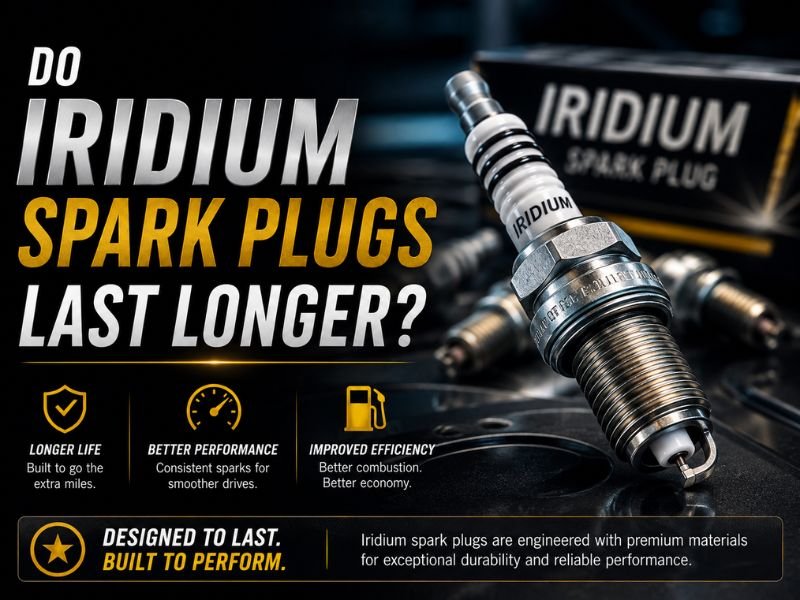
Yes, iridium spark plugs generally last longer than conventional nickel-alloy spark plugs because iridium resists electrode wear extremely well. However, not every iridium plug is designed for extended service, so the correct replacement interval can range from roughly 40,000–50,000 miles for some performance-focused iridium plugs to 80,000–100,000 miles for certain OE-style designs.
The important distinction is spark plug construction, not simply whether the word “iridium” appears on the box. Some plugs use iridium primarily to improve ignitability and performance, while others combine precious metals on both electrodes specifically to reduce wear over a much longer service interval.
Why Iridium Spark Plugs Usually Last Longer
Every time a spark plug fires, an electrical discharge jumps between its center electrode and ground electrode. Over thousands of miles and millions of ignition events, small amounts of electrode material gradually erode.
As the electrodes wear, the spark gap increases. NGK explains that a larger gap requires greater ignition voltage, eventually placing more demand on the ignition system and making misfires more likely.
Iridium helps because it is highly resistant to this type of wear.
DENSO developed iridium-alloy electrodes specifically to improve wear resistance while allowing an extremely fine center electrode. The company notes that its iridium alloy dramatically improved wear resistance compared with earlier platinum designs while also improving ignition characteristics.
This combination—high wear resistance plus a fine electrode—is the main reason many iridium spark plugs maintain an effective spark gap much longer than conventional plugs.
How Long Do Iridium Spark Plugs Actually Last?
There is no single mileage number that applies to every iridium spark plug.
NGK provides a useful example within its own product range. Its Iridium IX plugs are typically designed for approximately 40,000–50,000 miles, while its OE-style Laser Iridium plugs are typically designed for roughly 80,000–100,000 miles.
DENSO makes the same distinction even more explicitly. Its service-life guidance says some iridium plugs are normal-life designs with approximately 20,000 km service intervals, while certain long-life iridium designs can be rated around 100,000 km.
So the assumption that “all iridium plugs last 100,000 miles” is incorrect.
A better rule is:
| Spark Plug Design | Typical Service-Life Characteristic |
| Conventional nickel-alloy plug | Shorter service interval |
| Single precious-metal performance plug | Moderate to long life |
| Iridium performance plug | Often around 40,000–50,000 miles in some product lines |
| OE double precious-metal iridium | Often designed for much longer intervals |
| Certain Laser Iridium designs | Approximately 80,000–100,000 miles |
| Vehicle-specific OE plug | Follow vehicle manufacturer’s interval |
These are general examples rather than universal replacement rules. NGK specifically recommends following the vehicle manufacturer’s maintenance schedule because spark plug service intervals vary by engine and application.
Iridium vs. Conventional “Copper” Spark Plugs
You will often hear people compare iridium plugs with copper spark plugs, but that terminology can be misleading.
NGK explains that conventional plugs commonly called “copper plugs” actually use nickel-alloy electrodes, often with a copper core inside the center electrode. Copper itself is too soft and has too low a melting point to serve as the exposed electrode material in a conventional automotive plug.
That distinction matters because it is the exposed electrode material that directly influences erosion.
Conventional nickel-alloy electrodes typically wear faster than precious-metal designs. Iridium’s resistance to heat and erosion allows manufacturers to use a much smaller firing tip while maintaining durability.
So when people say an iridium plug lasts longer than a copper plug, the more technically accurate comparison is usually:
Iridium precious-metal electrode vs. conventional nickel-alloy electrode with a copper core.
Do Iridium Spark Plugs Last Longer Than Platinum?
Often, but not automatically.
Platinum is also a highly durable precious metal used specifically to reduce electrode wear. NGK notes that platinum spark plugs generally provide longer service intervals than standard nickel plugs.
Iridium offers excellent wear resistance and allows an even finer center electrode. DENSO states that the development of its iridium alloy improved wear resistance compared with previous platinum designs.
However, plug construction can matter more than the material name alone.
A single-iridium performance plug may have a shorter recommended service interval than a double-platinum or double-iridium OE plug designed specifically for longevity.
NGK’s own lineup demonstrates this. Its single precious-metal Iridium IX is generally rated for a shorter service interval than its dual precious-metal Laser Iridium OE designs.
Therefore, do not assume:
Iridium > platinum in every application.
Instead, compare the specific plug design and required service interval.
Why Some Iridium Plugs Last 100,000 Miles and Others Do Not
The ground electrode is an important part of the explanation.
A spark travels between the center and ground electrodes, so both surfaces are subject to erosion.
Adding iridium only to the center electrode protects one side of the spark gap. In some ignition-system designs, the ground electrode can still wear significantly.
NGK explains that vehicles with waste-spark ignition systems often use double precious-metal plugs because both electrodes experience significant erosion. Using a single precious-metal or nickel-alloy design in such an application can produce faster gap wear and shorter service life.
Long-life OE plugs therefore frequently use precious metals on both electrodes.
That construction helps maintain the designed spark gap for substantially longer than a plug optimized primarily for performance.
This is why you should replace an OE double-iridium plug with the correct equivalent rather than assuming any aftermarket iridium plug will provide the same maintenance interval.
Does the Fine Iridium Tip Wear Out?
Yes.
Iridium is extremely wear resistant, but it is not indestructible.
DENSO specifically states that iridium remains subject to spark erosion and high-temperature oxidation wear.
Over enough combustion cycles, electrode material gradually disappears.
The difference is the rate.
DENSO explains that electrode wear depends on factors including material melting point, strength, hardness, engine design, and operating conditions. Precious-metal materials such as platinum and iridium are used specifically to slow this process.
Eventually, even a high-quality iridium plug reaches the point where its gap and electrode shape no longer provide the ignition performance intended by the engine manufacturer.
What Can Make Iridium Spark Plugs Wear Out Early?
Iridium’s durability protects against normal electrode erosion, but it cannot protect the plug from every engine problem.
A plug can fail or become unusable long before its normal mileage interval if it is fouled, overheated, incorrectly installed, physically damaged, or used in an engine with another mechanical or combustion problem.
Short-trip operation can contribute to carbon or oil fouling because plugs may spend insufficient time at suitable operating temperature. DENSO specifically warns that repeated short trips and slow driving can contribute to fouling.
Other abnormal engine conditions can contaminate plugs with fuel, oil, or combustion deposits.
In these cases, an iridium electrode may still have plenty of physical material remaining while the plug no longer performs correctly.
That is why mileage alone does not determine spark plug health.
Can an Iridium Plug Last Longer Than the Recommended Interval?
It may physically continue firing beyond the scheduled replacement mileage, but that does not mean extending the interval is beneficial.
As spark plug electrodes wear, their sharp edges gradually round off and the gap increases. NGK explains that this raises the voltage required to create the spark and puts additional demand on the ignition system.
DENSO similarly warns that continuing to operate with worn plugs can stress the ignition coil and that plugs should be replaced before deterioration progresses too far.
This creates an important distinction between physical life and economical service life.
A spark plug might still produce some spark at very high mileage, but waiting until it produces obvious misfires is not necessarily good maintenance.
The recommended replacement interval is intended to replace the plug while ignition performance remains dependable.
Do Iridium Spark Plugs Maintain Their Gap Longer?
Generally, yes—especially long-life designs.
Because iridium is resistant to electrode erosion, the center electrode loses material more slowly. That helps slow enlargement of the spark plug gap.
DENSO explains that electrode wear progressively increases gap size and therefore increases the voltage required for ignition. Its iridium-alloy designs are intended to reduce that wear.
Long-life designs may also use platinum or another precious-metal pad on the ground electrode to slow wear on that side of the gap.
This ability to maintain electrode geometry is one of the biggest practical benefits of long-life iridium spark plugs.
Do Iridium Spark Plugs Improve Performance?
They can improve ignitability, but installing iridium plugs does not automatically create large horsepower gains in an otherwise healthy stock engine.
The fine electrode requires less voltage to initiate a spark and reduces the amount of electrode material interfering with the flame kernel. DENSO attributes improved ignitability to the very fine iridium center electrode used in its designs.
The larger practical advantage for many modern vehicles is maintaining reliable ignition over a long service interval.
If your existing plugs are badly worn, replacing them with the correct new plugs may restore smooth idle, easier starting, acceleration, and fuel economy that had deteriorated as the old plugs aged. DENSO identifies poor starting, unstable idle, reduced output, and poorer mileage as potential consequences of worn plugs.
That is restoration of lost performance rather than a guaranteed performance upgrade beyond the engine’s original capability.
Should You Upgrade to Iridium Just for Longer Life?
Only if the iridium plug is approved for the application.
Spark plugs vary in thread diameter, reach, heat range, electrode projection, resistance, seat design, and gap. A plug can physically thread into an engine and still be incorrect for it.
If your engine was designed for iridium plugs, replacing them with the correct OE-equivalent iridium design is generally the straightforward choice.
If the engine originally used conventional plugs, an appropriate manufacturer-approved iridium upgrade may provide longer service life, but you should verify exact compatibility rather than choosing by electrode material alone.
The plug with the longest theoretical lifespan is not automatically the correct plug for the engine.
Be Careful When Checking the Gap on Iridium Plugs
Fine-wire precious-metal electrodes are durable during normal combustion but can be physically damaged by careless handling.
NGK warns that when adjusting the gap on iridium or platinum fine-wire plugs, pressure should not be applied against the fine center electrode or insulator. If adjustment is required, only the ground electrode should be moved using an appropriate tool.
Many application-specific plugs arrive pre-gapped, but the correct specification should still be verified according to manufacturer guidance.
Damaging an iridium firing tip while aggressively prying on it defeats one of the main benefits of buying the plug.
Signs Your Iridium Spark Plugs May Need Replacement
Do not wait only for a mileage number if the engine develops ignition symptoms.
Worn plugs can increase required firing voltage and eventually contribute to misfires, difficult starting, rough idle, reduced power, or poorer fuel economy. NGK and DENSO both identify these types of symptoms as consequences of plug wear and deteriorating ignition performance.
A check-engine light with a misfire code may also justify inspection, but a misfire code does not prove the plug itself is responsible.
Ignition coils, injectors, wiring, compression, and other engine conditions can produce similar symptoms.
If the plugs have not yet reached their scheduled replacement mileage, diagnose the problem instead of assuming iridium has simply worn out early.
Follow the Vehicle’s Service Interval, Not a Generic Number
This is the most useful maintenance rule.
NGK explicitly recommends using the vehicle manufacturer’s replacement mileage because service intervals vary between makes, models, and engines.
Even within one manufacturer’s application chart, Laser Iridium service intervals can vary substantially. NGK’s published service reference includes OE applications with iridium intervals ranging from roughly 30,000 miles to 75,000 miles and beyond depending on the vehicle.
That is why an internet rule such as “change all iridium plugs every 100,000 miles” is too broad.
Your owner’s manual or official maintenance schedule should be the primary reference.
Frequently Asked Questions
How Many Miles Do Iridium Spark Plugs Last?
It depends on the design and vehicle. NGK says its Iridium IX plugs typically last around 40,000–50,000 miles, while OE Laser Iridium designs are typically intended for roughly 80,000–100,000 miles. Vehicle-specific intervals can differ.
Do Iridium Spark Plugs Last 100,000 Miles?
Some do, but not all. DENSO specifically distinguishes between normal-life iridium plugs and long-life designs rated around 100,000 km, while NGK offers OE iridium designs that can reach approximately 80,000–100,000-mile service intervals.
Do Iridium Spark Plugs Last Longer Than Regular Plugs?
Generally, yes. Iridium’s high wear resistance helps reduce electrode erosion compared with conventional nickel-alloy plug designs.
Is Iridium Better Than Platinum for Lifespan?
Iridium offers excellent wear resistance, but plug construction matters. A double-platinum long-life plug can outlast a single-iridium performance plug depending on the design and application.
Why Do Some Iridium Spark Plugs Last Only 40,000 Miles?
Some iridium plugs are designed primarily for ignitability and performance rather than maximum service life. NGK’s Iridium IX line, for example, has a shorter typical interval than its OE dual precious-metal Laser Iridium designs.
Can Iridium Spark Plugs Wear Out Early?
Yes. Fouling, abnormal engine operation, overheating, incorrect installation, and physical damage can make a plug unusable before normal electrode wear reaches its limit. DENSO notes that operating conditions materially affect plug wear and fouling.
Should I Clean Iridium Spark Plugs Instead of Replacing Them?
If a plug has reached its scheduled service interval or has significant electrode wear, cleaning does not restore the lost electrode material or original gap geometry. Replacement with the correct plug is the appropriate solution for normal wear.
Do Iridium Plugs Need Regapping?
Use the exact gap specified for the vehicle. If adjustment is necessary, NGK warns against applying pressure to the fine iridium center electrode because it can be damaged.
Can Old Iridium Spark Plugs Damage Ignition Coils?
Excessive electrode wear increases the required firing voltage, placing additional demand on the ignition system. DENSO warns that continued use of worn spark plugs can stress ignition coils and potentially shorten their life.
Should I Replace Iridium Plugs Before They Misfire?
Yes, when the vehicle’s scheduled maintenance interval calls for replacement. Waiting until obvious misfires occur means the plugs may already be beyond their economical service life.
Do Iridium Spark Plugs Last Longer Overall?
Yes, iridium spark plugs generally last longer than conventional nickel-alloy spark plugs because iridium resists electrode erosion and allows the firing tip to maintain its shape and spark gap for longer. Long-life OE iridium designs can reach substantially longer service intervals than conventional plugs, with some NGK applications designed for approximately 80,000–100,000 miles.
But iridium does not automatically mean 100,000-mile service life. Some performance-oriented iridium plugs have substantially shorter intervals, and DENSO explicitly notes that certain iridium designs have service lives similar to standard plugs.
The best approach is to use the exact spark plug specified for your engine and follow the vehicle manufacturer’s maintenance interval. When an engine is designed for long-life iridium plugs, their excellent wear resistance can significantly reduce how often the plugs need to be replaced while maintaining reliable ignition over many years of driving.