
No, not all diesel engines have glow plugs. Glow plugs are extremely common in passenger cars, pickups, SUVs, vans, and many small diesel engines, but some diesel engines use other cold-starting systems instead. Larger truck, agricultural, industrial, construction, marine, and stationary diesel engines may use an intake-air heater, grid heater, flame-start system, ether-assisted starting system, or no dedicated preheating device under normal conditions.
The reason is that a diesel engine does not fundamentally depend on glow plugs to ignite fuel. Unlike a gasoline engine, it does not normally use a spark plug to start combustion. A diesel compresses air until it becomes hot enough for injected diesel fuel to ignite.
Glow plugs simply make that process easier when the engine and incoming air are cold.
This distinction is important because people often assume that glow plugs are the diesel equivalent of spark plugs. They are not. Spark plugs must fire repeatedly while a gasoline engine runs. Glow plugs mainly provide supplemental heat during cold starting and warm-up, although many modern diesel control systems continue operating them for a period after startup for emissions, noise, and combustion-quality reasons.
Whether a particular diesel engine needs glow plugs depends on its combustion-chamber design, compression ratio, injection system, engine size, climate, emissions strategy, and cold-start system.
In this guide, I’ll explain why some diesel engines have glow plugs and others do not, how diesel engines start without them, the difference between glow plugs and intake heaters, whether direct-injection diesels still need glow plugs, and what happens when a glow plug fails.
Why Diesel Engines Do Not Need Spark Plugs
To understand why glow plugs are optional in some diesel engines, you first need to understand diesel combustion.
A gasoline engine generally draws in an air-fuel mixture and then uses a spark plug to ignite it at a precisely controlled moment.
A diesel engine works differently.
During the intake stroke, it draws primarily air into the cylinder.
The piston then compresses that air very strongly.
Compression increases the air temperature.
Near the end of the compression stroke, diesel fuel is injected into the hot compressed air.
If cylinder temperature and pressure are high enough, the fuel begins burning without an electrical spark.
This process is called compression ignition.
That means the engine’s normal combustion process does not require a spark plug.
Once a diesel engine is warm and running normally, the heat produced by compression and combustion is generally enough to sustain ignition.
The main challenge occurs during a cold start.
When the cylinder head, block, pistons, intake air, and combustion chamber are cold, they absorb heat from the compressed air.
That can make it more difficult for the first injection of fuel to ignite cleanly.
Glow plugs are one way to solve that problem.
What Does a Glow Plug Do?
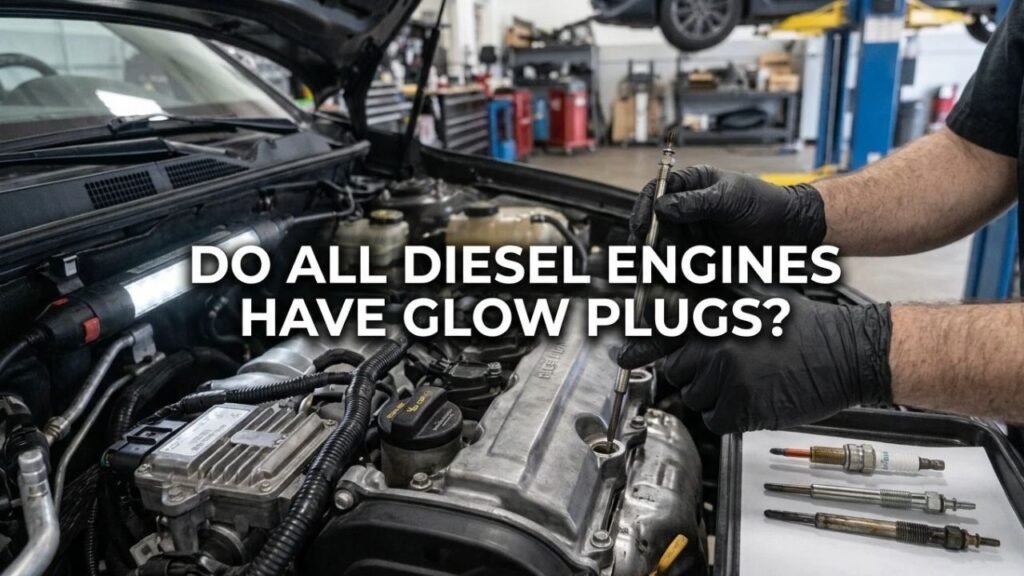
A glow plug is an electrically heated component installed so that its heated tip projects into or near the combustion area.
When the driver switches the ignition on or requests an engine start, the engine-control system can send electrical current through the glow plugs.
Their tips become extremely hot.
That extra heat raises the local temperature inside the combustion chamber and makes the first fuel injections easier to ignite.
In older diesel vehicles, drivers often had to wait several seconds while a dashboard glow-plug indicator illuminated.
Once the light went out, the engine could be cranked.
Modern diesel systems are much faster.
Electronic control modules can operate the glow plugs automatically based on coolant temperature, ambient conditions, battery voltage, and other information. In many vehicles, the driver may barely notice the preheating process.
Glow Plugs Can Keep Working After the Engine Starts
Modern glow plugs are not always switched off the instant the engine begins running.
Some systems use a period of post-glow after startup.
Keeping the plugs warm can help stabilize cold combustion, reduce white smoke, decrease cold-start noise, and help the engine meet emissions requirements while it warms.
This is one reason glow-plug systems remain important even though modern common-rail diesel injection has become extremely sophisticated.
Key Takeaways:
- Diesel engines ignite fuel through compression rather than a spark.
- Glow plugs provide supplemental heat when a cold engine cannot retain enough compression heat easily.
- Many modern systems operate glow plugs both before and after startup.
Do All Diesel Cars Have Glow Plugs?
Most modern diesel passenger cars use glow plugs.
Passenger-car diesel engines are relatively small, must start easily in cold weather, and have strict expectations for noise, smoke, emissions, and drivability.
Glow plugs help manufacturers achieve those goals.
A typical four-cylinder diesel car normally has one glow plug per cylinder.
A six-cylinder diesel passenger engine commonly has six.
Similarly, an eight-cylinder light-duty diesel may use eight glow plugs.
However, this should not be turned into the rule that every diesel engine must have one glow plug for every cylinder.
Some diesel engines use a different preheating strategy entirely.
Do All Diesel Trucks Have Glow Plugs?
No.
This is one of the clearest examples of why the answer to do all diesel engines have glow plugs is no.
Many diesel pickup trucks use individual glow plugs.
Other diesel truck engines use an intake grid heater instead.
A grid heater is an electrically heated element located in the intake-air path.
Rather than heating each combustion chamber individually, it heats the air entering the engine.
When that warmer intake air is compressed inside the cylinder, it reaches ignition temperature more easily.
Both systems are solving essentially the same cold-start problem through different methods.
Glow Plug System
A glow plug heats each cylinder locally.
This provides heat very close to where the fuel is injected.
Grid Heater System
A grid heater warms the intake-air stream before the air reaches the cylinders.
The warmed air then enters all cylinders.
Neither system is automatically better for every engine.
The engine manufacturer selects the cold-start system appropriate for its combustion-chamber design, packaging, electrical system, emissions strategy, and intended operating conditions.
What Is an Intake Grid Heater?
An intake grid heater is a high-current electrical heating element positioned in the intake manifold or intake-air system.
When energized, it becomes hot and raises the temperature of the air flowing toward the cylinders.
Grid heaters are particularly well known in some larger diesel engine applications.
One advantage is that the engine does not need a separate heating element installed in every combustion chamber.
However, a grid heater can draw a substantial amount of electrical current.
This is why diesel vehicles with intake-heater systems still need strong batteries and healthy starting systems.
A weak battery can cause two problems at once: the heater receives less electrical power and the starter cranks the engine more slowly.
Both effects make cold starting more difficult.
What Is an Intake Air Heater?
“Intake air heater” is a broader term that can include grid-style heaters and other electrically heated devices installed in the intake system.
The operating principle remains the same.
Instead of directly heating the combustion chamber, the system warms incoming air.
This hotter air reaches a higher temperature after compression and helps the fuel ignite.
Some engines may also combine intake heating with sophisticated injection timing or other cold-start strategies.
What Is a Flame-Start System?
Some diesel engines use a flame-based intake heating system rather than individual glow plugs.
A flame-start or thermostart-type system typically introduces a small amount of fuel into a heated element in the intake manifold.
The fuel burns and warms the air entering the engine.
This approach has been used in various tractors, industrial engines, older diesel equipment, and other applications.
It is fundamentally different from a glow plug inside each cylinder.
A flame-start device heats the intake charge for multiple cylinders from a centralized location.
This is another reason two diesel engines can start reliably in cold weather despite having completely different starting hardware.
Can a Diesel Engine Start Without Glow Plugs?
Yes.
A diesel can start without glow plugs if compression creates enough heat for the fuel to ignite.
How easily this happens depends on several factors.
A warm engine usually starts far more easily without preheating because the cylinder head, pistons, and combustion chamber are already hot.
Warm ambient temperatures also help.
Engine condition matters significantly.
A healthy diesel with strong compression generally starts more easily than a worn engine with low compression.
Cranking speed matters too.
The faster the starter turns the engine, the more effectively the air is compressed and the less time heat has to escape before injection.
Injection quality is another major factor.
Correct injection timing, fuel pressure, and atomization all improve cold-start combustion.
Because of these variables, an engine with failed glow plugs may start almost normally during summer but become extremely difficult to start on a cold winter morning.
Can a Diesel Run Without Glow Plugs?
Usually, yes, once it is running.
Glow plugs are not continuously firing like gasoline spark plugs.
The diesel combustion cycle is sustained primarily by compression ignition.
Therefore, many engines can continue running after the glow system is switched off.
Modern systems may still use post-glow for smoother operation and lower emissions, but the glow plug does not have to ignite every individual combustion event.
This explains why a diesel with one or more failed glow plugs may run perfectly after it warms up.
The main symptoms can occur during the first seconds after a cold start.
Why Do Some Diesel Engines Need Glow Plugs More Than Others?
Combustion-chamber design has a major influence.
Older indirect-injection diesel engines are particularly dependent on preheating.
In an indirect-injection engine, fuel is injected into a separate prechamber or swirl chamber connected to the main cylinder.
The large surface area of this small chamber can absorb substantial heat when the engine is cold.
Glow plugs were therefore extremely important for reliable cold starting.
Modern passenger diesels generally use direct injection.
Fuel is injected directly into the main combustion chamber.
Direct injection reduces some heat losses and allows much more precise fuel control.
However, modern direct-injection diesels still commonly use glow plugs because easy cold starting is only one consideration.
Emissions, noise, combustion stability, and warm-up performance also matter.
Do Direct-Injection Diesels Have Glow Plugs?
Many do.
It is a common misconception that only indirect-injection diesels need glow plugs.
Modern common-rail direct-injection passenger vehicles very commonly use them.
The difference is that an advanced direct-injection engine may be less dependent on long preheating periods than an old indirect-injection diesel.
Modern systems can precisely control:
Injection pressure.
Injection timing.
Multiple injection events.
Fuel quantity.
Glow-plug temperature.
EGR operation.
Airflow.
This allows very fast starting.
The driver may not even realize the glow plugs have been energized.
Do Common-Rail Diesels Have Glow Plugs?
Many common-rail diesels do.
Common-rail refers primarily to the fuel-injection system.
Fuel is held at high pressure in a common rail and electronically controlled injectors deliver precise amounts to each cylinder.
Common-rail technology does not eliminate the usefulness of glow plugs.
In fact, the engine computer can coordinate injection events and glow-plug operation very precisely during startup.
This can improve cold combustion considerably.
Do Old Diesel Engines Have Glow Plugs?
Many do, especially older passenger-car and light-duty indirect-injection engines.
But older diesel technology was extremely diverse.
Some engines used individual glow plugs.
Others used manifold heaters.
Some tractors and industrial diesels used thermostart flame heaters.
Some large engines could rely mainly on compression and powerful starting systems under normal conditions.
Therefore, you cannot identify the cold-start system simply by the age of the engine.
Do Large Diesel Engines Have Glow Plugs?
Many large diesels do not use conventional individual glow plugs.
Large commercial truck engines, heavy equipment, generators, marine diesels, and industrial engines may rely on other technologies.
Large engines can have very different combustion chambers and starting systems than automotive diesels.
Depending on the application, manufacturers may use:
Intake heating.
Grid heaters.
Fuel-fired intake heaters.
Starting-fluid systems.
Coolant heaters.
Oil heaters.
Block heaters.
High-capacity starting systems.
Or combinations of these.
The absence of glow plugs does not mean the engine has no cold-start assistance.
It may simply use a different system.
Key Takeaways:
- Light-duty diesel cars commonly use one glow plug per cylinder.
- Larger diesels may use intake-air heaters or other cold-start systems instead.
- Engine size alone does not determine whether glow plugs are present.
Do Diesel Generators Have Glow Plugs?
Some do and some do not.
Small portable or standby diesel generators may use glow plugs for easier starting.
Larger commercial generators may have intake heaters, coolant heaters, block heaters, or sophisticated preheating systems.
Stationary generators also have an advantage over vehicles: they can remain connected to external electrical power when not running.
This allows jacket-water heaters or block heaters to keep the engine warm continuously so it can start quickly during an emergency.
Do Diesel Tractors Have Glow Plugs?
Many diesel tractors use glow plugs, but not all.
Some use individual glow plugs in each cylinder.
Others use an intake-manifold heating device or thermostart system.
Older tractors may have distinctive starting procedures where the operator holds the key or switch in a preheat position before cranking.
If you are working on a tractor and cannot find glow plugs near the injectors, check the intake manifold for a centralized heater before assuming the engine has no preheat system.
Do Marine Diesel Engines Have Glow Plugs?
Some smaller marine diesels use glow plugs, especially engines derived from automotive or compact industrial designs.
Large marine diesels may not.
Marine engines vary enormously in displacement and construction.
A small sailboat auxiliary diesel and the main engine of a commercial ship have almost nothing in common in terms of scale.
Large marine engines use completely different starting and thermal-management systems.
Therefore, “marine diesel” alone does not tell you whether glow plugs are present.
Do Diesel Lawn Mowers Have Glow Plugs?
Many compact diesel lawn tractors and commercial mowers use glow plugs.
Their small diesel engines can benefit significantly from combustion-chamber preheating during cold starts.
The dashboard may have a glow-plug indicator or the ignition switch may include a preheat position.
Again, verify the particular engine because some equipment can use intake heating instead.
How Can You Tell If Your Diesel Has Glow Plugs?
The easiest method is to check the owner’s manual or engine service information.
You can also inspect the engine.
Glow plugs are usually installed in the cylinder head.
On many engines, you will find a small electrical connector, bus bar, or individual wire attached to each glow plug.
The plugs are typically located relatively close to the fuel injectors because both components need access to the combustion area.
However, modern diesel engines can be heavily covered by intake manifolds, wiring, sound insulation, and engine covers.
The glow plugs may not be easy to see.
Check the Dashboard
A glow-plug indicator is another clue.
It often looks like a small coil or spiral.
When the ignition is switched on, the light may illuminate briefly and then turn off when sufficient preheating has occurred.
However, the absence of a noticeable wait-to-start light does not prove there are no glow plugs.
Modern systems can complete preheating extremely quickly.
Glow Plugs vs. Spark Plugs
Glow plugs and spark plugs should not be confused.
A spark plug creates an electrical arc across an electrode gap.
That arc directly initiates combustion in a gasoline engine.
A glow plug does not normally create a spark.
It heats up.
Its job is to improve the temperature conditions that allow diesel fuel to ignite through compression.
| Feature | Glow Plug | Spark Plug |
| Common engine type | Diesel | Gasoline |
| Produces ignition spark | No | Yes |
| Main job | Adds heat for starting/warm-up | Directly ignites mixture |
| Operates continuously | Usually not in the same way | Fires repeatedly while engine runs |
| Has electrode gap | No conventional firing gap | Yes |
| Needed for normal warm combustion | Often no | Yes |
This is why a diesel can often continue running with failed glow plugs while a gasoline engine cannot run normally if its spark plugs stop firing.
What Happens When Glow Plugs Fail?
A failed glow plug usually causes its biggest problems when the engine is cold.
If only one glow plug fails in a multi-cylinder engine, the remaining cylinders may start normally while the affected cylinder initially struggles to ignite.
This can produce rough running during the first few seconds.
You may also see white or light-gray exhaust smoke.
The smoke can result from fuel entering a cold cylinder but not burning completely.
As the cylinder warms, the misfire may disappear.
If several glow plugs fail, cold starting can become much harder.
The starter may crank for a long time before the engine begins running.
In very cold conditions, the engine may not start at all.
Common Glow Plug Failure Symptoms
Typical symptoms include difficult cold starting, extended cranking, rough idle immediately after startup, temporary white smoke, and a glow-plug or check-engine warning.
The severity depends heavily on temperature and how many plugs have failed.
Can One Bad Glow Plug Stop a Diesel From Starting?
Usually not by itself on a multi-cylinder engine, especially in mild weather.
If a four-cylinder diesel has one failed glow plug, the other three cylinders may still ignite and start the engine.
The bad cylinder may join in as it warms.
But conditions matter.
A weak battery, very low ambient temperature, worn engine, low compression, or additional failed glow plugs can turn a relatively minor problem into a no-start condition.
If the engine is already near the limit of what it can start under, losing one glow plug may be enough to make a noticeable difference.
Do Glow Plugs Stay On While Driving?
They are not normally powered continuously throughout an entire drive.
However, modern engines can use them after startup under certain conditions.
This post-glow period may last while the engine is warming.
The ECU controls operation automatically.
Some advanced diesel strategies can also use glow plugs under specific emissions or combustion-management conditions.
The exact behavior is engine-specific.
Older systems are usually simpler and may switch the glow plugs off shortly after starting.
How Long Do Glow Plugs Last?
There is no single replacement interval that applies to every diesel.
Glow-plug life depends on design, electrical control, engine condition, starting frequency, and operating conditions.
Many are replaced only when testing shows a failure rather than according to a short routine maintenance interval.
However, a vehicle manufacturer may have specific inspection or service guidance.
Do not replace functioning glow plugs simply because someone gives you a universal mileage number.
Can You Replace Only One Glow Plug?
Yes, in some situations.
If testing clearly identifies a single failed plug, replacing only that plug can restore normal operation.
However, if all plugs are the same age and mileage, the others may not be far behind.
Access also matters.
If replacing glow plugs requires significant labor to remove an intake manifold or other components, replacing the complete set may make economic sense.
On the other hand, glow plug removal can carry a risk of breakage in some engines, so replacing working plugs unnecessarily is not always desirable.
Consider the engine design, service history, cost, and manufacturer recommendations.
Can You Test Glow Plugs?
Yes.
Glow plugs can be tested electrically.
Common diagnostic methods include checking electrical resistance, current draw, voltage supply, or using a scan tool to monitor the control system.
The exact expected resistance depends on the glow plug design.
Because glow plugs have very low electrical resistance when cold, ordinary multimeter lead resistance can affect measurements.
A simple resistance reading should therefore be interpreted carefully.
Modern glow plug modules can also monitor individual circuits and store diagnostic trouble codes.
If your vehicle has a glow-plug fault code, diagnosis should include the plugs, wiring, control module, fuse or power supply, and connectors rather than assuming the plug itself is always bad.
Why Modern Diesel Glow Plugs Are Different
Older glow plugs were relatively simple metal heating elements.
Modern systems can use fast-heating metal plugs or ceramic designs capable of reaching high temperatures rapidly.
Electronic controllers can regulate voltage and current precisely.
This allows extremely short preheating times.
It also makes modern systems more useful for emissions control after startup.
Because the plugs are more sophisticated, you should use the exact replacement specification.
A glow plug that physically screws into the cylinder head is not necessarily electrically compatible.
Installing the wrong resistance or voltage design can damage the plug or control module.
Do Diesel Engines Need Glow Plugs in Warm Weather?
Many glow-plug-equipped engines can start with little or no noticeable preheating in warm weather.
That does not make the glow plugs unnecessary.
The ECU may still operate them briefly to optimize startup.
The same engine might become extremely difficult to start once ambient temperatures drop.
This explains why failed glow plugs sometimes go unnoticed for months.
A vehicle may start perfectly throughout summer.
Then the first cold morning exposes the problem.
Are Glow Plugs Only for Cold Weather?
Cold starting is their most obvious purpose, but on modern diesels the answer is increasingly no.
Manufacturers can use controlled post-glow to improve:
Cold idle stability.
Fuel combustion.
Exhaust emissions.
Engine noise.
Warm-up behavior.
That means a modern glow plug is better thought of as part of the engine’s cold-combustion management system rather than merely a winter starting aid.
Can a Diesel Engine Be Converted From Glow Plugs to an Intake Heater?
This is generally not a sensible modification.
The combustion chamber and cold-start system are designed together.
Removing glow plugs and adding an intake heater can change cold-start performance, emissions, engine-control behavior, and diagnostic monitoring.
Modern ECUs may also detect missing glow-plug circuits and set fault codes.
If an engine was designed for glow plugs, repair the original system unless a manufacturer-approved conversion exists.
FAQs About Do All Diesel Engines Have Glow Plugs
Do all diesel engines have glow plugs?
No. Many diesel cars and light trucks do, but some diesel engines use intake heaters, grid heaters, flame-start systems, or other cold-start methods instead.
Do diesel engines need glow plugs to run?
Usually not once they are warm and running.
Normal diesel combustion is sustained by compression ignition.
Can a diesel start without glow plugs?
Yes, especially when the engine and outside temperature are warm.
Cold starting becomes much more difficult when the glow system is not working.
Do modern diesels still have glow plugs?
Many do.
Modern common-rail direct-injection diesels frequently use advanced fast-heating glow plugs for cold starting, warm-up, emissions, and combustion stability.
Do direct-injection diesels have glow plugs?
Many direct-injection diesel engines use glow plugs.
Direct injection does not eliminate the need for cold-start assistance.
Do common-rail diesels have glow plugs?
Many common-rail passenger and light-duty engines do.
Glow-plug operation can be coordinated electronically with the fuel-injection system.
Do diesel trucks have glow plugs?
Some do.
Others, particularly certain truck engines, use intake grid heaters instead.
What does a grid heater do?
A grid heater warms intake air before it enters the cylinders.
This warmer air reaches ignition temperature more easily when compressed.
Are grid heaters the same as glow plugs?
No.
Glow plugs heat individual combustion chambers, while grid heaters warm intake air for multiple cylinders.
Do old diesel engines have glow plugs?
Many do, especially older indirect-injection passenger diesels.
Other older engines use manifold heaters or flame-start systems.
Do tractors have glow plugs?
Many tractors do, but some use intake heaters or thermostart systems instead.
Do diesel generators have glow plugs?
Some smaller generators do.
Larger units may use coolant heaters, block heaters, or intake heating systems.
Do marine diesels have glow plugs?
Some small marine diesels do.
Large marine engines often use different starting and heating systems.
Does every diesel cylinder have a glow plug?
On engines designed around individual glow plugs, typically each cylinder gets one.
However, engines using centralized intake heating may have none.
Why doesn’t a diesel need spark plugs?
Diesel fuel is ignited by the heat created when air is strongly compressed inside the cylinder.
A gasoline engine generally requires an electrical spark.
Is a glow plug basically a spark plug?
No.
A glow plug is a heater.
A spark plug creates an electrical arc that directly ignites the air-fuel mixture.
Will a diesel run with one bad glow plug?
Often yes.
It may start roughly, produce temporary white smoke, or take longer to start when cold.
Will a diesel start with all glow plugs bad?
Possibly in warm conditions if compression and cranking speed are excellent, but cold starting can become extremely difficult or impossible.
Why does my diesel start fine in summer but badly in winter?
Failed glow plugs may not matter much when the engine and incoming air are warm.
Cold weather increases the need for preheating and can reveal a weak glow system.
Can bad glow plugs cause white smoke?
Yes.
During a cold start, fuel may not burn completely in a cylinder that lacks sufficient heat, producing white or light-gray smoke.
Can bad glow plugs cause a check engine light?
Yes.
Modern glow-plug control systems can detect electrical faults and store diagnostic trouble codes.
Should all glow plugs be replaced together?
Not always.
A single failed plug can be replaced, but age, labor access, manufacturer guidance, and the condition of the remaining plugs should be considered.
Conclusion
So, do all diesel engines have glow plugs? No.
Glow plugs are very common in diesel passenger cars, pickups, vans, compact equipment, and many other light-duty applications, but they are not a fundamental requirement for diesel combustion.
A diesel engine ignites its fuel through compression heat.
The air inside the cylinder becomes hot as the piston compresses it, and injected diesel fuel ignites when the temperature and pressure are high enough.
Glow plugs simply provide additional heat when a cold engine cannot create or retain sufficient combustion temperature easily.
Many engines accomplish the same goal differently.
Instead of individual glow plugs, they may use an intake grid heater, intake-air heater, flame-start system, block heater, coolant heater, or another cold-start aid.
Large commercial, industrial, agricultural, generator, and marine diesels are especially likely to use different starting technologies depending on the application.
Modern direct-injection and common-rail diesels have not made glow plugs obsolete. In fact, many sophisticated passenger-car diesels still use them because they help provide fast starting, smooth cold combustion, reduced smoke, lower noise, and better emissions performance.
The easiest way to determine what your diesel uses is to check its engine manual or service information. A glow-plug dashboard symbol, electrical connections on the cylinder head, or a glow-plug control module can also reveal the system.
The simplest rule is: all diesels rely on compression ignition, but not all diesels use the same method to help that ignition happen when the engine is cold. Glow plugs are one very common solution, not a universal requirement.