
Yes, you can try to jump start a car with bad spark plugs, but a jump starter will not repair, bypass, or compensate for faulty spark plugs.
If the battery is weak at the same time, providing extra starting power may help the engine crank faster and give marginal spark plugs a better chance of igniting the air-fuel mixture.
However, if the plugs are severely worn, fouled, cracked, incorrectly gapped, or otherwise unable to produce a strong spark, the engine may still crank without starting.
The important thing is to understand that the battery, starter system, and spark plugs perform different jobs. A jump starter supplies temporary electrical power to help the starter motor turn the engine, while the spark plugs create the spark needed to ignite the air-fuel mixture inside a gasoline engine.
Boosting a weak battery can solve a low-voltage or slow-cranking problem, but it cannot fix an ignition problem caused by bad plugs.
So, if the engine starts only after a jump, the battery or charging system may also need attention. If it cranks normally but still refuses to start, the spark plugs, ignition coils, fuel delivery, or another engine-related issue may be the real cause.
Understanding the difference will help you avoid repeatedly jump starting the car when the actual problem needs a different repair.
Can You Jump Start a Car With Bad Spark Plugs?
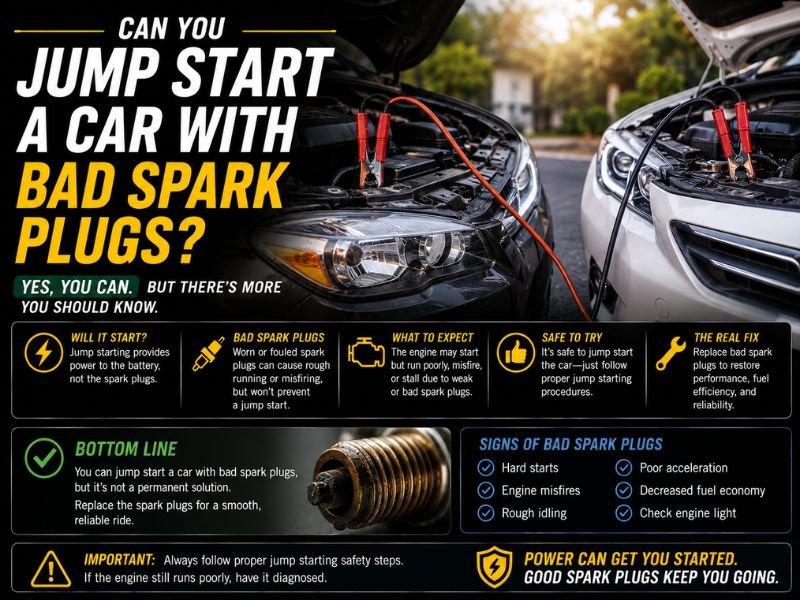
You can safely use an appropriate jump starter when a vehicle has bad spark plugs if the battery itself is suitable for jump starting and the vehicle manufacturer permits the procedure. The booster may help if insufficient battery power is part of the problem.
What it cannot do is make a defective plug healthy.
A spark plug must create a strong enough spark across its electrode gap at the correct time. NGK identifies carbon fouling, excessive plug gap, damaged plugs, worn ignition components, and insufficient ignition voltage as potential causes of misfires.
If the starter motor is barely turning because the battery is weak, boosting the battery may improve the situation significantly. If the starter is already cranking the engine normally and the plugs are not firing correctly, extra battery assistance may accomplish very little.
That distinction—slow crank versus strong crank but no start—is one of the most useful clues.
How Bad Spark Plugs Affect Starting
“Bad spark plugs” can describe several different conditions, and they do not all affect starting in the same way.
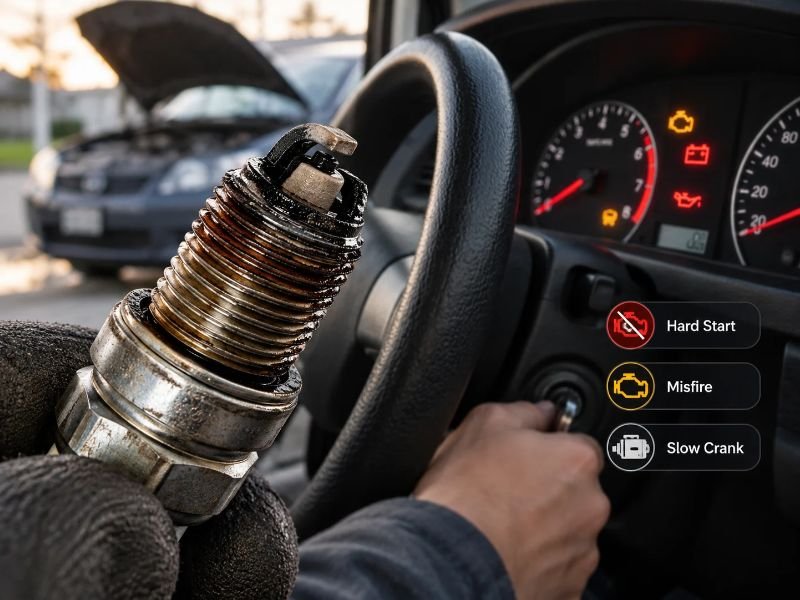
Worn Spark Plug Electrodes
Spark plug electrodes gradually wear during normal service. As the electrodes erode, the spark plug gap can increase, requiring greater ignition voltage for the spark to cross it.
NGK notes that a worn plug with an enlarged gap places greater demand on the ignition system. DENSO similarly associates extreme electrode wear and an excessive gap with poor starting and acceleration.
An engine with mildly worn plugs may still start, particularly when the battery is strong. If the battery is weak at the same time, the combined problems can make starting more difficult.
Fouled Spark Plugs
Spark plugs can become contaminated with carbon, gasoline, or oil deposits.
Fouling can interfere with proper spark formation and produce misfires or difficult starting. DENSO specifically identifies fuel fouling and oil fouling as conditions associated with poor starting and misfiring.
NGK also notes that a completely fouled plug may need replacement after the underlying cause of the fouling is identified.
A jump starter does not remove these deposits.
Damaged or Incorrectly Gapped Plugs
Physical damage can also prevent reliable ignition.
A cracked insulator, damaged electrode, or severely incorrect gap can disrupt the spark. DENSO associates insulator breakage with ignition shorts and misfires, while NGK warns that incorrect plug gap can contribute to misfires, fouling, power loss, poor fuel economy, and accelerated plug wear.
Extra cranking power cannot repair physical spark plug damage.
When a Jump Starter Can Actually Help
A jump starter is most likely to help when the vehicle has two problems at the same time: marginal spark plugs and a weak battery.
Imagine a gasoline engine whose plugs are worn but still capable of firing. If the battery has also become discharged, the starter may turn slowly and the engine may struggle to begin combustion.
A properly sized jump starter can supply additional battery power and restore stronger cranking. Clore Automotive describes jump starting as a method of assisting a vehicle whose battery does not have sufficient starting power and emphasizes proper voltage matching and connection procedures.
Under those circumstances, the car may start after boosting.
But the result can be misleading.
The jump starter did not “fix” the spark plugs. It improved the battery side of the starting equation, allowing plugs that were still marginally functional to ignite the mixture.
You may experience the same rough running, misfire, or hard-start symptoms later.
When a Jump Starter Will Not Solve the Problem
A jump starter becomes much less useful once the engine is already cranking normally.
If you connect the booster and hear the engine turning strongly at a normal speed, the starting battery may no longer be your main concern.
A gasoline engine that cranks but does not start may have a problem involving:
Spark, fuel delivery, compression, ignition control, or engine management.
Spark plugs are one possibility, but they are not the only one.
NGK notes that the plug, coil, and ignition components operate together as part of a high-voltage ignition system. Misfires can originate from the plug itself or from other deteriorated ignition components.
This is why installing a larger jump starter is not a meaningful fix for an engine that already cranks strongly.
Battery Problem vs. Spark Plug Problem
The symptoms can overlap, but the way the engine behaves provides useful diagnostic direction.
| Symptom | More Consistent With Battery Problem | More Consistent With Spark/Ignition Problem |
| Starter turns very slowly | Yes | Usually not |
| Rapid clicking during start attempt | Yes | Usually not |
| Lights become very dim while cranking | Yes | Usually not |
| Strong normal cranking but engine never fires | Less likely | Possible |
| Engine starts but runs roughly | Usually not | Yes |
| Repeated cylinder misfire | Usually not | Yes |
| Booster makes starter noticeably faster | Yes | Does not rule ignition problem out |
| Booster makes no difference to strong cranking | Less likely | Investigate ignition/fuel |
These symptoms are clues rather than absolute proof. A vehicle can have more than one fault at the same time.
Can a Car Start With One Bad Spark Plug?
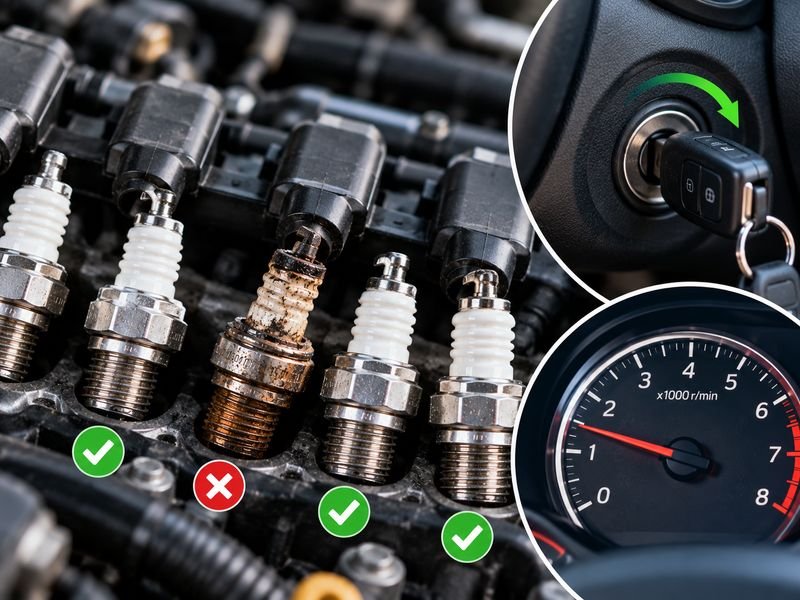
Often, yes.
If one spark plug in a four-, six-, or eight-cylinder engine fails, the remaining cylinders may still produce enough combustion for the engine to start and continue running.
The engine may then idle roughly, shake, lose power, or misfire.
NGK lists damaged plugs, carbon fouling, excessive gap, and ignition-system problems among common causes of misfires.
The situation becomes more serious when several cylinders cannot produce proper ignition.
If multiple plugs are heavily fouled or damaged, there may not be enough successful combustion events for the engine to start at all.
So “one bad plug” and “all the plugs are badly fouled” are very different no-start scenarios.
Can Bad Spark Plugs Cause a Crank-No-Start?
Yes, severe spark plug problems can contribute to a crank-no-start condition.
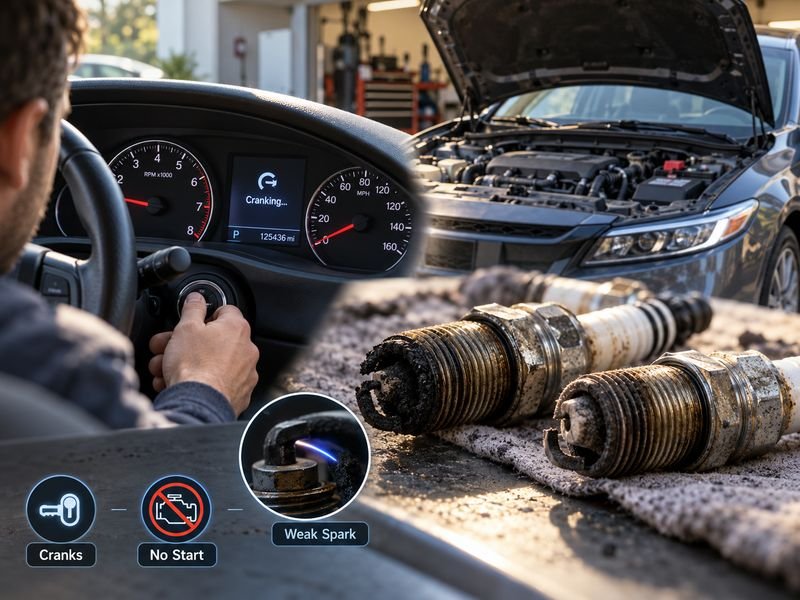
“Cranking” simply means the starter is rotating the engine. It does not mean combustion has started.
A gasoline engine still needs a suitable air-fuel mixture, compression, and properly timed ignition.
If the spark plugs cannot ignite the mixture, the starter may spin the engine normally for several seconds without it firing.
DENSO links excessive spark plug gap and extreme electrode wear with poor starting, while both DENSO and NGK identify several fouling and damage conditions that can interfere with proper ignition.
In this situation, adding a stronger jump starter does not replace the missing spark.
Can a Weak Battery Make Bad Spark Plugs Seem Worse?
Yes.
A marginal starting system can expose weaknesses elsewhere.
A battery that cannot maintain adequate electrical performance while the engine is cranking may produce slower starter operation and less favorable starting conditions. If the plugs already require unusually high ignition voltage because of electrode wear or excessive gap, the engine can become especially difficult to start.
NGK explains that greater plug gap increases the voltage required to produce a spark.
This is one reason a vehicle may seem to start “better” with a jump starter even though the plugs are worn.
The booster removes one limitation.
It does not eliminate the underlying ignition maintenance issue.
How Long Can a Car Run With Bad Spark Plugs?
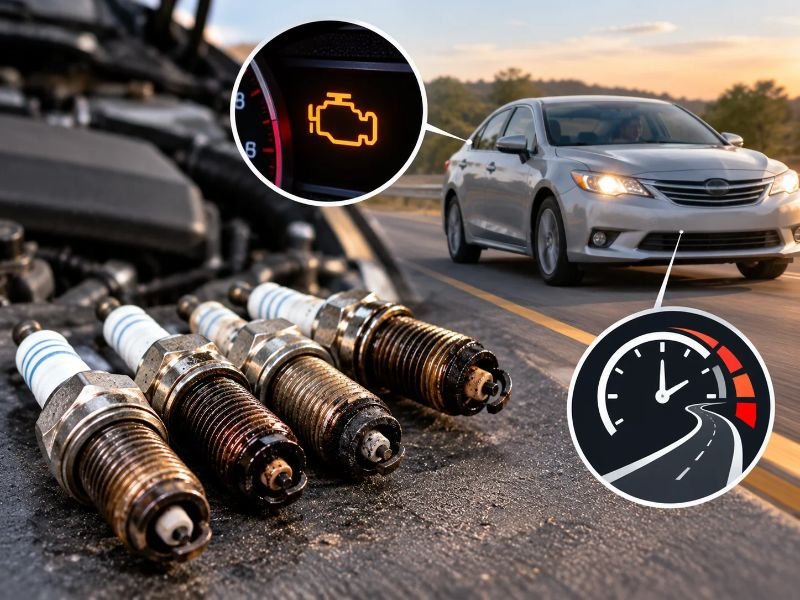
There is no fixed amount of time or mileage a car can run with bad spark plugs. Some engines may continue running for hundreds or even thousands of miles with worn plugs, while others may begin misfiring, losing power, or refusing to start much sooner.
It depends on how badly the spark plugs are worn or damaged.
If the plugs are only slightly worn, you may notice mild symptoms such as:
- Rough idle
- Slower acceleration
- Reduced fuel economy
- Hard starting
- Occasional hesitation
The engine may still run, but performance usually gets worse over time.
If a spark plug is severely fouled, cracked, or unable to fire consistently, the engine can develop a serious misfire. Driving for too long in that condition can send unburned fuel into the exhaust, which may overheat and damage the catalytic converter.
You should not wait for the engine to stop running completely before replacing bad spark plugs.
If the check engine light is flashing, the engine is shaking badly, power has dropped significantly, or the car is difficult to start, avoid unnecessary driving and diagnose the ignition problem as soon as possible.
In short, a car may continue running with bad spark plugs, but the longer you drive with a misfire, the greater the risk of poor performance, higher fuel consumption, and expensive exhaust-system damage.
What to Do If the Car Still Won’t Start After a Jump
Once a properly connected jump starter has restored strong cranking, stop focusing exclusively on battery power.
Check How the Engine Is Cranking
If cranking remains slow or labored, inspect the battery terminals, grounds, starter circuit, battery condition, and the jump starter connection.
If the engine now cranks strongly but does not fire, begin looking beyond the battery.
Repeatedly adding more booster power is unlikely to solve a normal-speed crank/no-start.
Check for Misfire or Ignition Trouble Codes
If the vehicle runs but has a check-engine light, a diagnostic scan may reveal misfire-related trouble codes.
A cylinder-specific misfire code can help narrow the investigation, but it does not automatically prove that the spark plug is the defective component. Ignition coils and other engine issues can cause similar symptoms.
Use codes as diagnostic evidence rather than instructions to replace parts blindly.
Inspect the Spark Plugs
If the plugs are due for inspection or there is good reason to suspect them, their condition can provide useful clues.
Look for excessive electrode wear, abnormal gap, heavy carbon deposits, wet fuel fouling, oily deposits, or physical damage.
NGK notes that a normally operating firing end is often light tan or gray, while abnormal deposits can reflect problems involving mixture, oil control, plug selection, compression, or ignition conditions.
Do not automatically clean and reinstall every fouled plug. Fouling can indicate a problem elsewhere that should be diagnosed.
Check the Rest of the Ignition System
Spark plugs are only one component of the ignition system.
A failed ignition coil, coil boot, wiring connection, or ignition-control component can prevent a healthy plug from firing properly.
If replacing or inspecting the plug does not resolve the problem, the rest of the ignition circuit needs attention.
Should You Keep Trying to Jump Start the Car?
Not indefinitely.
Once the engine is cranking strongly, repeated attempts can create unnecessary heat and drain both the vehicle battery and the portable booster.
Clore advises respecting the jump starter’s specified duty cycle rather than continuously cranking. Its guidance notes that jump starters require short cranking periods followed by rest and also warns that the battery may not be the cause of every no-start condition.
If the engine repeatedly cranks at normal speed without firing, additional attempts are unlikely to become more productive simply because you keep the jump starter connected.
That is the point to diagnose the no-start condition.
Should You Replace the Spark Plugs?
Replace spark plugs when inspection, diagnosis, or the manufacturer’s maintenance schedule indicates they are worn or defective.
Use the correct spark plug part number, heat range, and specified gap for the engine.
NGK recommends checking the gap against the vehicle manufacturer’s specification because an incorrect gap can cause misfires and other performance problems.
Replacement alone may not solve recurrent fouling.
If new plugs quickly develop oily deposits, heavy carbon, or fuel fouling, investigate why the engine is contaminating them instead of repeatedly installing another set.
A spark plug can be both the failed component and a clue to another problem.
Frequently Asked Questions
Will a Jump Starter Help if Spark Plugs Are Bad?
Only if weak battery power is also contributing to the starting problem. A jump starter improves cranking power but does not repair worn, fouled, damaged, or incorrectly gapped spark plugs.
Can a Car Start With One Bad Spark Plug?
Yes. Many engines can start and run with one misfiring cylinder, although they may idle roughly, lose power, or illuminate the check-engine light.
Can Bad Spark Plugs Make a Car Not Start at All?
Yes. If enough plugs cannot ignite the air-fuel mixture, the engine may crank normally without starting. Fouling, severe electrode wear, improper gap, and physical plug damage can all interfere with ignition.
Why Does My Car Crank but Not Start After a Jump?
If cranking speed is strong after boosting, insufficient battery power may no longer be the main issue. Spark, fuel delivery, compression, sensors, ignition components, and other engine faults should be considered.
Can a Weak Battery Cause Spark Plug Misfires?
A weak electrical system can contribute to poor starting conditions, but persistent misfires usually require diagnosis of the spark plugs, ignition coils, fueling, or other engine systems. Do not assume the battery is the sole cause just because a booster temporarily improves starting.
Will More Jump Starter Amps Help Bad Spark Plugs?
Not if the engine already cranks at normal speed. More available starting current cannot restore worn electrodes, clean severe fouling, repair an insulator, or correct an incorrect spark plug gap.
How Do I Know if the Battery or Spark Plugs Are the Problem?
Slow cranking, clicking, and heavily dimming lights point more strongly toward battery or starting-circuit trouble. Strong cranking accompanied by failure to fire, rough running, or cylinder misfires makes ignition and other engine systems more relevant.
Can Bad Spark Plugs Drain a Car Battery?
Not normally while the vehicle is parked. However, repeatedly cranking an engine that will not start can discharge the battery, leaving you with both an ignition problem and a weak battery.
Can a Jump Starter Fix a Misfire?
No. A portable jump starter provides battery assistance. A persistent misfire needs diagnosis of the plug, ignition coil, fuel delivery, compression, or related engine-control systems.
Should I Change Spark Plugs if Jump Starting Does Not Work?
Not automatically. If the engine cranks strongly after the jump but does not start, inspect and test the ignition and fuel systems before assuming the plugs are responsible.
Can You Jump Start a Car With Bad Spark Plugs?
You can jump start a car with bad spark plugs, but the jump starter only addresses insufficient battery starting power—it does not fix the plugs. If the plugs are mildly worn and the battery is also weak, stronger cranking may be enough to get the engine running; severely fouled or damaged plugs can still prevent ignition.
Pay attention to what happens after connecting the booster.
If slow cranking becomes strong cranking and the engine starts, battery weakness was probably part of the problem. If the engine cranks strongly but still refuses to start, stop treating it as purely a battery issue and investigate the spark plugs, ignition coils, fuel delivery, compression, and related engine systems.
The practical rule is simple: a jump starter can restore cranking power, but functioning spark plugs are still required to create combustion.