
Spark plug wires often run close together because they must connect the ignition coils or distributor to several spark plugs within a relatively small engine compartment. Seeing two wires touch may therefore look normal, but the way they are routed can affect ignition performance.
For most modern, good-quality ignition wires, brief physical contact between two properly insulated wires does not automatically cause a problem. However, allowing spark plug wires to remain tightly bundled together, rub against each other, cross repeatedly, or run parallel for long distances can increase the chance of electrical interference, insulation damage, or ignition crossfire, especially on older ignition systems or deteriorated wires.
If the insulation is cracked, burned, oil-soaked, or otherwise damaged, the high voltage traveling through the wire may escape and jump to another wire or a nearby metal component. This can cause misfires, rough running, poor acceleration, and sometimes a check engine light.
Understanding can spark plug wires touch each other also means understanding why manufacturers use wire separators, clips, and specific routing patterns. This guide explains when wire contact is acceptable, why crossfire can occur, how to identify bad routing, and how to arrange spark plug wires correctly.
Can Spark Plug Wires Touch Each Other?
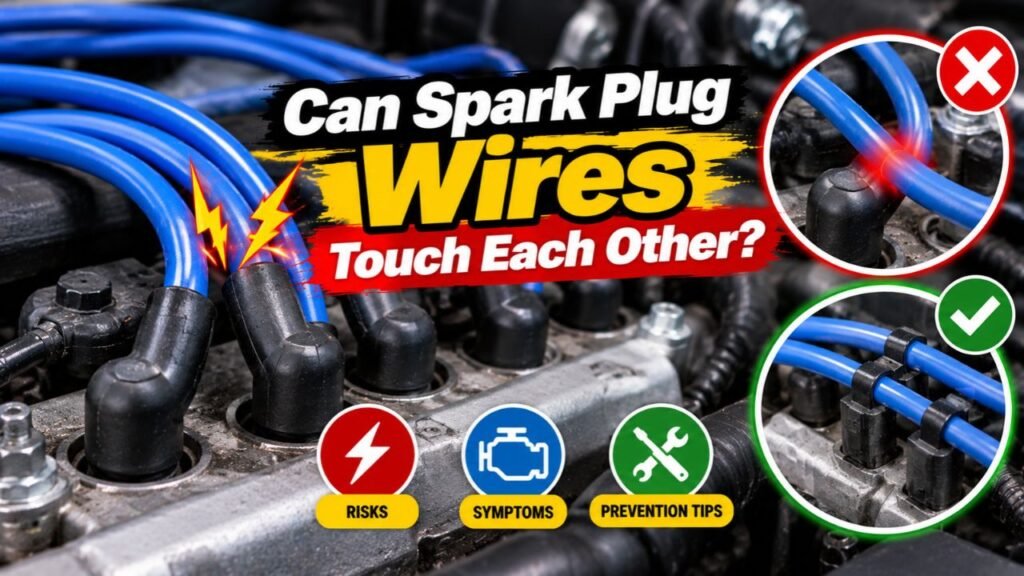
Yes, spark plug wires can physically touch each other without immediately causing a problem if the insulation is in excellent condition, but it is generally better to keep them separated and properly routed using the factory clips or wire separators.
Spark plug wires carry thousands of volts during ignition. Their insulation is specifically designed to contain that voltage, but insulation deteriorates with age, heat, vibration, oil exposure, and abrasion.
Keeping the wires separated helps reduce several possible problems:
- Electrical crossfire
- Electromagnetic interference
- Insulation rubbing and wear
- Heat damage
- Accidental contact with exhaust components
- Incorrect wire routing
A brief crossing point is generally less concerning than two ignition wires running tightly against each other for a long distance.
Why Spark Plug Wires Carry Such High Voltage
A spark plug needs high voltage to create an electrical arc across the spark plug gap.
Depending on the ignition system and operating conditions, the voltage can reach tens of thousands of volts.
That high voltage travels through the spark plug wire, also called an ignition cable, until it reaches the spark plug.
The wire typically contains:
- Conductive core
- Insulation layers
- Outer protective jacket
- Terminal connectors
- Rubber boots
These layers keep the electrical energy inside the wire until it reaches the plug.
When the insulation begins to fail, electricity may find an easier path to ground or another ignition wire.
What Happens When Spark Plug Wires Touch?
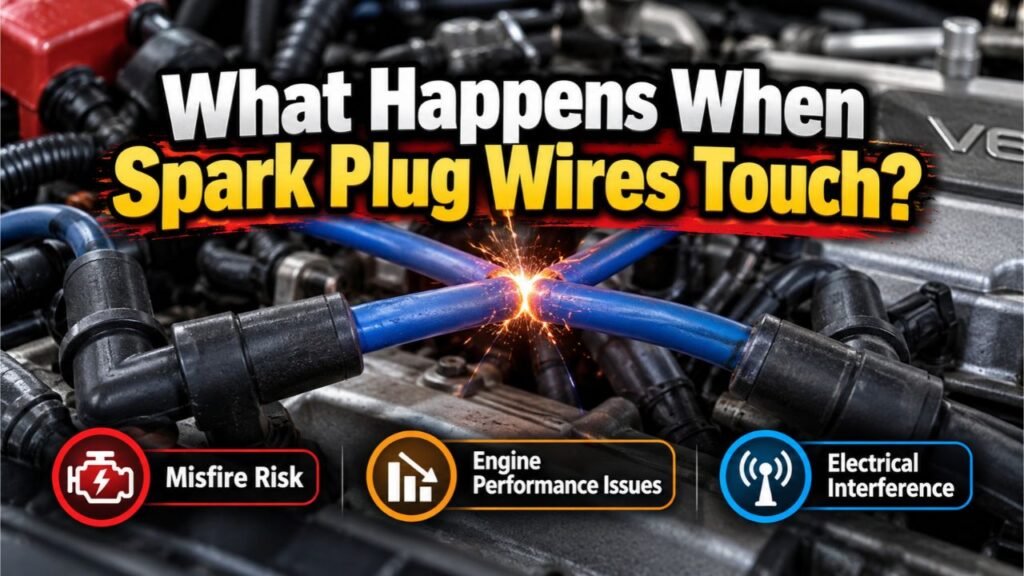
Nothing may happen if both wires are new, correctly insulated, and only touch lightly.
However, problems become more likely when:
- The wires are old.
- The outer insulation is cracked.
- The wires are tightly bundled.
- The wires rub while the engine vibrates.
- Two wires run parallel for a long distance.
- One wire is touching hot engine components.
The concern is not simply that two rubber-covered wires are touching. The real issue is what happens electrically and mechanically over time.
What Is Spark Plug Wire Crossfire?
Crossfire occurs when ignition energy from one spark plug wire affects another cylinder’s ignition circuit.
High voltage traveling through one wire creates an electromagnetic field around the cable.
If another ignition wire runs very close and parallel to it, electrical energy can sometimes be induced into the neighboring wire.
This is more likely with certain firing orders, ignition systems, and poorly shielded or deteriorated wires.
In more severe cases, voltage can physically arc from one damaged wire to another.
The result can be ignition at the wrong time.
Symptoms of Spark Plug Wire Crossfire
Crossfire can cause symptoms similar to other ignition problems.
Possible signs include:
- Engine misfire
- Rough idle
- Hesitation
- Poor acceleration
- Engine surging
- Reduced fuel economy
- Hard starting
- Check engine light
- Backfiring in some situations
These symptoms do not automatically prove that spark plug wires are touching.
Bad spark plugs, ignition coils, fuel injectors, vacuum leaks, compression problems, and other faults can produce similar symptoms.
Why Running Two Plug Wires Parallel Can Be a Problem
Two spark plug wires touching briefly at one crossing point is different from two wires lying beside each other for several inches.
Long parallel runs increase the opportunity for electromagnetic interaction.
That is why factory wire routing may intentionally separate particular ignition wires.
Some engines are especially sensitive to routing because cylinders that fire sequentially or near each other in the firing order can be affected by induced voltage.
Following the original manufacturer routing is therefore preferable to simply arranging the wires wherever they fit.
Can Spark Plug Wires Cross Over Each Other?
Yes.
Spark plug wires can cross each other at a point.
If they must cross, having them cross at an angle rather than running parallel is generally preferable.
A crossing point:
- Minimizes the length of close contact
- Reduces electromagnetic coupling
- Reduces prolonged rubbing
Use the factory wire guides whenever possible.
Should Spark Plug Wires Be Separated?
Yes, proper separation is generally recommended.
Most engines originally equipped with traditional spark plug wires also include some form of:
- Wire clips
- Separators
- Retainers
- Looms
- Routing brackets
These components are not merely cosmetic.
They help:
- Keep wires away from excessive heat
- Reduce rubbing
- Prevent tangling
- Maintain proper spacing
- Keep cables away from moving parts
- Preserve the intended firing-order routing
If factory separators are missing or broken, replacing them is inexpensive compared with diagnosing a persistent ignition misfire.
How Far Apart Should Spark Plug Wires Be?
There is no universal minimum spacing that applies to every engine.
The safest approach is to use the vehicle manufacturer’s original routing and wire separators.
Where factory routing allows the wires to cross, that is normally acceptable.
Where the factory system keeps particular wires separated, maintain that separation.
Do not create your own spacing specification unless you have service information for the vehicle.
Can Spark Plug Wires Cause a Misfire If They Touch?
They can, particularly if the wires are damaged, poorly insulated, or routed incorrectly.
Potential mechanisms include:
- High-voltage leakage
- Arcing between wires
- Electromagnetic crossfire
- Insulation damaged by rubbing
If the wires are new and properly insulated, simple physical contact alone may not cause a misfire.
However, keeping them correctly separated eliminates an unnecessary potential problem.
Can Electricity Jump Between Spark Plug Wires?
Yes, if insulation has deteriorated enough.
Ignition voltage can jump across small gaps when the electrical resistance of the intended path becomes higher than another available path.
A damaged wire may arc to:
- Another spark plug wire
- Engine block
- Cylinder head
- Metal bracket
- Exhaust shield
This is called high-voltage leakage.
You may sometimes hear a snapping or ticking sound when this occurs.
Can Spark Plug Wires Touch Metal?
They should not rest against grounded metal unnecessarily, especially if the insulation is old or damaged.
A properly insulated wire may physically touch some engine surfaces without immediately leaking voltage, but vibration can eventually wear through its outer jacket.
Particular caution is needed around:
- Sharp brackets
- Cylinder head edges
- Exhaust shields
- Ground straps
- Metal clips not designed for ignition wires
Use proper insulated retainers where the wiring passes near metal.
Can Spark Plug Wires Touch the Engine Block?
They may pass close to the engine block, but allowing them to rub directly against it is not ideal.
The combination of heat and engine vibration can damage the insulation.
If a wire touches the block because a retaining clip is missing, restore the proper routing rather than leaving it loose.
Can Spark Plug Wires Touch the Exhaust Manifold?
No.
Spark plug wires should be kept away from the exhaust manifold, headers, and other extremely hot exhaust components.
Exhaust heat can:
- Melt the outer jacket
- Harden insulation
- Cause cracking
- Damage plug boots
- Increase electrical leakage
On engines where the plug wires must pass close to headers or manifolds, properly designed heat shields or high-temperature protective boots may be used.
Do not rely on ordinary wire insulation to withstand direct exhaust contact.
What Do Burned Spark Plug Wires Look Like?
Heat-damaged wires may show:
- Melted outer jacket
- Hardened insulation
- Cracks
- Brown or black discoloration
- Burn marks
- Deformed boots
A heat-damaged ignition wire should generally be replaced.
Moving it away from the heat source will not repair compromised insulation.
What Causes Spark Plug Wires to Rub Together?
Engine vibration causes constant small movements.
If two loosely routed wires touch each other, their outer surfaces may rub repeatedly while the engine runs.
Over time, this can wear through the protective jacket.
The same problem can occur where a plug wire rubs against:
- Engine cover
- Metal bracket
- Hose
- Valve cover
- Wire loom
Proper clips minimize movement and abrasion.
How to Route Spark Plug Wires Correctly
Correct routing is one of the easiest ways to prevent ignition-wire problems.
1. Follow the Original Routing
Before removing old wires, take a photograph of their arrangement.
If the wires have already been removed, consult the vehicle’s routing diagram or service information.
2. Connect the Correct Cylinder
Each spark plug wire must connect the correct:
- Distributor terminal
- Ignition coil terminal
- Spark plug
A routing mistake can cause severe misfiring or prevent the engine from starting.
3. Use Factory Clips
Secure the wires in their factory retainers.
Replace broken clips rather than leaving the wires loose.
4. Avoid Long Parallel Runs
If possible, do not tightly bundle high-voltage ignition wires together for long distances.
Follow any special separation shown in the factory routing.
5. Keep Wires Away From Heat
Maintain clearance from:
- Exhaust manifolds
- Headers
- Turbocharger components
- Extremely hot engine surfaces
6. Avoid Sharp Edges
Do not route wires where they can rub against metal edges.
7. Leave Enough Length
A spark plug wire should not be stretched tightly.
There should be enough slack to accommodate engine movement without allowing the wire to contact hot or moving parts.
Why Firing Order Matters When Routing Plug Wires
The firing order determines the sequence in which the engine’s cylinders ignite.
Traditional distributor-based ignition systems use separate high-voltage wires running from the distributor cap to each spark plug.
If these wires are connected incorrectly, the spark may reach the wrong cylinder.
The engine may:
- Misfire badly
- Backfire
- Run rough
- Fail to start
Certain firing-order combinations can also be more susceptible to crossfire when their wires run tightly together.
This is another reason to preserve factory routing.
How to Check for Bad Spark Plug Wires
Start with a visual inspection.
Look for:
- Cracks
- Cuts
- Burn marks
- Damaged boots
- Oil contamination
- Abrasion
- Loose terminals
Also inspect the routing.
Make sure the wires are not rubbing together or resting on hot surfaces.
Look for Arcing
Electrical arcing may sometimes be easier to notice in low-light conditions.
You might see small blue sparks around damaged wires.
However, avoid touching ignition wires while the engine is running. Ignition systems can produce painful and potentially dangerous electrical shocks.
Can Water Reveal Bad Spark Plug Wires?
Moisture can make voltage leakage more noticeable, which is one reason an engine with deteriorated ignition wires may run worse in rain or humid weather.
Some traditional diagnostic techniques involve misting ignition components while observing for leakage, but this should be done carefully because the engine is running and high voltage is present.
For most DIY owners, visual inspection and proper diagnostic testing are safer approaches.
Can Spark Plug Wires Shock You?
Yes.
Ignition wires carry very high voltage.
Although current levels are limited, the shock can still be painful and may cause an involuntary reaction that creates a secondary injury.
Do not:
- Grab plug wires with the engine running.
- Pull a wire off a spark plug while the engine runs.
- Probe high-voltage circuits with bare tools.
People with implanted electronic medical devices should be especially cautious around active ignition systems and follow appropriate medical/device guidance.
Do New Cars Have Spark Plug Wires?
Many modern gasoline engines do not use traditional long spark plug wires.
Instead, they use coil-on-plug (COP) ignition.
With coil-on-plug systems, each spark plug has an ignition coil mounted directly above or very close to it.
This eliminates traditional high-voltage spark plug cables.
Some vehicles use:
- Coil packs with short plug wires
- Coil-near-plug systems
- Waste-spark systems
So whether your vehicle has replaceable plug wires depends on its ignition design.
Should Spark Plug Wires Be Zip-Tied Together?
Tightly zip-tying several high-voltage ignition wires into one bundle is generally not the preferred solution.
It can:
- Create long parallel runs
- Increase rubbing
- Make heat buildup worse
- Ignore manufacturer routing
Use dedicated spark plug wire separators or looms instead.
These retain the wires while maintaining spacing.
Are Spark Plug Wire Separators Necessary?
If the engine originally uses them, it is best to keep them installed.
Separators help preserve the routing engineers intended for the ignition system.
They are particularly useful on engines with:
- Long plug wires
- Distributor ignition
- High-performance ignition systems
- Headers
- Tight engine compartments
Missing separators should be replaced when practical.
Can Aftermarket Spark Plug Wires Reduce Crossfire?
Quality aftermarket ignition wires may use improved insulation and electromagnetic suppression materials.
However, expensive wires do not eliminate the need for proper routing.
Even high-quality wires should be:
- Kept away from exhaust heat
- Properly secured
- Inspected for damage
- Routed according to the firing order
Correct installation matters as much as wire quality.
What Happens If Plug Wires Are Connected Wrong?
Incorrect wire connections are much more serious than simple physical contact between cables.
If two wires are connected to the wrong cylinders, the ignition timing for those cylinders will be wrong.
Symptoms may include:
- Immediate misfire
- Backfiring
- Shaking
- Poor acceleration
- No-start condition
- Check engine light
If an engine develops severe misfiring immediately after spark plug wire replacement, check the firing order first.
When Should Spark Plug Wires Be Replaced?
There is no universal replacement interval for every vehicle.
Replace or inspect the wires according to the vehicle manufacturer’s maintenance recommendations and their actual condition.
Replacement may be appropriate when you find:
- Cracked insulation
- Burned boots
- Excessive resistance
- Internal conductor failure
- Visible arcing
- Persistent ignition leakage
- Damage from heat or abrasion
If one wire has failed because the entire set is old, replacing the complete set may make more sense than replacing one cable.
Can Bad Spark Plug Wires Damage Other Parts?
Persistent misfires caused by faulty wires can create other problems.
Unburned fuel may enter the exhaust system and overheat the catalytic converter.
A severe or flashing check engine light associated with misfire should therefore not be ignored.
Bad wires can also cause:
- Fouled spark plugs
- Poor fuel economy
- Reduced engine performance
- Increased emissions
Repairing an ignition fault promptly can prevent more expensive secondary damage.
Common Spark Plug Wire Routing Mistakes
Several mistakes are easy to avoid.
Bundling All Wires Together
Avoid tightly grouping all ignition wires into one large bundle.
Removing Factory Separators
The factory routing system exists for a reason.
Keep the clips and separators unless replacement parts provide another approved arrangement.
Routing Across the Exhaust
Never take the shortest route if it puts a wire against a manifold or header.
Stretching a Wire Too Tight
Engine movement can pull on terminals and boots.
Installing the Wrong-Length Wire in the Wrong Position
Many plug-wire sets include several different lengths.
Match each cable to its intended cylinder.
Forgetting the Firing Order
Mark or replace one wire at a time when possible to reduce the chance of mixing them up.
FAQs About Can Spark Plug Wires Touch Each Other
Is It Bad If Two Spark Plug Wires Are Touching?
Not necessarily. Two properly insulated wires touching briefly may work without any problem.
However, keeping the wires properly separated and secured reduces the risk of crossfire, rubbing, and insulation damage.
Can Spark Plug Wires Touch Without Causing a Misfire?
Yes.
Good-quality wires with intact insulation may touch without causing a misfire. Problems become more likely with damaged insulation, long parallel routing, heat exposure, or aging wires.
Can Spark Plug Wires Cross Each Other?
Yes.
A brief crossing is generally acceptable. If possible, crossing at an angle is preferable to running the wires tightly parallel for a long distance.
Can Plug Wires Cause Crossfire?
Yes.
Closely routed ignition wires can contribute to electromagnetic crossfire, especially with certain ignition systems and firing orders.
Physical arcing can also occur if the insulation is damaged.
Can Spark Plug Wires Touch the Valve Cover?
They may pass near or lightly contact some relatively cool engine surfaces, but repeated rubbing should be avoided.
Factory clips should be used to prevent unnecessary abrasion.
Can Spark Plug Wires Melt?
Yes.
Direct contact with exhaust manifolds, headers, or other extremely hot components can melt or harden the insulation.
A heat-damaged wire should be replaced.
Why Do Spark Plug Wires Have Separators?
Separators keep ignition wires organized, maintain proper spacing, prevent rubbing, and help keep them away from heat and moving components.
They may also reduce the possibility of ignition crossfire.
Can Bad Spark Plug Wires Cause a Check Engine Light?
Yes.
A damaged wire can cause an ignition misfire. On OBD-equipped vehicles, repeated misfires may trigger the check engine light and store diagnostic trouble codes.
Conclusion
So, can spark plug wires touch each other? Yes, properly insulated wires can occasionally touch or cross without immediately causing a problem. However, allowing them to remain tightly bundled or run parallel for long distances is not good practice.
Correct routing helps reduce crossfire, high-voltage leakage, abrasion, and heat damage. Use the factory clips and wire separators, keep ignition cables away from exhaust components, and replace any wires with cracked, burned, or damaged insulation.
If your engine is misfiring and the spark plug wires are touching, inspect both their condition and routing rather than assuming contact alone is the cause. Properly routed, healthy ignition wires should deliver the spark to the correct cylinder without leaking energy to neighboring wires or engine components.