
Subaru spark plugs commonly have scheduled replacement intervals around 60,000 miles on many models, but the exact lifespan depends on the model year and engine. Some older Subaru maintenance schedules specify different intervals, so your vehicle’s Warranty & Maintenance Booklet should determine when the plugs are actually due.
Spark plugs can sometimes continue firing beyond their scheduled interval, especially when they use durable precious-metal electrodes. That does not necessarily mean keeping them installed longer is beneficial, because gradual electrode wear and increasing spark gap place additional demand on the ignition system.
Subaru Spark Plug Life Is Usually a Maintenance Interval, Not a Failure Point
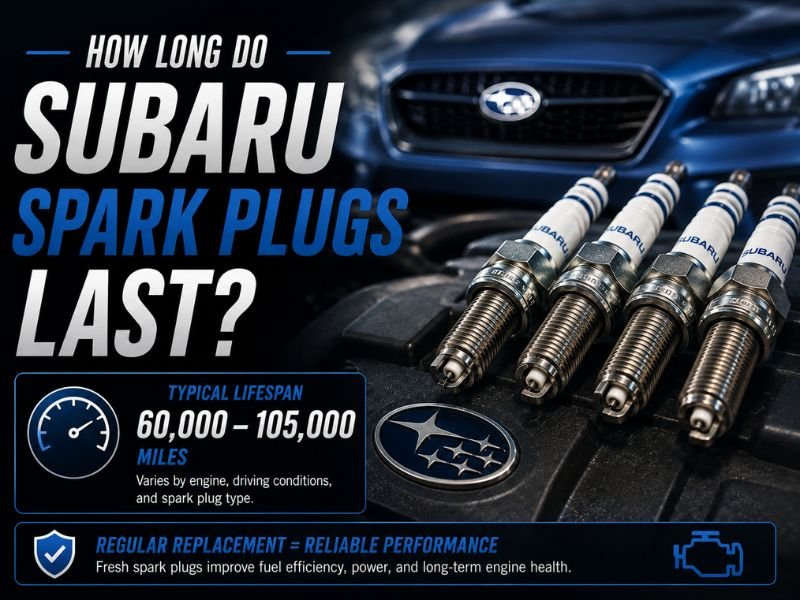
It helps to separate two different questions:
How long can the spark plugs physically continue working?
and
When does Subaru recommend replacing them?
Those numbers are not necessarily identical.
A spark plug may continue producing a spark after its scheduled replacement mileage, but the electrodes gradually erode every time it fires. NGK explains that this erosion rounds the electrode edges and increases the gap, requiring progressively more voltage from the ignition system.
Subaru schedules replacement before you necessarily experience a complete plug failure.
For example, Subaru’s official 2024 U.S. Warranty & Maintenance Booklet lists spark plug replacement at 60 months/60,000 miles and again at 120 months/120,000 miles for its Federal/California-specification vehicles.
That makes 60,000 miles an important reference point for many modern Subaru owners—but it should not be treated as a rule for every Subaru ever produced.
Why You May See Different Subaru Spark Plug Intervals Online
Searching for Subaru spark plug lifespan can produce apparently conflicting answers such as 60,000, 90,000, 100,000, or 120,000 miles.
There is a reason.
Subaru has published different maintenance requirements for different model years, engines, and vehicle generations. Its official 2018 maintenance information, for example, lists spark plug replacement at 120,000 miles, while official information for some other Subaru model years has specified a 60,000-mile replacement.
So the correct question is not simply:
“How long do Subaru spark plugs last?”
It is:
“What is the spark plug interval for my exact Subaru model year and engine?”
Subaru itself advises owners to use the recommended intervals in their Warranty & Maintenance Booklet or MySubaru account, with maintenance based on mileage or time as applicable.
A Practical Subaru Spark Plug Lifespan Guide
These ranges are best used as orientation rather than replacement instructions.
| Situation | What to Expect |
| Many newer Subaru schedules | Around 60,000 miles / 60 months |
| Certain older model-year schedules | Can differ substantially |
| Plug has reached Subaru interval | Replace as scheduled |
| Plug develops confirmed ignition problem early | Inspect or replace sooner |
| Modified/tuned Subaru | Interval may need individual evaluation |
| Unknown used-car maintenance history | Inspect records and verify current plug condition |
The factory schedule always takes priority over a generic lifespan estimate.
Why Subaru Spark Plugs Wear Out
Spark plugs operate in one of the harshest environments in the engine.
Each plug repeatedly creates an electrical discharge across the center electrode and ground electrode while exposed to combustion heat and pressure.
Gradually, material erodes from those electrodes.
NGK explains that as the electrodes lose their original sharp edges, the spark gap grows. The ignition system then needs greater voltage to jump that larger gap.
At first, you may notice no difference.
Eventually, however, the increased voltage requirement can contribute to:
Harder starting, intermittent misfires, rough operation, hesitation, or reduced ignition efficiency.
This gradual deterioration is why scheduled replacement makes sense even if the engine still seems to run normally.
Do Subaru Iridium Spark Plugs Last Longer?
Iridium spark plugs can provide excellent wear resistance, but seeing the word iridium does not automatically mean a plug should remain installed for 100,000 miles.
NGK makes an important distinction between different iridium designs.
Its Iridium IX plugs are typically designed for approximately 40,000–50,000 miles, while its OE-style Laser Iridium plugs are typically designed for approximately 80,000–100,000 miles. The Laser versions use dual precious-metal construction intended to maximize longevity.
Yet even that does not override Subaru’s maintenance schedule.
An OE-style plug capable of surviving a long service life may still have a shorter scheduled replacement interval in a particular engine.
Think of plug construction as describing its durability potential and the Subaru maintenance schedule as determining when you should service your car.
Why Subaru May Specify Replacement Before the Plug “Dies”
A spark plug does not usually fail like a burned-out light bulb.
Wear tends to be progressive.
At 40,000 miles, the engine may run perfectly.
At 55,000 miles, the plug may still appear functional.
At 60,000 miles, it may still start the engine without obvious trouble.
But the gap and electrode shape can already have changed from their original condition.
NGK recommends using the vehicle manufacturer’s replacement interval specifically because spark plug service requirements differ among makes and models.
The goal is preventative maintenance—not waiting until the engine develops a severe misfire.
Can Subaru Spark Plugs Last 100,000 Miles?
Physically, some spark plug designs are capable of very long service.
NGK’s OE Laser Iridium plugs, for example, are typically designed for approximately 80,000–100,000 miles.
But that does not mean you should automatically leave the plugs in your Subaru for 100,000 miles.
If your Subaru maintenance schedule says 60,000 miles, that is the appropriate service target even if the plug material itself could theoretically function longer.
Conversely, if your specific model-year schedule specifies a longer interval, there is no reason to replace healthy plugs at 60,000 miles simply because another Subaru uses that schedule.
This is where model-specific maintenance matters.
How Time Affects the Subaru Spark Plug Interval
Mileage is not always the only part of Subaru’s maintenance schedule.
Subaru states that maintenance intervals can be specified by months or miles, whichever occurs first, and recommends checking the Warranty & Maintenance Booklet for the exact vehicle.
The 2024 Subaru maintenance schedule, for example, pairs the 60,000-mile spark plug replacement with 60 months.
That matters for low-mileage owners.
A Subaru that travels only 6,000 miles per year may accumulate mileage slowly, while calendar time continues to pass.
Follow whichever condition the specific maintenance schedule tells you to use rather than assuming mileage is always the only trigger.
Signs Subaru Spark Plugs May Need Attention Early
A scheduled interval is appropriate for normal maintenance. Actual defects can appear earlier.
One of the most relevant symptoms is a misfire.
You may notice an uneven idle, hesitation under acceleration, difficult starting, or a flashing or steady check-engine light associated with an ignition-related problem.
However, these symptoms do not prove that the spark plugs themselves have failed.
A Subaru’s ignition system also includes ignition coils, coil boots, wiring, engine controls, and other components. Fuel delivery and mechanical problems can produce similar symptoms.
That means an early misfire should be diagnosed instead of automatically replacing plugs.
If the plugs are already near their scheduled interval, replacement may still make practical sense during that diagnosis.
What if the Spark Plugs Are Fouled Before 60,000 Miles?
Fouling is different from ordinary electrode wear.
A spark plug can become contaminated with carbon, oil, or excess fuel even when it has relatively low mileage.
Replacing the plug may restore normal ignition temporarily, but recurring fouling means the underlying engine condition deserves attention.
If one Subaru plug is heavily oil-covered while the others appear normal, for example, that difference is potentially diagnostic evidence.
Simply replacing all four plugs without investigating why one cylinder looks different can hide the symptom without fixing its cause.
The same applies to plugs that repeatedly become carbon fouled.
A spark plug’s condition can tell you something about the engine—not merely about the plug.
Do Turbocharged Subarus Wear Spark Plugs Faster?
Turbocharged engines can place substantial demands on an ignition system, but you should not create your own replacement interval simply because your Subaru has a turbo.
Models such as the WRX, turbocharged Outback, Legacy XT, and other forced-induction Subaru applications should follow the schedule specified for their exact year and engine.
The distinction becomes more important when the engine has been modified.
Higher boost, aftermarket tuning, altered fuel mixtures, or other performance modifications can change cylinder pressure and ignition requirements. In that situation, the factory maintenance assumptions may no longer describe how the vehicle is being operated.
A tuned Subaru may therefore require plug inspection, heat-range selection, gap decisions, or replacement intervals based on the tuner and spark plug manufacturer’s recommendations.
For an unmodified vehicle, start with Subaru’s factory schedule.
Should You Replace All Subaru Spark Plugs at Once?
For scheduled maintenance, yes, replacing the complete set generally makes sense.
A four-cylinder Subaru engine normally has four spark plugs that have accumulated essentially the same mileage and firing cycles.
Replacing only one old plug during routine maintenance would leave the others at the same stage of wear.
There is an exception when diagnosis identifies a problem unrelated to normal age.
If one relatively new plug is physically damaged or fouled because of a cylinder-specific issue, you should diagnose that cylinder rather than assuming all plugs have worn out simultaneously.
Subaru Boxer Engines Can Make Spark Plug Replacement More Labor-Intensive
Subaru’s horizontally opposed boxer engine layout places the cylinder heads on the sides of the engine bay.
That means the spark plugs are approached from the sides rather than from the top as on many inline engines.
The plugs are still conventional service items, but available working space can make replacement more time-consuming on some models.
This matters when deciding whether to replace plugs unnecessarily early.
If your exact Subaru schedule says 60,000 miles, follow it. But replacing expensive plugs at dramatically shorter intervals without a diagnostic or maintenance reason can add labor and cost without providing meaningful benefit.
When performing the service, correct spark plug type, gap, installation technique, and tightening specification are more important than simply installing the most expensive plug available.
What Happens if You Leave Subaru Spark Plugs in Too Long?
The first problem is usually not catastrophic engine failure.
It is steadily declining ignition margin.
As plug electrodes erode and the gap increases, the ignition coil must generate more voltage to produce the spark. NGK explains that eventually this can strain the ignition system enough that misfires occur and combustion becomes incomplete.
Possible consequences include rough running, difficult starting, reduced performance, and increased misfire activity.
There is also little practical advantage to deliberately extending a factory maintenance item far beyond its interval just to see how long it can survive.
A plug that still fires is not necessarily a plug performing as well as intended.
Buying a Used Subaru With Unknown Spark Plug History
Used vehicles create a different decision.
Suppose you buy a Subaru with 85,000 miles and no record of spark plug replacement.
If the applicable schedule called for replacement at 60,000 miles, the plugs may already be overdue.
Rather than judging only by how the engine sounds, check the maintenance records and verify the official interval for that model year.
Subaru provides vehicle-specific owner resources and maintenance information through its owner-support system.
Establishing a known maintenance baseline can be valuable when service history is incomplete.
Frequently Asked Questions
How Many Miles Do Subaru Spark Plugs Last?
Many Subaru maintenance schedules call for spark plug replacement around 60,000 miles, including the official 2024 U.S. schedule. Other model years can have different intervals, so check your vehicle’s specific maintenance booklet.
Do Subaru Spark Plugs Last 100,000 Miles?
Some precious-metal spark plugs are physically designed for very long service, but you should follow Subaru’s scheduled interval. A plug capable of reaching 100,000 miles should still be replaced earlier if Subaru specifies an earlier service point.
Does Subaru Recommend Spark Plugs at 60,000 Miles?
For the 2024 U.S. model-year maintenance schedule, yes. Subaru lists spark plug replacement at 60,000 miles/60 months, then again at 120,000 miles/120 months.
Why Do Some Subaru Manuals Say 120,000 Miles?
Maintenance requirements have varied between Subaru model years. Subaru’s official 2018 maintenance information, for example, lists spark plug replacement at 120,000 miles.
How Long Do Subaru Iridium Spark Plugs Last?
It depends on the exact plug design and vehicle schedule. NGK says Iridium IX plugs typically target roughly 40,000–50,000 miles, while OE Laser Iridium plugs typically target 80,000–100,000 miles.
Can Subaru Spark Plugs Fail Before 60,000 Miles?
Yes. Fouling, physical damage, abnormal combustion, ignition problems, or engine modifications can make plugs require attention before their normal scheduled mileage.
Should I Replace Subaru Spark Plugs if the Car Runs Fine?
If they have reached the scheduled replacement interval, yes. Preventative replacement avoids waiting until increasing electrode wear causes obvious ignition problems. NGK recommends following the vehicle manufacturer’s interval.
Can Worn Spark Plugs Cause a Subaru Misfire?
Yes. Increasing electrode wear enlarges the gap and raises the voltage needed to fire the plug, which can eventually contribute to misfires. Other ignition, fuel, or mechanical problems can cause misfires as well.
Should All Four Subaru Spark Plugs Be Replaced Together?
For routine scheduled service on a four-cylinder Subaru, replacing the complete set is generally appropriate because all plugs have accumulated similar mileage and operating time.
How Do I Find My Exact Subaru Spark Plug Interval?
Check your Warranty & Maintenance Booklet or MySubaru vehicle information for the exact year and model. Subaru specifically directs owners to these resources for maintenance intervals.
How Long Do Subaru Spark Plugs Last Overall?
Subaru spark plugs commonly have a scheduled service life around 60,000 miles on many current-era applications, but the exact interval is model-year and engine specific. Subaru’s 2024 U.S. maintenance schedule specifies replacement at 60,000 miles/60 months and again at 120,000 miles/120 months, while official schedules from other model years demonstrate that intervals can differ.
Do not extend the interval simply because an iridium plug is advertised as capable of lasting longer. Likewise, do not replace good plugs prematurely because another Subaru owner has a different schedule.
Your best maintenance target is the one Subaru published for your exact vehicle.
Once the plugs reach that point, replacement helps restore fresh electrode geometry and prevents the ignition system from having to compensate for an increasingly worn spark gap.
For most Subaru owners, the practical rule is simple: verify your model-specific interval, treat 60,000 miles as a common—not universal—reference point, and replace the plugs sooner only when inspection or diagnosis gives you a reason to.