
To clean a spark plug socket, wipe away loose dirt and grease, clean the metal body with a mild tool-safe cleaner, and carefully clean the internal rubber or magnetic retainer without damaging it. Dry the socket completely before storage, and replace a rubber insert that is swollen, cracked, loose, or no longer grips a spark plug securely.
A spark plug socket needs slightly different care from an ordinary deep socket because many designs contain an internal rubber grommet, magnetic retainer, or other feature that holds and protects the spark plug. Bosch specifically recommends rubberized or magnetic spark plug sockets because the retention system helps hold the plug and provides clearance around it during installation and removal.
Cleaning the socket is usually straightforward, but using excessive solvent, leaving abrasive debris inside it, or damaging the insert can make the tool less reliable. The goal is to remove oil, grease, dust, rust particles, and other contamination while preserving the socket’s retention mechanism.
First, Make Sure You Mean the Spark Plug Socket
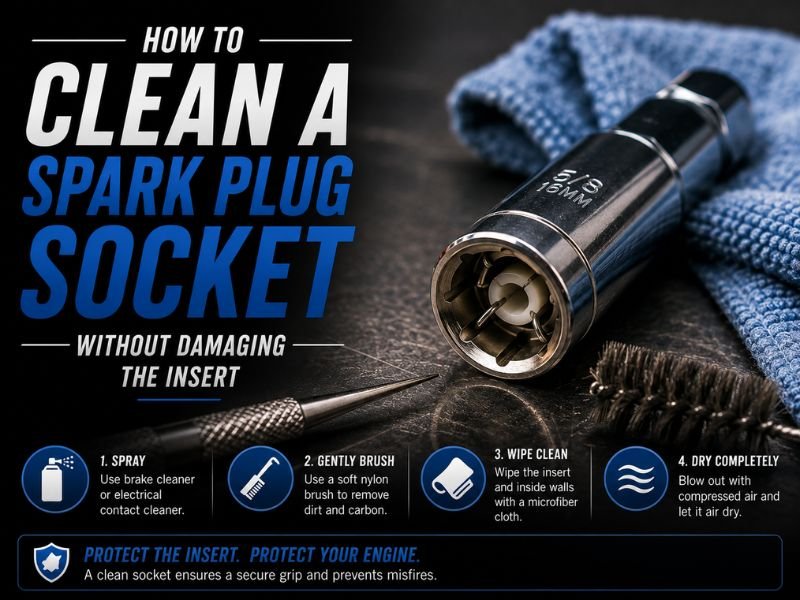
A spark plug socket is the deep socket tool that attaches to a ratchet or extension and fits over the hex portion of a spark plug.
It is not the same thing as:
- The spark plug itself
- The spark plug well in the cylinder head
- The ignition coil boot
- The spark plug hole leading into the combustion chamber
This distinction matters because cleaning a hand tool is considerably different from removing oil or debris from a spark plug well.
A typical spark plug socket may include a rubber grommet that grips the plug’s neck. Other designs use a magnet to retain the spark plug during removal and installation. TEKTON, for example, describes its spark plug sockets as using an internal rubber grommet to grip the plug, while magnetic designs from GEARWRENCH use an internal magnet for retention.
Why Does a Spark Plug Socket Need Cleaning?
Spark plug sockets normally require cleaning because they are exposed to the same contaminants found around an engine.
These may include:
- Engine oil
- Grease
- Dust
- Carbon-like grime
- Dirt from the spark plug well
- Rubber residue
- Metal particles
- Moisture
- Light corrosion
Oil is particularly common if the engine has leaking spark plug tube seals or a valve cover gasket problem.
Contamination can collect inside the socket around the rubber grommet or magnetic insert. If enough dirt accumulates, the socket may not slide fully onto the plug, or its retaining mechanism may not work as intended.
A dirty rubber insert can also become slippery, reducing its ability to hold the spark plug securely.
What You Need to Clean a Spark Plug Socket
You usually do not need specialized equipment.
Gather:
- Clean microfiber or lint-free cloth
- Cotton swabs
- Small nylon brush
- Mild detergent or tool-safe cleaner
- Warm water for removable rubber parts, if appropriate
- Compressed air, optional
- Isopropyl alcohol for limited degreasing where material-compatible
- Light rust-preventive oil, only if needed on suitable metal surfaces
- Protective gloves and eye protection when using cleaners
Avoid immediately soaking the entire socket in a strong solvent. A spark plug socket may contain rubber, adhesive, plastic, or magnetic components that react differently to chemicals.
If the tool manufacturer provides cleaning instructions, those recommendations should take priority.
How to Clean a Spark Plug Socket Step by Step
Step 1: Disconnect the Socket From the Ratchet and Extension
Remove the spark plug socket from the extension, swivel, or ratchet before cleaning it.
This allows you to inspect both openings and prevents grease trapped around the drive connection from being overlooked.
Look at the square drive opening as well as the deep spark plug end.
If the socket has an attached swivel or permanently integrated extension, inspect the joint separately for contamination.
Step 2: Remove Loose Dirt First
Before applying liquid cleaner, remove dry contamination.
Turn the socket upside down and gently tap it against your hand or a shop towel. Use a dry nylon brush to loosen dirt around the opening and internal walls.
Compressed air can also help clear loose particles.
When using compressed air, wear eye protection and direct the socket away from your face. Small metal flakes or dried debris can become airborne.
Removing loose grit first also prevents you from turning dust into an oily paste once cleaner is applied.
Step 3: Wipe the Exterior
For ordinary grease and fingerprints, start with a clean cloth.
A slightly damp cloth or a tool-safe cleaning wipe is often enough for a polished socket. GEARWRENCH notes that its full-polish chrome spark plug sockets are designed to wipe clean while the finish helps resist rust and corrosion.
For stubborn grease, apply a small amount of mild degreaser to the cloth rather than flooding the socket.
Wipe around:
- The socket body
- Size markings
- Drive end
- Spark plug end
- Knurled surfaces, if present
- Swivel joint exterior
Dry the metal afterward.
Step 4: Clean Inside the Socket
The internal cavity is where spark plug sockets differ from ordinary sockets.
Use a lint-free cloth wrapped around a narrow non-sharp tool, a cotton swab, or a small nylon brush to remove oil and grime from the interior walls.
Do not insert screwdrivers, picks, or other sharp metal objects aggressively into the socket. They can cut a rubber grommet, dislodge an insert, or damage a coating.
If grease is heavy, dampen the cloth or swab with a small amount of appropriate cleaner and make several passes.
The interior does not need to be perfectly polished. It simply needs to be free of contamination that interferes with proper seating and retention.
How to Clean a Spark Plug Socket With a Rubber Insert
Rubber-insert sockets deserve the most care.
The grommet grips the ceramic neck or insulator area of the spark plug so the plug can be lifted from a recessed well. TEKTON describes this rubber grommet as a deliberate retention feature for careful plug removal and installation.
Clean the Rubber Gently
Start with a dry cloth or cotton swab.
If oil has made the insert slippery, use only a small amount of mild cleaner that is compatible with rubber. If the insert can be removed according to the tool’s design, it can be cleaned separately and thoroughly dried before reassembly.
Avoid prolonged soaking in harsh solvents unless the manufacturer specifically permits it.
Strong chemicals can affect some rubber compounds or adhesives. The exact material used varies between manufacturers, so there is no single aggressive solvent that should automatically be considered safe for every socket.
Check Whether the Insert Still Grips
After cleaning and drying, insert a clean spark plug into the socket by hand.
The grommet should grip the plug well enough to retain it when the socket is lifted.
It should not:
- Fall out immediately
- Slide deep into the socket
- Pull out with the spark plug
- Feel excessively hard
- Crack or crumble
- Bind so tightly that removal becomes difficult
If cleaning does not restore proper retention, the insert or entire socket may need replacement.
How to Clean a Magnetic Spark Plug Socket
A magnetic socket requires less attention to rubber friction, but metal debris can accumulate around the magnet.
The magnet is supposed to hold the metal shell of the spark plug during removal and installation.
Use a cotton swab or lint-free cloth to wipe the magnetic area.
Pay particular attention to:
- Fine metal particles
- Rust flakes
- Dirt stuck to the magnet
- Greasy residue
- Small fragments from previous work
Because a magnet naturally attracts ferrous debris, tiny metal particles may remain even after the rest of the socket looks clean.
A narrow piece of adhesive tape can sometimes lift fine particles from an accessible magnetic surface without requiring excessive liquid cleaner.
Once clean, test the socket on a spark plug to confirm that the magnet still retains it securely.
Can You Use Brake Cleaner on a Spark Plug Socket?
Brake cleaner can remove grease from metal effectively, but it should not automatically be sprayed throughout every spark plug socket.
The concern is not simply the steel body. The socket may contain a rubber insert, adhesive, plastic component, protective coating, or other material that reacts differently to strong solvents.
If you want to use brake cleaner on the metal exterior, apply it conservatively and follow the cleaner and tool manufacturers’ compatibility guidance.
For a rubber-retaining socket, a gentler method is a better first choice.
Do not assume that because brake cleaner evaporates quickly it is harmless to every internal component.
Can You Use Carb Cleaner?
Carburetor cleaner has a similar limitation.
It may dissolve grease, but it is formulated primarily for carburetor deposits rather than routine hand-tool maintenance.
Using a strong automotive solvent is unnecessary when mild cleaner will remove the contamination.
If the socket contains rubber, the safest approach is to avoid soaking it in carb cleaner unless the socket manufacturer confirms compatibility.
Can You Use WD-40 to Clean a Spark Plug Socket?
A water-displacing lubricant can help loosen grime or protect some exposed metal surfaces, but it can also leave an oily film.
That is undesirable around a rubber insert if the residue makes the gripping surface slippery.
If you use a light oil or corrosion inhibitor on the metal body, wipe away the excess. The spark plug-retention area should remain clean rather than heavily lubricated.
A socket does not need to be wet with oil during storage.
How to Remove Rust From a Spark Plug Socket
Light surface corrosion can sometimes be cleaned, but first determine whether the rust is cosmetic or structural.
For minor exterior rust:
- Wipe off oil and dirt.
- Use a suitable nonaggressive rust-removal method on the affected metal.
- Wipe away all residue.
- Dry the socket completely.
- Apply a very light corrosion-protective coating if appropriate.
Do not aggressively grind a thin-wall spark plug socket.
Spark plug sockets are designed to fit into relatively confined plug wells, and significant material removal or deep corrosion can compromise the tool.
Chrome-plated sockets already rely partly on their finish for corrosion resistance. TEKTON states that its spark plug socket exterior is chrome plated for corrosion resistance, with additional protection on the interior.
If rust is deeply pitted, the socket is cracked, or the drive end is damaged, replacement is more appropriate than restoration.
How to Dry the Socket Properly
Do not put a wet socket directly back into a closed toolbox.
After cleaning:
- Wipe it with a dry cloth.
- Blow moisture from recesses with compressed air if available.
- Allow hidden areas around inserts to air-dry.
- Confirm that the drive square is dry.
- Store it only after moisture and cleaner have evaporated.
Residual moisture trapped behind a rubber insert or around unprotected internal metal can encourage corrosion.
Common Spark Plug Socket Cleaning Mistakes
Soaking the Entire Socket in Solvent
This can unnecessarily expose rubber, adhesives, coatings, or other internal parts to chemicals.
Lubricating the Rubber Insert
Oil can reduce the friction the rubber needs to hold the spark plug.
Ignoring Metal Debris on a Magnetic Insert
The socket may look clean while the magnet is still holding small particles.
Using a Sharp Pick Inside the Socket
Sharp tools can puncture or dislodge the grommet.
Storing the Socket Wet
Even corrosion-resistant tools benefit from being stored clean and dry.
Confusing the Socket With the Spark Plug Well
Cleaning the tool does not clean oil or debris from the engine’s spark plug well. These are separate procedures.
When Should You Replace the Spark Plug Socket?
Cleaning cannot correct every problem.
Replace the socket or its serviceable insert when you find:
- Split or crumbling rubber
- A hardened grommet
- An insert that repeatedly pulls out
- Weak or damaged magnetic retention
- A cracked socket body
- Severe internal corrosion
- Rounded internal flats
- A damaged square-drive opening
- A bent swivel
- A socket that no longer seats fully on the spark plug
A spark plug socket directly surrounds a fragile ceramic component during removal and installation, so a badly damaged tool is not worth continuing to use.
Frequently Asked Questions
How Do You Clean a Dirty Spark Plug Socket?
Remove loose debris first, then wipe the outside and interior with a lint-free cloth and mild cleaner. Clean the rubber or magnetic retention mechanism carefully and dry the socket completely before storage.
How Do You Clean Oil Out of a Spark Plug Socket?
Absorb as much oil as possible with a cloth or swab. Follow with a small amount of compatible degreaser, then wipe the socket dry. If it has a rubber insert, avoid unnecessarily soaking the rubber in strong solvent.
Can You Wash a Spark Plug Socket With Soap and Water?
The removable metal body can tolerate appropriate cleaning, but water should not be left trapped around inserts, swivels, or internal surfaces. Dry the tool immediately and thoroughly. Check manufacturer guidance before immersing a socket with specialized internal components.
How Do You Clean the Rubber Inside a Spark Plug Socket?
Wipe the rubber grommet with a clean cloth or swab. For oily residue, use a small amount of rubber-compatible mild cleaner. Allow it to dry completely and check that it still grips the spark plug.
Why Does the Rubber Insert Keep Coming Out?
The insert may be contaminated with oil, improperly seated, hardened with age, damaged, or simply worn. Clean both the insert and socket first. If it still comes loose, replacement is preferable.
Should You Grease a Spark Plug Socket?
The spark plug-retention surface generally should not be heavily greased. Oil on a rubber grommet can make it slippery and reduce its ability to retain the spark plug.
How Do You Clean a Magnetic Spark Plug Socket?
Wipe the interior with a lint-free cloth or cotton swab and remove metal particles collected around the magnet. Dry the socket and test its ability to hold a clean spark plug.
Can a Spark Plug Socket Rust?
Yes. Protective finishes improve corrosion resistance, but damaged finishes, trapped moisture, road salt, or poor storage can still allow corrosion to develop.
How Often Should You Clean a Spark Plug Socket?
There is no fixed maintenance interval. Clean it whenever it becomes oily, greasy, contaminated with debris, or before putting away a noticeably dirty tool.
Is a Magnetic or Rubber Spark Plug Socket Easier to Maintain?
Both can provide reliable spark plug retention. Rubber inserts require attention to contamination, wear, and chemical compatibility, while magnetic sockets may collect small ferrous particles around the magnet.
Conclusion
Knowing how to clean a spark plug socket properly comes down to removing grease and debris without damaging the internal retention system. Clean the metal body with a cloth and mild tool-safe cleaner, pay special attention to the rubber grommet or magnetic insert, and dry everything thoroughly before storage.
A rubber insert should remain clean enough to grip the spark plug without slipping, while a magnetic socket should be kept free of metal particles that accumulate around its magnet.
Avoid unnecessary solvent soaking, excessive lubrication, and sharp tools inside the socket. If the grommet is cracked or loose, the magnet no longer holds reliably, or the socket itself is corroded or damaged, replacement is safer than trying to restore a worn-out tool.
The practical rule is simple: keep the spark plug socket clean, dry, and able to retain a plug securely before using it around a recessed spark plug well.