
Learning how to read timing on a spark plug starts with one key fact: the plug does not carry a clear number that tells you the ignition timing. Instead, the plug can show signs of how the engine burned the mixture. The ground strap is often the most useful area when checking ignition timing on a traditional gasoline engine.
A good plug reading is more than looking for a certain color. You must consider the plug heat range, fuel, air-fuel mixture, engine load, compression, and test method. A clean-looking plug can still come from an engine with incorrect timing, so plug reading works best as a tuning aid rather than a stand-alone timing test.
What Does Timing Mean on a Spark Plug?
Ignition timing is the point when the spark plug fires in relation to the piston position. In many gasoline engines, the spark happens before the piston reaches top dead center on the compression stroke. This gives the burning mixture time to build useful pressure as the piston moves down.
When people ask how to read timing on a spark plug, they often mean how to spot signs of ignition timing from the plug. The plug can show heat and combustion clues, but it does not directly measure degrees of advance or retard. Exact timing must come from the engine’s timing system, timing marks, scan data, or an ECU.

- ✦ Ignition advance
The spark occurs earlier before top dead center. Too much advance can raise cylinder pressure and temperature and may contribute to knock or detonation.
- ✦ Ignition retard
The spark occurs later. Too much retard can reduce power and may increase exhaust heat.
- ✦ Spark plug evidence
The plug may show heat, deposits, or strap changes linked to combustion conditions, but those signs have several possible causes.
Why the Spark Plug Can Show Timing Clues
The spark plug sits inside the combustion chamber, so its firing end sees the effects of combustion. Changes in cylinder temperature and burn conditions can leave visible signs on the insulator nose, center electrode, and ground strap. These signs can help a tuner compare one engine setup with another.
Still, do not treat one plug mark as proof of a specific timing setting. The same appearance can have more than one cause. Fuel type, mixture, plug heat range, engine design, and test conditions all matter.
- ✦ Useful clue
A consistent heat pattern across several plugs can help identify a change in engine conditions.
- ✦ Not an exact gauge
A plug cannot reliably tell you that an engine has a precise value such as 28 or 32 degrees of timing.
How to Read Timing on a Spark Plug Step by Step
The safest way to learn how to read timing on a spark plug is to use a repeatable test. Do not remove a random used plug and assume its marks came from one driving condition. The plug may have seen idle, cruising, cold starts, rich running, and full-load operation.
For a useful reading, inspect the plug after a controlled run that matches the condition you want to study. On a performance engine, this may mean a short high-load test followed by an immediate shutdown, where safe and appropriate. Follow the vehicle maker’s procedures and local safety rules.

- ✦ 1. Use the correct spark plug
Confirm the plug type and heat range match the engine and its current setup.
- ✦ 2. Warm the engine
Bring the engine to normal operating temperature before making a comparison.
- ✦ 3. Apply the test load
Use the engine condition you want to study. A light cruise reading does not tell the same story as a full-load reading.
- ✦ 4. Shut down safely
For a controlled plug check, avoid allowing a long idle period after the test because idle operation can change the plug appearance.
- ✦ 5. Remove and inspect the plug
Let hot parts cool enough for safe handling, then inspect the firing end, porcelain, electrodes, and ground strap.
- ✦ 6. Compare all cylinders
Look for a pattern across the set. One unusual plug may point to a cylinder-specific problem rather than an ignition timing problem.
Start With the Ground Strap
The ground strap is the small metal arm that reaches over the center electrode. When learning how to read timing on a spark plug, this is one of the first places to inspect. A heat-related color or change near the bend can provide a clue about the conditions at the plug.
Do not use a single visual boundary as a universal timing chart. Different plugs, fuels, engines, and operating conditions can produce different strap patterns. Use the mark as a comparison tool and confirm changes with measured ignition timing and engine data.
- ✦ Look for heat changes
Inspect the strap from its tip toward its base and note where the visible heat pattern changes.
- ✦ Compare plugs
A matching pattern across several cylinders is more useful than an isolated mark on one plug.
Inspect the Porcelain
The ceramic insulator can show deposits and signs of combustion. A light tan or gray appearance can occur in a healthy engine, but modern fuels and engine controls mean color alone is not a reliable pass-or-fail test.
Look for signs such as heavy soot, wet fuel, oil deposits, blistering, or unusual speckling. Each can have several possible causes, so the plug should be read together with engine symptoms and other test data.
- ✦ Normal-looking deposits
A light, fairly even deposit can be consistent with normal operation, depending on the engine and fuel.
- ✦ Dark deposits
Black or sooty deposits can point to rich running, weak ignition, cold operation, or an unsuitable plug.
- ✦ White or damaged areas
Very clean, overheated, or damaged areas can indicate excessive heat or other combustion problems and deserve further testing.
How to Read the Ground Strap for Timing Clues
The ground strap is often discussed in racing and performance tuning because its heat pattern can change with combustion conditions. When you inspect it, look at the full strap rather than searching for one exact color line. The goal is to compare a known baseline with a changed timing setting.
If you change ignition timing, keep the other engine settings as stable as possible. A plug reading becomes much harder to interpret when timing, fuel, boost, air-fuel ratio, and plug type all change at once.

- ✦ Record the baseline
Write down the timing setting, plug type, fuel, engine temperature, and test conditions before making a change.
- ✦ Make one change
Change one major tuning variable at a time when practical. This makes the plug evidence easier to understand.
- ✦ Watch for excessive heat
A plug that shows signs of overheating needs investigation. Do not keep adding timing simply because the engine feels stronger.
- ✦ Use measured timing
Verify the actual timing with the correct timing light, scan data, or ECU information for the engine.
What a Timing Mark Does Not Tell You
A heat mark on the ground strap does not give a dependable universal conversion to ignition degrees. There is no simple rule that says a certain strap position always equals a specific number of degrees. Plug design and operating conditions can change the appearance.
This is one of the most important points in how to read timing on a spark plug. Use plug inspection to find trends and possible problems, not as a replacement for a timing measurement.
- ✦ No universal degree scale
The visible strap pattern cannot reliably tell you an exact ignition timing value.
- ✦ No single-cause diagnosis
A hot-looking plug can result from several engine or tuning conditions, not timing alone.
Spark Plug Signs of Too Much or Too Little Timing
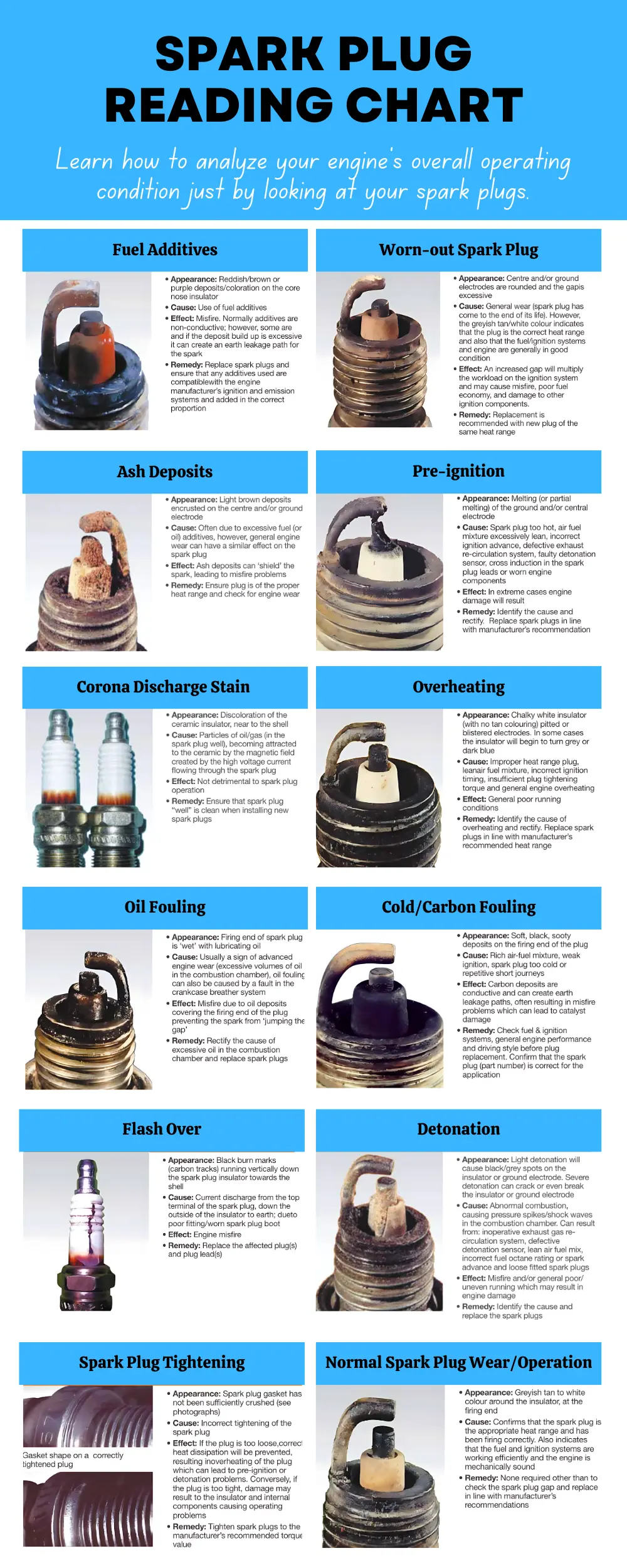
When checking how to read timing on a spark plug, avoid using one symptom as proof. Excessive ignition advance can increase cylinder pressure and heat, while excessive retard can move more combustion heat into the exhaust. The plug may show related effects, but other engine faults can create similar marks.
Detonation and pre-ignition are especially important. Both can damage an engine, and severe cases may occur before a plug gives you a clear visual warning. If an engine knocks under load, stop the test and diagnose the cause instead of relying on the plug alone.
- ✦ Possible excessive advance
Watch for signs of abnormal combustion, excessive heat, damaged electrodes, or other evidence that the engine may be running too aggressively.
- ✦ Possible excessive retard
Late ignition can reduce power and raise exhaust temperature. A plug alone cannot prove that timing is the cause.
- ✦ Detonation warning
Knock or ping under load can signal abnormal combustion. Fuel quality, mixture, temperature, compression, boost, and timing can all matter.
- ✦ Pre-ignition warning
Pre-ignition starts before the normal spark event and can create very high temperatures. It can cause severe engine damage and requires immediate attention.
Why Plug Color Alone Can Mislead You
Older plug-reading advice often focuses on color. That can help, but modern engines make the picture more complex. Fuel injection, oxygen sensors, electronic ignition, ethanol blends, catalytic converters, and modern fuel formulas can all affect what a plug looks like.
A plug that looks clean does not automatically mean the timing is correct. Likewise, a dark plug does not automatically mean the timing is too retarded. Always consider the complete engine system.
- ✦ Fuel matters
Different fuels can leave different deposits and can change the engine’s combustion behavior.
- ✦ Heat range matters
A plug that is too hot or too cold can change its appearance and may create misleading clues.
- ✦ Mixture matters
A rich or lean air-fuel mixture can affect plug temperature and deposits, making timing harder to isolate.
How to Read Timing on a Spark Plug Without Confusing Heat Range
Spark plug heat range is different from ignition timing. Heat range describes how quickly a plug transfers heat from its firing tip into the cylinder head. A hotter or colder plug can change the appearance of the firing end even when ignition timing stays the same.
This matters because a common mistake in how to read timing on a spark plug is blaming timing for every heat-related change. Before making a timing adjustment, confirm that the plug has the correct heat range and that the engine is operating as intended.

- ✦ Hot plug
A hotter heat range keeps more heat at the firing end. The exact range should match the engine and application.
- ✦ Cold plug
A colder plug transfers heat away from the firing end faster. Performance engines may use colder plugs, but the correct choice depends on the setup.
- ✦ Do not use heat range as timing
A plug’s heat range is a separate specification. Changing plugs can change what you see without changing ignition timing.
Signs That the Plug May Be Too Hot
An overheated plug may show an unusually clean insulator, damaged electrodes, or other heat-related changes. These signs can also occur with an incorrect plug, lean operation, cooling problems, or excessive combustion temperature.
If you see signs of overheating, do not assume that adding or removing timing will solve the issue. Check the plug specification, mixture, cooling system, fuel, and ignition system before continuing.
- ✦ Check the plug number
Use the engine or plug maker’s application data rather than choosing a heat range from color alone.
- ✦ Check engine temperature
Cooling problems can create high combustion temperatures that look like a tuning issue.
How to Read Timing on a Spark Plug on a Modern Fuel-Injected Engine
Modern American cars and trucks often use electronic ignition and engine control systems. The computer can change ignition timing based on engine speed, load, temperature, throttle position, knock feedback, and other inputs. That makes a single plug reading less useful for finding one fixed timing number.
For these engines, scan data and service information are often more useful than trying to infer timing from plug color. A scan tool may show commanded or reported ignition timing, while a timing light can help on systems designed to support that test.

- ✦ Read scan data
Where supported, use the correct scan data to see ignition timing and related engine parameters.
- ✦ Check for knock activity
Some engines can reduce timing when the control system detects knock. A changing timing value may be normal.
- ✦ Use service information
Factory procedures tell you whether timing can be checked with a timing light and whether the system needs a special procedure.
- ✦ Inspect plugs as supporting evidence
Plug condition can still reveal misfire, oil, fuel, overheating, and combustion issues that electronic data may not explain by itself.
Distributor Engines Versus Computer-Controlled Engines
Older distributor-based engines often give the tuner a direct way to set base timing. A timing light can show the crankshaft timing mark while the engine runs. The spark plug can then serve as a secondary check for combustion and heat behavior.
On many newer engines, the ECU controls timing. In that case, the correct timing value may change constantly. Learning how to read timing on a spark plug is still useful, but it should be part of a wider diagnostic process.
- ✦ Older engines
A timing light and crankshaft timing marks are often central to the timing check.
- ✦ Newer engines
Electronic controls and scan data often provide a better view of the actual timing strategy.
How to Confirm Spark Plug Timing With a Timing Light
If your goal is to know the actual ignition timing, use a timing light when the engine design and service procedure allow it. The light flashes when the selected cylinder fires and lets you compare that event with the timing marks on the crankshaft or harmonic balancer.
This is the proper way to confirm a timing value on many older gasoline engines. The exact procedure varies by engine, so follow the service manual. Some electronic ignition systems require a scan tool, special mode, or other method instead of a simple timing-light check.

- ✦ Find the timing marks
Locate the crankshaft pulley or balancer marks and the matching fixed pointer.
- ✦ Connect the timing light correctly
Follow the tool and vehicle instructions. Many lights use an inductive pickup on the number-one cylinder’s plug wire.
- ✦ Check the specified condition
The engine may need to be at a certain temperature or operating state for the reading to be valid.
- ✦ Compare the marks
The flashing light makes the timing mark appear stationary, allowing you to read the ignition event against the scale.
- ✦ Record the result
Write down the measured timing and engine conditions before changing the setting.
Why Timing Marks Beat Plug Guesswork
A timing mark gives you a direct measurement of crank position when the spark occurs. A spark plug gives you indirect evidence about the combustion that followed. These are different kinds of information.
That distinction is central to how to read timing on a spark plug. Use the plug to look for combustion clues and use the correct measuring tool to establish actual ignition timing.
- ✦ Direct measurement
A timing light or approved scan procedure can identify the ignition event in relation to crankshaft position.
- ✦ Indirect evidence
A spark plug shows the results of combustion and heat exposure rather than a direct timing value.
Common Spark Plug Conditions and What They Can Mean
A spark plug reading is most useful when you know what each visible condition can suggest. The key word is suggest. A plug appearance is rarely enough to identify one exact fault without other evidence.
Check the complete firing end. Look at the center electrode, ground strap, ceramic insulator, shell, and deposits. Then compare the result with the engine’s symptoms and measured data.

- ✦ Dry black soot
This can occur with a rich mixture, weak ignition, poor combustion, excessive idling, or a plug that runs too cold.
- ✦ Wet fuel
Fuel on the plug can point to flooding, an injector issue, repeated failed starts, or a cylinder that is not burning the mixture.
- ✦ Oil deposits
Oil on the firing end can be linked to oil entering the combustion chamber through worn rings, valve guides, seals, or other engine problems.
- ✦ Very clean or overheated tip
This can occur with high combustion temperature, a lean mixture, an unsuitable heat range, cooling problems, or other faults.
- ✦ Damaged electrode
Erosion, melting, or other damage can indicate severe heat or abnormal combustion and should not be ignored.
- ✦ Uneven cylinders
One plug that looks different from the others can point to a cylinder-specific fuel, ignition, injector, compression, or mechanical problem.
Do Not Diagnose Timing From One Plug Alone
If one cylinder has a different plug appearance, start by asking why that cylinder differs. A faulty injector, vacuum leak, ignition problem, compression issue, or oil leak can affect one plug without changing the basic timing for the entire engine.
This is a common lesson in how to read timing on a spark plug: patterns are more useful than isolated marks. Compare all cylinders and combine the plug reading with compression tests, scan data, fuel data, and ignition checks when needed.
- ✦ Compare all plugs
A set of plugs can show whether a condition affects the whole engine or only one cylinder.
- ✦ Check the ignition system
A weak coil, damaged wire, or poor connection can create a plug that looks abnormal.
- ✦ Check the fuel system
Injector flow or fuel delivery problems can alter plug deposits and temperature.
Mistakes to Avoid When Reading Spark Plug Timing
It is easy to overread a spark plug. Many online charts make plug reading look exact, but real engines are more complex. Use charts as visual guides, not as a substitute for engine-specific service data.
The biggest mistake is changing several settings at once. If you change timing, fuel mixture, boost, plug heat range, and fuel at the same time, the next plug reading will not tell you which change caused the result.
- ✦ Do not assume one color proves timing
Plug color is affected by many conditions and does not provide an exact timing measurement.
- ✦ Do not ignore fuel quality
Use the fuel grade and type required by the engine and tuning setup.
- ✦ Do not keep adding timing for power
More advance is not automatically better. Abnormal combustion can cause serious damage.
- ✦ Do not use an unknown plug
Confirm the plug part number, gap, and heat range before drawing conclusions.
- ✦ Do not test only at idle
Idle combustion conditions can differ greatly from the high-load conditions where timing problems often appear.
- ✦ Do not ignore engine data
Timing readings, air-fuel data, knock information, and temperature data can make a plug reading far more useful.