
To warm up diesel glow plugs, switch the ignition to the ON position without cranking the engine and wait for the glow plug or “Wait to Start” light to go out. Then start the engine normally. On many newer push-button diesels, the engine computer handles glow-plug preheating automatically, so you simply follow the normal starting procedure in the owner’s manual.
You normally do not need to manually heat glow plugs for a fixed number of seconds. Modern diesel engines control preheating according to conditions such as coolant temperature, intake-air temperature, battery voltage, and sometimes atmospheric pressure. A warm engine may require almost no preheating, while a diesel sitting overnight in freezing weather may need a longer glow period.
Older diesel engines can require more noticeable preheating. You may need to turn the key to the glow or ON position, watch the glow-plug indicator, and wait several seconds before cranking. Some very old equipment uses a manually controlled preheat switch or a specific starting procedure.
Once the engine starts, modern glow plugs may continue heating automatically. This post-glow period improves cold combustion, reduces white smoke, stabilizes idle, and lowers combustion noise. You do not need to keep the key in a special position to make this happen.
In this guide, I’ll explain how to warm up diesel glow plugs, how long you should wait, how key-start and push-button diesels differ, what to do in freezing weather, and which common cold-start practices can damage a diesel engine.
How to Warm Up Diesel Glow Plugs: Quick Steps
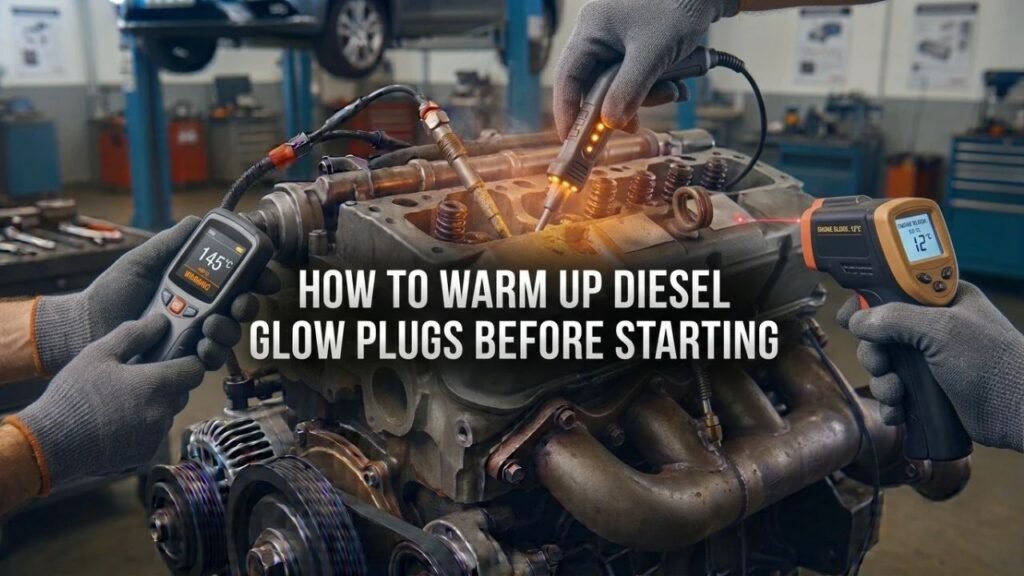
For a typical key-start diesel, the basic process is simple.
Turn off unnecessary electrical accessories if the battery is marginal or temperatures are extremely low.
Insert the key and turn it to the ON or RUN position without moving it all the way to START.
Look for the glow-plug indicator on the instrument panel. It often resembles a small yellow or amber coil.
Allow the glow-plug system to preheat.
When the glow-plug or “Wait to Start” indicator goes out, turn the key to START and crank the engine normally.
Release the key as soon as the engine starts.
Allow the engine to stabilize, then drive gently until normal operating temperature is reached.
Your exact vehicle may operate differently, so its owner’s manual takes priority over a generic procedure.
Many newer push-button diesels handle the sequence automatically.
When you press the brake or clutch and push START, the engine control system can activate the glow plugs and delay cranking for the required amount of time.
On some vehicles, you may see a brief preheating message or glow-plug symbol.
You generally should not try to recreate an old-fashioned manual glow cycle on a modern automatic system unless the manufacturer’s instructions specifically tell you to.
Key Takeaways:
- On most key-start diesels, switch the ignition on and wait for the preheat indicator to go out before cranking.
- Modern push-button vehicles often control the entire glow cycle automatically.
- Preheating time changes with engine and ambient temperature, so there is no universal number of seconds.
What Does Warming Up Glow Plugs Actually Mean?
A glow plug is an electrical heating element installed in or near the diesel combustion chamber.
When the engine control system supplies electrical current, resistance inside the plug generates heat.
Modern glow plugs can become extremely hot very quickly.
The purpose is not to warm the entire engine.
Instead, the plug creates a very hot area inside each cylinder so the first injections of diesel fuel can ignite reliably.
Diesel Engines Use Compression Ignition
A diesel does not normally use a spark plug.
Air enters the cylinder and is compressed strongly by the piston.
Compressing air raises its temperature.
Near the top of the compression stroke, the injector sprays diesel fuel into that hot air.
The fuel ignites because of heat.
When the engine is warm, compression can usually create enough heat without much additional assistance.
When everything is cold, the surrounding metal absorbs some of that heat.
That is where glow plugs become useful.
How Long Should You Warm Up Diesel Glow Plugs?
There is no universal preheating time.
Depending on the engine and conditions, it may take less than a second, several seconds, or longer on an older diesel in severe cold.
Modern fast-heating systems can reach starting temperature remarkably quickly.
Older glow-plug systems may require a substantially longer wait.
Let the Vehicle Decide When Possible
If your vehicle has a glow-plug warning lamp, the simplest procedure is to follow it.
Turn the ignition on.
Wait for the indicator to go out.
Then crank the engine.
Do not ignore the indicator and immediately crank a cold older diesel unless its owner’s manual says immediate starting is appropriate.
Temperature Changes the Preheat Time
A diesel started when the engine is already warm may need little or no visible glow time.
After sitting overnight at 70°F, the wait may be short.
At 20°F, it may remain active longer.
At extremely low temperatures, the glow system may use a more aggressive heating strategy.
The engine computer can make these decisions automatically on modern vehicles.
What Does the Glow Plug Light Mean?
The glow-plug indicator usually looks like a small coiled wire or spring.
When you turn the ignition on, the light may illuminate while the preheating system operates.
Once the vehicle determines that starting conditions are suitable, the light goes out.
You can then crank the engine on vehicles that use this driver-controlled sequence.
The Light May Go Out Before the Plugs Turn Off
This surprises many diesel owners.
The dashboard indicator does not necessarily show the entire period during which the glow plugs receive power.
After the engine starts, the control system may continue operating the plugs automatically.
This is called post-glow.
Therefore, a glow-plug light going out does not necessarily mean the plugs instantly become cold.
What if the Glow Plug Light Flashes?
A flashing glow-plug light on some vehicles can indicate a stored engine-management fault rather than normal preheating.
It does not automatically mean every glow plug is bad.
If the light flashes while the vehicle is running, scan the diesel for diagnostic trouble codes and use vehicle-specific service information.
How to Warm Up Glow Plugs on a Key-Start Diesel
A traditional ignition key makes the glow sequence easy to understand.
Step 1: Insert the Key
Make sure the transmission is in Park or Neutral as appropriate and the parking brake is set.
On a manual-transmission vehicle, follow the manufacturer’s clutch procedure.
Step 2: Turn the Key to ON
Turn the key to the RUN or ON position.
Do not crank yet.
The instrument panel lights will illuminate, and the engine-management system will begin its startup checks.
If preheating is required, the glow plugs receive power.
Step 3: Watch the Glow Plug Indicator
Look for the coil-shaped light or a “Wait to Start” message.
During warm weather, it may disappear almost immediately.
During cold weather, it can remain illuminated longer.
Step 4: Wait for the Light to Go Out
Once the indicator goes out, the engine should be ready for cranking according to the normal procedure for that vehicle.
Move the key to START.
Step 5: Release the Key When the Engine Starts
Do not continue operating the starter after the engine is running.
The glow-plug controller may continue heating the plugs automatically even though your involvement in the process is finished.
Push-button diesels generally require less driver involvement.
Put your foot on the brake pedal—or clutch where applicable—and press the start button according to the vehicle’s normal procedure.
The vehicle may automatically activate the glow plugs before allowing the starter to crank.
Some systems display a preheating message during that delay.
Do Not Assume Instant Cranking Means the Glow Plugs Were Skipped
Modern glow plugs heat quickly.
The computer may also begin preheating as soon as the vehicle is unlocked, a door is opened, or another condition signals that a start is likely, depending on vehicle design.
That means the driver may never experience the traditional several-second “wait for the plugs” routine.
Follow the normal factory start sequence rather than trying to override an automatic system.
Should You Cycle Glow Plugs Twice Before Starting?
Usually, you should not need to.
A healthy modern diesel glow system is designed to determine how much heating the engine requires.
Cycling the ignition repeatedly simply to get more glow time is normally unnecessary.
Why Older Diesel Owners Sometimes Do It
On an older diesel, particularly one with a marginal glow system, drivers sometimes switch the ignition on, let the glow cycle finish, turn it off, and then repeat the cycle.
The additional heating can sometimes make a reluctant engine start more easily.
But needing this regularly can indicate a problem.
Possible causes include weak glow plugs, a bad controller or relay, poor compression, a weak battery, slow starter speed, or a fuel-system fault.
Check the Owner’s Manual
Some older engines have manufacturer-specific cold-start procedures.
If the manual specifically allows repeated preheating in extreme cold, follow it.
Otherwise, do not make repeated cycling your permanent solution to a hard-start problem.
How to Warm Up Glow Plugs in Very Cold Weather
Cold weather creates the conditions in which glow plugs matter most.
Start with a healthy battery.
Battery output decreases in low temperatures, while cold engine oil creates additional resistance and makes the starter work harder.
The result can be slower cranking at exactly the time the diesel needs strong compression heat.
Give the Glow System Time to Complete Its Cycle
Do not rush the preheating indicator on a manually controlled key-start diesel.
If the glow light remains on longer than usual during freezing weather, that can be completely normal.
The control system recognizes that additional heat is required.
Use the Correct Winter Diesel Fuel
Extremely cold weather can create fuel-flow problems if diesel fuel is not appropriate for the temperature.
Glow plugs cannot compensate for fuel that has gelled or cannot reach the injectors properly.
Use fuel appropriate for your climate and follow the manufacturer’s cold-weather recommendations.
Use the Block Heater if Equipped
A block heater can make a major difference during severe cold.
It warms the engine before starting, reducing the amount of heat lost during compression.
Depending on design, it may warm the coolant, block, or another portion of the engine.
A warmer engine requires less assistance from the glow plugs and usually starts more easily.
Are Glow Plugs the Same as a Block Heater?
No.
Glow plugs heat small areas associated with the combustion chambers.
A block heater warms a much larger portion of the engine before you start it.
A diesel can have both.
In extremely cold climates, using the block heater makes the entire starting process easier even when all glow plugs are working correctly.
A Block Heater Does Not Replace Failed Glow Plugs
Preheating the engine externally may mask symptoms from a weak glow system.
However, it does not repair a failed glow plug or controller.
If diagnostic testing confirms a glow-system problem, fix it.
What Happens After the Diesel Starts?
Modern glow-plug operation often continues after startup.
This post-glow period is controlled automatically.
You normally do not have to do anything.
Why Glow Plugs Stay Hot
During the first moments of operation, the cylinder head and combustion chamber have not yet reached normal temperature.
Without enough heat, diesel fuel may burn less completely.
Continued glow-plug heating can make combustion more stable.
Benefits can include smoother idle, less white or blue smoke, reduced combustion noise, and lower cold-start emissions.
How Long Does Post-Glow Last?
It varies enormously.
Some systems may use the plugs only briefly after starting.
Others can operate them for several minutes under selected conditions.
Modern control systems may also vary current rather than simply switching the plugs fully on or fully off.
You do not need to manually time this process.
Should You Let a Diesel Idle to Warm Up After Using the Glow Plugs?
After starting, give the engine enough time for oil pressure and idle to stabilize, particularly in cold weather.
However, prolonged stationary idling is generally not the fastest or most efficient way to bring a modern diesel to operating temperature.
After a short stabilization period, gentle driving normally warms the engine and drivetrain more effectively.
Avoid hard acceleration, high rpm, heavy towing, or high boost until the engine has had time to warm.
Engine Coolant Temperature Is Not the Whole Story
Even when the dashboard temperature gauge begins rising, engine oil, transmission fluid, and other components may still be cold.
Drive moderately during the early part of the trip.
What if the Diesel Does Not Start After the Glow Light Goes Out?
Do not immediately assume you need more glow time.
A diesel needs several things to start successfully:
Adequate glow assistance when cold.
Strong battery voltage.
Sufficient starter speed.
Good cylinder compression.
Proper fuel pressure.
Correct injector operation.
Suitable fuel.
Accurate engine timing and sensor information.
If one of these is missing, repeatedly cycling the glow plugs may not solve the problem.
Avoid Endless Cranking
Starter motors generate substantial heat.
If the engine does not start, follow the vehicle manufacturer’s maximum cranking time and rest period.
Do not crank continuously until the battery becomes flat or the starter overheats.
Why Does My Diesel Start Better After a Second Glow Cycle?
A second cycle adds more heat.
If that consistently transforms a difficult cold start into an easy one, it can indicate that the first cycle is not producing enough combustion-chamber temperature.
Possible reasons include aging glow plugs or a control-system problem.
But there are other possibilities.
Low compression can make a cylinder require more supplemental heat.
A weak battery can reduce starter speed.
Injector problems can make cold combustion more difficult.
Treat repeated cycling as a diagnostic clue rather than proof that the glow plugs themselves are bad.
Can You Manually Power Glow Plugs to Warm Them Up?
Do not apply battery power directly unless the exact glow-plug system is specifically designed for that testing or operation procedure.
This is particularly important on modern diesels.
Not every glow plug is a simple 12-volt heater.
Modern fast-heating metal and ceramic plugs may operate at controlled voltages significantly below normal battery voltage.
The glow-plug module can regulate current very precisely.
Applying full battery voltage to the wrong type of plug can overheat or destroy it quickly.
Let the Controller Do Its Job
On a stock modern vehicle, the proper way to heat the plugs is through the factory glow-plug controller.
If the controller is not operating, diagnose the circuit rather than bypassing it with improvised wiring.
Can You Warm Glow Plugs With a Battery Charger?
A battery charger should be used for maintaining or charging the vehicle battery according to its instructions—not for directly powering individual glow plugs.
A fully charged battery certainly helps the glow system.
Glow plugs draw substantial current, and the starter requires even more electrical power.
So improving battery condition can make cold starting much more reliable.
But connect chargers to the vehicle as specified rather than improvising a separate glow-plug heater circuit.
Should You Press the Accelerator While Warming Glow Plugs?
Normally, no.
Modern electronically controlled diesels manage fueling during startup automatically.
Pressing the accelerator generally does not make the glow plugs heat faster.
Some older mechanical diesels may have particular throttle positions specified for cold starting, so follow the owner’s manual for older equipment.
For a modern passenger vehicle, leave the accelerator alone unless the manufacturer’s instructions state otherwise.
Can You Use Starting Fluid While the Glow Plugs Are Hot?
This deserves particular caution.
Do not use ether or starting fluid in an engine with an active glow-plug or intake-heater system unless the engine manufacturer specifically approves the procedure.
Starting fluid can ignite prematurely when exposed to a hot glow plug or intake heating element.
That can cause violent combustion, engine damage, or personal injury.
Many diesel manufacturers specifically warn against ether where electrical starting aids are fitted.
Fix the Starting Problem Instead
If your diesel needs starting fluid whenever temperatures fall, something is wrong.
Test the glow system, battery, starter, fuel supply, injectors, and compression as appropriate.
Starting fluid should not become a substitute for a functioning cold-start system.
Key Takeaways:
- Never apply direct battery voltage to an unknown modern glow plug.
- Do not use ether or starting fluid around active glow plugs or intake heaters unless the manufacturer explicitly permits it.
- Repeatedly needing extra preheating indicates a problem worth diagnosing.
How Do You Know if the Glow Plugs Are Actually Heating?
The dashboard light alone does not guarantee every glow plug is functioning properly.
The indicator tells you what the control system is doing or requesting, depending on the vehicle.
One individual plug could fail while the others continue operating.
Cold-Start Symptoms
Common clues of weak glow performance include long cranking when cold, rough running immediately after startup, white or gray smoke, and symptoms that become much worse as outside temperature falls.
Warm starts may remain completely normal.
Diagnostic Trouble Codes
Modern diesel control systems often monitor individual glow-plug circuits.
A scan tool may reveal codes identifying a particular cylinder or the glow-plug control system.
A circuit code does not necessarily prove the heating element itself is defective.
Wiring, connectors, the controller, fuse, or power supply can also cause problems.
Electrical Testing
Glow plugs can sometimes be checked through resistance or current measurements.
The appropriate method depends on plug design.
Very low resistance makes measurement technique important, and modern electronically controlled plugs require engine-specific procedures.
Why Does My Glow Plug Light Stay On a Long Time?
If outside temperature is extremely low, a longer preheat time can be normal.
The control system may simply be providing more heat.
But if the behavior suddenly changes under similar weather conditions, investigate it.
Potential problems include temperature-sensor faults, glow-plug control issues, electrical problems, or diagnostic faults.
What if It Never Goes Out?
Do not automatically leave the key on indefinitely.
Most systems have safeguards that limit glow-plug operation.
If the preheating indicator behaves abnormally, consult the vehicle’s manual and scan the engine for faults.
Why Does the Glow Plug Light Barely Come On in Summer?
The engine may not require significant preheating.
When coolant and intake-air temperatures are already high, compression can usually produce sufficient ignition temperature quickly.
Modern engine management can therefore shorten the visible preheat phase dramatically.
A very brief light in warm weather does not necessarily mean the glow plugs are not working.
Can You Overheat Glow Plugs by Leaving the Key On?
Older systems deserve caution because their control strategies vary.
Modern electronically controlled systems generally use timers, temperature control, current regulation, and safety shutoffs to prevent uncontrolled heating.
However, intentionally leaving the ignition on for a long time is still unnecessary and can drain the battery through other electrical loads.
Use the vehicle’s normal starting procedure rather than trying to manually extend preheating.
Do All Diesel Engines Need to Be Preheated?
No.
Some diesels do not use individual glow plugs at all.
They may use an intake grid heater or other cold-start system.
Modern engines may also require almost no noticeable preheating in warm conditions.
Older indirect-injection engines often depend much more heavily on glow plugs and can need a longer visible wait before cranking.
This is why advice that works for a 1980s diesel tractor may not apply to a modern common-rail pickup.
How to Warm Up Glow Plugs on an Older Diesel
Start by checking the owner’s or service manual because older systems vary considerably.
If the engine has a dedicated glow position on the ignition switch, move the switch to that position for the specified duration.
Some systems use a dashboard indicator that changes color or brightness as the plugs heat.
Others have a separate push button.
Do not simply hold the glow switch indefinitely.
Older plugs can be damaged by excessive heating if the system does not control current automatically.
Manual Systems Need More Driver Attention
Unlike modern computer-controlled diesels, a manual glow system may depend on the driver to stop heating at the proper time.
That makes the specified preheating duration particularly important.
If you do not know the correct procedure, obtain the service information before experimenting.
Can Bad Glow Plugs Take Longer to Warm Up?
Yes.
An aging glow plug can heat more slowly or fail to reach its intended temperature.
One completely failed plug may not heat at all while the others operate normally.
The engine can then start on the working cylinders and run roughly until the cold cylinder develops enough compression and combustion heat to begin firing correctly.
If cold-start performance has gradually worsened despite no major change in weather, testing the glow system is reasonable.
Can a Bad Glow Plug Relay Prevent Preheating?
Yes.
Older diesel systems commonly use a heavy-duty relay to supply the high electrical current required by the glow plugs.
If that relay fails, none or only some of the plugs may receive proper power.
Modern vehicles often use an electronic glow-plug control module instead.
A controller fault can produce similar symptoms.
Listen Carefully, but Don’t Diagnose by Clicking Alone
Some older glow relays produce an audible click.
Hearing it does not prove that full current is reaching the plugs.
Likewise, not hearing a click on a modern electronically controlled system does not prove anything is wrong.
Electrical testing provides much better evidence.
How to Improve Diesel Starting in Winter
Start with the fundamentals.
Keep the battery fully charged and in good condition.
Use the correct engine oil viscosity for your climate and manufacturer specification.
Use winter-appropriate diesel fuel.
Repair known glow-plug faults.
Use the block heater when recommended.
Allow the factory preheat cycle to finish.
Then crank normally rather than repeatedly starting and stopping the starter.
Once the engine starts, let it stabilize and drive gently while it warms.
These basic steps usually accomplish more than tricks such as repeated glow cycling or using starting fluid.
FAQs about How to Warm Up Diesel Glow Plugs
How do you warm up diesel glow plugs?
Turn the ignition to ON without cranking and wait for the glow-plug or “Wait to Start” light to go out. Then start the engine. Modern push-button vehicles often handle the sequence automatically.
How long should you let glow plugs warm up?
It depends on engine and ambient temperature. Modern plugs may require only a few seconds or less, while older systems can need longer. Follow the dashboard indicator and owner’s manual.
Should you wait for the glow plug light to go out?
On vehicles that use the glow-plug indicator as a “wait to start” signal, yes.
When the light goes out, crank the engine according to the normal starting procedure.
How many times should you cycle glow plugs?
A healthy modern diesel normally requires only the automatically controlled cycle.
Repeated cycling should not be necessary unless the vehicle manufacturer specifically recommends it.
Does cycling glow plugs twice help?
It can add heat on some older systems, but regularly needing two cycles may indicate weak glow plugs, low compression, battery problems, or another starting fault.
Do you have to warm glow plugs in summer?
The engine-management system may determine that little or no noticeable preheating is necessary in warm weather.
Let the vehicle control the process.
How long should glow plugs heat in winter?
There is no universal duration.
Cold temperatures typically increase preheat time. Wait for the vehicle’s preheat indicator rather than using a generic timer.
Do glow plugs stay on after the engine starts?
Many modern systems use post-glow for a controlled period after startup to improve combustion, idle stability, emissions, and smoke.
Should I leave the key on longer after the glow light goes out?
Normally no.
The glow controller determines the correct heating strategy. Start the engine when the vehicle indicates that it is ready.
Can you manually turn glow plugs on?
Older equipment may have a manual glow switch.
Modern automotive systems should normally be allowed to control the plugs electronically.
Can I connect 12 volts directly to a glow plug?
Not unless the exact glow plug is specified for direct 12-volt operation and the approved test procedure calls for it.
Many modern plugs can be damaged by direct battery voltage.
Do glow plugs get hot instantly?
Modern fast-heating plugs can reach useful operating temperatures very quickly, often within seconds.
Older designs may require longer.
Can bad glow plugs cause hard starting?
Yes.
The problem usually becomes most noticeable in cold weather.
Can weak glow plugs cause white smoke?
Yes.
A cylinder that is too cold can fail to burn injected diesel completely, producing white or gray startup smoke.
Can a weak battery make glow plugs work poorly?
Low battery voltage can affect the glow system and also slow the starter.
Both problems make cold diesel starting more difficult.
Does a block heater warm the glow plugs?
Not directly.
It warms the engine, reducing how much additional glow-plug heating is needed for cold starting.
Should you rev a diesel immediately after starting?
Avoid unnecessary high rpm on a cold engine.
Allow the idle to stabilize and drive gently while engine fluids and components warm.
Can you use starting fluid after warming glow plugs?
Do not use ether or starting fluid with active glow plugs or intake heaters unless the engine manufacturer specifically approves it. Premature ignition can cause serious damage.
Why won’t my diesel start even after the glow plugs warm up?
The problem may involve the battery, starter, compression, fuel pressure, injectors, fuel quality, sensors, glow controller, or other engine systems.
Why does my diesel need two glow cycles when cold?
The extra cycle adds heat, but regularly needing it can indicate a marginal glow system or another cold-start problem that deserves diagnosis.
Conclusion
Learning how to warm up diesel glow plugs is usually straightforward: switch the ignition on, allow the factory preheating cycle to operate, wait for the glow-plug or “Wait to Start” indicator to go out when your vehicle uses one, and then crank the engine normally.
You do not need to guess a universal heating time.
Modern diesel engine computers determine glow duration based on temperatures and other operating conditions. A warm engine may need almost no preheating, while a diesel sitting in subfreezing weather may require substantially more.
Push-button diesels often automate the process completely. Older mechanical diesels may require the driver to hold a dedicated glow position or switch for a specified period.
After startup, do not assume the glow plugs immediately turn off. Many modern systems automatically use post-glow to stabilize cold combustion, reduce white smoke and noise, and improve emissions performance.
In very cold weather, the best approach is to combine a healthy glow system with a strong battery, correct winter fuel, suitable engine oil, and a block heater when recommended.
Avoid repeatedly cycling the plugs as a permanent workaround, directly powering unknown modern glow plugs with a battery, or using ether around active glow plugs or intake heaters.
The safest rule is simple: let the diesel’s factory glow-plug system determine how much preheating it needs, start when the vehicle indicates it is ready, and diagnose the system if normal preheating is no longer enough for reliable cold starts.