
If you are wondering why do some engines have 2 spark plugs per cylinder, the main reason is to ignite the air-fuel mixture from two locations so combustion can spread across the cylinder faster and more evenly. Dual-spark ignition can shorten flame travel, improve combustion efficiency, reduce the tendency for engine knock, support leaner mixtures or higher compression in some designs, and help manufacturers meet performance, fuel-economy, and emissions goals.
Two spark plugs do not simply create “twice as much spark” or automatically double engine power. Instead, the engine designer uses the second ignition point to control how the flame develops inside the combustion chamber. In a large or unusually shaped chamber, one flame front may need considerable time to travel from one side to the other. Starting two flame fronts can burn the mixture in less time.
How the plugs operate also varies. Some engines fire both plugs nearly simultaneously. Others deliberately fire them at slightly different times depending on engine speed and load. Honda’s Dual and Sequential Ignition engines, for example, used two plugs placed at different areas of the combustion chamber and varied their firing sequence to accelerate combustion.
Well-known automotive examples of twin-plug technology include certain Chrysler/Dodge/Ram HEMI V8s, Alfa Romeo Twin Spark engines, and Honda i-DSI engines. Dual spark plugs have also been used in aircraft engines, although redundancy is a particularly important reason in aviation.
In this guide, I’ll explain why some engines have 2 spark plugs per cylinder, how two flame fronts change combustion, whether both plugs fire together, how twin plugs affect power and fuel economy, and what happens if one of the two plugs fails.
Why Do Some Engines Have 2 Spark Plugs Per Cylinder?
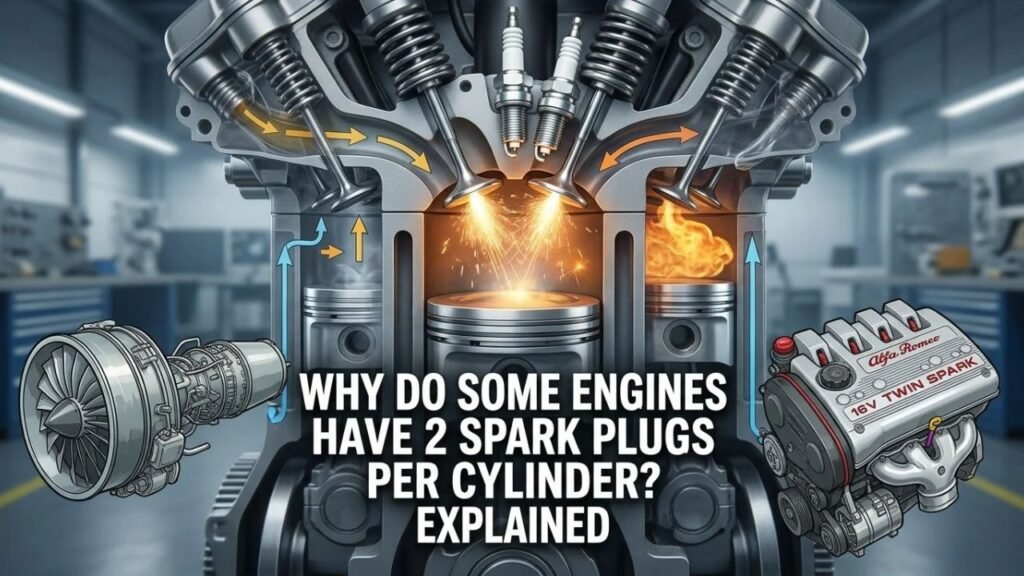
An internal-combustion engine has only a short period in which to burn the compressed air-fuel mixture efficiently.
Near the end of the compression stroke, the ignition system fires the spark plug. The spark creates a tiny burning region around the electrodes. That flame then expands outward through the rest of the mixture.
With one spark plug, combustion begins at one location.
With two properly positioned plugs, combustion can begin at two locations.
Instead of one flame front having to travel across most of the cylinder, two flame fronts can move toward each other.
That can significantly reduce the amount of time required for the charge to burn.
The design is particularly useful when combustion-chamber shape, cylinder bore, compression ratio, mixture strategy, or other engineering objectives make rapid combustion desirable.
The main potential benefits are:
- Faster and more complete combustion
- Improved resistance to knock and greater control of ignition timing
- Potential improvements in efficiency, emissions, and low-speed performance
Not every engine needs these advantages badly enough to justify the additional plugs and ignition hardware, which is why the overwhelming majority of automotive engines still use one spark plug per cylinder.
How Two Spark Plugs Burn the Fuel Faster
To understand twin-spark ignition, imagine lighting a long piece of paper from one end.
The flame must travel the entire length.
Now imagine lighting it simultaneously from both ends.
The two flame fronts travel toward the middle, reducing the distance each flame needs to cover.
An engine combustion chamber operates under far more complex conditions, but the same general concept applies.
One Spark Plug Creates One Primary Flame Front
A conventional gasoline engine typically positions the spark plug where engineers believe it can initiate efficient combustion.
Once the plug fires, the flame kernel develops around the electrode and expands through the compressed air-fuel mixture.
The mixture does not explode throughout the cylinder instantaneously.
Combustion takes measurable time.
Because the crankshaft continues turning during that period, the spark normally occurs before the piston reaches top dead center.
Engine designers carefully calibrate this ignition advance so peak cylinder pressure occurs at a useful point after top dead center.
Two Plugs Shorten Flame-Travel Distance
A twin-plug engine can start combustion at two different places.
Each flame therefore has less distance to travel before most of the charge has burned.
The burn can finish more quickly and, depending on chamber design, more uniformly.
Faster combustion can allow the engine to achieve the desired cylinder-pressure development with less ignition advance.
This becomes especially valuable in combustion chambers where the distance across the bore is relatively large.
Key Takeaways:
- Two plugs create two ignition points rather than one.
- Two flame fronts can burn the mixture more quickly than a single flame traveling across the entire chamber.
- The benefit comes from controlling combustion, not simply producing twice the electrical spark energy.
Dual Spark Plugs Can Help Reduce Engine Knock
One important advantage of faster combustion is improved resistance to detonation, commonly called spark knock or pinging.
Normal combustion starts at the spark plug and progresses across the chamber in a controlled flame front.
However, the portion of the mixture that has not yet burned—called the end gas—is being compressed and heated by the expanding combustion gases.
If that unburned mixture becomes too hot and pressurized, it can auto-ignite instead of waiting for the normal flame front to reach it.
The resulting pressure waves create detonation.
Faster Combustion Reduces the Time Available for Auto-Ignition
When two plugs shorten combustion duration, the remaining unburned mixture spends less time exposed to extreme temperature and pressure.
That can reduce the engine’s tendency to knock.
Manufacturers may use this advantage to support other design goals, such as higher compression ratios or efficient operation under demanding conditions.
Honda, for example, used twin sequential ignition in certain i-DSI engines as part of an overall combustion system designed for high efficiency and good resistance to knock.
It Doesn’t Make an Engine Knock-Proof
Two plugs do not eliminate detonation under every circumstance.
An engine can still knock because of:
Low-octane fuel, excessive engine temperature, excessive ignition advance, lean operating conditions, heavy deposits, excessive boost, or other combustion problems.
Twin ignition simply gives engineers another way to control combustion characteristics.
Why Large Combustion Chambers Can Benefit From Two Plugs
Combustion-chamber dimensions strongly influence flame travel.
Consider an engine with a relatively large cylinder bore.
If a single plug is located toward one side or cannot be placed perfectly in the center because valves occupy the ideal location, the flame may have to travel a relatively long distance before combustion is complete.
Adding a second plug can shorten that effective travel distance.
Spark Plug Location Is a Packaging Problem
A cylinder head has limited space.
Engineers need to fit:
Intake valves, exhaust valves, fuel injectors in direct-injection engines, coolant passages, camshafts or rocker components, and the spark plug itself.
The theoretically perfect spark-plug location may not be physically available.
A second plug offers another way to create desirable flame propagation even when valve placement prevents one plug from occupying the exact center of the chamber.
This is one reason cylinder-head architecture matters when deciding whether twin ignition is worthwhile.
Can Two Spark Plugs Improve Fuel Economy?
They can as part of the complete engine design.
The key phrase is as part of the design.
Simply drilling another spark plug hole into an ordinary engine would not automatically improve gas mileage.
Engineers need to calibrate compression ratio, ignition timing, mixture preparation, combustion-chamber geometry, and engine management around dual ignition.
Faster Combustion Can Improve Efficiency
When combustion occurs rapidly and predictably, engineers can place the pressure rise at a favorable point in the engine cycle.
More of the fuel’s energy can then contribute to pushing the piston downward instead of being lost to undesirable combustion behavior or heat transfer.
Certain dual-plug engines were developed specifically with fuel economy as a major objective.
Honda’s i-DSI system is a good example. Its two plugs were positioned diagonally in the combustion chamber, and the engine computer changed ignition timing according to RPM and load. The rapid combustion strategy supported efficient operation and, in some versions, very lean mixtures.
Twin Spark Does Not Guarantee Better MPG
A large performance V8 can use two plugs per cylinder and still consume considerably more fuel than a small single-plug four-cylinder engine.
Fuel economy depends on the entire engine and vehicle.
Dual ignition is simply one engineering tool that can help optimize combustion.
Can Two Spark Plugs Reduce Emissions?
Potentially, yes.
More rapid and complete combustion can reduce the amount of partially burned mixture leaving the cylinder.
Manufacturers have used twin-plug systems as one part of broader emissions-control strategies.
Better combustion stability can also allow the engine management system to operate efficiently across a wider range of conditions.
However, the exhaust system, catalytic converters, fuel injection, oxygen sensors, combustion temperature, valve timing, and numerous other factors ultimately determine emissions.
Two plugs alone cannot make an otherwise poorly designed engine clean.
Key Takeaways:
- Faster twin-plug combustion can reduce the time available for knock to develop.
- Dual ignition can support efficient or lean combustion strategies in engines specifically designed around it.
- Fuel economy and emissions improvements come from the overall engine design, not from simply doubling the spark-plug count.
Do Both Spark Plugs Fire at the Same Time?
Sometimes, but not always.
Dual-plug systems can be designed in several ways.
Some engines fire both plugs at approximately the same point in the combustion cycle.
This creates two flame fronts at almost the same time.
Other engines use staged or sequential ignition.
One plug fires first, followed by the second after a short programmed delay.
Honda i-DSI Is a Good Example
Honda’s intelligent Dual and Sequential Ignition system used two plugs per cylinder located near different sides of the combustion chamber.
The engine-management system could adjust their firing sequence according to RPM and engine load.
One plug could initiate combustion, followed shortly by the second plug to accelerate flame propagation.
Under other operating conditions, they could fire differently.
This gave engineers another variable for controlling the speed and character of combustion.
Not Every Twin-Plug Engine Uses the Same Strategy
Never assume that because two engines have 16 plugs, their ignition systems operate identically.
The number of coils, plug placement, timing strategy, electrical wiring, and control system can differ substantially.
Follow model-specific service information when diagnosing a twin-plug engine.
Why Do HEMI Engines Have 2 Spark Plugs Per Cylinder?
Modern HEMI V8s are among the best-known American examples of dual-plug engines.
Certain 5.7L, 6.1L, 6.2L, and 6.4L HEMI applications use two spark plugs for each cylinder.
That means an eight-cylinder engine may have 16 spark plugs.
The combustion-chamber architecture and large cylinder bore make combustion control important.
Using two ignition points helps the engineers achieve reliable, rapid combustion across the chamber while meeting performance, efficiency, and emissions objectives.
The second plug is therefore not merely a backup that sits unused during normal operation.
It is part of how the combustion system was engineered to function.
Why a HEMI Tune-Up Can Surprise Owners
Someone accustomed to ordinary V8 engines may buy eight spark plugs and then discover that the engine requires sixteen.
That doubles the plug count but does not necessarily double the total service difficulty because plug accessibility varies by engine and vehicle.
Always look up the exact model year and engine before purchasing plugs.
HEMI spark plug designs and recommended service intervals have also changed through different engine generations.
Why Did Alfa Romeo Use Twin Spark Engines?
Alfa Romeo is so closely associated with dual ignition that it used Twin Spark as an engine name.
Alfa used two spark plugs per cylinder in several generations of engines, including performance and production applications.
The combustion concept allowed two flame fronts to spread through the mixture more rapidly.
On later Twin Spark engines, one plug could be positioned more centrally while another occupied a secondary position in the combustion chamber.
Alfa promoted the system as a way to improve combustion, performance, fuel consumption, and emissions.
Twin ignition also has deep roots in Alfa’s history, including racing applications long before modern electronic engine management existed.
Why Did Honda Use Two Spark Plugs Per Cylinder?
Honda’s i-DSI system approached twin ignition somewhat differently.
DSI stands for Dual and Sequential Ignition.
Instead of simply firing two identical sparks together, Honda used electronic control to vary the ignition timing of the two plugs depending on engine conditions.
The goal was rapid combustion and excellent fuel efficiency.
Honda used this technology in several small engines and in applications such as certain Civic Hybrid models.
The system demonstrates one of the most important points about dual-plug engines: the second spark plug is not always there just to create another simultaneous spark.
It can be part of a sophisticated combustion-control strategy.
Are Two Spark Plugs Used for Redundancy?
In ordinary automotive engines, redundancy is usually not the primary reason.
Both plugs are generally considered part of the normal combustion design.
The engine may still burn the mixture if one plug stops firing, but combustion may no longer occur the way the engineers intended.
Depending on the system and operating condition, you could experience reduced performance, roughness, increased emissions, worse fuel economy, or diagnostic trouble codes.
Aircraft Engines Are Different
Aircraft piston engines commonly use two spark plugs per cylinder for two major reasons:
Improved combustion and ignition-system redundancy.
Many traditional aircraft engines use two independent magneto ignition systems.
Each magneto can operate a separate spark plug in every cylinder.
If one ignition system fails, the other can continue operating the engine.
That redundancy has obvious safety value in aviation.
Automotive twin-plug systems generally should not be thought of as having one “main” plug and one emergency backup plug.
Does Having Two Spark Plugs Double Horsepower?
No.
This is one of the biggest misconceptions about twin ignition.
A spark plug contributes almost no meaningful mechanical power to the crankshaft.
Its job is to initiate combustion.
Once a reliable spark ignites the mixture, the chemical energy in the fuel produces the cylinder pressure.
Two ignition points can allow the engine to burn that mixture in a more useful way, which may help engineers develop more power from a particular engine design.
But adding a second plug to a conventional engine does not suddenly double the fuel’s energy.
An engine producing 200 horsepower with one plug per cylinder will not make 400 horsepower simply because it has two plugs.
Does Each Spark Plug Need Its Own Ignition Coil?
Not necessarily.
There are several ways to operate twin plugs.
An engine may use individual coils for each plug, multiple outputs from one coil, short secondary wires, or other arrangements.
Honda used independent ignition control in its i-DSI system, allowing the two plugs to be timed separately.
Other engines can use different coil arrangements while still operating two plugs per cylinder.
The spark plug count therefore does not automatically tell you the ignition-coil count.
For service work, look at the exact ignition diagram for that engine.
What Happens If One Spark Plug Fails in a Twin-Plug Cylinder?
The cylinder may continue producing combustion if the second plug still fires, but that does not mean everything is normal.
Remember that the combustion chamber was designed to use two ignition points.
With one missing, the surviving flame front must travel farther.
Combustion can become slower or less consistent.
The actual symptoms depend heavily on the engine and operating conditions.
A driver might experience little obvious difference under light-load conditions but notice reduced performance or roughness when the engine is heavily loaded.
Modern engine controls may also identify abnormal combustion or misfire behavior.
Replace the Actual Fault, Not Automatically Everything
If diagnosis identifies one failed spark plug, inspect the related plug, ignition boot, coil, wiring, and connector.
Whether all plugs should be replaced depends on their mileage and service interval.
If all 16 plugs in a V8 are nearing their scheduled replacement mileage, replacing the complete set generally makes more sense than installing one new plug next to fifteen worn ones.
Key Takeaways:
- Automotive dual-plug systems normally use both plugs as part of normal combustion rather than keeping one only as a backup.
- One failed plug may still allow combustion, but the cylinder may no longer burn the mixture as designed.
- Two plugs per cylinder do not mean two ignition coils per cylinder; ignition-system layouts vary.
Do Both Spark Plugs Use the Same Gap?
Often they do, but not universally.
Some twin-plug engines use identical spark plugs in both locations.
Others may use different plug designs or sizes because the two locations have different packaging requirements.
NGK technical information, for example, notes that engines using two plugs in one cylinder can require different plug sizes when cylinder-head space is restricted.
Never assume the second plug should match the first simply because both are in the same combustion chamber.
Use the exact part numbers and gaps listed for the specific engine.
Do Twin-Plug Engines Need Special Spark Plugs?
Not necessarily “special” in the sense of a completely unique technology, but they do need the exact plugs specified by the engine manufacturer.
That may mean two identical plugs per cylinder, or two different plug positions with different part numbers.
Heat range, thread reach, seat type, electrode projection, resistor design, and spark gap all matter.
Do not substitute a plug simply because the threads fit.
This is especially important on tightly packaged multi-plug cylinder heads where incorrect reach can position an electrode improperly inside the combustion chamber.
Are Twin-Plug Engines More Expensive to Maintain?
Spark plug service can cost more simply because there are more plugs to buy and change.
An eight-cylinder single-plug engine needs eight plugs.
An eight-cylinder twin-plug engine needs sixteen.
If premium iridium or platinum plugs are specified, the parts difference can be significant.
Labor also depends on plug accessibility.
The second plug may be positioned in an area that is less convenient to reach.
However, modern long-life precious-metal plugs can substantially extend service intervals compared with older conventional plugs.
Follow the engine’s maintenance schedule rather than assuming a dual-plug engine needs more frequent tune-ups.
Why Don’t All Engines Use Two Spark Plugs?
If twin plugs provide benefits, it is reasonable to ask why every gasoline engine doesn’t use them.
The biggest answer is that modern engine design offers many other ways to achieve fast, controlled combustion.
A Second Plug Adds Cost and Complexity
Each extra spark plug needs space in the cylinder head.
It also needs an electrical connection, ignition hardware, sealing threads, manufacturing operations, and service access.
Multiply that by four, six, or eight cylinders and the cost becomes meaningful.
Modern Combustion Chambers Are Highly Optimized
Many engines position one spark plug close to the center of a compact combustion chamber.
Sophisticated intake-port design can create tumble and turbulence that rapidly distributes the flame.
Direct fuel injection, variable valve timing, high-energy coils, advanced engine computers, and carefully shaped piston crowns give engineers additional ways to control combustion.
Under those conditions, a second spark plug may provide too little additional benefit to justify its complexity.
Space Is Increasingly Valuable
Modern cylinder heads may already contain four valves per cylinder plus a direct fuel injector.
Finding space for another spark plug can be extremely difficult.
Designing around one centrally positioned spark plug may therefore be the better solution.
Twin Spark vs. Dual Ignition: Are They the Same?
The terms overlap but are not always used identically.
Twin spark generally describes an engine with two spark plugs per cylinder.
Dual ignition may mean two ignition points per cylinder, but in aircraft terminology it can also emphasize two independent ignition systems.
In automotive marketing, manufacturers have used names such as Twin Spark, Dual Spark, and Dual Sequential Ignition for different engineering approaches.
The important factor is the actual hardware and firing strategy, not the marketing name.
Common Misconceptions About Engines With Two Spark Plugs
One misconception is that one plug operates at low RPM and the other only turns on at high RPM.
That may not reflect how a particular system actually works. Firing strategies vary, and in many engines both plugs participate regularly.
Another misconception is that the second plug exists only in case the first one fails.
That logic fits certain aircraft systems better than most automotive engines.
Some people also assume two plugs mean twice the fuel is being burned. The fuel quantity is controlled by the fuel-injection system, not by the number of spark plugs.
Finally, two plugs do not automatically mean the engine is more powerful than a comparable single-plug engine. They are one design choice among many that influence overall engine performance.
FAQs About Why Do Some Engines Have 2 Spark Plugs Per Cylinder
Why do some engines have 2 spark plugs per cylinder?
Two plugs create two ignition points, allowing flame fronts to travel across the combustion chamber more quickly. This can improve combustion control, knock resistance, efficiency, and emissions.
Do both spark plugs fire at the same time?
It depends on the engine. Some fire them close together, while systems such as Honda i-DSI can vary their firing sequence according to RPM and load.
Does two spark plugs mean twice the power?
No. The second plug improves how combustion develops; it does not double the amount of fuel energy in the cylinder.
Why does a 5.7 HEMI have 16 spark plugs?
Certain 5.7L HEMI V8s use two plugs in each of eight cylinders, giving a total of 16. Dual ignition is part of the engine’s combustion design.
Does a 6.4 HEMI have two spark plugs per cylinder?
Yes. Many 6.4L HEMI applications use twin spark plugs, resulting in 16 plugs for the V8.
What is an Alfa Romeo Twin Spark engine?
It is an Alfa Romeo gasoline-engine family that uses two spark plugs in each cylinder to accelerate and optimize combustion.
Why did Honda use two spark plugs?
Honda’s i-DSI engines used dual sequential ignition to create rapid combustion. The system could alter the timing of the two plugs according to engine operating conditions.
Are two spark plugs mainly for backup?
Not in most cars. Both plugs are normally part of the intended combustion strategy. Aircraft twin ignition places much greater emphasis on redundancy.
Will an engine run if one of the two plugs fails?
It may continue producing combustion from the remaining plug, but performance, efficiency, emissions, or combustion quality can suffer. The failed component should be repaired.
Do twin-plug engines need twice as many coils?
Not necessarily. Coil configurations vary. Some systems independently control each plug, while others use different multi-output arrangements.
Do both plugs always use the same part number?
No. Some engines use identical plugs, while others can use different plug sizes or designs for the two positions. Always check the exact engine specification.
Are twin-plug engines more fuel efficient?
They can be when the overall engine is designed to take advantage of rapid combustion. The second plug alone does not guarantee better fuel economy.
Do two plugs prevent engine knock?
They can improve knock resistance by shortening combustion duration, but the engine can still knock from incorrect fuel, overheating, timing problems, deposits, or other causes.
Why don’t all engines have two plugs per cylinder?
The additional plug increases cost, packaging difficulty, ignition-system complexity, and maintenance. Many modern combustion chambers perform extremely well with one centrally positioned plug.
Are two spark plugs better than one?
They are better only when the engine is specifically designed to benefit from dual ignition. A well-designed single-plug engine does not need a second plug simply for the sake of having one.
Conclusion
So, why do some engines have 2 spark plugs per cylinder? The main reason is to start combustion from two locations, shortening the distance the flame needs to travel across the combustion chamber.
That faster flame propagation can help the engine burn its air-fuel mixture more quickly and uniformly. Depending on the engine design, engineers can use those characteristics to improve knock resistance, combustion stability, fuel efficiency, emissions, torque, or performance.
Different manufacturers have used twin ignition in different ways. Alfa Romeo made dual ignition famous with its Twin Spark engines. Honda’s i-DSI system went further by varying the timing of the two plugs according to engine speed and load. Modern HEMI V8s use two spark plugs per cylinder as part of their combustion strategy, which is why certain eight-cylinder HEMIs require 16 spark plugs.
The second plug should not simply be viewed as an emergency backup. In most automotive twin-plug engines, both plugs are part of normal operation. Aircraft engines are somewhat different because their twin ignition systems are also deliberately designed to provide redundancy.
Two spark plugs do not double horsepower, and they do not automatically make an engine more efficient than every single-plug engine. Modern engine designers can achieve rapid combustion through compact chambers, centralized plugs, strong mixture motion, direct injection, advanced ignition systems, and other technologies.
Ultimately, dual spark plugs are an engineering solution to a combustion problem: by creating two carefully controlled flame fronts instead of one, the engine can burn the mixture faster and give designers greater control over when and how cylinder pressure develops.