
If you are searching for how to test a spark plug with a 12v battery, the first thing to know is that a spark plug does not make its own high voltage. A 12V battery supplies low-voltage electrical power. An ignition coil then raises that voltage to a level high enough to jump the plug gap.
That means a direct connection from a 12V battery to a normal spark plug is not a valid spark test. In shop work, the safer approach is to inspect the plug first, check its resistance when the plug design allows it, and then use a proper spark tester or the correct ignition system to check for a real spark.

Can You Test a Spark Plug With a 12V Battery?
Not by connecting the battery straight to the spark plug. A standard spark plug has a center electrode, an insulator, a metal shell, and a small air gap. The plug needs a high-voltage pulse to push current across that gap.
A 12V battery only provides about 12 volts under normal conditions. A spark plug ignition system uses an ignition coil to turn low battery voltage into a much higher voltage pulse. The exact voltage varies by ignition system and operating conditions, so it is better to focus on the complete ignition system than on one fixed voltage number.
This is the key point when learning how to test a spark plug with a 12v battery: the battery can be part of a test setup, but it cannot replace the ignition coil.

- ✦ 12V battery
Supplies low-voltage electrical power to a vehicle or suitable test circuit.
- ✦ Ignition coil
Uses the low-voltage supply and switching circuit to create a high-voltage pulse.
- ✦ Spark plug
Uses that high-voltage pulse to create a spark across its gap.
- ✦ Spark tester
Provides a safer and clearer way to check whether an ignition system can produce a spark.
Why Direct 12V Testing Does Not Work
A spark plug is not a small light bulb that turns on when you apply 12V. Its job is to create a spark only when the ignition system sends a high-voltage pulse through it.
If you connect the positive and negative battery terminals directly to a normal spark plug, you should not expect a spark across the gap. Do not try to force one by making and breaking battery connections by hand. That can cause arcing, heat, short circuits, or damage to parts.
- ✦ No direct spark
A normal 12V supply is far below the voltage needed to jump a typical spark plug gap.
- ✦ Do not improvise the circuit
Avoid loose wires, battery short circuits, and hand-made switching methods.
What You Need for a Safe Spark Plug Test
Before testing, remove the plug only if the engine is cool and the service procedure for your vehicle allows it. Keep the work area dry and clear of fuel vapors. Wear eye protection because a spark can ignite fumes and send small particles into the air.
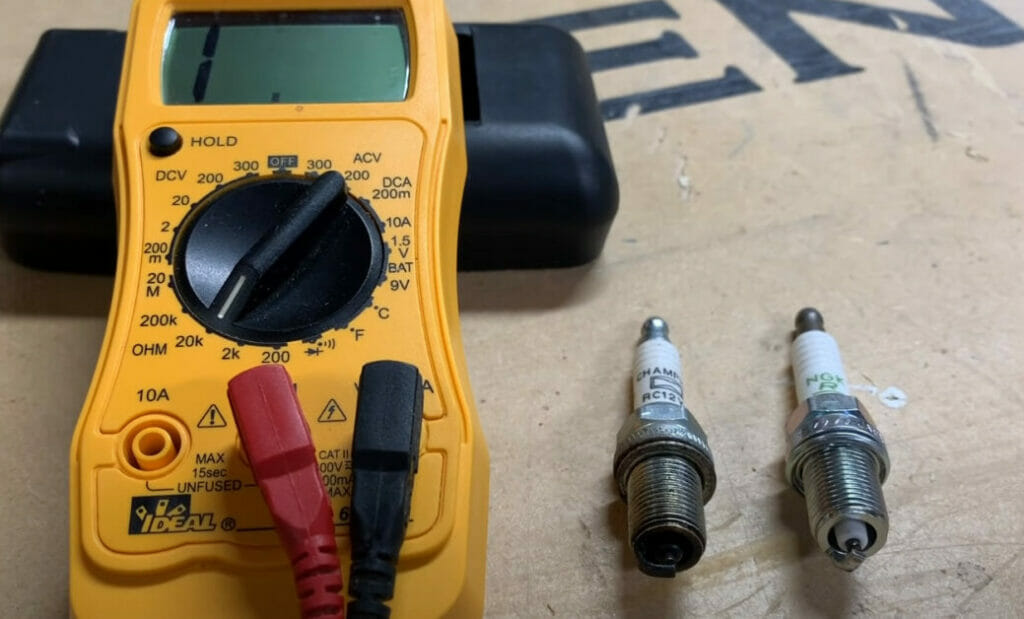
For most home garage checks, a spark tester is the best tool. A digital multimeter can also help with basic electrical checks, but it cannot fully prove that a spark plug works under pressure inside an engine.

- ✦ Safety glasses
Protect your eyes from sparks, dirt, and small debris.
- ✦ Spark tester
Lets you check ignition output without holding a loose plug near engine parts.
- ✦ Digital multimeter
Can check resistance on spark plugs that have a measurable internal resistor.
- ✦ Insulated tools
Help reduce the risk of accidental contact with high-voltage ignition parts.
- ✦ Service information
Gives the correct plug type, gap, resistance information, and ignition test method for your engine.
Safety Rules Before You Start
Never hold a spark plug or ignition wire while the engine is cranking. Ignition systems can produce a painful and dangerous high-voltage shock. Keep hands, loose clothing, and tools away from belts, fans, and other moving parts.
Also keep gasoline, starting fluid, and other flammable liquids away from an open spark test. Disable fuel delivery when the service procedure calls for it, especially when repeated cranking could send unburned fuel into the engine or exhaust.
- ✦ Work with a cool engine
This lowers the risk of burns while removing and handling the plug.
- ✦ Avoid fuel vapors
A visible ignition spark can ignite flammable vapors.
- ✦ Keep the plug grounded correctly
Use the approved test method and a clean metal ground when the procedure requires one.
How to Test a Spark Plug With a 12V Battery and Ignition Coil
If your goal is specifically to use a 12V battery, the battery must work with an ignition coil and the correct switching circuit. The basic idea is simple: the battery supplies the coil, while the coil creates the high-voltage pulse needed by the spark plug.
However, the wiring is not universal. Older coil-and-distributor systems, modern coil-on-plug systems, and electronic ignition modules use different control methods. Do not copy a generic wiring diagram onto a modern vehicle unless it matches the exact ignition system.
A safe bench test should follow the coil maker’s wiring diagram. The battery is connected to the proper coil power circuit, the switching side is controlled by the correct ignition module or test device, and the coil’s high-voltage output feeds a spark tester or compatible spark plug.
This is a much better answer to how to test a spark plug with a 12v battery than connecting the plug directly to the battery. The battery powers the part of the system that creates the high voltage; it does not create the spark at the plug by itself.

- ✦ Step 1: Identify the ignition system
Find out whether you have a coil-and-distributor setup, coil pack, or coil-on-plug system.
- ✦ Step 2: Confirm the wiring
Use the vehicle or coil manufacturer’s wiring diagram before applying battery power.
- ✦ Step 3: Use the correct 12V supply
Connect battery power only to the terminals designed for that supply.
- ✦ Step 4: Use the correct switching circuit
The coil needs a proper control method to create its high-voltage pulse.
- ✦ Step 5: Test the high-voltage output
Use a spark tester or the approved spark plug test method rather than touching the high-voltage lead.
- ✦ Step 6: Interpret the result
A strong, repeatable spark supports the operation of the ignition circuit, but it does not prove that every plug will fire correctly under compression.
Why the Ignition Coil Matters
The ignition coil acts much like a transformer. Its primary side receives low-voltage power, while its secondary side produces a high-voltage pulse. A switching device controls the coil so that this pulse occurs at the right time.
Because ignition coils differ, there is no single safe set of battery connections that works for every vehicle. A wrong connection can overheat a coil, damage an ignition module, blow a fuse, or create an unexpected high-voltage arc.
- ✦ Follow the exact diagram
Use the wiring information for your specific coil and ignition system.
- ✦ Do not guess terminal functions
Similar-looking coils can use different terminal layouts and control methods.
A Simpler Method: Test the Spark Plug With a Spark Tester
For most drivers, a spark tester is easier and safer than building a 12V battery test circuit. A basic inline tester fits between the ignition output and the plug, depending on the ignition design. Other testers connect directly to the ignition lead or coil output.
Follow the tester instructions and the vehicle service procedure. Then crank the engine or run the approved test. A visible and consistent spark at the tester shows that the ignition system is producing high voltage at that point in the circuit.
This method is useful because it tests the ignition system while keeping your hands away from the high-voltage path. It also helps separate a possible plug problem from a coil, wire, fuse, module, or control problem.
- ✦ Connect the tester
Install it at the correct point in the ignition circuit according to the tester and vehicle instructions.
- ✦ Crank safely
Keep clear of moving engine parts and follow any required fuel-disable procedure.
- ✦ Watch the spark
Look for a clear, repeatable spark rather than relying on one random flash.
- ✦ Compare results
If the tester sparks but the plug does not work correctly, inspect the plug, gap, and connection.
What a Spark Tester Can Tell You
A spark tester can show whether the ignition system is sending high voltage to the test point. That makes it useful when an engine cranks but does not start, or when one cylinder appears to have a misfire.
A no-spark result does not automatically mean the spark plug is bad. The fault may be upstream in the ignition coil, wiring, control module, crankshaft position signal, power supply, or ground.
- ✦ Spark present
The tested part of the ignition path is producing a high-voltage event.
- ✦ No spark
Further diagnosis is needed before replacing the spark plug.
How to Check a Spark Plug Without a 12V Battery
A visual inspection is a good first step. Remove the plug and look for a cracked ceramic insulator, damaged threads, worn electrodes, heavy deposits, or signs of oil or fuel fouling. The plug gap should also match the engine maker’s specification.
You can also use a multimeter for a basic resistance check. Many resistor spark plugs have an internal resistor, but resistance values vary by plug design. A resistance reading alone cannot prove that a plug will make a strong spark when the engine is running.
This is why the most complete approach combines visual inspection, correct gap measurement, resistance testing when useful, and a proper ignition spark test.

- ✦ Check the ceramic
Look for cracks, chips, or other damage to the white ceramic insulator.
- ✦ Check the electrodes
Look for severe wear, melting, erosion, or heavy deposits.
- ✦ Check the gap
Measure the gap with the proper gauge and compare it with the engine specification.
- ✦ Check resistance
Measure through the plug when its design includes a resistor and the manufacturer provides a useful range.
How to Test Spark Plug Resistance With a Multimeter
Set the multimeter to resistance mode. Touch one probe to the spark plug terminal and the other to the center electrode contact at the firing end. The plug may need a special adapter or contact point if the center electrode is recessed.
Compare the reading with the spark plug manufacturer’s specification. An open circuit or a reading far outside the stated range can point to a faulty resistor or internal connection, but a normal reading does not guarantee good spark performance.
- ✦ Remove the plug
Test the plug away from the ignition circuit so high voltage cannot reach you.
- ✦ Use the correct meter setting
Select resistance mode and make sure the probes make clean contact.
- ✦ Compare with specifications
Do not treat one generic resistance value as correct for every spark plug.
How to Tell if a Spark Plug Is Bad
A spark plug can fail in more than one way. It may have a cracked insulator, worn electrode, damaged threads, incorrect gap, heavy deposits, or an internal electrical fault. Some plugs may look acceptable but still fail when exposed to the pressure and heat inside a running cylinder.
Common engine symptoms include hard starting, rough idle, hesitation, poor acceleration, or a misfire. These symptoms can also come from fuel, air, compression, wiring, sensors, or other ignition parts, so do not blame the plug based on symptoms alone.
If one plug looks very different from the others, that difference can provide a useful clue. For example, unusual oil or fuel deposits may point to a problem beyond the plug itself.

- ✦ Cracked insulator
A visible crack or chip is a reason to replace the plug.
- ✦ Badly worn electrode
Severe wear can change the gap and reduce reliable ignition.
- ✦ Heavy fouling
Oil, fuel, or carbon deposits can interfere with normal spark formation.
- ✦ Wrong gap
A gap that is too wide or too narrow can affect ignition performance.
- ✦ No spark in a proper test
A plug that fails a suitable ignition test should be investigated and often replaced.
Do Not Confuse a Bad Plug With a Bad Ignition System
If several cylinders have no spark, replacing several spark plugs may not fix the problem. A shared power feed, ignition module, crank sensor, coil control signal, or ground can affect more than one cylinder.
If only one cylinder has a problem, compare its plug and ignition path with a known-good cylinder when the vehicle’s design allows that test. Follow the service manual because modern ignition systems can react badly to incorrect swapping or probing.
- ✦ One-cylinder fault
Inspect the plug, coil, connector, and wiring for that cylinder.
- ✦ Multiple-cylinder fault
Check shared power, control, timing, and ignition components before replacing many plugs.
Common Mistakes When Testing a Spark Plug With a 12V Battery
The biggest mistake is treating the spark plug as if it were a 12V device. It is not. The plug needs the high-voltage output of an ignition system, so a direct battery test tells you very little and can create an unsafe setup.
Another common mistake is assuming that any visible spark means the ignition system is healthy. Spark quality can change with plug gap, temperature, compression, and electrical load. A proper tester and the vehicle maker’s test procedure give you a much better diagnosis.
- ✦ Connecting 12V directly to the plug
A direct battery connection does not reproduce the high-voltage ignition pulse required by a normal spark plug.
- ✦ Guessing coil wiring
Different coils and ignition systems use different terminals and control methods.
- ✦ Holding the plug by hand
Never hold an ignition-connected plug during cranking or a high-voltage test.
- ✦ Testing near fuel
Keep sparks away from gasoline, vapors, and other flammable materials.
- ✦ Relying only on resistance
A resistance check is limited and cannot fully test spark performance under engine conditions.
- ✦ Replacing parts without diagnosis
A no-spark condition may come from the ignition system rather than the spark plug.
When a 12V Battery Test Makes Sense
A 12V battery can be useful when you are testing a complete ignition setup on a compatible bench system. In that case, the battery powers the coil and the correct switching electronics, while the coil produces the high-voltage pulse.
For a normal vehicle repair, though, you usually do not need to build this setup. The vehicle battery and ignition system already provide the power and switching needed for a proper test.
- ✦ Bench ignition testing
Useful when you have the correct coil, switching circuit, wiring diagram, and safe test equipment.
- ✦ Vehicle diagnosis
A spark tester and the manufacturer’s diagnostic procedure are usually more practical.