
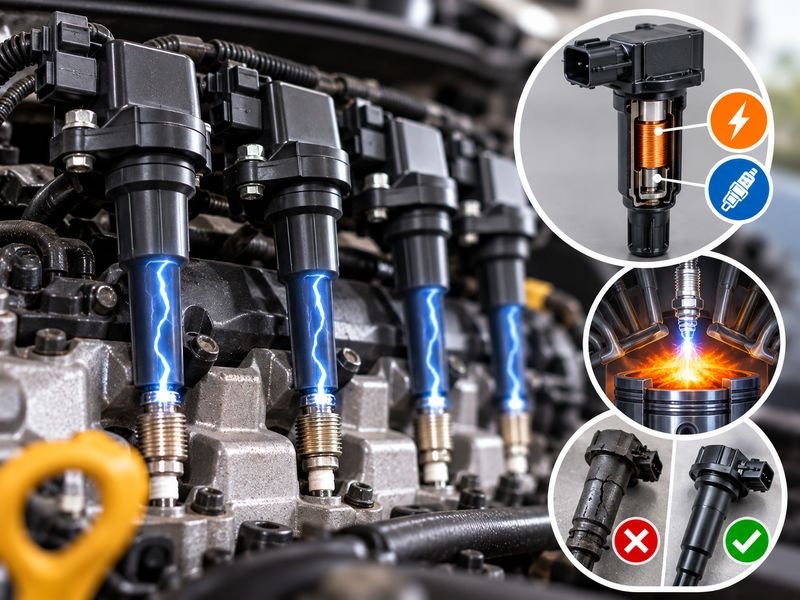
Spark plugs cannot create a spark on their own. They need a powerful electrical supply from another important ignition system component: the spark plug coil. Also known as an ignition coil, this component converts the vehicle’s low-voltage battery power into the high voltage required for the spark plug to ignite the air-fuel mixture inside the engine.
Many drivers know that spark plugs are responsible for creating the ignition spark, but they often overlook the role of spark plug coils. A failing coil can prevent the spark plug from working properly and may lead to engine problems such as misfires, rough idling, poor acceleration, and difficulty starting.
Modern vehicles rely heavily on ignition coils because they provide precise electrical control for efficient combustion. Depending on the engine design, a vehicle may use one ignition coil for multiple cylinders or a separate coil for each spark plug through a coil-on-plug system.
Understanding what are spark plug coils helps vehicle owners recognize how the ignition system works, identify possible coil problems, and make better maintenance decisions. In this complete guide, you will learn how spark plug coils work, different coil types, common failure symptoms, causes of coil problems, testing methods, and when replacement may be necessary.
What You Will Learn From This Guide
In this guide, you will discover:
- What spark plug coils are and what they do
- How ignition coils create the voltage needed for spark plugs
- Different types of spark plug coil systems
- The difference between spark plugs and ignition coils
- Signs of a failing spark plug coil
- Causes of ignition coil failure
- How spark plug coils are tested and replaced
The ignition system depends on multiple components working together. A healthy spark plug, proper ignition coil output, and correct engine timing are all necessary for reliable combustion and smooth engine performance.
At SparkPlugGuide, Chris Turner explains automotive maintenance topics in a practical and beginner-friendly way, helping drivers understand how engine components work and how to identify common vehicle problems.
What Are Spark Plug Coils?
Spark plug coils, commonly known as ignition coils, are electrical components that provide the high voltage needed for spark plugs to create an ignition spark. The vehicle battery produces low-voltage electricity, but spark plugs require much higher voltage to ignite the compressed air-fuel mixture inside the combustion chamber.
The ignition coil works as a transformer by increasing electrical voltage and sending it to the spark plug at the correct time. Without a properly functioning spark plug coil, the spark plug cannot generate the spark needed for combustion.
Spark Plug Coil vs Ignition Coil
Spark plug coil and ignition coil are two names commonly used for the same component.
The term ignition coil is the technical name used by automotive manufacturers, while many vehicle owners use terms such as:
- Spark plug coil
- Coil pack
- Ignition coil
All of these terms refer to the component responsible for producing the high-voltage electrical energy required by the spark plug.
Why Spark Plug Coils Are Important
Spark plug coils are a critical part of the ignition system because they directly affect engine combustion.
A properly working ignition coil helps:
- Create a strong ignition spark
- Maintain smooth engine operation
- Improve fuel combustion
- Support reliable engine starting
When a coil becomes weak or fails completely, the spark plug may not receive enough voltage to ignite the fuel mixture properly.
How Spark Plug Coils Work With Spark Plugs
The spark plug coil and spark plug work together as a complete ignition system.
The process works like this:
- The vehicle battery supplies electrical power
- The engine control module (ECM) controls ignition timing
- The ignition coil increases voltage
- The spark plug receives high-voltage electricity
- The spark plug creates a spark inside the combustion chamber
Each component has a specific role, and a problem with one part can affect the entire ignition process.
Why Modern Vehicles Use Spark Plug Coils
Older vehicles often used a single ignition coil with a distributor system to send voltage to multiple spark plugs. Modern vehicles commonly use coil-on-plug systems because they provide more precise ignition control.
Benefits of modern ignition coil systems include:
- Better combustion efficiency
- More accurate spark timing
- Improved engine performance
- Reduced emissions
How Do Spark Plug Coils Work?
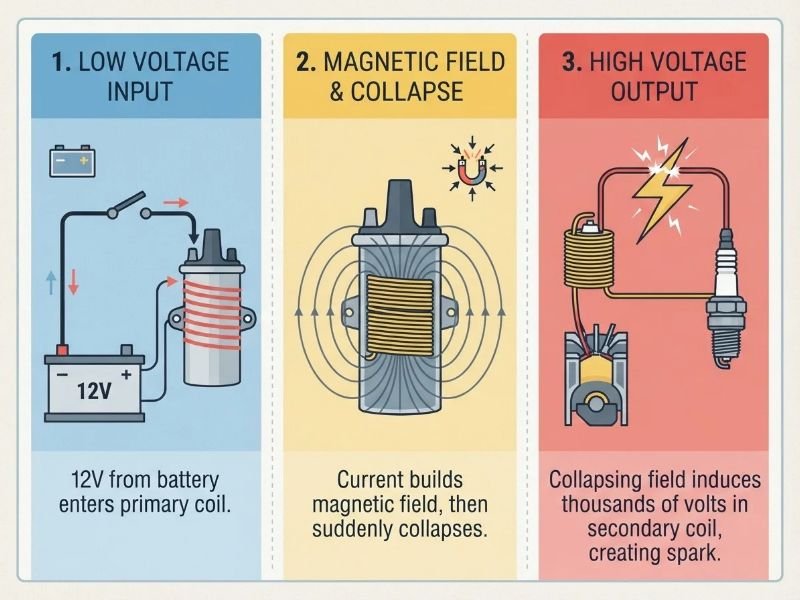
Spark plug coils work by converting the low voltage from the vehicle’s battery into the high voltage required to create a spark at the spark plug. This process happens through electromagnetic induction inside the ignition coil.
The ignition coil stores electrical energy briefly and releases it at the exact moment needed for combustion.
Voltage Transformation Process
An ignition coil contains two main wire circuits:
- Primary winding
- Secondary winding
The process begins when electrical current flows through the primary winding, creating a magnetic field. When the current is interrupted, the magnetic field collapses and produces a much higher voltage in the secondary winding.
This high-voltage electricity is then sent to the spark plug.
Sending Power to Spark Plugs
After generating high voltage, the ignition coil transfers electrical energy to the spark plug.
The spark plug then uses this energy to create a spark across the electrode gap.
The process must happen at the correct time because ignition timing affects:
- Engine power
- Fuel efficiency
- Smooth operation
A weak or inconsistent coil output can prevent the spark plug from creating a strong ignition spark.
Role During Engine Combustion
Spark plug coils play an important role during the combustion cycle.
The ignition system must deliver the spark:
- At the correct moment
- With enough voltage
- Consistently across all cylinders
A properly functioning ignition coil helps ensure that the air-fuel mixture burns efficiently inside the combustion chamber.
Role of the Engine Control Module (ECM)
Modern vehicles use the engine control module to manage ignition timing.
The ECM controls:
- When the ignition coil activates
- How long electrical energy is stored
- When the spark occurs
This allows modern engines to adjust ignition performance based on driving conditions.
Why Ignition Coil Performance Matters
A weak ignition coil may still allow the engine to run, but it can create problems such as:
- Engine hesitation
- Misfires
- Reduced acceleration
- Poor fuel economy
Maintaining a healthy ignition system helps ensure reliable engine performance.
Where Are Spark Plug Coils Located?
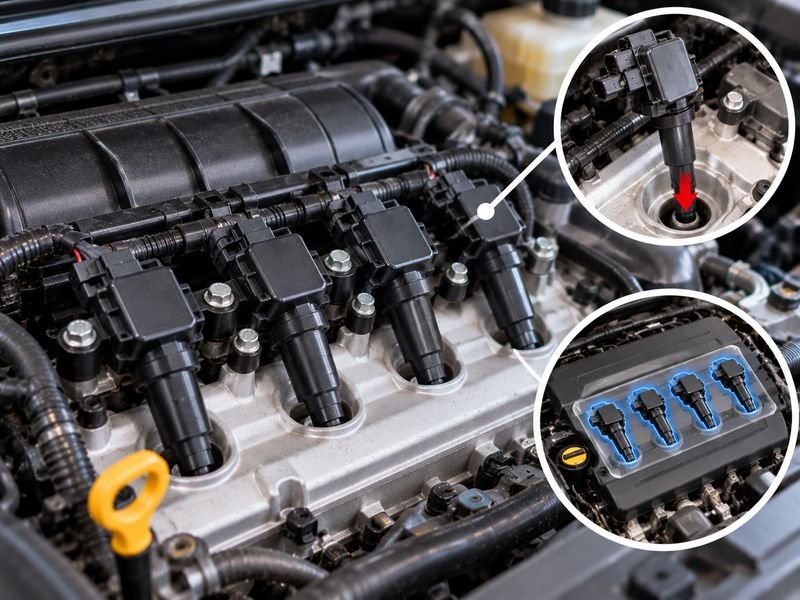
The location of spark plug coils depends on the vehicle’s ignition system design. Modern engines usually place ignition coils close to the spark plugs, while older systems may use a single coil located away from the engine and connected through ignition wires.
Knowing where spark plug coils are located helps during inspection, diagnosis, and replacement.
Coil-on-Plug System
The coil-on-plug (COP) system is the most common design used in modern vehicles.
In this setup:
- Each spark plug has its own ignition coil
- The coil sits directly above the spark plug
- No traditional spark plug wires are required
This design allows the engine control module to control each cylinder’s ignition more precisely.
Advantages of coil-on-plug systems include:
- Improved ignition accuracy
- Better engine performance
- Reduced energy loss
- Easier cylinder-specific diagnosis
Many modern cars, trucks, and SUVs use this type of ignition system.
Coil Pack System
A coil pack system uses one ignition coil unit to provide power to multiple spark plugs.
Instead of having one coil for every spark plug, the system groups multiple ignition coils together in a single assembly.
Coil pack systems are commonly found in some older vehicles and certain engine designs.
Benefits include:
- Fewer individual components
- Simpler ignition design
- Lower replacement complexity
However, if one part of the coil pack fails, multiple cylinders may be affected.
Distributor-Based Ignition Systems
Older vehicles often use a distributor-based ignition system.
This design includes:
- One main ignition coil
- Distributor
- Spark plug wires
The ignition coil creates high voltage, and the distributor sends that power to the correct spark plug at the correct time.
Although reliable for older engines, distributor systems provide less precise ignition control compared with modern coil systems.
How to Find Spark Plug Coils in Your Vehicle
The location of ignition coils depends on the engine layout, but they are commonly found:
- On top of the engine cylinder head
- Near the spark plugs
- Under plastic engine covers
To identify them, look for electrical connectors attached to small coil-shaped components above the spark plugs.
Always consult the vehicle service information before removing ignition components.
Types of Spark Plug Coils
Spark plug coils come in different designs depending on the vehicle’s ignition system. Manufacturers choose different coil configurations based on engine requirements, performance goals, and technology available.
Understanding the main types helps explain why different vehicles have different ignition systems.
Coil-on-Plug (COP) Ignition Coils
Coil-on-plug ignition coils are the most common type in modern vehicles.
Each cylinder has its own individual ignition coil mounted directly above the spark plug.
Advantages include:
- Precise ignition control
- Stronger spark delivery
- Easier fault detection
If one coil fails, the problem is usually limited to one cylinder, making diagnosis easier.
Pencil Coils
Pencil coils are a type of coil-on-plug design with a long, narrow shape.
They are commonly used in engines with limited space around the spark plugs.
Features include:
- Compact design
- Direct connection to spark plugs
- Efficient voltage delivery
Their small size allows manufacturers to fit advanced ignition systems into modern engine designs.
Coil Pack Ignition Systems
Coil packs combine multiple ignition coils into a single unit.
They can provide spark energy to multiple cylinders through spark plug wires.
Common characteristics include:
- Shared coil housing
- Multiple ignition outputs
- Simpler wiring design
Some older and mid-generation vehicles use coil pack systems.
Distributor Ignition Coils
Distributor ignition coils are used in older vehicles.
The system includes:
- One ignition coil
- Distributor cap
- Rotor
- Spark plug wires
The distributor controls where the electrical energy is sent.
These systems are less common today because modern engines require more precise ignition control.
Which Spark Plug Coil Type Is Best?
The best ignition coil type depends on the engine design.
Modern coil-on-plug systems are popular because they provide:
- Better ignition timing control
- Improved efficiency
- More accurate engine management
However, each system is designed according to the requirements of the specific engine.
Spark Plug Coil vs Spark Plug: What Is the Difference?
Spark plug coils and spark plugs work together, but they perform completely different functions in the ignition system.
The ignition coil creates the electrical energy needed for ignition, while the spark plug uses that energy to create the actual spark inside the combustion chamber.
Understanding the difference helps explain how the engine ignition process works.
Spark Plug Function
The spark plug is the component that creates the ignition spark.
Its main job is to:
- Receive high voltage from the ignition coil
- Create a spark across the electrode gap
- Ignite the air-fuel mixture
The spark plug operates directly inside the combustion chamber, where it experiences extreme heat and pressure.
Spark Plug Coil Function
The spark plug coil does not create the spark directly.
Its job is to:
- Convert battery voltage into high voltage
- Store electrical energy temporarily
- Deliver power to the spark plug
Without the ignition coil, the spark plug would not receive enough electrical energy to ignite the fuel mixture.
How They Work Together
The ignition process follows this sequence:
Battery → Engine Control Module → Ignition Coil → Spark Plug → Combustion
Each component depends on the other.
A good spark plug cannot work properly with a weak ignition coil, and a strong ignition coil cannot compensate for a damaged spark plug.
Which One Fails More Often?
Both spark plugs and ignition coils can fail, but they usually fail for different reasons.
Spark plugs may wear due to:
- Electrode erosion
- Carbon deposits
- Normal usage
Ignition coils may fail due to:
- Heat exposure
- Electrical problems
- Internal component breakdown
Proper diagnosis is important because symptoms from spark plug and coil problems can often appear similar.
Symptoms of a Bad Spark Plug Coil
A failing spark plug coil can affect the engine’s ability to create a strong and consistent ignition spark. When an ignition coil becomes weak or fails completely, the affected spark plug may not receive enough voltage to ignite the air-fuel mixture properly.
The symptoms of a bad spark plug coil can sometimes look similar to spark plug problems, so proper diagnosis is important.
Engine Misfire
One of the most common signs of a failing ignition coil is an engine misfire.
A misfire happens when one or more cylinders fail to combust properly because the spark is weak or missing.
Possible signs include:
- Engine shaking
- Uneven power delivery
- Loss of acceleration
- Rough engine operation
A failed ignition coil can prevent the spark plug from creating the spark needed for normal combustion.
Rough Idling
A bad spark plug coil can cause the engine to run unevenly while the vehicle is stationary.
During idle, drivers may notice:
- Engine vibration
- Unstable RPM
- Shaking sensation
This happens because one or more cylinders may not be producing consistent power.
Poor Acceleration
A weak ignition coil can reduce engine performance, especially during acceleration.
When the spark is not strong enough, the fuel mixture may not burn completely.
This can result in:
- Sluggish acceleration
- Reduced engine power
- Delayed throttle response
Difficulty Starting the Engine
A failing ignition coil may make starting the engine harder.
Problems may include:
- Longer cranking time
- Intermittent starting issues
- Engine failing to start
If the coil cannot produce enough voltage, the spark plug may not ignite the fuel mixture properly.
Check Engine Light
Modern vehicles monitor ignition system performance using sensors and the engine control module (ECM).
When the system detects ignition problems, it may trigger:
- Check engine light
- Misfire-related trouble codes
- Cylinder-specific fault codes
A diagnostic scan can help identify whether the issue is related to an ignition coil.
Reduced Fuel Economy
A weak ignition coil can cause incomplete combustion.
When fuel does not burn efficiently, the engine may consume more fuel than normal.
Drivers may notice:
- Lower fuel mileage
- Increased fuel consumption
- Poor engine efficiency
Engine Stalling
In severe cases, a failed ignition coil can cause the engine to stall.
This may happen when:
- Multiple coils fail
- Ignition output becomes unstable
- Combustion is interrupted
A stalling engine should be diagnosed quickly to prevent further problems.
What Causes Spark Plug Coil Failure?
Spark plug coils are designed to last for many years, but several factors can cause them to weaken or fail. Since ignition coils operate under high electrical stress and extreme engine temperatures, they can eventually develop internal problems.
Understanding the causes of coil failure can help vehicle owners prevent unnecessary ignition issues.
Heat Damage
Excessive heat is one of the most common causes of ignition coil failure.
Spark plug coils are exposed to high temperatures from:
- Engine operation
- Exhaust components
- Poor heat protection
Over time, repeated heat cycles can damage internal coil materials and reduce performance.
Electrical Problems
Ignition coils depend on precise electrical operation.
Electrical issues that may contribute to failure include:
- Voltage irregularities
- Damaged wiring
- Poor electrical connections
Problems in the electrical system can place additional stress on the coil.
Moisture and Contamination
Water, oil, and other contaminants can affect ignition coil performance.
Common sources include:
- Engine oil leaks
- Water entering the ignition area
- Damaged coil seals
Moisture can interfere with electrical connections and reduce spark output.
Worn Spark Plugs
Old or worn spark plugs can increase stress on ignition coils.
When the spark plug gap becomes too large, the ignition coil may need to produce higher voltage to create a spark.
Over time, this additional demand can contribute to coil wear.
Normal Wear Over Time
Like many engine components, ignition coils can eventually fail due to normal aging.
Factors affecting lifespan include:
- Vehicle usage
- Driving conditions
- Engine temperature
- Maintenance quality
Even a properly maintained ignition coil may eventually require replacement.
Poor Quality Replacement Parts
Low-quality ignition coils may fail earlier than original equipment or high-quality replacement parts.
Choosing reliable components helps improve:
- Durability
- Performance
- Long-term reliability
How Long Do Spark Plug Coils Last?
Spark plug coils are designed to provide long-term service, but their lifespan depends on vehicle design, driving conditions, and maintenance quality. Unlike spark plugs, which are replaced regularly, ignition coils often last much longer before requiring replacement.
There is no exact replacement interval for most ignition coils because failure usually occurs when performance problems appear.
Average Ignition Coil Lifespan
Many ignition coils can last approximately:
- 80,000 to 150,000 miles
- Several years of normal driving
However, lifespan can vary significantly between vehicles and operating conditions.
Some coils may last much longer, while others may fail earlier due to environmental or mechanical factors.
Factors Affecting Spark Plug Coil Life
Several factors can influence how long ignition coils last.
Important factors include:
- Engine temperature
- Driving habits
- Spark plug condition
- Electrical system health
Vehicles used in harsh conditions may experience faster component wear.
How Spark Plugs Affect Coil Lifespan
Spark plugs and ignition coils work together, so the condition of one component can affect the other.
Worn spark plugs can increase the voltage demand on the ignition coil.
This may cause:
- Additional electrical stress
- Reduced coil efficiency
- Earlier failure
Replacing spark plugs according to manufacturer recommendations helps protect ignition coils.
Signs That Spark Plug Coils May Need Replacement
Ignition coils may need attention when drivers notice:
- Engine misfires
- Rough idle
- Poor acceleration
- Check engine light
Proper diagnosis helps determine whether the issue is the coil, spark plug, or another engine component.
Should You Replace All Spark Plug Coils at Once?
If one ignition coil fails, it does not always mean every coil needs replacement.
Replacement decisions depend on:
- Vehicle age
- Coil condition
- Maintenance history
In some situations, replacing only the failed coil is sufficient, while older vehicles may benefit from replacing multiple coils.
How to Test Spark Plug Coils
Testing spark plug coils helps determine whether an ignition coil is producing the correct electrical output and working properly. Since symptoms of a bad coil can look similar to spark plug or fuel system problems, proper testing is important before replacing parts.
A complete diagnosis may involve visual inspection, diagnostic tools, and electrical measurements.
Visual Inspection of the Ignition Coil
The first step in checking a spark plug coil is performing a visual inspection.
Look for signs such as:
- Cracks in the coil housing
- Burn marks
- Corrosion on connectors
- Oil contamination
- Damaged wiring
Physical damage may indicate that the coil is no longer operating correctly.
Checking for Diagnostic Trouble Codes
Modern vehicles use the engine control module (ECM) to monitor ignition performance.
A diagnostic scanner can identify problems through:
- Misfire codes
- Cylinder-specific ignition codes
- Ignition coil fault codes
For example, a code may indicate that a specific cylinder is experiencing an ignition problem.
However, diagnostic codes usually identify the affected area, not always the exact failed component.
Swapping Ignition Coils for Testing
A common diagnostic method is moving a suspected faulty coil to another cylinder.
The process involves:
- Moving the suspected coil
- Clearing or checking fault codes
- Observing whether the problem follows the coil
If the misfire moves with the coil, the ignition coil may be the cause.
Testing Coil Resistance
Some ignition coils can be tested using a multimeter to measure electrical resistance.
This involves checking:
- Primary winding resistance
- Secondary winding resistance
The measured values are compared with manufacturer specifications.
However, not all modern coil designs can be accurately tested this way.
Professional Ignition Coil Testing
Professional technicians may use advanced diagnostic equipment to analyze:
- Coil performance
- Ignition patterns
- Electrical output
This can help identify intermittent problems that are difficult to detect with basic testing methods.
Can a Bad Spark Plug Cause Coil Problems?
Spark plugs and ignition coils work together, which means problems with one component can affect the other. While a bad spark plug does not always directly damage an ignition coil, certain spark plug problems can increase stress on the coil and contribute to premature failure.
Maintaining both components properly helps protect the entire ignition system.
How Worn Spark Plugs Affect Ignition Coils
As spark plugs wear, the electrode gap can become larger.
A larger gap may require:
- Higher voltage from the ignition coil
- More electrical energy to create a spark
- Increased stress on coil components
Over time, this additional demand may shorten ignition coil life.
Carbon Fouling and Coil Stress
Dirty or fouled spark plugs can also affect ignition performance.
Problems such as:
- Carbon buildup
- Oil contamination
- Fuel fouling
may prevent normal spark formation.
When the spark plug does not operate efficiently, the ignition coil may work harder to compensate.
Incorrect Spark Plug Type
Using the wrong spark plug can also affect ignition coil performance.
Incorrect spark plugs may have:
- Wrong heat range
- Incorrect gap specification
- Different electrical requirements
Always use spark plugs recommended for the specific engine.
Should Spark Plugs and Coils Be Replaced Together?
Spark plugs and ignition coils do not always need to be replaced at the same time.
Replacement depends on:
- Component condition
- Vehicle mileage
- Maintenance history
However, when replacing ignition coils, it is important to ensure the spark plugs are in good condition.
Preventing Ignition Coil Problems
Good maintenance practices include:
- Replacing spark plugs on schedule
- Using correct spark plug specifications
- Fixing oil leaks
- Checking ignition components regularly
Proper spark plug maintenance can help reduce unnecessary stress on ignition coils.
How Much Does It Cost to Replace Spark Plug Coils?
The cost of replacing spark plug coils depends on several factors, including the vehicle model, number of coils required, parts quality, and labor costs. Some vehicles have easily accessible coil-on-plug systems, while others require more time and effort to repair.
Understanding the cost factors helps vehicle owners plan for ignition system maintenance.
Ignition Coil Replacement Parts Cost
The price of an ignition coil varies depending on:
- Vehicle brand
- Coil design
- Original equipment manufacturer (OEM) vs aftermarket parts
Generally, individual ignition coils are less expensive for common vehicles and more expensive for specialized engines.
Labor Cost for Ignition Coil Replacement
Labor costs depend on how difficult it is to access the ignition coils.
Factors include:
- Engine layout
- Location of coils
- Required disassembly
Vehicles with easily accessible coil-on-plug systems may require less labor time.
DIY vs Professional Replacement
Some ignition coil replacements are simple enough for experienced vehicle owners to perform.
DIY replacement may require:
- Basic hand tools
- Correct replacement coil
- Knowledge of ignition components
Professional replacement may be preferred when:
- Access is difficult
- Diagnosis is uncertain
- Additional engine problems exist
Should You Replace One Coil or All Coils?
If one ignition coil fails, replacing only that coil may be enough.
However, replacing multiple coils may be considered when:
- The vehicle has high mileage
- Several coils show signs of aging
- Maintenance history is unknown
The best choice depends on the vehicle condition and diagnostic results.
Does Replacing Spark Plug Coils Improve Performance?
Replacing a failed ignition coil can restore normal engine operation.
Possible improvements include:
- Smoother idle
- Better acceleration
- Reduced misfires
- Improved combustion
However, a new coil will not fix performance problems caused by other issues such as fuel system problems or engine mechanical faults.
Do All Cars Have Spark Plug Coils?
Most modern gasoline-powered vehicles use spark plug coils, also known as ignition coils, to provide the high voltage needed for spark plugs. However, not all vehicles use the same ignition coil design. The type of ignition system depends on the vehicle’s age, engine design, and manufacturer technology.
Understanding the differences between ignition systems helps explain why some vehicles have individual coils while others use different setups.
Modern Gasoline Engines
Most modern gasoline engines use ignition coils because they provide better control over the ignition process.
Common modern designs include:
- Coil-on-plug systems
- Individual ignition coils
- Electronic ignition systems
These systems allow the engine control module (ECM) to control ignition timing more precisely.
Benefits include:
- Improved combustion efficiency
- Better fuel economy
- Reduced emissions
- More reliable engine performance
Older Ignition Systems
Older vehicles may not use individual spark plug coils like modern cars.
Instead, they may use:
- One ignition coil
- Distributor
- Spark plug wires
In these systems, a single ignition coil produces high voltage, and the distributor sends that energy to the correct spark plug.
Although reliable, these systems are less common today.
Do Diesel Engines Use Spark Plug Coils?
No. Diesel engines do not use spark plug coils because they do not use spark ignition.
Diesel engines rely on:
- High compression
- Fuel injection
- Compression ignition
They may use glow plugs for cold starting, but glow plugs do not work with ignition coils like gasoline spark plugs.
Do Electric Vehicles Have Spark Plug Coils?
Fully electric vehicles do not have spark plug coils because they do not have combustion engines.
Electric vehicles use:
- Battery systems
- Electric motors
- Power electronics
Since there is no air-fuel combustion process, there is no need for spark plugs or ignition coils.
Common Spark Plug Coil Problems
Spark plug coils are designed to operate under demanding conditions, but they can develop problems over time. Since ignition coils are responsible for delivering high voltage to spark plugs, any failure can affect engine combustion and overall performance.
Recognizing common coil problems helps vehicle owners identify issues before they become more serious.
Failed Ignition Coil
A completely failed ignition coil cannot produce the voltage needed for the spark plug.
Common symptoms include:
- Engine misfire
- Loss of power
- Rough running
- Difficulty starting
When one coil fails in a coil-on-plug system, the affected cylinder may stop producing power.
Weak Coil Output
An ignition coil does not always fail completely. Sometimes it becomes weak and produces inconsistent voltage.
A weak coil may cause:
- Intermittent misfires
- Poor acceleration
- Reduced engine efficiency
These problems can be harder to diagnose because the vehicle may still run.
Damaged Coil Connector
Ignition coils depend on electrical connectors to receive signals and power.
Problems may occur due to:
- Corrosion
- Loose connections
- Damaged wiring
A damaged connector can create symptoms similar to a failed ignition coil.
Oil Contaminated Coil
Oil leaks can affect ignition coils, especially when oil enters the spark plug well.
Oil contamination may cause:
- Poor electrical connection
- Coil damage
- Misfires
Fixing the source of the oil leak is important to prevent repeated ignition problems.
Moisture Damage
Water and moisture can interfere with ignition coil operation.
Possible causes include:
- Damaged seals
- Water entering the engine area
- Poor protection around electrical components
Keeping ignition components dry helps maintain reliable operation.
Incorrect Spark Plug Maintenance
Poor spark plug maintenance can increase stress on ignition coils.
Examples include:
- Old spark plugs
- Incorrect spark plug gap
- Wrong spark plug type
Maintaining spark plugs properly helps reduce unnecessary strain on ignition coils.
Frequently Asked Questions About Spark Plug Coils
Spark plug coils are an important part of the ignition system, but many drivers are unsure about their function, lifespan, and replacement needs. These common questions explain the basics of ignition coils and how they affect engine performance.
Are Spark Plug Coils and Ignition Coils the Same?
Yes. Spark plug coils and ignition coils refer to the same component.
The official automotive term is usually ignition coil, but many people use spark plug coil because the component works directly with spark plugs.
How Many Spark Plug Coils Does a Car Have?
The number of ignition coils depends on the vehicle’s ignition system.
Modern vehicles commonly use:
- One coil per spark plug
- One coil per cylinder
For example, a four-cylinder engine with a coil-on-plug system usually has four ignition coils.
Can You Drive With a Bad Ignition Coil?
A vehicle may continue running with a bad ignition coil, but driving with this problem is not recommended.
A failing coil can cause:
- Misfires
- Reduced performance
- Increased emissions
- Potential engine damage
It is best to diagnose and repair the problem as soon as possible.
How Do I Know If My Spark Plug Coil Is Bad?
Common signs of a bad ignition coil include:
- Engine misfire
- Rough idle
- Poor acceleration
- Check engine light
- Difficulty starting
Proper testing is needed to confirm whether the coil is the actual cause.
Do Spark Plug Coils Need Maintenance?
Ignition coils usually do not have a specific maintenance schedule.
However, keeping the ignition system healthy helps extend coil life.
Helpful maintenance includes:
- Replacing spark plugs on time
- Fixing oil leaks
- Checking electrical connections
Should I Replace Spark Plugs and Coils Together?
Spark plugs and ignition coils do not always need replacement together.
The decision depends on:
- Vehicle condition
- Mileage
- Component performance
However, worn spark plugs should be addressed because they can increase stress on ignition coils.
What Happens When an Ignition Coil Fails?
When an ignition coil fails, the affected spark plug may not receive enough voltage to create a proper spark.
This can result in:
- Cylinder misfire
- Poor combustion
- Reduced engine performance
How Much Does a Spark Plug Coil Cost?
The cost of a spark plug coil depends on:
- Vehicle model
- Coil type
- Brand
- Labor requirements
Individual ignition coils are usually priced differently depending on the application.
Conclusion
Spark plug coils are a critical part of the ignition system because they provide the high voltage needed for spark plugs to ignite the air-fuel mixture. Without a properly working ignition coil, the engine may experience problems such as misfires, rough idling, poor acceleration, and reduced performance.
Understanding what are spark plug coils helps vehicle owners recognize the difference between spark plugs and ignition coils, identify common failure symptoms, and understand why proper ignition system maintenance matters.
Modern vehicles commonly use coil-on-plug systems because they provide accurate ignition control and better engine efficiency. However, regardless of the ignition system design, spark plug coils must deliver consistent electrical power to maintain reliable combustion.
Regular spark plug maintenance, fixing oil leaks, checking ignition components, and using the correct replacement parts can help extend ignition coil life. When symptoms appear, proper diagnosis is important because ignition problems can come from spark plugs, coils, wiring, or other engine components.
At SparkPlugGuide, Chris Turner explains automotive maintenance topics in a practical and easy-to-understand way, helping drivers better understand their vehicles and make informed decisions about spark plugs, ignition coils, and engine care.