
If you are changing worn spark plugs, you may be wondering, should i replace ignition coils with spark plugs at the same time? In most vehicles, the answer is no. Spark plugs are routine maintenance items, while ignition coils are generally replaced only when they fail, become damaged, or begin causing ignition problems.
A set of spark plugs may need replacement several times during a vehicle’s life, while properly functioning ignition coils can often remain in service much longer. Replacing good coils simply because you are installing new plugs usually adds unnecessary expense.
There are exceptions. A high-mileage engine with weak coils, cracked coil housings, damaged boots, recurring misfires, or oil contamination may benefit from replacing one or more coils while the spark plugs are already accessible.
This guide explains how spark plugs and ignition coils work together, when coils should be replaced, symptoms of failing coils, and what to inspect whenever you install new spark plugs.
Should I Replace Ignition Coils With Spark Plugs?
You generally do not need to replace ignition coils when replacing spark plugs if the coils are operating normally.
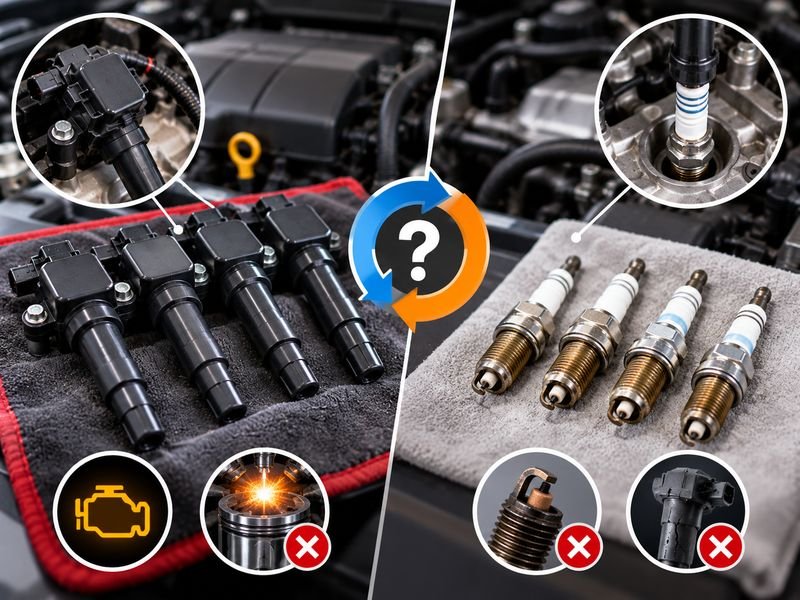
Spark plugs and ignition coils are part of the same ignition system, but they have different service requirements.
Spark plugs are wear items. Their electrodes gradually wear and their gap changes as mileage increases.
Ignition coils are not usually scheduled maintenance items. They are designed to remain in service until they develop an electrical or physical problem.
For most vehicles, a sensible approach is:
- Replace the spark plugs at the manufacturer’s recommended interval.
- Inspect the ignition coils and coil boots.
- Reuse coils that are working properly and show no signs of damage.
- Replace any coil that is confirmed faulty or visibly deteriorated.
Replacing all of the coils along with the plugs may make sense in certain situations, but it should not automatically be part of every spark plug service.
How Ignition Coils and Spark Plugs Work Together
Understanding the relationship between these components makes it easier to know why their replacement schedules are different.
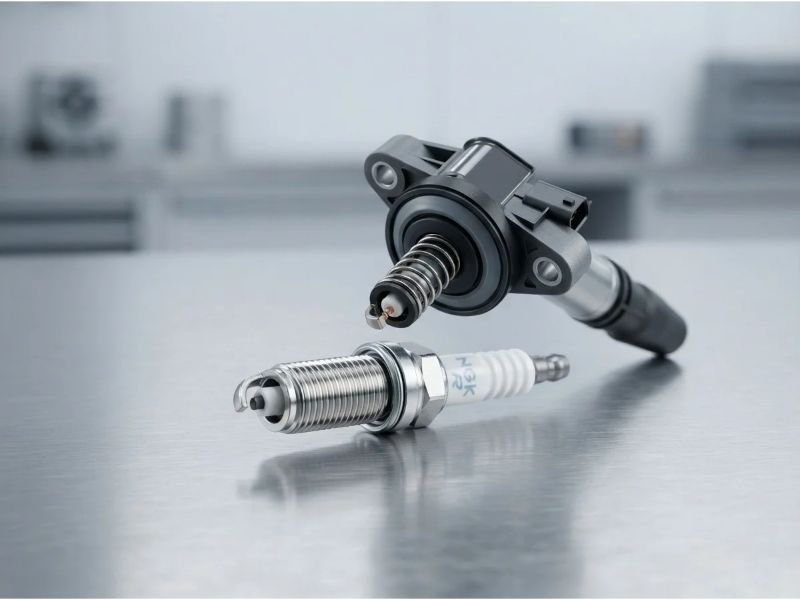
A vehicle’s battery supplies relatively low voltage. The ignition coil converts that voltage into the much higher voltage needed to create a spark.
That electrical energy travels to the spark plug.
The spark plug creates a spark across a small gap between its electrodes. That spark ignites the compressed air-fuel mixture inside the combustion chamber.
The basic sequence is:
Battery and charging system → ignition coil → spark plug → combustion
Modern vehicles commonly use a coil-on-plug ignition system, often abbreviated COP. In this design, each cylinder usually has its own ignition coil installed directly above the spark plug.
Because the coil must often be removed to access the plug, it is convenient to inspect both components during the same service.
Why Spark Plugs Need Replacement More Often
Spark plugs operate directly inside the combustion chamber where they are exposed to extreme heat, combustion pressure, fuel residue, and repeated electrical discharge.
Over time, their electrodes wear.
As the electrode wears, the spark plug gap can become wider. A wider gap usually requires more voltage from the ignition coil to create a spark.
Eventually, worn plugs can contribute to:
- Hard starting
- Engine misfires
- Rough idle
- Reduced fuel economy
- Hesitation during acceleration
- Increased emissions
- Extra stress on the ignition system
Spark plug replacement intervals vary significantly depending on plug material and vehicle design.
Some conventional plugs have relatively short maintenance intervals, while many modern platinum or iridium spark plugs are designed for much longer service life.
Always follow the interval listed in the vehicle manufacturer’s maintenance schedule instead of assuming every vehicle uses the same mileage recommendation.
How Long Do Ignition Coils Last?
Ignition coils typically do not have a universal replacement interval.
Many coils last well beyond 100,000 miles, while others can fail much earlier because of heat, vibration, moisture, electrical problems, or excessive demand from worn spark plugs.
Coil life depends on factors such as:
- Engine design
- Underhood temperature
- Coil quality
- Spark plug condition
- Spark plug gap
- Oil or coolant contamination
- Electrical system condition
- Driving environment
Because coil lifespan varies so much, replacing an ignition coil based only on mileage is usually unnecessary unless the vehicle manufacturer specifically recommends it.
When Should You Replace Ignition Coils With Spark Plugs?
Replacing coils while changing plugs can make sense when there is evidence that the coils are deteriorating.
The Engine Already Has a Misfire
If the engine has a cylinder-specific misfire, diagnose the cause before assuming the spark plug is responsible.
A failed coil can produce diagnostic trouble codes such as:
- P0300 for random or multiple-cylinder misfires
- P0301 for a cylinder 1 misfire
- P0302 for a cylinder 2 misfire
- Similar P030X codes for other cylinders
However, a misfire code does not automatically prove that the ignition coil is faulty.
Misfires can also result from:
- Worn spark plugs
- Fuel injector problems
- Vacuum leaks
- Compression problems
- Wiring faults
- Fuel delivery issues
The coil should be tested or properly diagnosed before replacement whenever possible.
A Coil Has Cracks or Physical Damage
Inspect the coil housing when removing it.
Replace a coil if you find obvious damage such as:
- Cracked plastic
- Burn marks
- Melted areas
- Corroded terminals
- Broken electrical connectors
- Severe moisture intrusion
Cracks can allow electricity to escape before reaching the spark plug, causing weak spark or intermittent misfires.
The Coil Boot Is Damaged
On many coil-on-plug systems, a rubber coil boot connects the coil to the spark plug.
Boots can become:
- Cracked
- Brittle
- Torn
- Oil-soaked
- Carbon tracked
A damaged boot can allow high voltage to leak to the cylinder head instead of reaching the spark plug.
Some manufacturers sell replacement boots separately, meaning you may not need an entirely new ignition coil.
Oil Is Inside the Spark Plug Well
Oil around the coil or spark plug should not simply be wiped away and ignored.
Oil commonly enters spark plug wells because of leaking valve cover gaskets or spark plug tube seals.
Prolonged oil exposure can damage rubber coil boots and sometimes contribute to ignition coil failure.
The underlying oil leak should be repaired along with addressing any damaged ignition components.
The Vehicle Has Very High Mileage and Known Coil Problems
Some vehicle models are more prone to ignition coil failure than others.
If several coils have already failed and the remaining coils are the same age, replacing the complete set may sometimes be reasonable—especially if access is difficult and labor is significant.
However, this decision should be based on the vehicle’s condition and service history rather than automatically replacing every coil at a certain mileage.
Should You Replace All Ignition Coils If One Fails?
Not necessarily.
It is perfectly acceptable in many situations to replace only the failed ignition coil.
Ignition coils are independent components on most coil-on-plug systems. One coil failing does not automatically mean the others are defective.
Replacing one coil is particularly reasonable when:
- The vehicle has relatively low mileage.
- The other coils test normally.
- There are no additional misfires.
- The coils show no visible deterioration.
Replacing the entire set becomes more reasonable when multiple coils begin failing within a short period or when all coils are old and heavily heat-cycled.
Cost is also important. Depending on the vehicle, replacing an entire set can be considerably more expensive than replacing one failed coil.
Can Worn Spark Plugs Damage Ignition Coils?
Worn spark plugs can increase the workload placed on ignition coils.
As the spark plug gap grows, the ignition system may need higher voltage to jump the gap.
The ignition coil must work harder to supply that voltage.
Over a long period, excessive demand can contribute to coil insulation breakdown or electrical failure.
This is one reason replacing spark plugs at the recommended interval is important even when the engine still appears to run normally.
Keeping properly gapped plugs installed can reduce unnecessary stress on the ignition system.
Signs an Ignition Coil May Need Replacement
A failing ignition coil can produce several noticeable symptoms.
Engine Misfire
Misfires are one of the most common symptoms.
The engine may stumble, shake, or hesitate because one cylinder is not consistently burning its air-fuel mixture.
Rough Idle
A weak or failing coil may cause the engine to shake noticeably at idle.
The symptoms may become more obvious when accessories such as the air conditioner increase engine load.
Hesitation During Acceleration
Ignition problems often become easier to notice under load.
A failing coil may cause hesitation, jerking, or a lack of power during acceleration.
Check Engine Light
The engine control module can detect abnormal crankshaft speed caused by misfires and illuminate the check engine light.
A flashing check engine light commonly indicates an active misfire severe enough that continued driving could overheat and damage the catalytic converter.
Poor Fuel Economy
Incomplete combustion can reduce efficiency, although poor fuel economy has many possible causes and should not be used alone to diagnose an ignition coil.
Difficult Starting
Multiple weak coils or severe ignition problems may cause extended cranking or difficulty starting.
A single failing coil often causes poor engine operation rather than a complete no-start condition.
How to Tell Whether the Spark Plug or Ignition Coil Is Bad
Because spark plug and coil problems can produce similar symptoms, proper diagnosis matters.
One commonly used diagnostic method on engines with individual coils is a coil swap test.
For example, if a scan tool shows a misfire on cylinder 2:
- Turn the engine off and allow it to cool.
- Move the cylinder 2 ignition coil to another cylinder.
- Move the other cylinder’s coil to cylinder 2.
- Clear codes if appropriate.
- Run the engine again and monitor the misfire.
If the misfire follows the coil to the new cylinder, the coil is likely faulty.
If the misfire remains on the original cylinder, another problem may be responsible.
A technician may also inspect the spark plug, test coil electrical circuits, check injector operation, and perform compression testing when needed.
What Should You Inspect When Replacing Spark Plugs?
Spark plug service is a good opportunity to inspect the rest of the ignition system.
Ignition Coil Housing
Check each coil for cracks, overheating, corrosion, or other visible damage.
Coil Boots
Look for hardened rubber, tears, burn marks, oil saturation, or carbon tracking.
Carbon tracking often appears as a thin dark line where electrical energy has traveled along the surface of the boot or spark plug insulator.
Electrical Connectors
Make sure coil connectors are secure and free from broken locking tabs or damaged wiring.
Spark Plug Wells
Look for oil, coolant, water, dirt, or debris.
Contaminated plug wells should be cleaned and the source of the contamination identified.
Spark Plug Condition
The removed plugs can reveal useful clues.
Abnormal deposits, unusual electrode wear, oil fouling, or a damaged insulator may indicate an engine problem that deserves further diagnosis.
Should You Replace Coil Boots With Spark Plugs?
Replacing coil boots can sometimes be worthwhile, especially on high-mileage vehicles.
Rubber boots are exposed to significant engine heat and gradually harden.
If boots are inexpensive and available separately, replacing them during spark plug service can be a reasonable form of preventive maintenance.
However, boots that remain flexible and undamaged usually do not require automatic replacement.
Check whether your vehicle’s manufacturer sells the boot separately from the coil assembly.
Do New Ignition Coils Improve Performance?
New ignition coils generally will not increase engine power when the existing coils are already functioning correctly.
A healthy ignition coil either produces sufficient spark energy for the engine’s needs or it does not.
Replacing good factory coils with new ones normally does not create additional horsepower.
You may notice improved performance after coil replacement if the old coils were weak and causing:
- Misfires
- Hesitation
- Rough running
- Incomplete combustion
In that situation, the repair is restoring lost performance rather than adding power beyond the engine’s normal output.
Can You Reuse Ignition Coils After Changing Spark Plugs?
Yes.
Reusing healthy ignition coils after changing spark plugs is completely normal.
Carefully remove the coils, inspect them, install the new spark plugs to the proper specification, and reinstall the coils.
Avoid pulling aggressively on the coil boots because aged rubber can tear.
Also make sure the electrical connectors click securely back into place.
Do Ignition Coils Require Dielectric Grease?
Some manufacturers recommend a small amount of dielectric grease inside the end of the coil boot.
Dielectric grease can help:
- Prevent moisture intrusion
- Reduce boot sticking
- Protect electrical connections from corrosion
However, it should be used correctly.
You generally need only a small amount around the inside lip of the boot. Filling the entire boot with grease is unnecessary.
Always follow the vehicle or ignition component manufacturer’s instructions because procedures can vary.
Is It Better to Replace Spark Plugs Before Ignition Coils?
If the spark plugs are due for scheduled replacement and there is no confirmed coil failure, replacing the plugs first is usually appropriate.
Old plugs can contribute to misfires and place additional electrical demand on the coils.
Installing the correct new spark plugs may resolve ignition symptoms caused by worn plugs.
However, if diagnostics already show that an ignition coil has failed, replacing only the spark plugs will not repair the faulty coil.
Both issues should be addressed when both are present.
Can You Drive With a Bad Ignition Coil?
Driving with a failing ignition coil is generally not recommended for longer than necessary.
A misfiring cylinder may send unburned fuel into the exhaust system. That fuel can overheat the catalytic converter, potentially causing expensive damage.
Stop driving and have the problem addressed promptly if:
- The check engine light is flashing.
- The engine is shaking severely.
- Power is significantly reduced.
- You smell unusual exhaust or fuel odors.
- The vehicle is difficult to control safely.
A steady check engine light still deserves diagnosis, but a flashing light generally indicates a more urgent misfire condition.
Common Mistakes When Replacing Spark Plugs and Ignition Coils
Several simple mistakes can create new ignition problems.
Installing the Wrong Spark Plugs
Use the plug type and specification recommended for the engine.
Incorrect heat range, reach, or design can affect engine operation.
Using the Wrong Spark Plug Gap
Some spark plugs come pre-gapped, but the specification should still be verified when the manufacturer allows gap adjustment.
Incorrect gap can contribute to misfires.
Overtightening Spark Plugs
Spark plugs are installed into the cylinder head, which is commonly aluminum on modern engines.
Overtightening can damage threads or the spark plug.
Follow the vehicle manufacturer’s torque specification whenever possible.
Replacing Coils Without Diagnosing the Misfire
A misfire code identifies the cylinder experiencing the problem, not necessarily the failed part.
Do not automatically replace an ignition coil without considering the spark plug, injector, compression, wiring, and other possible causes.
Ignoring Oil in the Plug Wells
Replacing the plugs and coils without fixing a leaking valve cover or tube seal may allow the same problem to return.
Spark Plug vs. Ignition Coil Replacement
| Component | Spark Plug | Ignition Coil |
| Routine maintenance item | Usually yes | Usually no |
| Wears gradually | Yes | Can deteriorate, but often fails unpredictably |
| Has scheduled replacement interval | Commonly | Usually not |
| Can cause misfires | Yes | Yes |
| Should automatically be replaced together | No | No |
| Inspect during spark plug service | Yes | Yes |
| Replace when faulty | Yes | Yes |
The key difference is that spark plugs are normally replaced based on service intervals, while coils are primarily replaced based on condition and diagnosis.
When Replacing All Coils May Make Sense
Although replacing every coil during a spark plug service is usually unnecessary, there are situations where it can be reasonable.
Consider replacing the full set when:
- Several coils have recently failed.
- The vehicle has very high mileage.
- The coils are original and heavily aged.
- Multiple coils show cracking or deterioration.
- Coil access requires significant labor.
- The engine is known for age-related coil failures.
- You want to reduce the likelihood of repeated repairs and the cost is acceptable.
Even then, replacing all coils is a preventive choice rather than a universal maintenance requirement.
When to Have a Mechanic Diagnose the Ignition System
Basic inspection and spark plug replacement may be manageable for experienced DIY owners, but professional diagnosis can be worthwhile when symptoms persist.
Consider having a technician inspect the vehicle if:
- The engine continues misfiring after new plugs.
- Multiple misfire codes are present.
- The check engine light flashes.
- New coils repeatedly fail.
- Oil keeps filling the spark plug wells.
- Wiring damage is suspected.
- Compression problems may be present.
- The correct diagnosis is unclear.
Repeatedly buying ignition parts without identifying the actual cause can become more expensive than proper testing.
FAQs About Should I Replace Ignition Coils With Spark Plugs?
Do ignition coils need to be changed every time you change spark plugs?
No. Ignition coils normally do not need replacement every time spark plugs are changed. Inspect the coils and replace only those that are damaged, failing, or causing ignition problems.
Is it better to replace all ignition coils at once?
Not necessarily. If one coil fails and the others are healthy, replacing only the failed coil is often perfectly acceptable.
Replacing all coils may be reasonable on an older high-mileage vehicle if several coils have already failed or the remaining coils show significant deterioration.
Can new spark plugs fix an ignition coil problem?
No. New spark plugs cannot repair an internally damaged ignition coil.
However, worn spark plugs can cause symptoms similar to a weak coil, so replacing overdue plugs may resolve misfires caused by the plugs themselves.
Should I replace ignition coils at 100,000 miles?
There is generally no universal 100,000-mile replacement requirement for ignition coils.
If the coils are functioning normally, there may be no reason to replace them simply because the odometer reaches 100,000 miles.
Follow your vehicle manufacturer’s recommendations and inspect the coils whenever the plugs are serviced.
Can bad spark plugs cause ignition coils to fail?
Worn or incorrectly gapped plugs can increase the voltage demand placed on ignition coils.
That additional electrical stress can contribute to coil failure over time, although many other factors can also cause ignition coils to fail.
Can one bad ignition coil damage a new spark plug?
A failed coil usually causes poor ignition rather than physically destroying a spark plug. However, prolonged misfiring can lead to fuel fouling or deposits on the plug.
Fixing the underlying coil problem quickly helps prevent additional ignition and emissions issues.
Should I replace coil boots when changing spark plugs?
Replace coil boots if they are cracked, hardened, torn, carbon tracked, or contaminated with oil.
If the boots remain flexible and undamaged, they can usually be reused.
Will replacing ignition coils improve gas mileage?
Replacing faulty coils may restore fuel economy if misfires were causing incomplete combustion.
Replacing perfectly healthy coils usually will not improve gas mileage.
Conclusion
So, should i replace ignition coils with spark plugs? In most cases, no. Replace spark plugs according to the manufacturer’s maintenance schedule, but replace ignition coils based on their actual condition and diagnostic results.
Whenever you install new spark plugs, inspect the ignition coils, coil boots, electrical connectors, and spark plug wells for damage or contamination. Reusing healthy coils is normal and can save considerable money.
If a coil is cracked, electrically faulty, causing a confirmed misfire, or damaged by oil or heat, replacing it during the spark plug service makes sense. Otherwise, there is little benefit in replacing good ignition coils simply because the spark plugs are being changed.