
If you are troubleshooting a misfire or planning a tune-up, you may wonder: are ignition coils the same as spark plugs? They are not. Ignition coils and spark plugs are two different components, but they work closely together in a gasoline engine’s ignition system.
The ignition coil creates the high voltage needed for combustion. The spark plug uses that voltage to produce a spark inside the engine’s combustion chamber. Without a properly working coil, the spark plug may not receive enough voltage. Without a good spark plug, the voltage produced by the coil cannot create a reliable spark.
Because problems with either component can cause similar symptoms—including engine misfires, rough idle, hesitation, and a check-engine light—drivers sometimes confuse them.
This guide explains exactly how ignition coils and spark plugs differ, how they work together, how to tell which one may be failing, and whether you need to replace them at the same time.
Are Ignition Coils the Same as Spark Plugs?
No. Ignition coils and spark plugs are not the same part.
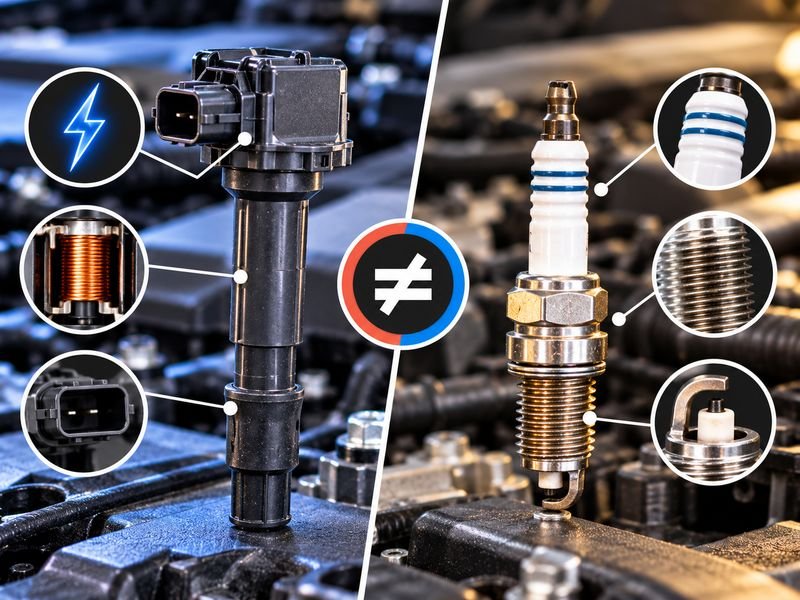
An ignition coil converts the vehicle’s relatively low battery voltage into the much higher voltage needed to create a spark.
A spark plug sits in the cylinder head and uses that high voltage to create an electrical spark across a small gap. That spark ignites the compressed air-fuel mixture inside the combustion chamber.
A simple way to understand the difference is:
- Ignition coil: Produces high voltage.
- Spark plug: Uses that voltage to create the spark.
Both components are essential to the ignition process, but they perform different jobs.
Ignition Coil vs. Spark Plug: Quick Comparison
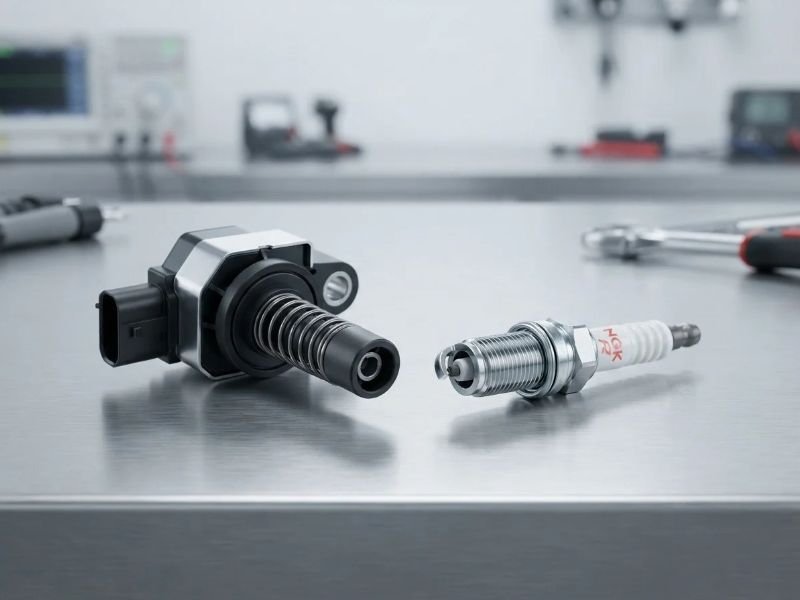
| Feature | Ignition Coil | Spark Plug |
| Main purpose | Produces high-voltage electricity | Creates the ignition spark |
| Location | Usually above or near the spark plug | Threaded into the cylinder head |
| Electrical role | Increases voltage | Discharges voltage across a gap |
| Number in many modern engines | Usually one per cylinder | Usually one per cylinder |
| Routine maintenance | Usually replaced when faulty | Replaced at scheduled intervals |
| Common failure symptom | Misfire or weak/no spark | Misfire, hard starting, poor combustion |
| Typical design | Electronic coil assembly | Metal and ceramic threaded plug |
Modern gasoline engines commonly use a coil-on-plug ignition system, where each spark plug has its own ignition coil directly above it. This physical arrangement is one reason the two parts are sometimes confused.
What Does an Ignition Coil Do?
An ignition coil acts like a small electrical transformer.
A vehicle battery supplies relatively low voltage, which is not enough by itself to create a reliable spark across a spark plug gap under cylinder pressure.
The ignition coil increases that voltage dramatically so the spark plug can fire.
Inside the ignition coil are electrical windings that create a magnetic field. When the ignition system rapidly switches the coil’s electrical current, the collapsing magnetic field generates the high voltage required for ignition.
The exact voltage required depends on factors such as:
- Engine design
- Cylinder pressure
- Spark plug gap
- Ignition-system design
- Engine operating conditions
What Happens After the Coil Produces Voltage?
Once high voltage is generated, the electrical energy travels from the ignition coil to the spark plug.
In a modern coil-on-plug system, the coil usually sits directly over the plug. A rubber coil boot connects the coil to the spark plug terminal.
Older ignition systems may instead use:
- A distributor
- Spark plug wires
- A single ignition coil
- Coil packs shared between cylinders
Regardless of the design, the ignition coil’s basic purpose remains the same: provide enough electrical energy for the spark plug to fire.
What Does a Spark Plug Do?
A spark plug creates the actual spark that starts combustion.
The threaded end of the spark plug extends into the engine’s combustion chamber. At the tip are two electrodes separated by a carefully specified spark plug gap.
When high voltage reaches the plug, electricity jumps across that gap. The resulting spark ignites the compressed air-fuel mixture.
Combustion then pushes the piston downward, helping produce the power that turns the crankshaft and moves the vehicle.
Main Parts of a Spark Plug
Although a spark plug looks simple, it contains several important components:
- Terminal
- Ceramic insulator
- Metal shell
- Center electrode
- Ground electrode
- Spark gap
Spark plug electrodes may use materials such as copper, platinum, or iridium, depending on the plug design and vehicle requirements.
The correct plug type, heat range, and gap are important for proper combustion and engine performance.
How Ignition Coils and Spark Plugs Work Together
The ignition coil and spark plug operate as a team.
The process generally works like this:
- The engine control module determines when a cylinder should fire.
- The ignition coil stores electrical energy.
- The coil converts that energy into high voltage.
- The voltage travels to the spark plug.
- Electricity jumps across the spark plug gap.
- The spark ignites the compressed air-fuel mixture.
- Combustion produces power inside the cylinder.
If either component cannot perform its job correctly, the cylinder may experience an ignition misfire.
This is why faulty ignition coils and worn spark plugs can cause many of the same symptoms.
Can a Bad Spark Plug Cause an Ignition Coil Problem?
Yes. In some situations, a worn or improperly gapped spark plug can place additional stress on an ignition coil.
As spark plug electrodes wear, the gap may become wider. A wider gap generally requires more voltage to create a spark.
The ignition coil may therefore have to work harder to fire a badly worn spark plug.
Other ignition problems, including excessive resistance or damaged coil boots, may also increase electrical demand on the coil.
This does not mean every worn spark plug will immediately damage an ignition coil. However, replacing spark plugs according to the manufacturer’s maintenance schedule can help keep the ignition system working properly.
Can a Bad Ignition Coil Damage a Spark Plug?
A failed ignition coil does not normally damage a spark plug simply because the coil stops working.
However, a malfunctioning ignition system can contribute to poor combustion and spark plug fouling.
If a cylinder repeatedly misfires, unburned fuel or deposits may accumulate on the spark plug. A severely fouled plug may eventually need cleaning or replacement, depending on its condition.
More importantly, prolonged misfiring can allow unburned fuel to enter the exhaust system, where it may overheat or damage the catalytic converter.
A continuously flashing check-engine light often indicates a severe misfire. Driving should be minimized until the problem is diagnosed.
Symptoms of a Bad Ignition Coil
A failing ignition coil may prevent one cylinder from receiving adequate ignition voltage.
Common symptoms include:
- Engine misfire
- Rough idle
- Hesitation during acceleration
- Reduced engine power
- Hard starting
- Poor fuel economy
- Check-engine light
- Shaking or vibration
- Engine stalling in some cases
A diagnostic scan may reveal cylinder-specific misfire codes such as P0301, P0302, or similar codes.
However, a misfire code does not automatically prove that the ignition coil is faulty. Spark plugs, fuel injectors, wiring problems, vacuum leaks, compression problems, and other faults can produce similar symptoms.
Symptoms of Bad Spark Plugs
Worn or fouled spark plugs can cause symptoms that closely resemble ignition-coil failure.
Possible signs include:
- Rough idle
- Engine misfires
- Difficulty starting
- Hesitation
- Poor acceleration
- Reduced fuel economy
- Check-engine light
- Increased exhaust emissions
- Uneven engine operation
Symptoms alone usually cannot confirm whether the ignition coil or spark plug is responsible.
Proper diagnosis is important before replacing parts.
How Can You Tell Whether a Coil or Spark Plug Is Bad?
One of the best approaches is to combine diagnostic trouble codes with physical inspection and targeted testing.
For example, if a scan tool indicates a misfire on cylinder 3, the spark plug and ignition coil for that cylinder can be inspected.
Inspect the Spark Plug
A spark plug can provide useful clues about what is happening inside the cylinder.
Look for:
- Excessive electrode wear
- Incorrect spark plug gap
- Cracked ceramic insulator
- Heavy carbon deposits
- Oil contamination
- Fuel fouling
- Damaged electrodes
A badly worn or contaminated plug may be responsible for the misfire.
Test or Swap the Ignition Coil
On many coil-on-plug engines, a technician may move a suspected ignition coil from the misfiring cylinder to another cylinder.
For example:
- Cylinder 3 has a misfire.
- The cylinder 3 ignition coil is moved to cylinder 2.
- Diagnostic codes are cleared.
- The engine is operated again.
- The vehicle is rescanned.
If the misfire moves from cylinder 3 to cylinder 2, the ignition coil becomes a strong suspect.
This method is not appropriate for every vehicle, so manufacturer-specific diagnostic procedures should always be considered.
Do You Replace Ignition Coils When You Replace Spark Plugs?
Usually, no.
Spark plugs are routine maintenance items, while ignition coils are generally replaced when they fail or diagnostic testing indicates that they are defective.
If the vehicle runs correctly and the ignition coils show no signs of failure, replacing all of them simply because the spark plugs are due is usually unnecessary.
However, the coil boots should be inspected when the spark plugs are changed.
Check for:
- Cracks
- Burn marks
- Carbon tracking
- Oil contamination
- Damaged terminals
- Hardened or deteriorated rubber
Some vehicles use replaceable coil boots, while others may require replacement of the complete ignition coil assembly when certain components fail.
Should You Replace All Ignition Coils at Once?
Not necessarily.
Unlike spark plugs, ignition coils usually do not have a universal scheduled replacement interval.
If one ignition coil fails, it is often acceptable to replace only the defective coil, assuming the others test correctly and remain in good condition.
Replacing several or all ignition coils may make sense in certain situations, especially on a high-mileage vehicle where multiple original coils are showing similar deterioration.
Even then, replacement should be based on:
- Vehicle condition
- Diagnostic results
- Age and mileage
- Reliability needs
- Repair cost
There is no general rule requiring all ignition coils to be replaced whenever one fails.
Should You Replace All Spark Plugs at Once?
Generally, yes.
Spark plugs normally wear at similar rates because they operate over the same mileage and service interval.
If an engine has six spark plugs and they are due for scheduled replacement, replacing the complete set is usually preferred over replacing only one worn plug.
An exception may occur when a single spark plug becomes damaged or fouled well before the normal replacement interval.
Always follow the maintenance schedule for your specific vehicle.
How Often Do Spark Plugs Need Replacement?
There is no single replacement mileage that applies to every vehicle.
Spark plug replacement intervals depend on:
- Vehicle manufacturer
- Engine design
- Spark plug material
- Driving conditions
- Maintenance schedule
Some spark plugs have relatively short service intervals, while modern iridium or platinum spark plugs may be designed to remain in service much longer.
The owner’s manual or manufacturer’s maintenance schedule provides the correct replacement interval for your vehicle.
Avoid assuming that every vehicle needs spark plugs at the same mileage.
How Long Do Ignition Coils Last?
Ignition coils generally do not have a fixed replacement schedule.
An ignition coil may last for many years, but its lifespan can be affected by:
- Engine heat
- Vibration
- Electrical problems
- Moisture
- Oil leaking into spark plug wells
- Damaged coil boots
- Excessive spark plug gaps
- Poor electrical connections
Because ignition coils are usually considered failure-replacement parts rather than routine maintenance items, they should normally be tested before replacement.
Are Spark Plugs Inside the Ignition Coils?
No, but on many modern engines the ignition coil sits directly over the spark plug.
A coil-on-plug ignition coil usually fits into a spark plug well. A rubber boot extends from the coil to the top of the spark plug.
When the ignition coil is removed, the spark plug remains threaded deeper inside the cylinder head.
A spark plug socket, extension, and ratchet are normally used to remove the plug after the coil has been taken off.
This stacked arrangement can make it appear that the spark plug is part of the ignition coil, but they are separate components.
Is an Ignition Coil the Same as a Coil Pack?
Not always.
The terminology depends on the ignition-system design.
A coil-on-plug system normally uses one individual ignition coil for each cylinder.
A coil pack may contain ignition coils that serve multiple cylinders within a single assembly.
Older systems may use a single ignition coil combined with a distributor.
All of these systems perform a similar basic function: creating the high voltage required to fire the spark plugs.
Is a Spark Plug Wire the Same as an Ignition Coil?
No.
A spark plug wire, sometimes called an ignition lead, carries high voltage from an ignition coil or distributor to a spark plug.
Modern coil-on-plug engines usually do not use traditional long spark plug wires because each ignition coil sits directly above its spark plug.
The three components have different jobs:
- Ignition coil: Creates high voltage.
- Spark plug wire: Carries high voltage on systems that use wires.
- Spark plug: Creates the spark.
Can an Engine Run With a Bad Ignition Coil?
Yes, sometimes, but the engine may run very poorly.
In an engine with individual ignition coils, one failed coil can cause one cylinder to stop firing properly while the remaining cylinders continue operating.
The engine may:
- Shake
- Lose power
- Misfire
- Use more fuel
- Illuminate the check-engine light
Driving for an extended period with an active misfire is not recommended because unburned fuel can enter the exhaust system and potentially damage the catalytic converter.
If the check-engine light is flashing, reduce driving and have the vehicle diagnosed promptly.
Can an Engine Run With a Bad Spark Plug?
Yes. An engine may continue running with one faulty spark plug, but performance can suffer significantly.
A badly worn, fouled, cracked, or incorrectly gapped spark plug may cause intermittent or continuous misfires.
Driving with the problem unresolved can lead to:
- Reduced power
- Poor fuel economy
- Increased emissions
- Rough engine operation
- Possible catalytic converter damage from severe misfiring
Replacing the spark plug alone may not solve the problem if the underlying cause is an oil leak, fuel-system problem, failing ignition coil, compression problem, or another engine fault.
Common Mistakes When Diagnosing Coils and Spark Plugs
One common mistake is replacing an ignition coil simply because a diagnostic code identifies a cylinder misfire.
For example, code P0302 means cylinder 2 is misfiring. It does not specifically mean that the cylinder 2 ignition coil has failed.
Possible causes include:
- Worn spark plug
- Failed ignition coil
- Faulty fuel injector
- Intake vacuum leak
- Low compression
- Wiring problem
- Connector failure
- Fuel-delivery problem
Another common mistake is replacing all ignition coils automatically whenever the spark plugs are changed.
Healthy ignition coils normally do not require replacement as part of a standard spark plug service.
Proper diagnosis should determine which component actually needs attention.
FAQs About Are Ignition Coils the Same as Spark Plugs?
Does Every Spark Plug Have an Ignition Coil?
Many modern gasoline engines use one ignition coil for each spark plug, but not every ignition system is designed that way.
Older vehicles may use a single ignition coil and distributor, while some engines use coil packs that serve multiple spark plugs.
Can I Change Spark Plugs Without Changing Ignition Coils?
Yes.
In most vehicles, you can replace the spark plugs without replacing the ignition coils.
The coils are typically removed temporarily to access the spark plugs and then reinstalled if they are still working correctly.
Can I Replace an Ignition Coil Without Replacing the Spark Plug?
Yes.
If an ignition coil fails but the spark plugs are relatively new and remain in good condition, you may only need to replace the defective coil.
However, inspecting the spark plug for wear, excessive gap, fouling, or damage is still a good idea.
Which Is More Likely to Need Routine Replacement?
Spark plugs.
Spark plugs are wear items with manufacturer-recommended service intervals. Ignition coils usually remain installed until they fail or show signs of deterioration.
Can New Spark Plugs Fix a Bad Ignition Coil?
No.
A new spark plug cannot repair an ignition coil that has an internal electrical failure.
However, replacing badly worn spark plugs may solve a misfire if the spark plugs—not the ignition coils—were causing the problem.
Can a Bad Coil Cause a Check-Engine Light?
Yes.
A failing ignition coil can cause a cylinder misfire that triggers the check-engine light.
The stored diagnostic trouble code may identify the misfiring cylinder, but it does not always prove that the ignition coil itself is faulty.
Are Ignition Coils More Expensive Than Spark Plugs?
Ignition coils are generally more expensive per component than standard spark plugs.
Actual prices vary depending on the vehicle, engine, brand, ignition-coil design, and labor required for access.
Do Diesel Engines Have Ignition Coils and Spark Plugs?
Conventional diesel engines do not use gasoline-style spark plugs or ignition coils to ignite fuel.
Diesel engines rely on compression ignition.
Many diesel engines use glow plugs to help with cold starting, but glow plugs serve a different purpose from gasoline-engine spark plugs.
Conclusion
So, are ignition coils the same as spark plugs? No. They are separate components that perform different but closely connected jobs.
The ignition coil creates high voltage, while the spark plug uses that voltage to create the spark that ignites the air-fuel mixture inside a gasoline engine.
Because a bad ignition coil and a worn spark plug can both cause misfires, rough running, hesitation, and a check-engine light, proper diagnosis is more reliable than replacing parts based on symptoms alone.
Spark plugs are usually replaced according to the manufacturer’s maintenance schedule. Ignition coils generally stay in service until testing or symptoms show that replacement is necessary.