
An engine misfire happens when one or more cylinders fail to burn the air-fuel mixture correctly. Ignition problems are among the most common causes, especially on vehicles that still use traditional spark plug wires between the ignition coils or distributor and the spark plugs.
If you are asking can spark plug wires cause misfire, the answer is yes. A damaged, worn, loose, or electrically leaking spark plug wire can prevent enough ignition voltage from reaching a spark plug. That cylinder may then fire weakly, intermittently, or not at all.
A related question is can one spark plug cause a misfire. It can. A single worn, fouled, cracked, incorrectly gapped, or defective spark plug can cause only one cylinder to misfire while the rest of the engine continues running.
Because spark plugs, wires, ignition coils, fuel injectors, compression problems, and vacuum leaks can produce similar symptoms, diagnosis is important before replacing parts. This guide explains how plug wires cause misfires, how one bad spark plug can affect an engine, common symptoms, diagnostic trouble codes, testing methods, and when other problems should be considered.
Can Spark Plug Wires Cause Misfire?
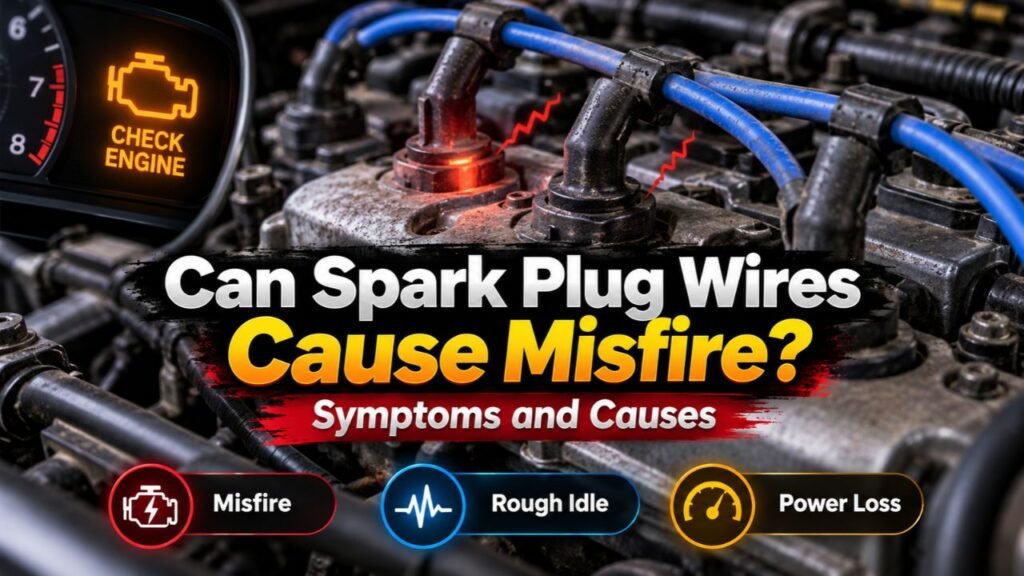
Yes, spark plug wires can cause a misfire if they cannot reliably carry the ignition system’s high voltage from the coil or distributor to the spark plug.
A spark plug requires thousands of volts to create an electrical arc across its electrodes. The exact voltage required varies according to the ignition system, spark plug gap, cylinder pressure, and engine operating conditions.
A damaged wire can allow part or all of that electrical energy to escape before it reaches the spark plug.
This may result in:
- Intermittent misfires
- Constant cylinder misfire
- Rough idle
- Hesitation during acceleration
- Loss of engine power
- Check engine light
- Poor fuel economy
A plug wire does not have to be completely broken to cause problems. Internal resistance, deteriorated insulation, damaged terminals, or electrical leakage can all interfere with proper ignition.
How Spark Plug Wires Work
Spark plug wires are high-voltage electrical cables used on certain ignition systems.
Their job is to carry electrical energy from the:
- Ignition coil
- Coil pack
- Distributor, on older systems
to the individual spark plugs.
The spark plug then uses this voltage to produce a spark inside the combustion chamber.
Modern vehicles increasingly use coil-on-plug ignition, where an individual ignition coil sits directly over each spark plug. These engines normally do not have traditional long spark plug wires.
However, many older vehicles and some engine designs use wires between coils and plugs.
How Bad Spark Plug Wires Cause a Misfire
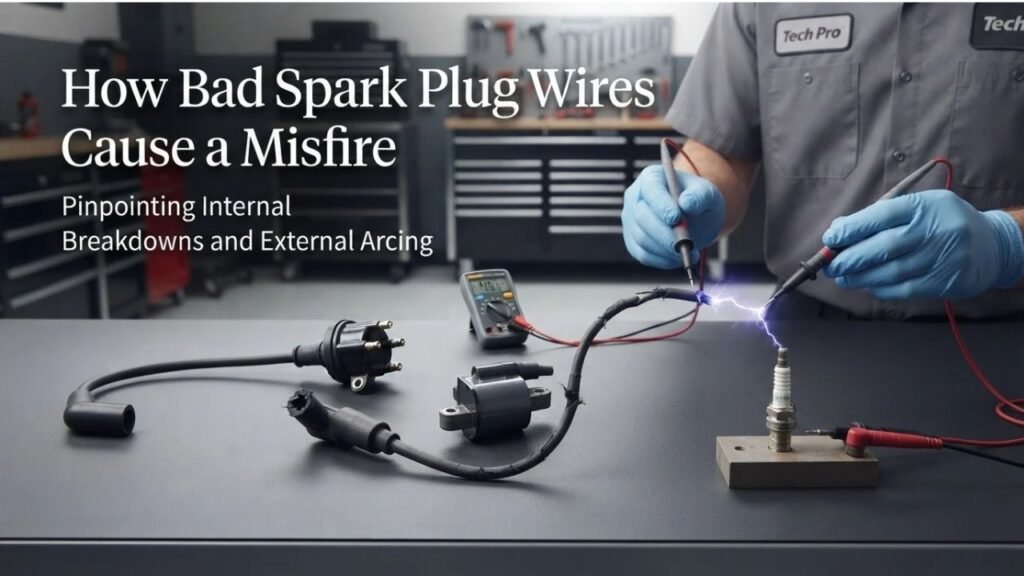
Several different wire failures can interrupt ignition.
Cracked or Damaged Insulation
Spark plug wires are surrounded by insulation that keeps high voltage inside the cable.
Heat, age, chemicals, and vibration can eventually cause the insulation to:
- Crack
- Harden
- Split
- Burn
- Deteriorate
Electricity can then escape through the damaged area instead of reaching the plug.
This is commonly called voltage leakage.
Excessive Internal Resistance
Spark plug wires are designed with a specific amount of electrical resistance.
As wires age or deteriorate internally, resistance can become excessive.
Too much resistance may reduce the energy delivered to the spark plug enough to cause ignition problems.
Broken Internal Conductor
The conductive core inside a plug wire can break.
The wire may look perfectly normal externally while making an unreliable electrical connection internally.
Engine vibration can make the connection appear and disappear, creating an intermittent misfire.
Loose Spark Plug Connection
The wire terminal must make secure contact with the spark plug.
If the boot is not completely seated, the electrical connection may be weak.
This often happens after spark plug replacement when a boot has not fully snapped into place.
Loose Coil or Distributor Connection
The opposite end of the wire must also be properly connected to the coil, coil pack, or distributor.
A loose terminal can create the same symptoms as a bad connection at the plug.
Burned Plug Wire
Spark plug wires routed too close to an exhaust manifold or another hot engine component can become damaged.
A melted or burned section may allow high voltage to leak to ground.
Correct wire routing is therefore important.
Moisture Around the Ignition System
Water can make an already weak ignition system more likely to misfire.
That is why some vehicles with deteriorating plug wires may run normally when dry but misfire after:
- Heavy rain
- Washing the engine compartment
- Driving through deep water
- Humid weather
Healthy ignition wires should still be properly insulated, so repeated wet-weather misfires can indicate deteriorated components.
Can One Spark Plug Cause a Misfire?
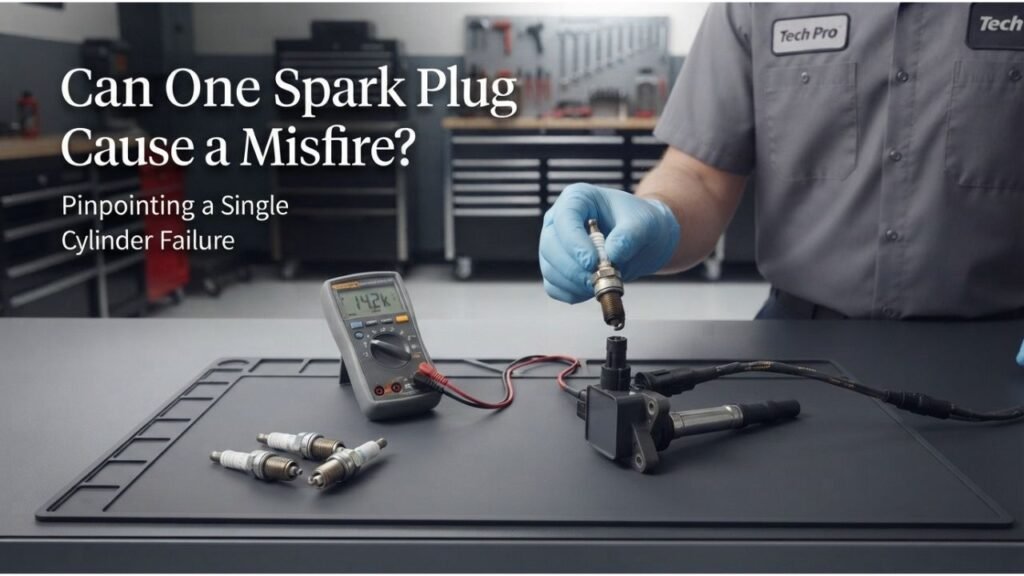
Yes. One bad spark plug can cause a misfire in a single cylinder.
Each cylinder normally has its own spark plug. If one plug cannot create a strong spark at the correct time, that cylinder may fail to burn its air-fuel mixture properly.
The remaining cylinders may continue operating, which is why an engine can still run with one misfiring cylinder.
However, it will usually run rougher and produce less power.
One spark plug may misfire because it is:
- Worn
- Fouled
- Cracked
- Incorrectly gapped
- Contaminated
- Damaged during installation
- Loose
- Incorrect for the engine
A plug can also appear faulty when the true problem is the ignition coil, wire, injector, or cylinder itself.
Common Spark Plug Problems That Cause Misfires
Worn Electrodes
Every spark plug gradually wears as it fires.
As the electrodes erode, the spark gap can increase.
A larger gap requires more ignition voltage.
Eventually, the ignition system may struggle to fire the plug consistently, particularly:
- During acceleration
- Under heavy engine load
- At high cylinder pressure
Fouled Spark Plug
A spark plug can become coated with deposits that interfere with spark formation.
Common types of contamination include:
- Carbon
- Engine oil
- Fuel
- Ash deposits
A fouled plug may misfire continuously or intermittently.
The type of deposit can also provide clues about another engine problem.
For example, an oil-fouled plug may indicate that engine oil is entering the combustion chamber.
Cracked Ceramic Insulator
The ceramic portion of a spark plug helps keep high voltage isolated.
A cracked insulator can allow electricity to travel somewhere other than across the electrode gap.
Cracks can result from:
- Physical impact
- Improper installation
- Manufacturing defects
- Incorrect tool use
Incorrect Spark Plug Gap
The spark plug gap is the distance between the center and ground electrodes.
If the gap is too wide, additional voltage is required to produce a spark.
If the gap is incorrect for the engine, misfires can occur.
Some modern fine-wire plugs are pre-gapped and may require special handling. Always follow the plug manufacturer’s and vehicle manufacturer’s recommendations.
Wrong Spark Plug
Spark plugs differ in:
- Heat range
- Thread diameter
- Reach
- Electrode design
- Resistance
- Seat design
Using the wrong plug can cause poor operation or, in extreme cases, engine damage.
Use the exact plug specification approved for the engine.
Common Symptoms of Bad Spark Plug Wires
Plug-wire problems can produce several symptoms.
Rough Idle
The engine may shake or feel uneven while sitting at a stop.
A single-cylinder misfire is often especially noticeable at idle.
Hesitation During Acceleration
Ignition systems experience greater demands when cylinder pressure increases.
A weak plug wire may work during light cruising but begin misfiring when you accelerate.
Loss of Power
A misfiring cylinder contributes less power than a properly operating cylinder.
The vehicle may feel slower than normal.
Check Engine Light
Modern engine computers monitor crankshaft speed and combustion consistency.
When the computer detects repeated misfires, it may turn on the check engine light and store a trouble code.
Poor Fuel Economy
Misfires waste fuel and reduce combustion efficiency.
A prolonged ignition problem may noticeably lower fuel economy.
Engine Surging or Stumbling
An intermittent electrical connection can cause the engine to alternate between normal operation and misfiring.
This can feel like stumbling, bucking, or surging.
Misfire Trouble Codes
An OBD-II diagnostic scanner can provide useful information.
Common misfire codes include:
- P0300 – Random or multiple-cylinder misfire detected
- P0301 – Cylinder 1 misfire detected
- P0302 – Cylinder 2 misfire detected
- P0303 – Cylinder 3 misfire detected
- P0304 – Cylinder 4 misfire detected
The pattern continues for engines with additional cylinders.
For example, P0306 generally indicates a detected misfire involving cylinder 6.
However, a trouble code identifies where the computer detected the misfire. It does not automatically identify the failed part.
A P0302 code does not necessarily mean cylinder 2 needs a new spark plug.
The cause could instead be:
- Plug wire
- Ignition coil
- Fuel injector
- Vacuum leak
- Low compression
- Wiring problem
- Mechanical engine problem
Diagnosis is still required.
Flashing vs. Steady Check Engine Light
A steady check engine light indicates that the engine computer has detected a fault.
A flashing check engine light during a severe misfire deserves more immediate attention.
Repeated misfiring can send unburned fuel into the exhaust system.
That fuel can overheat and damage the catalytic converter, which can turn a relatively inexpensive ignition problem into a much more expensive repair.
If the check engine light flashes while the engine runs extremely rough, reduce driving and have the vehicle diagnosed promptly.
How to Check Spark Plug Wires for Misfire Problems
Several checks can help identify a bad wire.
Inspect the Wires Visually
With the engine off and cool, inspect each wire.
Look for:
- Cracks
- Burns
- Cuts
- Melted insulation
- Oil contamination
- Damaged boots
- Corroded terminals
Pay particular attention to places where the wire contacts hot or sharp components.
Check That Every Wire Is Fully Seated
Make sure each wire is securely attached at both ends.
If the wires were recently removed for maintenance, confirm that none have been left partially connected.
Verify Wire Routing
On distributor-based engines, each wire must connect the correct distributor terminal to the correct cylinder.
Incorrect routing can change the firing sequence and cause severe misfires.
Use the vehicle’s correct firing-order diagram.
Measure Wire Resistance
Some spark plug wires can be tested using a digital multimeter.
Disconnect the wire and measure resistance from one terminal to the other.
The acceptable value depends heavily on:
- Wire design
- Wire length
- Manufacturer specifications
Do not assume there is one universal resistance value for every plug wire.
Compare the measurement with the service specifications for the vehicle or wire set.
An open circuit or dramatically abnormal reading can indicate a damaged conductor.
Should You Spray Water on Plug Wires to Find a Misfire?
You may see older diagnostic methods that involve spraying water around ignition wires while the engine is running and watching for electrical arcing.
Although moisture can make insulation leakage easier to detect, intentionally working around a running high-voltage ignition system carries unnecessary risk.
A safer approach for most DIYers is to:
- Inspect the wires with the engine off.
- Test resistance when appropriate.
- Use a scan tool to identify affected cylinders.
- Have suspected high-voltage leakage tested professionally.
Avoid touching ignition wires while the engine is running.
Ignition systems can generate very high voltage.
How to Test Whether One Spark Plug Is Causing the Misfire
If a scanner identifies a specific cylinder, the plug can be inspected.
For example, suppose the engine has a P0303 code.
Cylinder 3’s spark plug can be removed and compared with plugs from other cylinders.
Look for:
- Heavy carbon buildup
- Oil contamination
- Cracked ceramic
- Excessively worn electrodes
- Incorrect gap
- Physical damage
An experienced technician may also swap certain components between cylinders as part of diagnosis.
If the misfire moves to the cylinder receiving the suspect component, that provides strong evidence that the component is responsible.
The exact procedure depends on the ignition system.
Can You Replace Only One Spark Plug?
Technically, yes. If one spark plug has a confirmed isolated defect and the other plugs are relatively new and in good condition, replacing only that plug can sometimes be reasonable.
However, spark plugs are commonly replaced as a complete set when they have reached their scheduled service interval.
If one old plug is worn because of normal mileage, the others are likely worn as well.
Replacing the complete set can provide:
- More consistent ignition
- Equal plug age
- More predictable maintenance
- Reduced chance of another plug failing shortly afterward
If one new plug fails because of a unique defect or contamination issue, replacing the entire set may not always be necessary.
Should Spark Plug Wires Be Replaced as a Set?
In many cases, yes.
Plug wires age under similar conditions.
If one old wire has deteriorated because of heat and age, the others may not be far behind.
Replacing the entire wire set can make sense when:
- The wires are old.
- Multiple wires have visible cracking.
- Several resistance readings are abnormal.
- They have accumulated high mileage.
- The manufacturer’s maintenance schedule calls for replacement.
If one relatively new wire was physically damaged during another repair, replacing only that wire may be reasonable if an exact replacement is available.
Can New Spark Plug Wires Still Cause a Misfire?
Yes.
New wires can cause misfires if they are:
- Incorrectly routed
- Not fully seated
- Damaged during installation
- Poorly manufactured
- Wrong for the vehicle
On older distributor systems, connecting just two wires to the wrong cylinders can make the engine run very poorly.
If a misfire begins immediately after plug-wire replacement, recheck the installation first.
Can Spark Plugs Misfire Only Under Load?
Yes.
A weak ignition system may appear normal at idle but misfire during acceleration.
Cylinder pressure increases under load, making it more difficult for the spark to jump the plug gap.
Problems that may appear mainly under load include:
- Worn spark plugs
- Excessive plug gap
- Weak ignition coils
- Deteriorated plug wires
- Poor wire terminals
This is why some ignition faults appear only when climbing a hill or accelerating onto a highway.
Can Spark Plug Wires Cause a Random Misfire?
Yes.
If multiple plug wires are old or damaged, the engine may produce misfires across several cylinders.
This may trigger a P0300 random/multiple-cylinder misfire code.
However, P0300 has many other possible causes, including:
- Vacuum leaks
- Fuel-delivery problems
- Low fuel pressure
- Multiple ignition failures
- Incorrect air-fuel mixture
- Mechanical engine problems
Do not automatically replace plug wires whenever a P0300 code appears.
Other Problems That Can Cause a Misfire
Spark plugs and wires are only two possible causes.
Bad Ignition Coil
A weak or failed coil can prevent a cylinder from receiving sufficient ignition voltage.
Vehicles may use:
- One coil
- Multiple coil packs
- One coil per cylinder
A bad coil often produces symptoms very similar to a bad spark plug.
Fuel Injector Problem
A cylinder needs the correct amount of fuel.
A clogged, electrically failed, or mechanically stuck injector can cause a cylinder misfire even when the ignition system works perfectly.
Vacuum Leak
Unmetered air entering the engine can make the air-fuel mixture too lean.
Some intake leaks primarily affect one cylinder, while others affect several cylinders.
Low Compression
Ignition and fuel can both work correctly and the cylinder can still misfire if it cannot build sufficient compression.
Possible mechanical causes include:
- Burned valve
- Damaged piston
- Worn piston rings
- Head-gasket failure
- Valve-train problem
Fuel Pressure Problems
Insufficient fuel pressure can cause multiple-cylinder misfires, especially under load.
Possible causes include a weak fuel pump or other fuel-system faults.
Can Driving With a Misfire Damage the Engine?
Continuing to drive with a significant misfire is not a good idea.
The immediate risk often depends on the cause and severity.
A severe ignition misfire can allow unburned fuel to enter the catalytic converter, potentially overheating it.
A misfire caused by another mechanical issue could also indicate a more serious engine problem.
Have persistent misfires diagnosed rather than continuing to drive until the engine barely runs.
Spark Plug Wire vs. Spark Plug Misfire Symptoms
The symptoms often overlap, which is why diagnosis matters.
| Symptom | Bad Spark Plug Wire | Bad Spark Plug |
| Rough idle | Yes | Yes |
| Misfire under acceleration | Yes | Yes |
| Check engine light | Yes | Yes |
| Reduced power | Yes | Yes |
| Poor fuel economy | Yes | Yes |
| Visible cracked insulation | Common clue | No |
| Worn electrode | No | Common clue |
| Fouled tip | No | Common clue |
| Electrical leakage | Possible | Possible through damaged insulator |
| Wet-weather misfire | More suggestive | Possible |
Symptoms alone usually cannot prove which component has failed.
Common Mistakes When Diagnosing an Ignition Misfire
Replacing Spark Plugs Without Diagnosing the Cause
A new plug may temporarily improve the condition but quickly become fouled again if an oil, fuel, or mechanical problem exists.
Assuming a Misfire Code Means a Bad Spark Plug
A cylinder-specific code tells you which cylinder is misfiring, not why.
Installing Plug Wires in the Wrong Order
Incorrect firing order can cause immediate severe engine problems.
Replace wires one at a time when possible to avoid mixing them up.
Pulling on the Wire Instead of the Boot
When removing a plug wire, grip the boot rather than pulling directly on the cable.
Pulling the wire itself can damage the internal conductor.
Ignoring Oil Around the Spark Plugs
Some engines can leak oil into the spark plug wells.
Oil contamination can affect ignition components and indicate a valve-cover gasket or tube-seal problem.
Fix the leak rather than simply cleaning the plug repeatedly.
When to Have the Misfire Professionally Diagnosed
Professional diagnosis is a good idea if:
- The check engine light is flashing.
- The engine shakes severely.
- You cannot identify the misfiring cylinder.
- New plugs did not solve the problem.
- The same spark plug repeatedly fouls.
- Compression may be low.
- The misfire occurs only under specific loads.
- The vehicle uses a complex modern ignition system.
- Multiple trouble codes are present.
A technician may use scan-tool data, ignition testing equipment, compression testing, fuel-injector testing, and other diagnostic methods to identify the root cause.
FAQs About Can Spark Plug Wires Cause Misfire
Can bad spark plug wires cause a constant misfire?
Yes.
A wire with a broken conductor, severe insulation damage, or poor terminal connection can prevent a cylinder from firing consistently.
A less severe wire problem may cause only intermittent misfires.
Can spark plug wires cause a misfire only when accelerating?
Yes.
Higher cylinder pressure during acceleration places greater demand on the ignition system. A weak wire may work at idle but allow ignition voltage to leak under load.
Can one spark plug cause a misfire?
Yes. One defective, fouled, worn, damaged, or incorrectly gapped spark plug can cause the cylinder it serves to misfire.
Other cylinders may continue operating normally.
Can one bad spark plug make the whole engine shake?
Yes.
Even one misfiring cylinder can make the engine noticeably shake, especially at idle.
The effect may be more noticeable on engines with fewer cylinders.
Can a bad spark plug wire trigger a check engine light?
Yes.
If the damaged wire causes enough misfires, the engine computer can detect them and illuminate the check engine light.
A cylinder-specific P0301–P0308-type code may be stored depending on the affected cylinder.
How can you tell if a spark plug wire is bad?
Look for damaged insulation, burned areas, loose terminals, corrosion, and abnormal resistance.
A scan tool can help identify which cylinder is misfiring, but additional testing is normally needed to prove that the wire is responsible.
Should I replace spark plugs if I replace spark plug wires?
Not automatically.
Inspect the spark plugs and consider their age and maintenance interval.
If the plugs are already due for replacement, doing both jobs together can make sense.
Will changing spark plugs fix a misfire?
It will if worn, fouled, incorrectly gapped, or damaged spark plugs are the actual cause.
Changing plugs will not fix a misfire caused by an ignition coil, plug wire, injector, compression problem, vacuum leak, or another engine fault.
Conclusion
So, can spark plug wires cause misfire? Yes. Worn insulation, excessive internal resistance, broken conductors, loose terminals, incorrect routing, and heat damage can all prevent enough ignition voltage from reaching the spark plug.
Likewise, one spark plug can cause a misfire in a single cylinder if the plug is worn, fouled, cracked, incorrectly gapped, or otherwise defective.
Because ignition coils, fuel injectors, vacuum leaks, fuel-delivery problems, and low compression can produce many of the same symptoms, avoid replacing parts based on the misfire code alone. Identify the affected cylinder, inspect the ignition components carefully, and diagnose the underlying cause before deciding which parts need replacement.