
What is the spark plug gap on a 5.7 350? For many classic Chevrolet 350 small-block engines, the commonly used gap is about 0.035 inch with an older points-style ignition and around 0.045 inch with many HEI ignition systems. However, there is no single spark plug gap for every 5.7L 350. The correct specification depends on the engine year, ignition system, cylinder heads, spark plug, and specific Chevrolet application.
That distinction is important because Chevrolet produced the 350-cubic-inch V8 in many configurations over several decades. For example, Chevrolet’s 1979 specifications list a 0.045-inch gap for its 5.7L V8 with HEI, while a 1994 Caprice 5.7L LT1 specifies 0.050 inch. Chevrolet Performance 350 crate engines also vary: some specify 0.045 inch, while the SP350 specification lists 0.040 inch.
So if you simply have an older carbureted small-block Chevy 350, 0.035 or 0.045 inch are the two numbers you are most likely to encounter—but you should identify the ignition system and engine before setting the plugs.
In this guide, I’ll explain the correct spark plug gap for common Chevy 350 configurations, why points and HEI engines use different gaps, how to determine the specification for your exact 5.7L, how to measure and adjust the gap, and what happens when the gap is too wide or too narrow.
What Is the Spark Plug Gap on a 5.7 350?
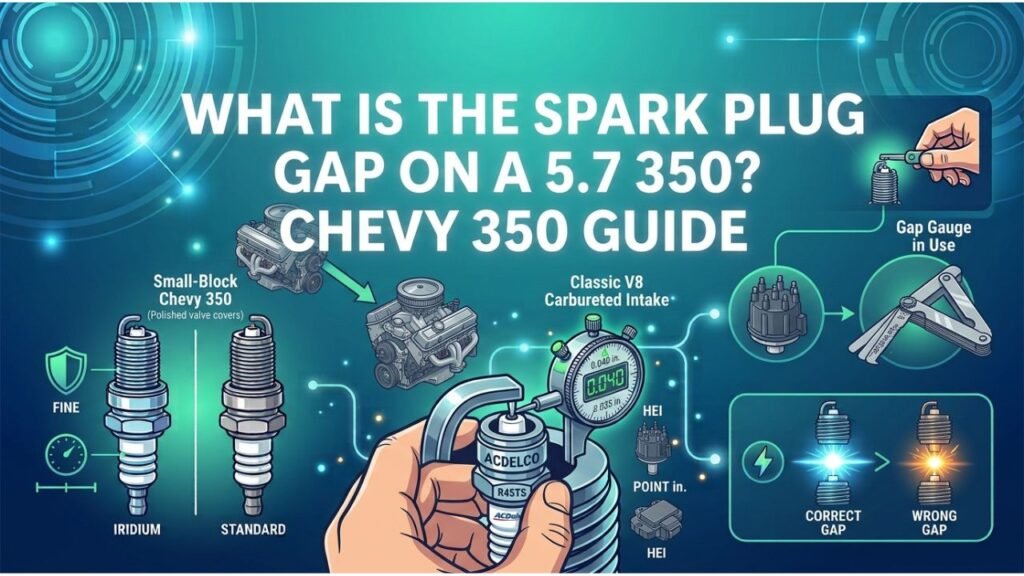
For a traditional Chevrolet small-block 350, a useful starting guide is:
| 5.7L / 350 Configuration | Typical or Specified Gap |
| Older points-style small-block 350 | About 0.035 in. |
| Many classic HEI-equipped 350s | About 0.045 in. |
| Chevrolet Performance 350/265 | 0.045 in. |
| Chevrolet Performance CT350 | 0.045 in. |
| Chevrolet Performance SP350 | 0.040 in. |
| 1994 Chevrolet Caprice LT1 5.7L/350 | 0.050 in. |
Historical Chevrolet specifications help show why the answer cannot be reduced to one number. A 1968 Chevrolet specification lists spark plug gaps of 0.033–0.038 inch for the engines covered in that application, essentially the traditional 0.035-inch neighborhood associated with many breaker-point systems. By 1979, Chevrolet specified 0.045 inch for its 5.0L and 5.7L V8s using HEI.
That change makes sense because ignition technology changed.
A stronger ignition can generally support a larger spark plug gap because it can develop enough voltage to jump the increased distance reliably.
The Most Important Rule
Do not set your plugs to 0.035 inch simply because the engine displacement is 350 cubic inches.
And do not automatically set every HEI 350 to 0.045 inch either.
The engine’s year, ignition system, plug design, and manufacturer specification should determine the final setting.
Key Takeaways:
- Older points-equipped Chevy 350s are commonly around 0.035 inch.
- Many classic HEI 350 applications use around 0.045 inch.
- Some later or performance 5.7L engines specify 0.040 or 0.050 inch, so verify the exact application.
Why Does the Chevy 350 Spark Plug Gap Vary?
The spark plug gap is the distance between the center electrode and ground electrode at the firing end of the plug.
The ignition coil has to generate enough voltage for electricity to jump that space.
A larger gap can expose more of the air-fuel mixture to the initial spark kernel, but it also requires more voltage.
A smaller gap requires less voltage but produces a spark across a shorter distance.
The correct gap is therefore matched to the ignition system and combustion requirements.
Breaker Points vs. HEI
Early small-block Chevy engines commonly used a distributor with mechanical breaker points.
These ignition systems have less available spark energy than later electronic designs, so relatively modest plug gaps are normal.
A gap around 0.035 inch is therefore common on older points-style Chevrolet V8 applications.
GM’s HEI, or High Energy Ignition, became widely used in the 1970s.
As the name suggests, HEI provides considerably greater ignition capability than older breaker-point systems.
That allowed Chevrolet to use wider spark plug gaps in many applications. GM’s 1979 specifications explicitly identify the 5.7L V8 as using HEI and specify a 0.045-inch spark plug gap.
Electronic Fuel Injection Did Not Create One Universal Gap
Later 350 engines received throttle-body injection, tuned-port systems, computer-controlled distributors, and other ignition changes.
It is tempting to assume all later electronic engines use the same setting.
They do not.
A 1994 Chevrolet Caprice with the 5.7L LT1, for example, specifies a 0.050-inch gap.
This is why knowing that an engine is simply a “5.7 Chevy” is not enough for a precise tune-up specification.
Is the Spark Plug Gap .035 or .045 on a Chevy 350?
Both can be correct.
If you have an older traditional small-block Chevy with a breaker-point distributor, approximately 0.035 inch is a common specification.
If the same general engine family has been equipped with a GM-style HEI distributor, 0.045 inch is frequently encountered.
However, an ignition conversion complicates things.
Suppose you have a 1969 small-block 350 that originally used points but someone later installed an HEI distributor.
The original vehicle specification may have been based on the weaker points ignition.
The upgraded ignition may support a different gap.
In a modified engine like this, I would determine which distributor, coil, spark plugs, cylinder heads, and ignition components are actually installed rather than blindly following the vehicle’s original tune-up sticker.
Should You Automatically Open the Gap After Installing HEI?
Not necessarily.
A stronger ignition gives you the capability to run a wider gap, but that does not mean the largest gap possible is automatically best.
Compression ratio, boost, plug condition, coil output, plug wires, engine speed, and combustion pressure all affect the voltage required to fire the plug.
For a mostly stock naturally aspirated small-block Chevy with conventional HEI, the factory-style specification is generally the sensible target.
For modified engines, use the recommendation supplied by the ignition and spark plug manufacturers or by the engine builder.
Chevy Performance 350 Spark Plug Gaps
Current and recent Chevrolet Performance documentation demonstrates how even new crate engines carrying the 350 name do not all use one gap.
The Chevrolet Performance 350/265 specification lists AC Delco R45TS spark plugs at 0.045 inch. The CT350 specification also lists a 0.045-inch gap.
The Chevrolet Performance SP350, however, lists an AC Delco MR43LTS plug with a 0.040-inch gap.
These engines all belong to the broader Chevrolet 350 world, yet their published gaps differ.
That makes the correct diagnostic approach clear: identify the exact engine rather than searching only by displacement.
How to Find the Correct Spark Plug Gap for Your 5.7 350
If you do not know which number applies to your engine, begin by identifying the vehicle and ignition system.
Start With the Year, Make, and Model
“Chevy 350” describes an engine displacement, not one specific tune-up configuration.
A 1970 Camaro 350, 1979 pickup 350, 1994 Caprice LT1, and Chevrolet Performance crate 350 may all require different parts or specifications.
The vehicle year is therefore the easiest first filter.
Identify the Ignition System
Look at the distributor.
A classic points distributor is relatively small and uses mechanical breaker points internally.
A traditional GM HEI distributor has a much larger cap, with the ignition coil commonly mounted inside the top of the cap.
If the engine has been modified, do not assume the distributor is original.
Many older small-block Chevys were converted from points to HEI decades ago.
Identify the Spark Plug
Read the part number printed on the plug.
The correct gap should be compatible with both the engine and the exact plug design.
Do not assume two plugs that physically screw into the same cylinder head should automatically use identical settings.
Reach, heat range, seat design, resistor configuration, and electrode construction can differ.
Check the Under-Hood Emissions or Tune-Up Label
On many vehicles, an emissions or tune-up label under the hood provides useful engine specifications.
If the vehicle retains its original engine and ignition system, this can be one of the most convenient references.
On a swapped or extensively modified engine, however, the original label may no longer apply.
Use the Factory Service Information
When available, the factory specification for the exact year and engine is the best reference.
This is particularly important for later computer-controlled 5.7L engines, where guessing from an earlier small-block specification can give you the wrong gap.
Is a Chevy 5.7 Always a 350?
No, and this causes considerable confusion.
A traditional Chevrolet 350 has approximately 350 cubic inches of displacement and is commonly described as a 5.7L engine.
But Chevrolet later used the 5.7L designation for other engine families.
For example, the LS1 used in a 2001 Corvette is identified as a 5.7L V8 but has 346 cubic inches of displacement rather than being a traditional 350 small-block. Chevrolet specified a 0.060-inch plug gap for that particular 2001 Corvette application.
That is another reason searching only for “5.7 spark plug gap” can produce seemingly contradictory answers.
If you specifically mean the classic Gen I Chevrolet 350 small-block, say “SBC 350” when searching specifications.
If you mean an LT1, Vortec 5.7, LS1, or a particular truck engine, identify that separately.
Key Takeaways:
- “5.7L” does not always mean the classic 350 small-block.
- Identify the engine family before using a gap specification.
- Engine swaps and ignition conversions can make the original vehicle specification inappropriate.
What Spark Plug Gap for a 350 With Points Ignition?
For a classic small-block Chevrolet running a conventional breaker-point ignition, approximately 0.035 inch is a common target.
Historical Chevrolet data supports this general range. Chevrolet’s 1968 specifications list 0.033–0.038 inch in the relevant ignition data, placing the nominal setting near 0.035 inch.
A slightly narrower gap is appropriate because the points-style ignition has more limited voltage and spark-energy capability than a later HEI system.
If you open the gap too far on a weak points ignition, the engine may run acceptably at idle but begin misfiring under acceleration or high cylinder pressure.
That is because it becomes harder for the spark to jump the gap as cylinder pressure increases.
What Spark Plug Gap for a 350 With HEI?
For many classic GM HEI-equipped 350s, 0.045 inch is a common factory-style setting.
GM’s 1979 Chevrolet specifications list the 5.7L V8 with HEI and a 0.045-inch plug gap. Chevrolet Performance also specifies 0.045 inch for several current/recent 350 configurations using compatible ignition setups.
However, do not assume every aftermarket HEI distributor automatically requires 0.045 inch.
Some high-performance ignition manufacturers may recommend another setting depending on coil output and engine configuration.
If you installed an aftermarket HEI system, follow its tuning guidance.
What Spark Plug Gap for a Modified Chevy 350?
A modified engine deserves more caution.
Changes such as higher compression, forced induction, nitrous oxide, aftermarket cylinder heads, performance coils, or ignition boxes can alter the ideal gap.
High Compression
Higher cylinder pressure makes it more difficult for a spark to jump the electrode gap.
An engine with substantially increased compression may require a smaller gap than a mild street engine even if it has a strong ignition system.
Supercharged or Turbocharged 350
Boost greatly increases cylinder pressure.
Performance tuners often reduce spark plug gap on boosted engines to help prevent spark blowout under load.
There is no universal reduced-gap number for every boosted small-block Chevy.
The correct setting depends on boost level, ignition output, plug type, and engine combination.
High-Energy Aftermarket Ignition
A high-output coil or capacitive-discharge ignition may support a wider gap than a stock points ignition.
But wider is not automatically better.
If the engine runs cleanly at the recommended gap, increasing it simply because the ignition can fire a wider gap may provide little benefit while demanding more voltage from the coil and wires.
How to Measure the Spark Plug Gap
Use a proper spark plug gap gauge.
Wire-style gauges are particularly useful because the round wire measures the actual distance between the electrodes without relying on a tapered edge.
Slide the gauge between the center electrode and ground strap.
You should feel a light, controlled drag when the gauge matches the gap.
For example, if the specification is 0.045 inch, the 0.045-inch gauge should pass with slight resistance.
A smaller gauge should move more freely, while a meaningfully larger one should not pass normally.
Do Not Measure From the Wrong Point
Measure at the closest working surfaces of the center and ground electrodes.
Do not measure from an unusual edge or the side of a worn electrode.
Old plugs can develop rounded electrodes that make accurate gap measurement more difficult.
If the electrodes are badly worn, replace the plugs rather than trying to restore them simply by adjusting the gap.
How to Adjust the Spark Plug Gap
If the gap is too small, gently bend the ground electrode away from the center electrode using the proper gap tool.
If it is too wide, carefully move the ground electrode inward.
Apply force only to the ground strap.
Do not pry against the center electrode or ceramic insulator.
After each small adjustment, measure again.
The goal is accuracy, not speed.
Be Careful With Fine-Wire Plugs
Modern platinum and iridium spark plugs may use extremely small center electrodes.
Aggressive gapping can damage these fine-wire tips.
Some pre-gapped specialty plugs should not be adjusted at all unless the manufacturer specifically permits it.
ACDelco, for example, warns that certain GM OE iridium plugs are pre-gapped during manufacturing and should be replaced rather than forcibly adjusted if the gap is incorrect.
For a traditional SBC using conventional copper plugs such as certain R45-series designs, normal careful gap adjustment is much less problematic.
What Happens if the Spark Plug Gap Is Too Wide?
An excessively wide gap requires higher ignition voltage.
If the coil and ignition system cannot consistently provide it, the spark may fail to jump the electrodes.
Symptoms can include hard starting, hesitation, rough acceleration, or misfires under load.
The engine may run normally at idle yet stumble when accelerating because cylinder pressure rises under load and makes the gap more difficult to fire.
A wide gap also increases electrical stress on the coil, distributor components, plug wires, and boots because the ignition system has to generate more voltage before the spark occurs.
What Happens if the Spark Plug Gap Is Too Narrow?
A narrow gap is usually easier for the ignition system to fire.
However, the spark occurs across a smaller distance.
If the gap is significantly below specification, combustion quality and performance can suffer.
Possible symptoms include less efficient combustion, poor throttle response, or fouling in certain operating conditions.
The engine may still run, which can make an overly narrow gap less obvious than an excessively wide one.
The correct approach is not to intentionally narrow the plugs simply because doing so makes misfires disappear.
If the engine cannot fire the specified gap, investigate the ignition system unless the engine combination genuinely requires a reduced performance setting.
Does Spark Plug Brand Change the Required Gap?
Usually, the engine’s required ignition specification is the primary consideration, but plug design also matters.
Replacement spark plugs from different brands may be sold pre-gapped near the intended application specification.
Never assume they arrived perfectly adjusted.
Shipping and handling can bend a ground electrode.
Check conventional adjustable plugs before installation.
At the same time, do not change the gap on a specialty fine-wire plug unless the manufacturer allows it.
Heat Range Is Different From Gap
A plug’s heat range describes its ability to transfer heat from the firing tip into the cylinder head.
It is not the same as spark plug gap.
You can have two plugs with identical gaps but different heat ranges.
Modified Chevy 350 engines often require careful heat-range selection in addition to gap tuning, especially with high compression, sustained high load, nitrous, or forced induction.
Should All Eight Spark Plugs Have the Same Gap?
Yes, assuming they are all the same correct plug and the engine does not use an unusual cylinder-specific specification.
Consistency matters.
If seven plugs measure 0.045 inch and one measures 0.030 inch, that cylinder’s ignition event will not be operating under the same conditions as the others.
Before installation, check all eight plugs individually.
This takes only a few minutes and removes one potential cause of an uneven idle or misfire.
When Should You Recheck Spark Plug Gap?
Conventional spark plug electrodes wear with use.
As material gradually erodes, the gap can increase.
Older copper/nickel plugs generally require replacement more frequently than modern long-life platinum or iridium designs.
If a classic Chevy 350 develops a high-load misfire after many miles, inspecting plug condition and gap is a reasonable part of diagnosis.
However, if the plugs are badly worn or fouled, replacement is usually better than repeatedly regapping old plugs.
Spark Plug Gap and Ignition Timing Are Different
These two tune-up specifications are sometimes confused.
Spark plug gap is the physical spacing between electrodes.
Ignition timing determines when the spark occurs relative to piston position.
Changing one does not automatically correct the other.
A Chevy 350 can have perfectly gapped plugs and still run badly because timing is incorrect.
Likewise, perfect ignition timing cannot compensate for plugs that have gaps too wide for the ignition system to fire reliably.
A proper tune-up considers both.
Spark Plug Gap and Plug Wire Condition
Plug wires become particularly important as gap increases.
A wider gap requires greater voltage.
If an old spark plug wire has damaged insulation, the voltage may find an easier path to ground before reaching the spark plug.
This can create an intermittent misfire that appears only under load.
If you are converting an older 350 to HEI and increasing the gap, inspect the plug wires, distributor cap, rotor, and coil at the same time.
A stronger ignition system still cannot perform properly through deteriorated secondary ignition components.
Key Takeaways:
- A wide plug gap demands more voltage and can reveal weak coils, wires, or distributor components.
- A gap that is too narrow may still run but is not automatically ideal.
- Set all eight plugs consistently and diagnose the whole ignition system if the correct gap causes misfires.
Common Mistakes When Gapping Chevy 350 Spark Plugs
One of the most common mistakes is treating every 350 Chevrolet engine as identical.
The engine was produced for too many years and applications for one universal number to be reliable.
Another mistake is installing spark plugs directly from the box without inspecting them.
Even plugs advertised as pre-gapped can be damaged during transport.
A third mistake is forcing a fine-wire electrode with an unsuitable gap tool.
Always move the ground strap rather than prying against the center electrode.
Finally, do not confuse spark plug part-number gap information with the specification for your exact engine.
A particular ACDelco plug may be sold with a certain nominal gap, but the same basic plug family can be used in different applications.
FAQs about What Is the Spark Plug Gap on a 5.7 350
What is the standard spark plug gap for a Chevy 350?
There is no single universal specification.
Around 0.035 inch is common for older points-style small-block 350s, while approximately 0.045 inch is common on many HEI-equipped 350s.
Is a Chevy 350 spark plug gap .035?
It can be.
Approximately 0.035 inch is commonly associated with older breaker-point small-block Chevrolet ignition systems.
Verify the exact year and application.
Is .045 a correct gap for a 350?
Yes, for many HEI-equipped Chevrolet 350 engines.
GM’s 1979 5.7L V8 specification and several Chevrolet Performance 350 applications call for 0.045 inch.
What is the spark plug gap on a Chevy 350 with HEI?
Around 0.045 inch is common for many stock-style HEI setups.
Aftermarket ignition systems and modified engines may use a different specification.
What is the gap for a Chevy 350 with points?
Around 0.035 inch is a common traditional setting.
Historical Chevrolet specifications include a 0.033–0.038-inch range in older applications.
What is the spark plug gap for a Chevrolet Performance 350?
It depends on the specific crate engine.
The CT350 and 350/265 documentation specify 0.045 inch, while the SP350 specification lists 0.040 inch.
What is the spark plug gap for a 1994 Chevy 5.7?
It depends on the vehicle and engine.
For example, GM documentation for the 1994 Chevrolet Caprice 5.7L LT1 specifies 0.050 inch.
Can I gap my Chevy 350 plugs to .060?
Do not use 0.060 inch unless your exact engine and ignition setup specifically calls for it.
That wider setting is used in some other GM 5.7L applications, but it is not a universal Chevy 350 specification.
Does HEI need a wider gap?
HEI can generally support a wider plug gap than older breaker-point ignition because of its greater ignition capability.
Many classic Chevrolet HEI applications therefore use approximately 0.045 inch.
What happens if I gap a points ignition at .045?
The engine may still run, but the older ignition may struggle to fire the wider gap consistently, particularly under load or with worn ignition components.
Use the proper specification for the system.
Can a wrong plug gap cause a misfire?
Yes.
A gap that is too wide can exceed the ignition system’s ability to fire reliably, especially under heavy load.
Plug condition and other ignition components should also be checked.
Should I check new spark plugs before installing them?
Yes, unless the plug manufacturer specifically says not to adjust that plug design.
Check conventional plugs with an appropriate gap gauge before installation.
Does spark plug gap affect fuel economy?
An incorrect gap can contribute to incomplete combustion or misfires, potentially reducing efficiency.
However, fuel economy depends on many other engine and vehicle conditions as well.
Does spark plug gap affect horsepower?
A seriously incorrect gap can reduce performance by causing weak or inconsistent ignition.
Once the engine has a stable spark at the correct specification, simply widening the gap does not guarantee additional horsepower.
Should all eight plugs be exactly the same?
They should all be set consistently to the specification for that engine and plug combination.
Check every plug individually before installation.
How do I know whether my 350 has HEI?
A traditional GM HEI distributor usually has a noticeably large distributor cap with the ignition coil integrated into the cap.
Older points distributors are smaller and contain mechanical breaker points.
Is an LS1 5.7 the same as a Chevy 350?
No.
The LS1 is commonly called a 5.7L but displaces 346 cubic inches and belongs to a different engine family.
Do not use classic SBC 350 tune-up specifications for an LS1.
Conclusion
So, what is the spark plug gap on a 5.7 350? If you mean a traditional Chevrolet small-block 350, about 0.035 inch is common for older points ignition, while about 0.045 inch is common for many HEI-equipped engines.
But neither number is universal.
Chevrolet documentation shows 350-family applications with several different specifications, including 0.040, 0.045, and 0.050 inch depending on the engine. Even engines carrying the same 5.7L or 350 description can use different ignition systems and spark plugs.
The safest approach is to identify the exact year, vehicle, engine family, ignition system, and spark plug before adjusting anything.
If you have a stock classic SBC with points, 0.035 inch is a reasonable clue to investigate. If it has a stock-style HEI distributor, 0.045 inch is a common specification. If it is a Vortec, LT1, crate engine, swapped engine, or modified performance build, verify the specific recommendation instead of applying one generic Chevy 350 number.
Once you know the correct value, check all eight plugs with a proper gap gauge and adjust only the ground electrode when the plug design permits it.
The bottom line is simple: the Chevrolet 350 does not have one universal spark plug gap—the ignition system and exact engine determine the correct setting.