
If an engine cranks but refuses to start, it can be tempting to remove a spark plug and spray starting fluid directly into the cylinder. Starting fluid is extremely combustible, so the idea seems logical: put a little fuel-like vapor inside the combustion chamber and see whether the engine fires.
Yes, an engine may briefly fire if starter fluid is sprayed into a spark plug hole, but doing so is generally not recommended. Starting fluid is highly flammable, can create an overly rich or uncontrolled mixture inside the cylinder, and may increase the risk of backfire, fire, cylinder-wall lubrication loss, or engine damage if too much is used.
There are also safer and more useful ways to determine whether a no-start problem is caused by lack of fuel. Starting fluid, when appropriate for a particular gasoline engine and diagnostic procedure, is normally introduced through the air intake in a very small amount, not poured or heavily sprayed directly into the spark plug hole.
Understanding the difference matters because the spark plug hole leads directly into the combustion chamber. Anything sprayed there goes straight onto the piston, cylinder wall, and potentially the spark plug electrodes after reinstallation.
This guide explains whether you can spray starter fluid in a spark plug hole, why mechanics generally avoid the method, what can happen if you do it, and safer ways to diagnose an engine that cranks but will not start.
Can You Spray Starter Fluid in Spark Plug Hole Safely?
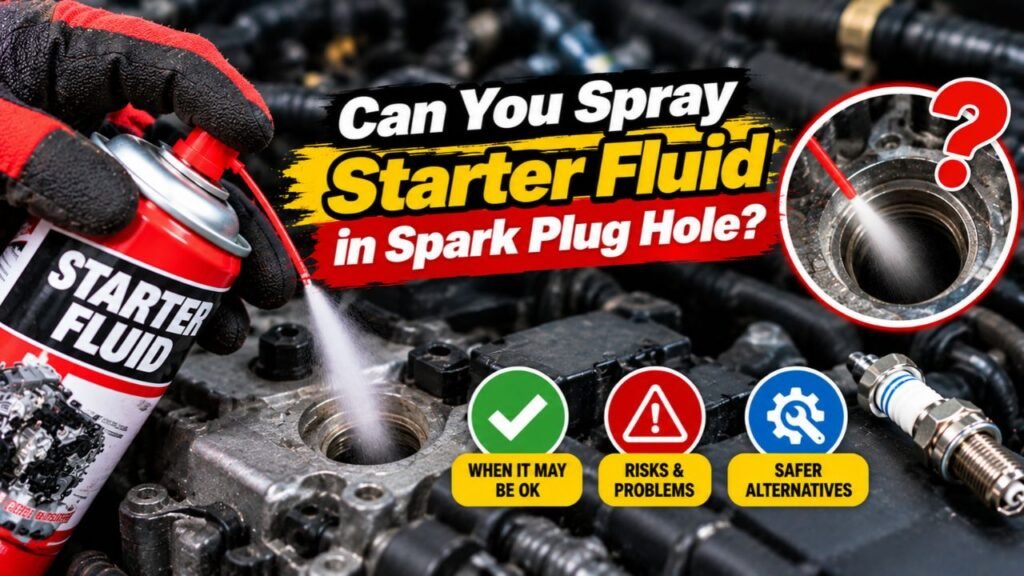
Technically, a small amount of starting fluid inside a gasoline engine’s combustion chamber may ignite when the spark plug fires. However, spraying starting fluid directly through the spark plug hole is not considered a good general diagnostic or starting procedure.
The main problem is control.
When starting fluid is introduced through the intake, incoming air helps mix and distribute the vapor before it reaches the cylinders. When it is sprayed directly into a spark plug hole, the fluid can become concentrated in one cylinder.
That can result in:
- An excessively rich mixture
- Liquid fuel collecting in the cylinder
- Loss of lubricating oil from the cylinder wall
- Spark plug fouling
- Backfire
- Fire outside the engine
- Abnormally harsh combustion
- Misleading diagnostic results
If the engine will not start, it is usually better to diagnose fuel, spark, compression, and timing systematically.
What Is Starting Fluid?
Starting fluid, also called starter fluid, is an aerosol product intended to help some engines start under specific conditions.
Many starting fluids contain highly volatile compounds that ignite more easily than gasoline.
Depending on the product formulation, starting fluid may contain substances such as:
- Ether or other highly volatile hydrocarbons
- Propellants
- Lubricating additives
- Other combustible solvents
Because these ingredients evaporate and ignite easily, starting fluid can help determine whether an engine’s no-start condition is related to fuel delivery.
However, that same high flammability is why it must be used carefully.
Why Spraying Starter Fluid Into the Spark Plug Hole Is Risky
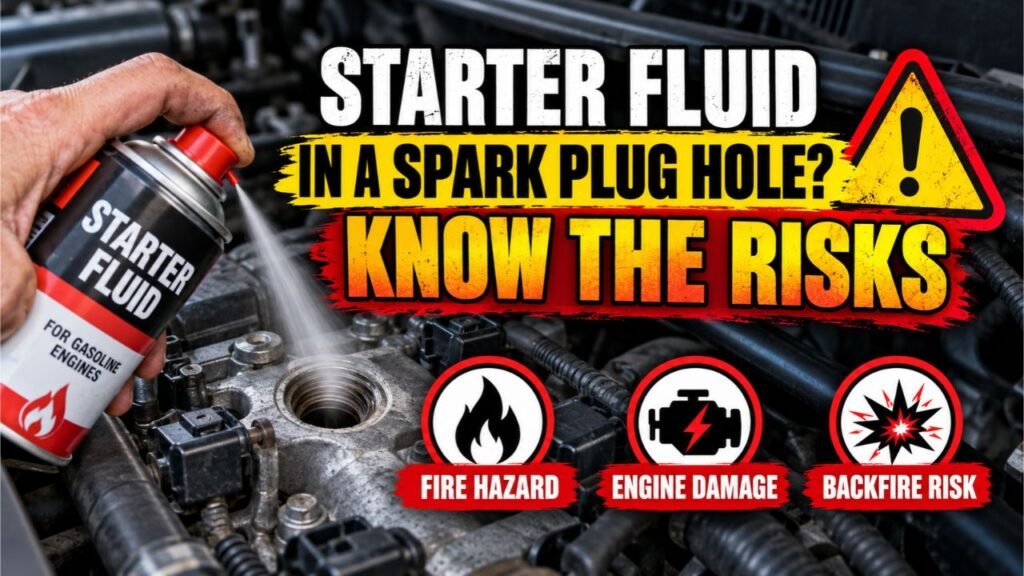
The spark plug opening gives direct access to the combustion chamber.
That makes it very different from spraying a controlled amount into the intake.
Starter Fluid Can Be Too Concentrated
An internal combustion engine needs the correct mixture of fuel and air.
Spraying starting fluid directly into a cylinder can create a concentrated pocket of combustible vapor or liquid.
More starting fluid does not make an engine more likely to start.
In fact, too much can make ignition less predictable.
Liquid Can Collect in the Cylinder
Starting fluid is intended to vaporize rapidly, but excessive spraying can still introduce liquid into the combustion chamber.
A small accidental amount generally will not fill a cylinder, but deliberately spraying large quantities into a spark plug hole is unsafe.
If enough liquid enters a cylinder, the piston may be unable to compress it normally.
This condition is known as hydrolock.
Hydrolock can place extreme force on:
- Connecting rods
- Pistons
- Bearings
- Crankshaft components
Hydrolock from a quick mist of starting fluid would be unusual, but flooding a cylinder with any liquid should be avoided.
Starting Fluid Can Wash Oil From the Cylinder Wall
The cylinder wall normally has a thin lubricating oil film.
Strong petroleum solvents and excessive fuel can dilute or wash away some of this oil.
This is sometimes called cylinder wash or bore wash.
Loss of lubrication can increase friction between:
- Piston rings
- Cylinder walls
- Pistons
A tiny amount used during diagnosis may not cause measurable damage, but repeatedly spraying solvent-based starting products directly into the cylinder is unnecessary and should be avoided.
Can Starter Fluid Damage Spark Plugs?
It can contribute to spark plug problems if excessive fluid is used.
If the cylinder becomes overly wet, the spark plug may become fuel fouled.
A wet plug may have difficulty creating a strong spark across its electrodes.
This can make an already difficult starting problem worse.
If a plug is soaked with fuel or starting fluid, it may need to dry or be cleaned or replaced before the engine will start normally.
Can Starting Fluid Cause Backfire?
Yes.
Starting fluid can contribute to a backfire or combustion event outside the normal timing window, especially if too much fluid is present or the engine has ignition or valve-timing problems.
Backfire risk is one reason highly flammable starting products should be kept away from:
- Open flames
- Cigarettes
- Sparks
- Hot exhaust components
- Electrical arcing
Spraying starting fluid around a hot engine requires particular care.
What Happens If You Spray Starter Fluid in a Spark Plug Hole?
The result depends on how much is used and the condition of the engine.
A Tiny Amount
The engine may fire briefly after the plug is reinstalled.
If it does, this might suggest that the engine has:
- Some compression
- At least some ignition capability
- A possible fuel-delivery problem
However, this is not a precise diagnostic test.
Too Much Starting Fluid
Excessive fluid can:
- Wet the spark plug
- Flood the cylinder
- Produce harsh combustion
- Remove cylinder-wall lubrication
- Cause backfiring
- Increase fire risk
- Potentially create mechanical problems in extreme cases
The fact that a small amount may work does not make direct-cylinder spraying a recommended procedure.
Is It Better to Spray Starting Fluid Into the Air Intake?
If starting fluid is appropriate for the specific gasoline engine, a very small controlled amount through the intake is generally more sensible than spraying it through a spark plug hole.
The intake system allows the engine to draw the vapor into the cylinders along with air.
However, even intake use requires caution.
Do not randomly spray starting fluid into an unfamiliar engine.
Some engines have:
- Mass airflow sensors
- Electronic throttle bodies
- Intake heaters
- Turbochargers
- Sensitive intake components
Always follow the engine or vehicle manufacturer’s diagnostic procedures.
What Does It Mean if an Engine Starts on Starting Fluid?
If a gasoline engine briefly starts or attempts to run on starting fluid but dies immediately afterward, there may be a problem with normal fuel delivery.
Possible causes include:
- Failed fuel pump
- Low fuel pressure
- Clogged fuel filter
- Faulty fuel injectors
- Injector electrical problem
- Fuel pump relay problem
- Blown fuse
- Empty fuel tank
- Contaminated fuel
- Engine-control problem
However, starting on starting fluid does not automatically prove that the fuel pump is bad.
Further diagnosis is required.
What if the Engine Does Not Start on Starting Fluid?
If the engine does not even attempt to fire with an appropriate small amount of combustible vapor available, the problem may not be fuel delivery.
Possible causes include:
- No ignition spark
- Weak spark
- Incorrect ignition timing
- Very low compression
- Valve timing problem
- Crankshaft position sensor issue
- Camshaft position sensor issue
- Flooded engine
- Mechanical engine damage
A proper spark test, compression test, scan-tool diagnosis, and fuel-pressure test can provide much more useful information.
Safer Ways to Diagnose a No-Start Engine
Instead of spraying starter fluid directly into the spark plug hole, work through the basic requirements an engine needs to run.
Check for Spark
A gasoline engine needs a properly timed ignition spark.
A suitable spark tester can help determine whether the ignition system is producing spark.
Possible no-spark causes include:
- Failed ignition coil
- Crankshaft position sensor problem
- Camshaft sensor problem
- Wiring fault
- Blown fuse
- Ignition-module problem
- Engine-control problem
Avoid holding a spark plug or ignition wire with your hand while cranking the engine.
Ignition systems can produce high voltage.
Check Fuel Pressure
Modern fuel-injected gasoline engines require adequate fuel pressure.
Low pressure may indicate:
- Weak fuel pump
- Restricted filter
- Electrical supply problem
- Pressure-regulator issue
Fuel-pressure specifications vary by vehicle, so use the manufacturer’s specification rather than assuming a universal pressure value.
Inspect the Spark Plugs
Removing the plugs can reveal useful clues.
A spark plug may be:
- Dry
- Fuel soaked
- Carbon fouled
- Oil fouled
- Damaged
A completely dry plug after repeated cranking may suggest that fuel is not reaching the cylinder, although further testing is still needed.
Check Compression
Fuel and spark will not make an engine run properly without adequate compression.
Low compression may result from:
- Worn piston rings
- Burned valves
- Bent valves
- Head gasket failure
- Incorrect valve timing
- Broken timing belt or chain problems
A compression gauge can provide useful information.
Scan for Trouble Codes
On modern vehicles, an OBD-II scan tool may identify stored trouble codes.
Even when the check engine light is not illuminated, stored or pending codes can sometimes provide diagnostic clues.
What if Gasoline Was Put Directly Into the Spark Plug Hole?
Pouring gasoline directly into the spark plug hole is also not recommended.
Gasoline is highly flammable and can:
- Flood the cylinder
- Wash lubricant from cylinder walls
- Wet the spark plug
- Produce dangerous vapors
- Create fire risk
Directly pouring fuel into a cylinder is not a substitute for diagnosing why the normal fuel system is not working.
Starter Fluid vs. Carb Cleaner in a Spark Plug Hole
Starting fluid and carburetor cleaner are not the same thing.
Starter fluid is formulated primarily for easy ignition.
Carburetor cleaner is designed to dissolve:
- Gum
- Varnish
- Fuel residue
- Carbon deposits
Carb cleaner can also be flammable, but that does not make it an appropriate starting fuel.
Neither product should routinely be sprayed directly into a combustion chamber simply to make an engine start.
Can You Use Brake Cleaner Instead of Starter Fluid?
No.
Brake cleaner is designed for cleaning brake components, not for use as engine starting fuel.
Different brake-cleaner formulations contain chemicals that should not be deliberately burned inside an engine.
Use automotive chemicals only for their intended applications.
What About WD-40?
WD-40 and similar penetrating or water-displacing products are not proper replacements for starting fluid.
Their formulations and combustion characteristics differ.
Using random aerosol chemicals as starting aids can:
- Contaminate sensors
- Create harmful fumes
- Increase fire risk
- Make diagnosis less accurate
Use proper diagnostic methods instead.
Never Use Starting Fluid Carelessly on a Diesel Engine
Diesel engines require additional caution.
Most diesel engines do not have conventional spark plugs. Many use glow plugs, and some engines use intake heaters to help with cold starting.
Ether-based starting fluids can ignite dangerously when exposed to a hot glow plug or intake heater.
This can cause:
- Violent pre-ignition
- Intake damage
- Engine damage
- Fire
Some diesel manufacturers specifically prohibit starting-fluid use.
Never use ether or starting fluid in a diesel engine unless the engine manufacturer specifically approves the method.
What if You Already Sprayed Starter Fluid Into the Spark Plug Hole?
If you already sprayed a very small amount into the cylinder, do not panic.
Avoid adding more.
If a large amount was sprayed, do not immediately reinstall the spark plug and crank the engine aggressively.
Depending on the amount present, the safest approach may involve allowing excess volatile fluid to evaporate or removing excess liquid before attempting to start the engine.
Keep ignition sources away from the open spark plug hole because combustible vapor may escape.
If you suspect that a significant amount of liquid entered the cylinder, professional assistance is appropriate.
Signs You Used Too Much Starting Fluid
Possible signs include:
- Strong solvent or ether smell
- Wet spark plug
- Engine cranks but does not fire
- Backfire
- Very rough firing
- Smoke after starting
If the engine becomes flooded, repeatedly adding more starting fluid usually makes the problem worse.
Stop and diagnose the underlying issue.
When Should You Call a Mechanic?
Professional diagnosis is sensible if:
- The engine repeatedly cranks without starting.
- You cannot verify spark.
- Fuel pressure is unknown or incorrect.
- Compression appears low.
- The engine backfires repeatedly.
- You suspect timing-chain or timing-belt problems.
- A large amount of liquid entered a cylinder.
- The engine suddenly stopped while driving.
- You smell fuel but cannot locate the source.
Modern engines use interconnected ignition, fuel, sensor, and security systems, so a no-start condition is not always caused by one obvious component.
Common Mistakes When Using Starting Fluid
Several mistakes can make a simple no-start diagnosis more dangerous.
Avoid:
- Spraying large amounts into a cylinder
- Pouring starting fluid into a spark plug hole
- Spraying near open flames
- Cranking while flammable vapor is escaping
- Assuming starting fluid proves the fuel pump is bad
- Repeatedly using starting fluid instead of fixing the problem
- Using it on a diesel without manufacturer approval
- Substituting brake cleaner or random solvents
Starting fluid should never become a routine method for starting an engine that has a mechanical or fuel-system fault.
FAQs About Can You Spray Starter Fluid in Spark Plug Hole
Will starter fluid in a spark plug hole make an engine start?
It may cause a gasoline engine to fire briefly if the engine has spark and enough compression.
However, direct application through the spark plug hole is not the recommended way to use starting fluid.
How much starter fluid should you put in a spark plug hole?
There is no generally recommended amount because direct-cylinder application is not a normal starting procedure.
Avoid spraying or pouring starting fluid into the spark plug hole.
If starting fluid is used as an approved diagnostic aid, follow the vehicle or product manufacturer’s instructions.
Can starter fluid damage piston rings?
Repeated or excessive use can reduce cylinder-wall lubrication, potentially increasing wear.
A single tiny exposure is unlikely to instantly destroy healthy piston rings, but routinely spraying solvent-rich starting fluid directly into cylinders is poor practice.
Can starter fluid cause hydrolock?
A normal mist of aerosol starting fluid would be unlikely to hydrolock an engine.
However, introducing a large enough quantity of any liquid into a cylinder can prevent normal compression and potentially cause mechanical damage.
Where should starter fluid be sprayed?
When approved for a particular gasoline engine, starting fluid is generally introduced in a controlled amount through an appropriate point in the air-intake system.
Follow the engine manufacturer’s procedure because intake designs vary.
Can you spray starter fluid directly on a spark plug?
It is unnecessary and not recommended.
A wet or contaminated spark plug can have difficulty producing a reliable spark.
Why does my engine run only when I spray starter fluid?
If an engine runs temporarily on starting fluid but stops afterward, normal fuel delivery may be inadequate.
Check fuel pressure, pump operation, injectors, electrical circuits, and related controls.
Is starter fluid safe for every engine?
No.
Some gasoline engines may tolerate controlled diagnostic use, while certain diesel engines and engines with intake heaters or glow plugs can be damaged by ether-based starting products.
Always check manufacturer guidance.
Conclusion
So, can you spray starter fluid in spark plug hole openings? A small amount may allow a gasoline engine to fire temporarily, but spraying starting fluid directly into the combustion chamber is generally not recommended.
Starting fluid is extremely flammable, and excessive use can wet the spark plug, wash lubricant from the cylinder wall, create uncontrolled combustion, contribute to backfire, and potentially cause more serious problems if too much liquid enters the cylinder.
If an engine cranks but will not start, use the symptom as a reason to check the fundamentals: spark, fuel pressure, compression, and timing. If starting fluid is appropriate for diagnostic use on the specific engine, follow the manufacturer’s procedure and use only the intended application method rather than spraying it directly through the spark plug hole.