You may physically be able to change spark plugs with the battery connected, but disconnecting the battery or power source is the safer procedure. DENSO specifically instructs technicians to switch the engine off and disconnect the battery or power source before replacing or adjusting spark plugs.
The reason is not that removing a spark plug normally draws current from the battery. The concern is that the ignition system, starter circuit, electrical connectors, and ignition coils can still be connected to a live electrical system while you are working.
Can You Change Spark Plugs With the Battery Connected?
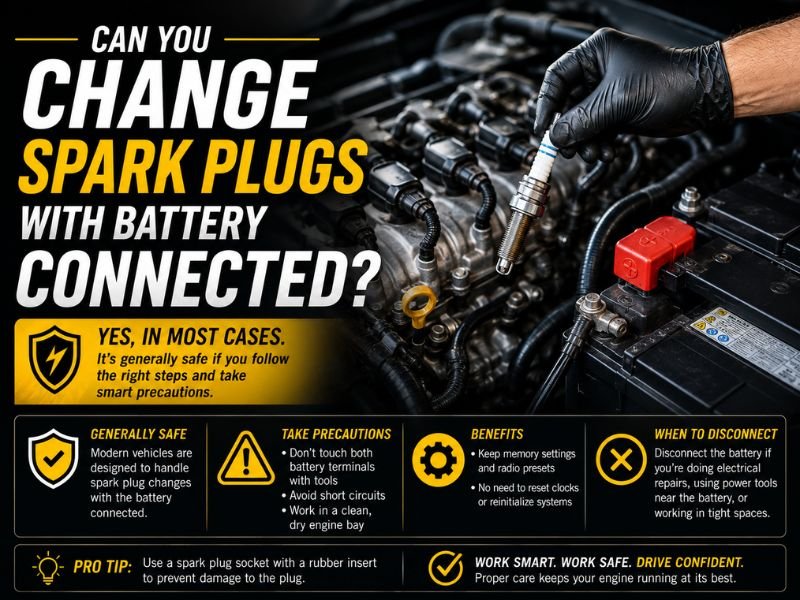
Mechanically, removing and installing a spark plug does not require battery power. With the engine switched off, a spark plug is simply threaded into the cylinder head.
That is why someone may successfully replace plugs without disconnecting the battery and experience no immediate problem.
However, possible and recommended are not the same thing.
DENSO’s official spark plug precautions state that the engine should be switched off and the battery or power source disconnected before spark plug replacement or adjustment. The company warns that ignoring the precaution can create risks including electrical shock, fire, or injury.
For a normal DIY spark plug replacement, disconnecting the appropriate battery terminal before disturbing ignition components therefore provides an additional layer of protection.
Your vehicle’s service information should take priority because electrical procedures vary between models.
Why Disconnect the Battery Before Changing Spark Plugs?
Modern gasoline engines typically use an electronically controlled ignition system.
Battery power ultimately supplies the electrical system, while the ignition coil creates the much higher voltage needed for a spark to jump across the spark plug electrodes. DENSO explains that the plug receives high voltage from the ignition system and uses the resulting discharge across the electrode gap to ignite the air-fuel mixture.
When changing plugs, you frequently have to unplug or move ignition coils and wiring.
Disconnecting battery power reduces the chance of accidentally energizing something while your hands and tools are around those components.
It also reduces the possibility of an accidental short if a metal tool touches an energized terminal or connector and a grounded metal component at the same time.
The precaution becomes particularly sensible when access to the plugs requires removing several electrical connectors or working in a crowded engine bay.
What Happens If You Leave the Battery Connected?
Usually, nothing dramatic happens simply because the battery remains connected while the engine and ignition are off.
That is why many people have changed spark plugs without disconnecting it.
The problem is that you are accepting unnecessary electrical risk.
For example, someone could accidentally switch the ignition on while ignition coils are disconnected, or a tool could contact an unintended electrical connection.
On vehicles with push-button starting, remote-start capability, sophisticated body electronics, or automatic systems, relying only on the fact that the engine currently appears switched off may not be the most conservative service approach.
A disconnected battery helps isolate the low-voltage electrical system while the ignition components are being handled.
Which Battery Terminal Should You Disconnect?
For a conventional 12V automotive battery, service procedures commonly involve disconnecting the negative battery terminal when electrical isolation is required.
However, the exact procedure should come from the vehicle manufacturer’s service information.
Some vehicles have battery-monitoring sensors integrated into the negative connection, remote battery locations, or manufacturer-specific power-down procedures.
Do not disconnect random battery cables just because they are easy to reach.
Before beginning, make sure the ignition is completely off and keep the disconnected terminal from accidentally contacting the battery post again while you are working.
When reconnecting the battery, follow the manufacturer’s specified sequence.
Ford, for example, instructs owners in its battery procedures to make sure the ignition remains switched off before reconnecting the battery.
Will Disconnecting the Battery Cause Problems?
It can cause temporary changes on some vehicles.
Disconnecting battery power may reset certain clock settings, radio presets, automatic window functions, learned settings, or battery-management information, depending on the vehicle.
Ford’s current owner information, for example, notes that some features may require resetting after the battery has been disconnected or replaced. Certain Ford battery-management systems may also need time to relearn battery state information after power has been restored.
This does not mean you should leave the battery connected simply to avoid resets.
Instead, check the owner’s manual or service instructions before disconnecting power so you know whether your vehicle requires a special procedure afterward.
Older vehicles may only lose a clock or radio setting. Newer vehicles can have considerably more electronic systems.
Do You Have to Disconnect the Battery on Every Vehicle?
There is no universal DIY procedure that overrides the vehicle manufacturer’s instructions.
DENSO gives a broad spark plug safety recommendation to disconnect the battery or power source before replacement.
Your specific vehicle, however, may have additional requirements.
The spark plugs themselves may be buried beneath coil-on-plug ignition coils, intake components, electrical harnesses, engine covers, or other hardware. Some engines also require specialized removal procedures.
Ford, for example, has published engine-specific spark plug removal instructions for certain engines rather than treating every spark plug replacement as an identical procedure.
That is why a model-specific repair manual matters.
A procedure that is straightforward on one four-cylinder engine may be substantially more complicated on another vehicle.
Battery Disconnection Does Not Make the Ignition System the Only Safety Concern
Even after electrical power has been isolated, there are other ways a spark plug job can go wrong.
One of the biggest is damaging the cylinder-head threads.
NGK emphasizes correct spark plug installation torque. Improper tightening can result in insufficient heat transfer, plug damage, or other operating problems.
Another concern is debris.
NGK recommends making sure spark plug holes are clean before installation because dirt around the threads can interfere with correct tightening.
That means disconnecting the battery is only one part of a safe replacement job.
Correct plug selection, clean plug wells, proper starting of the threads, and correct tightening are equally important.
A Safer Spark Plug Replacement Workflow
A good spark plug replacement begins with a cool engine and the correct replacement plugs.
Verify the exact plug part number and gap requirements for the vehicle. NGK notes that a spark plug may physically fit many engines while still requiring the correct application-specific gap and installation specifications.
Next, switch the vehicle completely off and follow the manufacturer’s battery-disconnection procedure when required or recommended. DENSO’s general spark plug guidance calls for disconnecting the battery or power source before replacement.
Remove engine covers or other access components carefully, then disconnect the ignition coil electrical connectors without pulling on the wiring itself.
Before removing each plug, make sure loose dirt cannot fall into the cylinder through the plug hole.
Remove the old plug with the correct spark plug socket.
When installing the new plug, start the threads carefully rather than immediately applying heavy torque with a ratchet. Cross-threading a spark plug in an aluminum cylinder head can turn routine maintenance into an expensive repair.
Finally, tighten the plug according to the engine or spark plug manufacturer’s specified procedure. NGK publishes specific torque guidance based on plug dimensions and cylinder-head material and warns that proper tightening is essential.
Reinstall the ignition coils and connectors, reconnect the battery according to the vehicle procedure, and then start the engine.
Should You Disconnect the Battery Before Unplugging Ignition Coils?
It is the safer approach when the manufacturer’s procedure calls for battery isolation.
Modern coil-on-plug systems contain electrical connectors that control the ignition coils.
DENSO explains that spark plugs rely on the high voltage produced by the ignition system to create the spark across their electrodes.
You do not want the ignition system commanded on while coils are removed or electrical connectors are being handled.
At an absolute minimum, the ignition should be fully switched off.
For a DIY spark plug replacement, following the manufacturer’s battery-disconnection recommendation provides more complete isolation.
Can You Get Shocked Changing Spark Plugs?
The spark plug itself does not continuously contain dangerous ignition voltage with the engine shut down.
The high voltage exists when the ignition system commands the coil to fire.
However, an operating ignition system can generate very high voltage to bridge the spark plug gap. DENSO explains that the ignition system applies high voltage between the plug’s center and ground electrodes until electrical discharge occurs.
That is another reason not to work around exposed ignition components with the engine running or the system being activated.
Do not perform improvised spark tests by holding ignition components with your hands while another person cranks the engine.
Can You Change Only One Spark Plug?
You can physically replace one plug if diagnosis shows that only that plug has been damaged, but maintenance replacement is commonly performed according to the engine manufacturer’s specified schedule and configuration.
Spark plugs wear as their electrodes gradually erode. DENSO notes that electrode wear can interfere with stable ignition as service life progresses.
If all plugs have accumulated the same mileage and one is worn from normal service, the others may be approaching a similar condition.
However, one abnormally fouled or damaged plug can also indicate a cylinder-specific problem rather than ordinary plug wear.
In that case, replacing all the plugs without diagnosing the cause may hide the symptom temporarily rather than solve the underlying issue.
Should the Engine Be Cold Before Changing Spark Plugs?
A cool engine is generally the sensible condition for spark plug service, particularly with aluminum cylinder heads.
The plug and cylinder-head threads need to be handled carefully, and working around a hot engine also adds an obvious burn risk.
Follow the specific vehicle or plug manufacturer’s installation instructions rather than removing plugs immediately after a hard drive.
Correct tightening matters once the new plug is installed. NGK notes that insufficient torque can prevent proper heat transfer from the plug to the cylinder head, while incorrect installation can create plug-related problems.
Frequently Asked Questions
Can I Change Spark Plugs Without Disconnecting the Battery?
It may be physically possible on many vehicles, but DENSO’s official safety guidance says to switch off the engine and disconnect the battery or power source before replacing or adjusting spark plugs.
What Happens If I Change Spark Plugs With the Battery Connected?
You may complete the job without incident, but the ignition and other electrical circuits remain connected to battery power. Disconnecting the battery reduces avoidable electrical risks while coils, connectors, and tools are being handled.
Should I Disconnect the Positive or Negative Terminal?
When battery isolation is required, automotive procedures commonly start with the negative side, but use the procedure specified for your exact vehicle. Modern cars may have battery-monitoring hardware or other model-specific requirements.
Will Disconnecting the Battery Reset the ECU?
Battery disconnection can reset or require relearning of some electronic functions depending on the vehicle. Ford, for example, documents feature resets and battery-management relearning following battery disconnection on certain vehicles.
Can I Remove Ignition Coils With the Battery Connected?
Because ignition coils are electrically controlled components capable of generating the high voltage needed for spark, following the manufacturer’s electrical isolation procedure is the safer choice.
Can Changing Spark Plugs Damage the ECU?
A normal spark plug replacement performed according to the vehicle’s service instructions should not damage the ECU. Avoid turning the ignition on unnecessarily while connectors are unplugged, shorting electrical circuits, or using incorrect testing procedures.
Do I Need to Disconnect the Battery to Gap Spark Plugs?
DENSO’s safety guidance specifically states that the battery or power source should be disconnected before replacing or adjusting plugs.
Should I Change Spark Plugs With a Hot Engine?
A cool engine is the safer working condition. It reduces burn risk and allows you to handle plug and cylinder-head threads more carefully.
Do New Spark Plugs Need to Be Torqued?
Yes. Spark plugs must be tightened according to the applicable manufacturer specification. NGK publishes application-dependent tightening guidance and emphasizes correct torque during installation.
What Should I Do After Reconnecting the Battery?
Make sure all ignition coils, connectors, engine covers, and other removed components are correctly reinstalled before restoring power. Then follow any model-specific reset or relearn procedures described by the vehicle manufacturer.
Can You Change Spark Plugs With the Battery Connected Safely?
Although you may physically be able to change spark plugs with the battery connected, disconnecting the battery or power source is the safer procedure and is specifically recommended in DENSO’s spark plug safety instructions.
The benefit is electrical isolation while you disconnect ignition coils, wiring connectors, and other components around the spark plug wells. It also reduces the chance that the ignition system will be energized accidentally while you are working.
The only complication is that battery disconnection can reset certain electronic settings on some modern vehicles, so check the owner’s manual or service information before beginning.
For the safest approach, work with the engine off and cool, follow the vehicle-specific battery procedure, keep debris out of the plug wells, install the correct plugs, and use the specified tightening method. Battery disconnection is a small extra step compared with the potential problems caused by working carelessly around a live ignition system.