
Yes, parts of a spark plug can damage certain types of automotive glass, especially tempered side windows, but not every car window is made from the same type of glass.
The question do spark plugs break car windows usually comes from the unusual properties of the ceramic material used around a spark plug’s center electrode. Spark plug insulators are commonly made from a very hard ceramic material.
Small hard objects can create highly concentrated stress when they strike certain types of safety glass, and that can sometimes cause tempered glass to fracture.
That does not mean a complete spark plug will automatically break any car window, nor does it mean every automotive window reacts the same way.
Side and rear windows have traditionally often used tempered safety glass, while windshields are generally made from laminated safety glass. Many newer vehicles also use laminated glass in some side windows for noise reduction, security, or occupant protection.
The difference matters because tempered and laminated glass fail in completely different ways. Tempered glass is designed to break into many relatively small pieces when its internal stress structure fails. Laminated glass contains a plastic interlayer that helps hold the glass together even after cracking.
This article explains why spark plug ceramic can damage some windows, which automotive glass is more resistant, how to identify tempered versus laminated glass, and the safety and legal considerations surrounding broken vehicle glass.
Do Spark Plugs Break Car Windows?
Yes, spark plug ceramic can potentially fracture tempered automotive glass, but the result depends heavily on the type of glass.
Automotive windows generally fall into two main categories:
- Tempered glass
- Laminated glass
Tempered glass is much more likely to suddenly shatter when a highly concentrated impact creates enough local stress.
Laminated glass normally cracks while remaining held together by an internal plastic layer, making complete penetration much more difficult.
The important point is that the effect is related to glass construction and material properties, not simply the fact that the object came from a spark plug.
Why Can Spark Plug Ceramic Damage Glass?
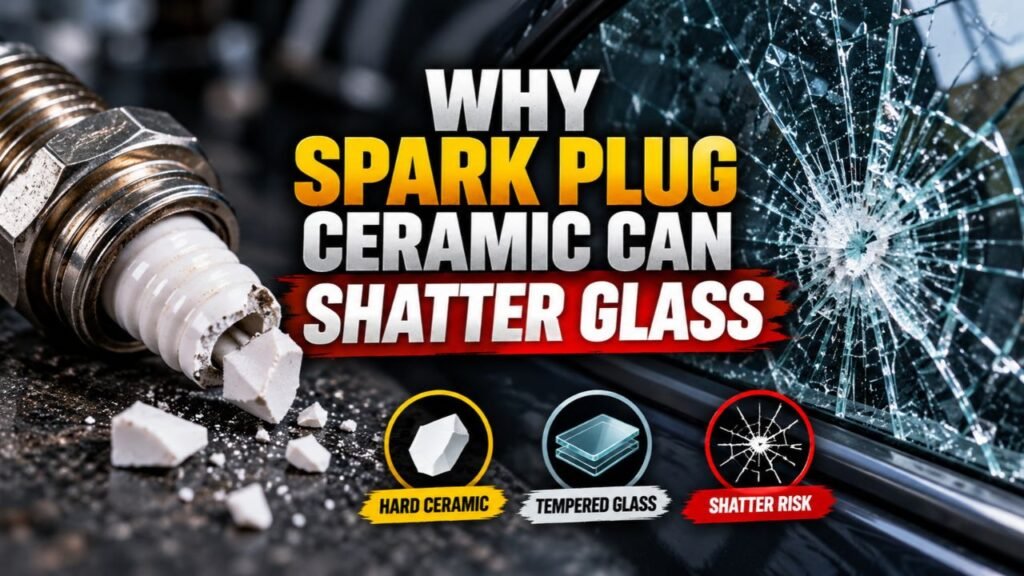
The white insulator around the center of a traditional spark plug is made from a very hard ceramic, commonly based on alumina ceramic.
This material must tolerate:
- High combustion temperatures
- High electrical voltage
- Repeated heating and cooling
- Mechanical stress
- Chemical exposure
Ceramic is hard but brittle.
When fractured, ceramic can form very hard edges and small contact points. A hard object contacting glass over a tiny area can create much higher localized stress than a larger, softer object delivering similar overall energy.
That concentrated stress is especially important with tempered glass.
What Is Tempered Automotive Glass?
Tempered glass is safety glass that has been heat-treated to create internal stresses.
The manufacturing process leaves the outer surface under compression and the interior under tension.
This makes tempered glass substantially stronger than ordinary untreated glass under many normal loads.
However, once damage penetrates the strong compressed surface layer and disrupts the internal stress balance, the entire pane can fracture rapidly.
Instead of forming a few large sharp pieces, tempered glass generally breaks into many small fragments.
This behavior is intentional because smaller pieces usually present less severe cutting hazards than large shards.
Why Does Tempered Glass Shatter So Suddenly?
Tempered glass contains stored internal stress.
You can think of the glass as being held in a carefully balanced condition.
As long as the outer compressive layer remains intact, the glass remains strong.
If sufficiently concentrated damage penetrates that layer, the internal tensile stresses can cause cracks to spread extremely rapidly throughout the pane.
That is why a tempered side window can appear completely normal one moment and then suddenly break across almost its entire surface.
Are Car Side Windows Tempered?
Many automotive side windows have historically been made from tempered safety glass.
However, you should not assume every side window is tempered.
Some modern vehicles use laminated side glass, particularly for:
- Noise reduction
- Theft resistance
- Improved occupant containment
- Premium vehicle construction
A vehicle can even contain different types of glass in different doors or window positions.
The glass marking is the best place to check.
Are Windshields Tempered Glass?
No. Modern automotive windshields are generally made from laminated safety glass.
A typical laminated windshield consists of:
- An outer glass layer
- A plastic interlayer
- An inner glass layer
The interlayer, commonly made from a tough plastic material such as polyvinyl butyral (PVB), holds broken glass together.
That is why a windshield can develop extensive cracks while still remaining largely intact.
Can Spark Plug Ceramic Break a Windshield?
Spark plug ceramic can chip or crack glass under some circumstances, but a laminated windshield behaves very differently from a tempered side window.
Even if one glass layer is damaged, the plastic interlayer helps prevent the windshield from collapsing into the passenger compartment.
A windshield may develop:
- A chip
- A star-shaped crack
- Spreading fractures
- Surface damage
But laminated construction makes complete breakage much more difficult than with typical tempered side glass.
This is one reason windshields are used as a structural and occupant-protection component rather than simply as a transparent panel.
Tempered vs. Laminated Car Glass
The basic difference can be summarized like this:
| Feature | Tempered Glass | Laminated Glass |
| Construction | Single heat-treated pane | Multiple glass layers with plastic interlayer |
| Common location | Many side and rear windows | Windshield and some modern side windows |
| Failure behavior | Breaks into many small pieces | Cracks but usually remains together |
| Resistance to concentrated impact | Can fail suddenly | Generally more difficult to penetrate completely |
| After breaking | Opening may be exposed | Interlayer usually keeps pane in place |
| Safety purpose | Reduces large sharp fragments | Helps prevent penetration and occupant ejection |
Neither glass type is unbreakable.
They are engineered to fail in different ways for safety reasons.
Why Doesn’t an Ordinary Rock Always Have the Same Effect?
Different materials transfer force differently.
A relatively large object distributes impact over a broader area.
A very hard, sharp contact point can concentrate that force into a much smaller area.
Stress is closely related to force divided by contact area.
So when contact area becomes extremely small, localized stress can become very high even without enormous overall force.
This principle is not unique to spark plug ceramic. It is a general characteristic of hard, brittle materials interacting with glass.
Does the Whole Spark Plug Have the Same Effect?
No.
A complete spark plug contains multiple components, including:
- Steel shell
- Electrodes
- Ceramic insulator
- Terminal
- Internal sealing components
The unusual glass-breaking reputation specifically relates to the hard ceramic insulator, not simply to a spark plug as a complete automotive component.
Throwing or striking glass with automotive parts is dangerous and can cause unpredictable fragmentation, injury, and property damage.
Why Is Spark Plug Ceramic So Hard?
Spark plug insulators need to electrically isolate thousands of volts while operating inside an extremely hot engine environment.
Alumina-based ceramic is suitable because it provides:
- High electrical resistance
- Heat resistance
- Mechanical strength
- Chemical resistance
- Good dimensional stability
The same hardness that allows the insulator to survive inside an engine also means broken ceramic can have extremely hard fracture surfaces.
Hardness, however, should not be confused with toughness.
Ceramic can be very hard while still being brittle and prone to breaking when struck.
Can Every Tempered Window Be Broken Easily?
No.
Tempered glass strength varies according to:
- Thickness
- Manufacturing quality
- Window curvature
- Existing scratches or chips
- Impact location
- Vehicle design
- Glass formulation
A pane may tolerate substantial force in one situation and fail from a much smaller concentrated impact in another.
Because the failure can be sudden and unpredictable, deliberately testing automotive glass is unsafe.
How Can You Tell if a Car Window Is Tempered or Laminated?
Look near one corner of the glass for the manufacturer’s permanent marking or glass bug.
The marking may include words such as:
- TEMPERED
- LAMINATED
- LAMISAFE
- AS1
- AS2
Exact markings vary among manufacturers and vehicles.
If the glass explicitly says LAMINATED, it contains multiple bonded layers.
If it says TEMPERED, it is heat-treated safety glass designed to fragment when broken.
What Do AS1 and AS2 Mean?
Automotive safety glass in the United States may carry markings related to federal glazing standards.
AS1 glass is commonly associated with windshields and meets higher light-transmission requirements.
AS2 is frequently found on side and rear glazing where slightly different visibility requirements apply.
However, the AS marking alone is not always the easiest way to determine whether a window is laminated or tempered. Look for the actual construction description whenever available.
Do Newer Cars Use Laminated Side Windows?
Yes, some do.
Laminated side windows are increasingly found on vehicles designed for better:
- Cabin quietness
- Security
- Crash protection
- Occupant retention
Laminated side glass can reduce wind and road noise because the interlayer helps damp vibration.
It can also make rapid entry through a broken side window more difficult.
The use of laminated side glass varies by manufacturer, trim level, model year, and window position.
What About Rear Windows?
Many traditional rear windows are tempered.
When a tempered rear window fails, most or all of the pane may fragment.
However, vehicle designs vary, and some specialized or modern applications can use other glazing technologies.
Check the markings on the specific glass rather than assuming based solely on its location.
Can Broken Spark Plug Ceramic Scratch Car Glass?
Yes.
A hard ceramic material can potentially scratch automotive glass.
Scratches may be:
- Superficial
- Deep enough to catch a fingernail
- Associated with small chips
- Potential starting points for future cracks
Windshield scratches and chips can become more significant when exposed to vibration, temperature changes, or additional impacts.
A damaged windshield should be assessed before a small defect spreads into a larger crack.
Is Broken Spark Plug Ceramic Dangerous?
Yes.
Broken ceramic can produce small sharp fragments.
Automotive glass itself can also cause injury even though safety glass is designed to reduce some hazards.
Possible risks include:
- Eye injuries
- Skin cuts
- Embedded glass particles
- Damage to vehicle interiors
- Tire punctures from debris
- Hazard to pedestrians and animals
Do not intentionally fracture spark plugs or vehicle glass as an experiment.
Wear appropriate eye protection when handling damaged automotive glass during legitimate repairs.
Is Breaking a Car Window Illegal?
Intentionally breaking someone else’s vehicle window can constitute property damage, vandalism, burglary-related conduct, or another criminal offense depending on the circumstances and local law.
Even breaking your own vehicle glass can create safety, cleanup, and insurance issues.
There are legitimate emergency situations where vehicle glass may need to be broken, such as rescuing a person or animal trapped inside a dangerous vehicle. Emergency circumstances involve very different legal and safety considerations from intentionally damaging a vehicle.
If there is an immediate life-threatening emergency, contact 911 in the United States and follow instructions from emergency responders whenever possible.
Why You Should Not Experiment With Automotive Glass
Glass failure is unpredictable.
A test that appears harmless can send fragments into:
- Eyes
- Skin
- Nearby vehicles
- People standing nearby
- Upholstery
- HVAC vents
Automotive glass replacement can also be expensive, particularly when the window includes:
- Rain sensors
- Cameras
- Defroster elements
- Antennas
- Acoustic layers
- Driver-assistance-system components
There is little practical benefit to deliberately testing how easily a vehicle window can break.
What Should You Do if Your Car Window Is Broken?
If a vehicle window has already been damaged, focus on safety first.
Avoid placing your hands directly into loose glass.
Keep children and pets away from the area.
For a broken side window:
- Have loose glass professionally removed if necessary
- Protect the vehicle interior from rain
- Arrange glass replacement
- Inspect nearby trim and paint for damage
If vandalism or theft may be involved, document the damage and contact local law enforcement and your insurance company as appropriate.
Can a Cracked Windshield Still Be Driven With?
It depends on the size and location of the damage.
A small chip may sometimes be professionally repaired.
A larger crack, particularly one affecting the driver’s field of view or reaching an edge, may require windshield replacement.
Windshields also contribute to vehicle structural integrity and proper deployment behavior of some restraint systems.
Some modern vehicles have ADAS cameras mounted near the windshield. Windshield replacement may require camera calibration after installation.
Spark Plug Ceramic vs. Emergency Glass Breakers
Purpose-built emergency escape tools are specifically designed for vehicle emergencies.
Some include:
- Seat-belt cutters
- Glass-breaking mechanisms
However, not every emergency glass breaker works on laminated side windows.
Drivers who keep an emergency escape tool should:
- Follow the manufacturer’s instructions
- Confirm which glass types the tool is designed for
- Store it somewhere reachable after a crash
- Understand that the windshield is laminated and generally not intended as the primary emergency exit
A commercial emergency tool is a much safer and more appropriate option than improvising with automotive parts.
Common Misconceptions About Spark Plugs and Car Windows
Any Spark Plug Instantly Breaks Any Car Window
False.
The outcome depends on the glass type, impact, construction, and other factors.
Laminated and tempered automotive glass respond very differently.
Windshields Shatter Like Side Windows
Usually false.
Windshields are laminated and generally remain held together after cracking.
Ceramic Is Stronger Than Glass in Every Way
Not exactly.
Ceramic can be harder than common glass, but hardness and overall strength are different properties.
Both materials can be brittle.
Broken Safety Glass Cannot Cut You
False.
Tempered glass generally produces smaller pieces than ordinary glass, but those pieces can still have sharp edges and cause injury.
All Modern Side Windows Are Tempered
False.
An increasing number of vehicles use laminated side glass.
Check the marking on the actual window.
FAQs About Do Spark Plugs Break Car Windows
Do Spark Plugs Really Break Car Windows?
Parts of a spark plug, particularly the hard ceramic insulator material, can damage certain automotive glass.
Tempered side glass is generally more susceptible to sudden fragmentation from concentrated impact than laminated glass.
Why Does Spark Plug Ceramic Break Tempered Glass?
Hard ceramic can create highly concentrated stress over a small contact area.
Tempered glass contains internal stresses from its manufacturing process. If its protective surface compression is sufficiently disrupted, cracks can rapidly spread through the entire pane.
Can a Spark Plug Break a Windshield?
A windshield can certainly be damaged by hard objects, but windshields are laminated and generally do not shatter open like tempered side glass.
The plastic interlayer usually keeps cracked glass together.
Are All Car Side Windows Tempered?
No.
Many are tempered, but some modern vehicles use laminated side windows.
Look for markings such as TEMPERED or LAMINATED on the glass.
Why Do Side Windows Break Into Tiny Pieces?
Tempered glass is manufactured with internal stress designed to make it fragment into many smaller pieces when it fails.
This reduces the number of large knife-like shards compared with ordinary untreated glass.
Is Spark Plug Ceramic Stronger Than a Car Window?
That comparison is overly simple.
Spark plug ceramic is extremely hard, while automotive glass is engineered for specific impact, visibility, and safety characteristics.
The interaction between the materials depends on hardness, contact area, internal glass stress, and glass construction.
Can Spark Plug Ceramic Damage Laminated Side Glass?
It can potentially chip or crack the outer glass layer, but laminated construction makes complete penetration much more difficult because the plastic interlayer holds the glass together.
What Is the Safest Tool for Breaking a Window in an Emergency?
Use a purpose-built automotive emergency escape tool and follow its instructions.
Confirm that the tool is compatible with the type of side glass in your vehicle because laminated side glass may behave differently from tempered glass.
Conclusion
So, do spark plugs break car windows? Spark plug ceramic can damage and potentially fracture tempered automotive glass because its hardness can create highly concentrated stress at the glass surface. However, that does not mean every spark plug will break every vehicle window.
Traditional side and rear windows are often tempered, while windshields are laminated and designed to remain together after cracking. Some newer vehicles also use laminated side glass, making the difference increasingly important.
The phenomenon is best understood as a materials-science characteristic rather than something to test in practice. Deliberately damaging vehicle glass is dangerous, can cause injury, and may be illegal when the vehicle is not yours. For emergencies, use a purpose-built escape tool appropriate for your vehicle’s glass type.