
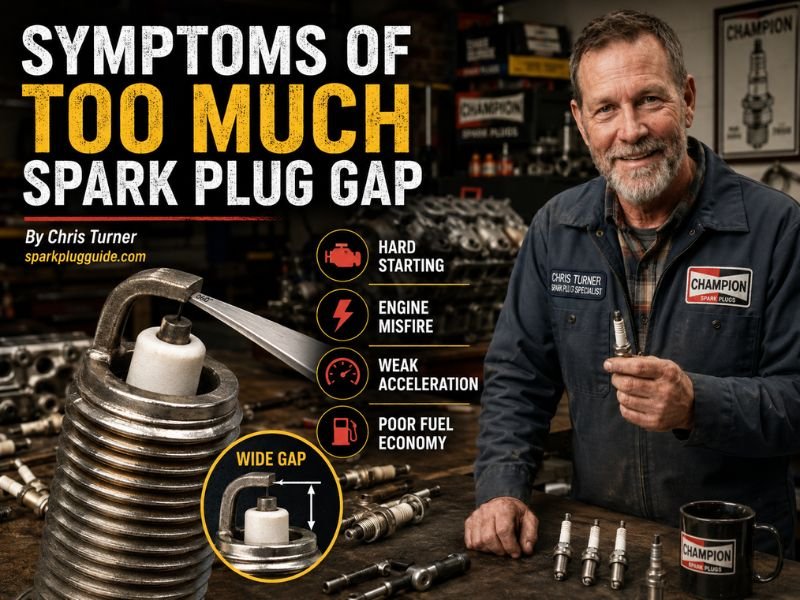
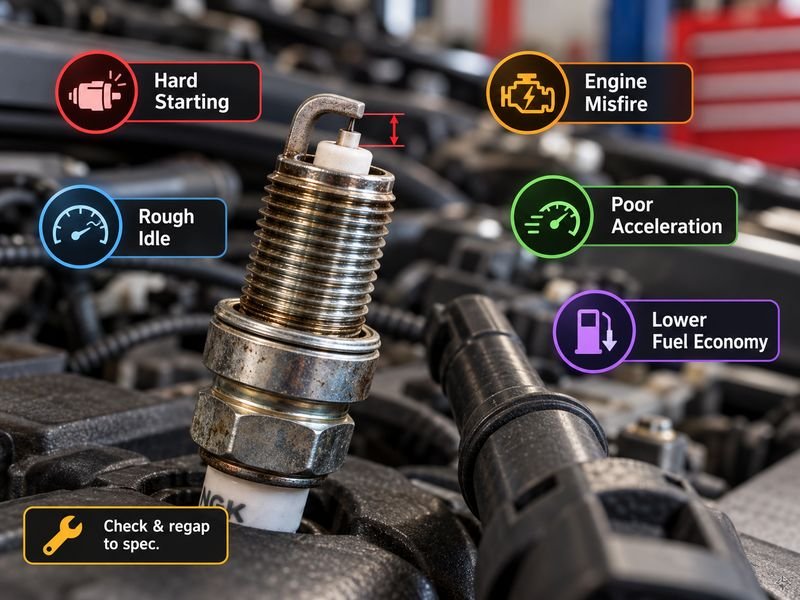
The most common symptoms of too much spark plug gap are hard starting, engine misfires, rough idle, hesitation during acceleration, power loss, and poor fuel economy. An excessively wide gap forces the ignition system to use more voltage to create a spark.
The spark plug gap is the distance between the center electrode and the ground electrode. This distance must match the engine manufacturer’s specification for the spark plug to ignite the air-fuel mixture consistently.
When the gap becomes too wide, the spark may be weak, delayed, intermittent, or completely absent. The problem is often most noticeable during startup, acceleration, high engine load, or cold weather.
What Happens When the Spark Plug Gap Is Too Wide?
A spark plug creates an electrical spark by sending high voltage across the space between its two electrodes.
The wider the gap becomes, the more voltage the ignition system needs to make the spark jump across it. If the ignition coil cannot supply enough voltage under a particular operating condition, the plug may fail to fire.
An excessively wide gap can result in:
- Weak ignition
- Intermittent spark
- Delayed combustion
- Incomplete fuel burning
- Cylinder misfires
- Increased ignition coil stress
A slightly wider gap may still allow the engine to run normally under light conditions. However, problems may appear when the engine is cold, accelerating, climbing a hill, towing, or operating at higher RPM.
Common Symptoms of Too Much Spark Plug Gap
The exact symptoms depend on how far the gap exceeds specification, the strength of the ignition system, engine load, and the condition of the spark plug electrodes.
1. The Engine Is Hard to Start
Hard starting is one of the most common signs of an excessive spark plug gap.
During engine cranking, battery voltage may drop because the starter motor is using a large amount of electrical current. The ignition system may therefore have less available voltage than it does after the engine starts.
If the spark plug gap is too wide, the spark may not jump consistently during cranking.
You may notice:
- Longer cranking before the engine starts
- Several starting attempts
- Difficult cold starts
- Difficult hot restarts
- Starting followed by immediate stumbling
- A gasoline smell after repeated cranking
The engine may eventually start after enough attempts, especially if only one plug has an excessive gap. However, repeated hard starting suggests that the ignition system is struggling to create a reliable spark.
2. Engine Misfires
An engine misfire occurs when the air-fuel mixture in one or more cylinders fails to burn correctly.
With too much spark plug gap, the ignition voltage may not be strong enough to cross the electrode space during every combustion cycle. The plug may fire normally during some cycles and fail during others.
Misfire symptoms may include:
- Jerking while driving
- Sudden interruptions in power
- Uneven engine sound
- Shaking during acceleration
- Popping from the exhaust
- A flashing or steady check engine light
Misfires caused by excessive gap may become more obvious under heavy load. Higher cylinder pressure makes it harder for the spark to jump between the electrodes.
3. Rough or Unstable Idle
A spark plug with an excessive gap may fire inconsistently while the engine is idling.
The engine may continue running, but the idle may feel uneven because one or more cylinders are not producing consistent combustion.
Common signs include:
- Vibration through the steering wheel or seat
- Engine speed rising and falling
- Uneven exhaust pulses
- Occasional stumbling
- A low or unstable idle
- The engine feeling close to stalling
A rough idle can also result from vacuum leaks, dirty fuel injectors, ignition coil problems, or incorrect airflow. The spark plug gap becomes a stronger suspect when the plugs were recently installed or adjusted.
4. Hesitation During Acceleration
An excessively wide gap often causes noticeable hesitation when the accelerator is pressed.
During acceleration, the engine receives more air and fuel, and cylinder pressure increases. The ignition system must produce a stronger spark to ignite the denser mixture.
If the gap is wider than specified, the engine may hesitate because the spark cannot cross the electrodes consistently.
You may experience:
- A delayed response after pressing the accelerator
- Brief stumbling during takeoff
- Jerking while merging
- Hesitation when climbing a hill
- Poor response during sudden acceleration
- Normal operation after reducing throttle
This symptom may not appear while the vehicle is parked. The engine can idle normally but misfire as soon as it is placed under load.
5. Loss of Engine Power
Too much spark plug gap can reduce engine power by preventing complete and consistent combustion.
When one cylinder misfires, it does not contribute its normal amount of power. If several plugs have excessive gaps, the power loss can become much more noticeable.
Possible signs include:
- Slow acceleration
- Weak throttle response
- Difficulty maintaining speed uphill
- Reduced towing performance
- Poor high-RPM performance
- The engine feeling strained
The vehicle may still be drivable, but it may require more throttle than usual to produce the same acceleration.
Power loss caused by excessive gap may worsen as the spark plug electrodes continue to wear.
6. Poor Fuel Economy
An engine with an excessive spark plug gap may consume more fuel than normal.
When the plug fails to ignite the mixture properly, some gasoline may leave the cylinder without producing useful energy. The engine may also require more throttle to compensate for reduced power.
You may notice:
- Fewer miles per gallon
- More frequent refueling
- Reduced driving range
- A stronger fuel smell from the exhaust
- Increased fuel use combined with rough running
Poor fuel economy alone does not prove that the gap is too wide. However, it supports the diagnosis when combined with misfires, hesitation, and visibly excessive electrode spacing.
7. The Check Engine Light Turns On
Too much spark plug gap may cause the vehicle’s computer to detect repeated combustion misfires.
The check engine light may remain steady when the misfire is occasional. It may flash when the misfire is severe enough to risk damaging the catalytic converter.
A scan tool may show:
- A cylinder-specific misfire code
- A random or multiple-cylinder misfire code
- Pending misfire codes
- Misfire counts for a particular cylinder
A misfire code does not identify the exact failed part. The cause may be the spark plug gap, ignition coil, injector, wiring, or mechanical condition of the cylinder.
The plug gap should be measured before replacing more expensive ignition components.
8. Weak Performance Under Heavy Load
An excessive spark plug gap may cause few or no symptoms during normal cruising but produce severe problems under load.
Heavy-load conditions include:
- Accelerating sharply
- Driving uphill
- Towing a trailer
- Carrying heavy cargo
- Operating at high RPM
- Running a small engine through thick grass or heavy material
Cylinder pressure rises under these conditions. The higher pressure creates greater electrical resistance across the spark plug gap.
The engine may run normally at idle and low speed but begin misfiring as soon as the load increases. This pattern strongly suggests an ignition system that cannot consistently supply the required voltage.
9. Increased Stress on the Ignition Coil
Too much spark plug gap forces the ignition coil to generate higher voltage than it would with a correctly adjusted plug.
The ignition coil may initially compensate for the wider gap. Over time, however, the increased electrical demand can place additional stress on the coil, plug wire, coil boot, and insulation.
Possible signs of ignition stress include:
- Misfires that worsen as the engine becomes hot
- Visible carbon tracking
- Burn marks inside the coil boot
- Repeated ignition coil failure
- Electrical arcing around the plug
- A sharp ticking sound from the ignition area
A wide gap does not always destroy an ignition coil. However, leaving the gap excessive can contribute to premature ignition-component failure.
Symptoms of Too Much Spark Plug Gap at a Glance
| Symptom | What You May Notice | Why a Wide Gap Causes It |
| Hard starting | Long cranking or repeated attempts | More voltage is needed during startup |
| Engine misfire | Jerking or interrupted power | The spark fails to cross the gap |
| Rough idle | Shaking or unstable RPM | Combustion becomes inconsistent |
| Acceleration hesitation | Stumbling under throttle | Cylinder pressure increases ignition demand |
| Power loss | Weak acceleration | Some cylinders fail to produce full power |
| Poor fuel economy | Increased fuel use | Fuel does not burn completely |
| Check engine light | Stored misfire codes | The computer detects failed combustion |
| Load-related problems | Misfire uphill or at high RPM | High pressure makes sparking more difficult |
| Ignition coil stress | Arcing or repeated coil issues | The coil must produce excessive voltage |
What Does an Excessive Spark Plug Gap Look Like?
A spark plug gap is considered excessive when the distance between the center electrode and ground electrode is wider than the engine manufacturer’s specification.
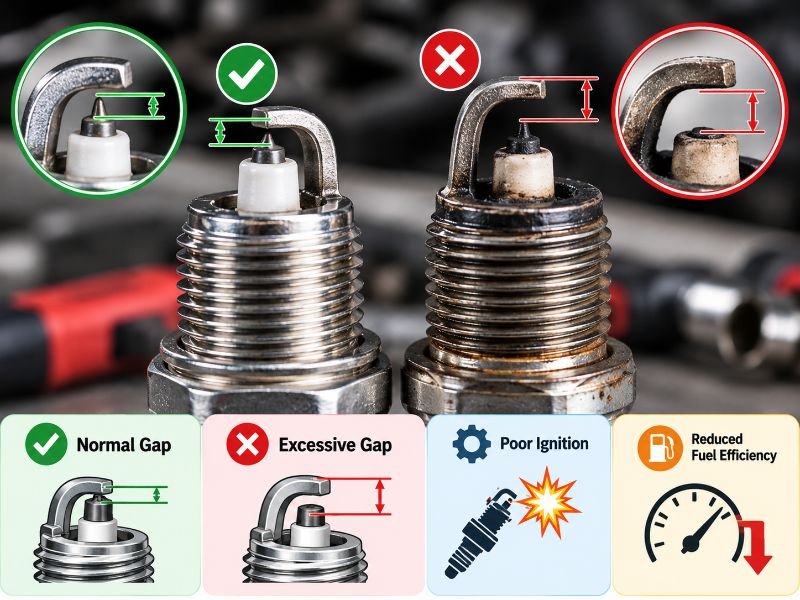
You may notice:
- A visibly large space between the electrodes
- Rounded or eroded electrode edges
- A ground electrode bent too far away
- A gap larger than the specification on a feeler gauge
- Uneven spacing between the electrodes
- Excessive wear compared with a new plug
Visual inspection alone is not accurate enough for small differences. A plug that looks normal may still be several thousandths of an inch outside specification.
Always measure the gap with a proper tool.
What Causes the Spark Plug Gap to Become Too Wide?
An excessive gap can result from normal wear, incorrect adjustment, installation mistakes, or use of the wrong spark plug.
Normal Electrode Wear
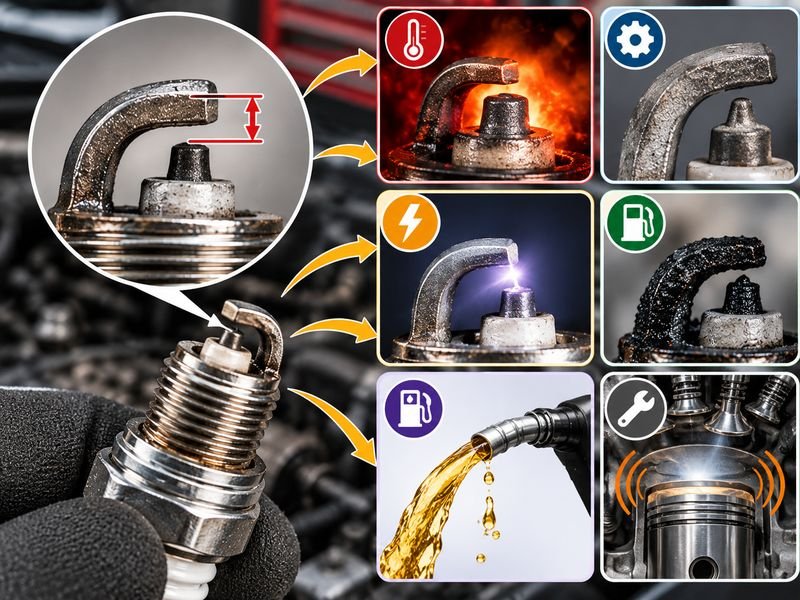
Every time a spark jumps between the electrodes, a tiny amount of electrode material may wear away.
Over thousands of ignition cycles, the electrode edges become rounded and the gap gradually increases.
This is one reason old spark plugs may begin causing symptoms even when they are not dirty or cracked.
Incorrect Manual Adjustment
A spark plug may be accidentally opened too far while being adjusted.
This can happen when:
- Too much force is applied to the ground electrode
- The wrong gapping tool is used
- The measurement is read incorrectly
- The plug is adjusted without checking the engine specification
- The gap is repeatedly bent back and forth
Only the ground electrode should normally be adjusted. Pressure should not be applied to the center electrode or ceramic insulator.
Installing Pre-Gapped Plugs Without Checking Them
Many spark plugs are sold as pre-gapped, but that does not guarantee that the gap is correct for every engine that can use the plug.
The gap may also change during packaging, shipping, or handling.
A plug can have the correct part number while still requiring a different gap for a specific engine application.
I recommend checking every plug before installation, even when the box states that it is pre-gapped.
Using the Wrong Spark Plug
A spark plug designed for another engine may have a different factory gap, heat range, reach, or electrode design.
Installing an incorrect plug may result in poor ignition even when the plug physically fits the cylinder head.
Always confirm the exact plug part number and gap specification for the engine.
Accidental Contact During Handling
The ground electrode may be bent away from the center electrode if the plug is dropped or struck against a hard object.
A plug can also be damaged if it is handled carelessly during installation.
Inspect and measure the plug again after any impact.
How to Confirm That the Spark Plug Gap Is Too Wide
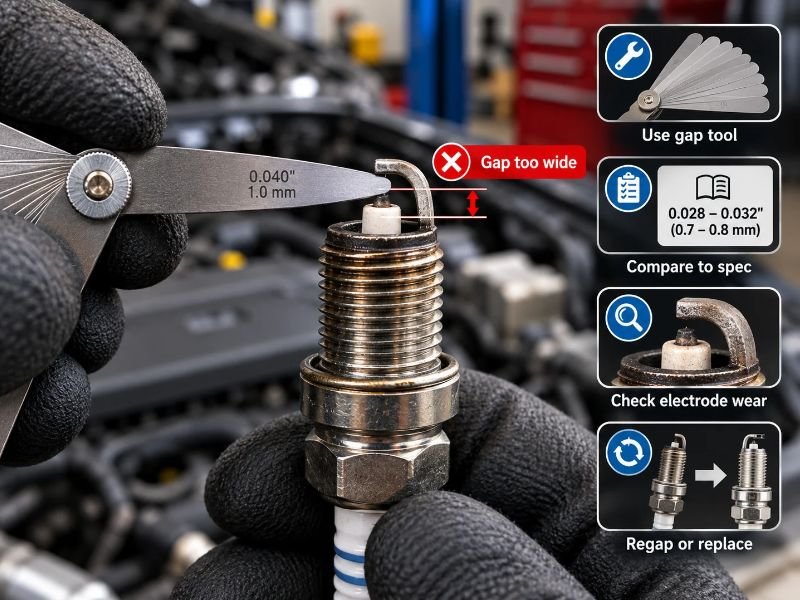
I confirm an excessive spark plug gap by removing the plug, inspecting the electrodes, and measuring the distance with a proper gap gauge.
Allow the Engine to Cool
Do not remove spark plugs from a hot engine.
Allowing the engine to cool reduces the risk of burns and helps protect aluminum cylinder-head threads from damage.
Clean Around the Spark Plug
Remove dirt, oil, and loose debris from the plug well before taking out the spark plug.
This prevents contamination from falling into the cylinder and makes it easier to inspect the ignition boot for carbon tracking or damage.
Remove the Plug Carefully
Use the correct spark plug socket and keep the extension aligned with the plug.
Avoid placing sideways pressure on the ceramic insulator.
Keep track of the cylinder location of each plug, especially when diagnosing a cylinder-specific misfire.
Measure the Gap
Use a wire-style gauge, feeler gauge, or another tool approved for the plug design.
Insert the correct gauge between the center and ground electrodes. The gauge should pass through with light resistance.
If a larger-than-specified gauge fits easily, the gap is excessive.
Do not estimate the gap by sight.
Compare With the Manufacturer’s Specification
The correct spark plug gap varies by engine.
Specifications may differ based on:
- Engine model
- Ignition system
- Spark plug design
- Compression ratio
- Fuel type
- Manufacturer requirements
Do not apply one universal gap measurement to every car, motorcycle, lawn mower, generator, or small engine.
Use the vehicle or engine service information for the correct specification.
Too Much Spark Plug Gap vs. Too Little Gap
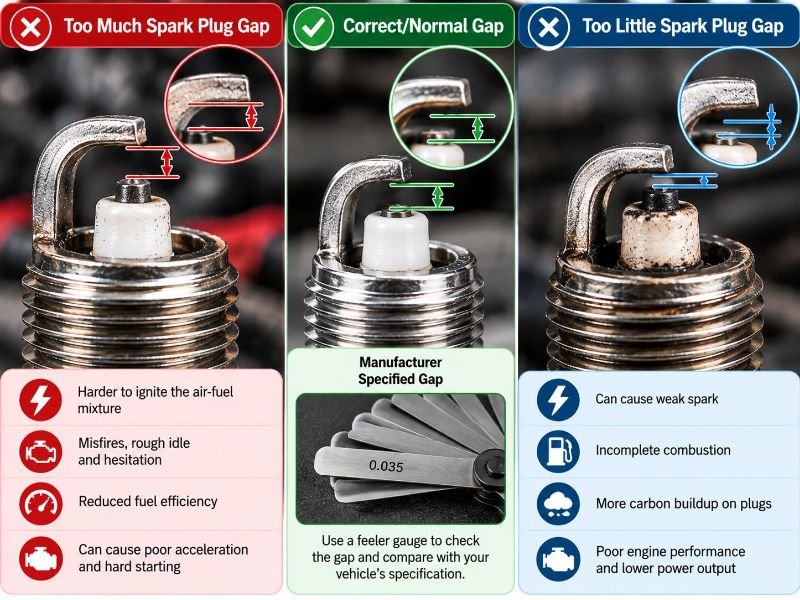
An excessively wide gap and an excessively narrow gap can both cause poor engine performance, but they affect ignition differently.
| Gap Condition | Main Electrical Effect | Common Symptoms |
| Too much gap | Requires excessive ignition voltage | Hard starting, misfires under load, hesitation |
| Too little gap | Creates a shorter and smaller spark | Weak combustion, fouling, poor response |
| Correct gap | Matches ignition-system design | Reliable starting and consistent combustion |
A wide gap is more likely to cause problems during starting and heavy-load operation.
A narrow gap may fire more easily, but the smaller spark may not ignite the mixture as effectively under some conditions.
The goal is not to create the largest possible spark plug gap. The correct gap is the one specified for the engine.
Can Too Much Spark Plug Gap Cause No Spark?
Yes. If the gap is excessively wide, the ignition voltage may be unable to jump from the center electrode to the ground electrode.
The result may be:
- No visible spark during testing
- An intermittent spark
- Arcing through the ignition boot
- Voltage leaking down the plug insulator
- Internal ignition coil breakdown
However, a no-spark condition can also result from a failed ignition coil, damaged wiring, bad crankshaft sensor, faulty ignition module, or electrical power problem.
The gap should be measured as part of the ignition diagnosis.
Can Too Much Spark Plug Gap Damage the Engine?
An excessive spark plug gap does not usually cause immediate internal engine damage by itself.
However, continued operation with severe misfires may create secondary problems.
Possible risks include:
- Catalytic converter overheating
- Ignition coil damage
- Carbon buildup
- Reduced engine performance
- Increased exhaust emissions
- Fuel dilution during severe misfiring
A flashing check engine light should not be ignored. It often indicates an active misfire that may quickly damage the catalytic converter.
Can You Drive With an Excessive Spark Plug Gap?
The engine may continue running with an excessive gap, but driving is not recommended when the vehicle is misfiring, shaking, or losing power.
A slightly wide gap may cause only mild hesitation. A severely wide gap can produce unpredictable misfires and sudden power loss.
Stop driving and inspect the ignition system when:
- The check engine light flashes
- The engine shakes heavily
- Acceleration becomes unsafe
- Strong fuel odor comes from the exhaust
- The vehicle repeatedly stalls
- Ignition arcing is visible
Correcting the gap or replacing the worn plug is usually simpler and less expensive than repairing damage caused by prolonged misfiring.
Should an Over-Gapped Spark Plug Be Adjusted or Replaced?
A relatively new conventional spark plug may sometimes be adjusted if it has no physical damage and the manufacturer allows gapping.
Replacement is the better choice when the plug has:
- Rounded or worn electrodes
- Cracked ceramic
- Burned electrode surfaces
- Heavy deposits
- Damaged threads
- Excessive mileage
- A bent or weakened ground electrode
- Precious-metal electrode damage
Fine-wire platinum and iridium plugs require careful handling. The center electrode can be damaged if the gapping tool presses against it.
If the plug has already been used for an extended period, correcting the gap may not restore the sharp electrode edges needed for reliable ignition.
How to Prevent Excessive Spark Plug Gap
A few basic practices can prevent the gap from becoming too wide prematurely.
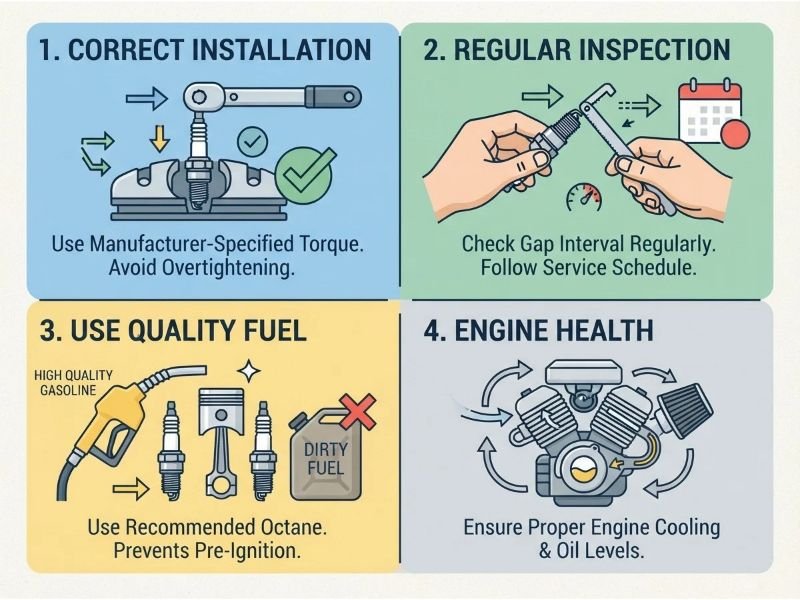
- Use the exact spark plug specified for the engine.
- Measure the gap before installation.
- Use a proper spark plug gapping tool.
- Adjust only the ground electrode when permitted.
- Avoid dropping the plug.
- Install the plug using the correct torque.
- Replace plugs at the recommended service interval.
- Inspect the ignition coil boot for arcing or carbon tracking.
- Do not assume every pre-gapped plug is ready to install.
Regular inspection is especially useful when the engine begins misfiring under load or becomes harder to start.
Frequently Asked Questions
What Are the First Symptoms of Too Much Spark Plug Gap?
The first symptoms are often longer cranking, slight hesitation, or an occasional misfire during acceleration.
A small increase in gap may not affect idle immediately. The problem usually becomes more noticeable when cylinder pressure rises and the ignition system needs additional voltage.
Can Too Much Spark Plug Gap Cause a Misfire?
Yes. An excessive gap can prevent the spark from jumping consistently between the electrodes.
The misfire may occur only under load at first. As the gap grows or the ignition components weaken, the misfire may begin happening at idle and during normal driving.
Can Too Much Spark Plug Gap Cause Rough Idle?
Yes. If one or more plugs fire intermittently, the engine may shake, stumble, or experience unstable RPM at idle.
However, rough idle can also result from vacuum leaks, injector problems, low compression, or ignition coil faults.
Can Too Much Spark Plug Gap Cause Hard Starting?
Yes. A wider gap requires more voltage, while the ignition system may have reduced available voltage during cranking.
The engine may take longer to start, require several attempts, or start and immediately run roughly.
Can Too Much Spark Plug Gap Cause Poor Acceleration?
Yes. Acceleration increases cylinder pressure, making it harder for the spark to cross an excessive gap.
The engine may hesitate, jerk, misfire, or feel weak when the throttle is opened.
Does a Bigger Spark Plug Gap Create More Power?
Not necessarily.
A larger gap can expose more of the air-fuel mixture to the spark, but only if the ignition system can fire it reliably. Increasing the gap beyond specification usually causes misfires and performance loss rather than additional power.
Can I Check Spark Plug Gap by Eye?
No. Visual inspection is not accurate enough to confirm the correct gap.
Use a proper gap gauge and compare the measurement with the specification for the exact engine.
Do New Spark Plugs Need to Be Gapped?
New plugs should at least be checked before installation.
Even pre-gapped plugs can have the wrong setting for a particular engine or may have been altered during shipping and handling.
Conclusion
The common symptoms of too much spark plug gap include hard starting, engine misfires, rough idle, hesitation, power loss, poor fuel economy, and weak performance under heavy load.
An excessive gap requires the ignition coil to generate more voltage to produce a spark. When the available voltage is insufficient, the plug may fire intermittently or fail to ignite the air-fuel mixture.
I recommend measuring the plug with a proper gap gauge and comparing it with the exact engine specification. If the electrodes are worn, rounded, burned, or damaged, replacing the spark plug is usually more reliable than simply reducing the gap.
Correct spark plug spacing helps the engine start easily, accelerate smoothly, maintain power, and avoid unnecessary stress on the ignition system.